Posts filed under ‘Government’
The Impoverished Global Babysitter

I don’t mind being a babysitter for the world, as long as I get paid for it. Unfortunately, not only are we paying to be the nation’s global defense babysitter, but we are also paying for the protection responsibility with unsustainable borrowings.
I don’t want to be a cold-hearted neighbor to our friends and allies, but it is all a matter of degree. Collecting a vacationing neighbor’s newspaper and mail, and watching for any potential suspicious activity is all part of being a conscientious, dependable neighbor, but where do you draw the line? As a good neighbor, should I also be responsible for paying for and installing a security system on their premises? Or how about getting my 16 year old nephew to spend the night at my neighbor’s because of some scary noises heard during the previous night?
For politicians to say we need to cut spending but defense spending is off the table is hypocritical. Bruce Bartlett, columnist at The Fiscal Time, had this to say on the subject:
“No one is saying the defense budget is the sole source of the deficit, but the fact is that it has risen from 3 percent of the gross domestic product in fiscal year 2001 to 4.7 percent this year. That additional 1.7 percent of GDP amounts to $250 billion in spending — almost 20 percent of this year’s budget deficit. And according to a recent Congressional Research Service report, the cost of wars in Iraq and Afghanistan alone accounted for 23 percent of the combined budget deficits between fiscal years 2003 and 2010.”
Even the government should have learned one of the prime lessons from the 2008-2009 financial crisis: tough times require the necessity to do more with less. Whether you are talking about a large corporation like $173 billion valued General Electric (GE), a small mom-and-pop coffee shop, or a middle-class family of four, the moral of the story is bad things eventually happen to individuals, corporations, and governments that live beyond their means. The crisis was exacerbated by excessive borrowing to achieve the higher standard of living and operations.
New Heightened Sensibility?
The initial deficit reduction proposals crafted by the bipartisan commission headed by Erskine Bowles and Alan Simpson should be lauded, regardless of how much Congress decides to dilute the $4 trillion in budget cuts over the next 10 years. The plan may not garner votes for politicians, but these types of necessary cuts will place our country on firmer ground and provide a more sustainable path to prosperity. More specifically, the plan would bring the federal budget deficit down to 2.2% of GDP (Gross Domestic Product) by 2015 and reduce the country’s debt to 60% of GDP by 2024.
Building Flying Rolls Royces
Bowles and Simpson appear to get it, but our bloated government doesn’t seem to understand. If I were running an unprofitable company with a lot of debt, would it be a good idea to develop a new flying Rolls Royce car fleet (with questionable utility) for my employees? Common fiscal sense would dictate the answer to be “NO.”
Regrettably our government has answered “yes” by building a ridiculously costly flying Rolls Royce fleet of its own under the name of Joint Strike Fighter (the F-35 program from Lockheed Martin Corp. [LMT]). This absurdly priced program – the costliest in our country’s history – is projected to cost up to $382 billion for 2,443 aircraft over the next two decades (Reuters). This translates into a whopping $156 million per aircraft. Cost overruns have already come in 40-90% higher than expected over the last nine years, and the price tag continues to rise. The state of the art jet program is touted as a Swiss army knife (flexibility to be used by all three branches of the military), but may actually turn out to be a butter knife due to the program’s questioned utility (see great PBS video here).
So like any company, individual, or government, there is something called prioritization. By cutting fat in less critical areas, a portion of those savings can be redeployed to INCREASE spending in the areas that matter. I won’t wade into the relative merits (or lack thereof) related to Afghanistan and Iraq expenditures or appropriate troop levels, but suffice it to say, I’m certain spending can be cut in many areas to make room for our country’s primary defense priorities.
I’m no defense expert but when faced to deal with a murky, inconspicuous issue of terrorism (cave dwelling insurgents and bomb-making sleeper cells), intelligence collection and international coordination make more sense than building $150 million flying Rolls Royces, which are better suited for fighting an obsolete cold war than finding terrorist needles in a global haystack.
Crotch Costs
Layer on the new TSA passenger flight costs associated with crotch fondling pat downs and the costs related to buying miniaturized shampoo and gel containers, one wonders if tax-payer money can be more efficiently spent. For what it’s worth, the FDA has approved the latest body scanning machines with no health concerns, so if an airport worker gets his/her jollies by ogling an overweight out of shape passenger like me, then so be it. The fact of the matter is that estimates show 99% of passengers choose the innocuous body scan, which displays a white, ghost-like naked computer image to the agent. For those worried about self image issues or privacy concerns, perhaps the airports can set up a meet-and-greet room option for passengers to become better acquainted with the agent before passing through the scanner.
Freeloaders Cutting Spend
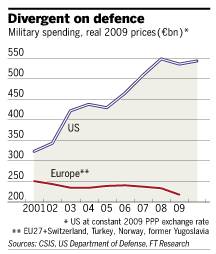
Source: The Financial Times
Domestic defense spending cuts become especially touchy when discussed in concert with European spending reductions. Take for example German plans to slash $10.7 billion in defense spending by 2014 and British spending cuts of 10% to 20% (around $6 – $12 billion). Europeans are labeled by Americans as socialists because of their lengthy paid vacations, maternity leaves, and generous healthcare benefits. More power to them and I desire all those things for myself and my family too, but I just don’t want my taxes to pay for others’ benefits when our country cannot afford those same wonderful benefits for ourselves.
While our Defense Secretary, Robert Gates, has been talking a good game with respect to a $100 billion in savings cuts, these cuts should be put in the context of a $567 billion budget for 2011 and a $700 billion estimated 2015 budget. As it turns out, these $100 billion in cuts are not cuts at all – Gates is also talking out of the other side of his mouth by saying he wants to continue increasing overall defense spending.
Is the size of spending appropriate? According to SIPRI, an independent international research institute, the U.S. defense budget accounts for 54% of the world’s total military spending, when our population only represents less than 5% of the world’s total. If that is not a disproportionate subsidy to the rest of the world, then I do not know what one is? The real longer term threat is not Iran or North Korea, but rather China. I’ll go out on a limb and say we can probably hold our own for a while, considering China is still only spending about 15% of what we spend on defense.
As I stated earlier, it is more important than ever to do more with less. Corporations are clearly doing that now by cutting spending, while still able to create record profits. The government has to get on board with trimming fat in all areas of our government…including defense. Coordinating intelligence and combining resources across the globe is crucial if we want to get more bang for our buck, while still devoting adequate resources to fend off the real and immediate evil threats of terrorism. Babysitting is an important duty and responsibility, but as impoverished Americans we are not capable of providing that service to the whole world free of charge.
Wade W. Slome, CFA, CFP®
Plan. Invest. Prosper.
DISCLOSURE: Sidoxia Capital Management (SCM) and some of its clients own certain exchange traded funds, but at the time of publishing SCM had no direct position in GE, LMT, Rolls Royce, or any other security referenced in this article. No information accessed through the Investing Caffeine (IC) website constitutes investment, financial, legal, tax or other advice nor is to be relied on in making an investment or other decision. Please read disclosure language on IC “Contact” page.
Ration or Tax: Eating Cake Not an Option

We live in an instant gratification society that would like everything for free ( like my pal Bill Maher), which explains why we want to have our healthcare cake and eat it too. I think George Will said it best when discussing universal healthcare coverage, “If you think health care is expensive now, just wait until it is free.” Look, I love free stuff too, like the rest of us, whether it’s free sausage sample at Costco (COST) or a breath mint at the Olive Garden (DRI). But regrettably, exploding deficits come at a price.
With midterm elections coming up, the issue of healthcare is once again front and center. The majority party feels like a checkbook is a solution to healthcare prosperity. Can you really look me in the eyes and say covering additional 32 million uninsured Americans is going to save us money. The government hasn’t exactly built a ton of credibility with the disastrous train-wreck we call Medicare, which is already carrying 45 million covered passengers.
The minority party hasn’t done a lot better with the layering of the 2006 unsustainable Medicare Part D drug plan. Conservatives are campaigning on “repeal and replace” and that is great, but where are the cuts?
There are only two solutions to our current healthcare problem: ration or tax (read Plucking Feathers of Taxpaying Geese). Is healthcare a right or privilege? I don’t know, but if we want to cover current obligations, or add 32 – 50 million more uninsured, then we will be required to cut expenses (ration) to pay for increased benefits and/or increase taxes to cover additional benefits. I would love to cover all Americans, along with the starving children in Africa too, but unfortunately we are limited by our resources. Writing checks with borrowed money will only last for so long.
How severe are the exploding healthcare costs, which are covering the graying of the 76 million baby boomers? Here’s how Forbes describes the unsustainable Medicare obligations:
The Medicare Trustees tell us that Medicare’s expected future obligations exceeded premiums and dedicated taxes by $89 trillion (measured in current dollars). No, that’s not a misprint. To put that number in perspective, Medicare’s liability is about 5 1/2 times the size of Social Security’s ($18 trillion) and about six times the size of the entire U.S. economy.
Not a pretty picture. These estimates look pretty far in the future, but even more bare bone figures arrive at a still frightening $33 trillion. Take a look at healthcare spending forecasts as a percentage of GDP – even the lowest estimates are depressing:
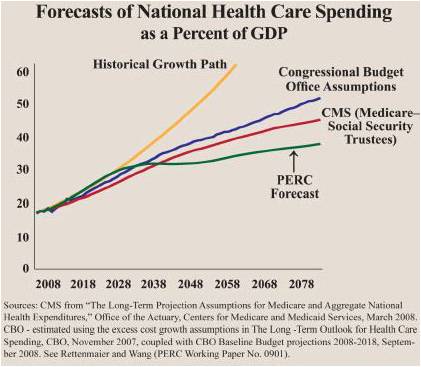
Source: National Center for Policy Analysis via Forbes
In our increasingly flat globalized world, competition between countries is becoming even more intense. We are in a marathon race for improved standards of living, and all these debts and deficits are dragging us down like an anchor tied to our legs. Even without considering other massive entitlements like Social Security, healthcare alone has the potential of grinding our economy to a halt. Politicians are great at promising more benefits and tax cuts in exchange for your votes, but true leadership requires delivering the sour medicine necessary for future prosperity. Before we eat the healthcare cake, let’s raise the money to buy the cake first.
Read more about the Medicare Explosion on Forbes
Wade W. Slome, CFA, CFP®
Plan. Invest. Prosper.
DISCLOSURE: Sidoxia Capital Management (SCM) and some of its clients own certain exchange traded funds, but at the time of publishing SCM had no direct position in COST, DRI, or any other security referenced in this article. No information accessed through the Investing Caffeine (IC) website constitutes investment, financial, legal, tax or other advice nor is to be relied on in making an investment or other decision. Please read disclosure language on IC “Contact” page.
Crisis Delivers Black-Eye to Classic Economists

Markets are efficient. Individuals behave rationally. All information is reflected in prices. Huh…are you kidding me? These are the beliefs held by traditional free market economists (“rationalists”) like Eugene Fama (Economist at the University of Chicago and a.k.a. the “Father of the Efficient Market Hypothesis”). Striking blows to the rationalists are being thrown by “behavioralists” like Richard Thaler (Professor of Behavioral Science and Economics at the University of Chicago), who believes emotions often lead to suboptimal decisions and also thinks efficient market economics is a bunch of hogwash.
Individual investors, pensions, endowments, institutional investors, governments, are still sifting through the rubble in the aftermath of the 2008-2009 financial crisis. Experts and non-experts are still attempting to figure out how this mass destruction occurred and how it can be prevented in the future. Economists, as always, are happy to throw in their two cents. Right now traditional free market economists like Fama have received a black eye and are on the defensive – forced to explain to the behavioral finance economists (Thaler et. al.) how efficient markets could lead to such a disastrous outcome.
Religion and Economics
Like religious debates, economic rhetoric can get heated too. Religion can be divided up in into various categories (e.g., Christianity, Islam, Judaism, Hinduism, Buddhism, and other), or more simply religion can be divided into those who believe in a god (theism) and those who do not (atheism). There are multiple economic categorizations or schools as well (e.g., Keynsians, monetarism, libertarian, behavioral finance, etc.). Debates and disagreements across the rainbow of religions and economic schools have been going on for centuries, and the completion of the 2008-09 financial crisis has further ignited the battle between the “behavioralists” (behavioral finance economists) and the “rationalists” (traditional free market economists).
Behavioral Finance on the Offensive
In the efficient market world of the “rationalists,” market prices reflect all available information and cannot be wrong at any moment in time. Effectively, individuals are considered human calculators that optimize everything from interest rates and costs to benefits and inflation expectations in every decision. What classic economics does not include is emotions or behavioral flaws.
Purporting that financial market decisions are not impacted by emotions becomes more difficult to defend if you consider the countless irrational anomalies considered throughout history. Consider the following:
- Tulip Mania: Bubbles are nothing new – they have persisted for hundreds of years. Let’s reflect on the tulip bulb mania of the 1600s. For starters, I’m not sure how classic economists can explain the irrational exchanging of homes or a thousand pounds of cheese for a tulip bulb? Or how peak prices of $60,000+ in inflation-adjusted dollars were paid for a bulb at the time (C-Cynical)? These are tough questions to answer for the rationalists.
- Flash Crash: Seeing multiple stocks (i.e., ACN and EXC) and Exchange Traded Funds (ETFs) temporarily trade down -99% in minutes is not exactly efficient. Stalwarts like Procter & Gamble also collapsed -37%, only to rebound minutes later near pre-collapse levels. All this volatility doesn’t exactly ooze with efficiency (see Making Millions in Minutes).
- Negative T-Bill Rates: For certain periods of 2008 and 2009, investors earned negative yields on Treasury Bills. In essence, investors were paying the government to hold their money. Hmmm?
- Technology and Real Estate Bubbles: Both of these asset classes were considered “can’t lose” investments in the late 1990s and mid-2000s, respectively. Many tech stocks were trading at unfathomable values (more than 100 x’s annual profits) and homebuyers were inflating real estate prices because little to no money was required for the purchases.
- ’87 Crash: October 19, 1987 became infamously known as “Black Monday” since the Dow Jones Industrial Average plunged over -22% in one day (-508 points), the largest one-day percentage decline ever.
The list has the potential of going on forever, and the recent 2008-09 financial crisis only makes rationalists’ jobs tougher in refuting all this irrational behavior. Maybe the rationalists can use the same efficient market framework to help explain to my wife why I ate a whole box of Twinkies in one sitting?
Rationalist Rebuttal
The rationalists may have gotten a black eye, but they are not going down without a fight. Here are some quotes from Fama and fellow Chicago rationalist pals:
On the Crash-Related Attacks from Behavioralists: Behavioralists say traditional economics has failed in explaining the irrational decisions and actions leading up to the 2008-09 crash. Fama states, “I don’t see this as a failure of economics, but we need a whipping boy, and economists have always, kind of, been whipping boys, so they’re used to it. It’s fine.”
Rationalist Explanation of Behavioral Finance: Fama doesn’t deny the existence of irrational behavior, but rather believes rational and irrational behaviors can coexist. “Efficient markets can exist side by side with irrational behavior, as long as you have enough rational people to keep prices in line,” notes Fama. John Cochrane treats behavioral finance as a pseudo-science by replying, “The observation that people feel emotions means nothing. And if you’re going to just say markets went up because there was a wave of emotion, you’ve got nothing. That doesn’t tell us what circumstances are likely to make markets go up or down. That would not be a scientific theory.”
Description of Panics: “Panic” is not a term included in the dictionary of traditional economists. Fama retorts, “You can give it the charged word ‘panic,’ if you’d like, but in my view it’s just a change in tastes.” Calling these anomalous historic collapses a “change in tastes” is like calling Simon Cowell, formerly a judge on American Idol, “diplomatic.” More likely what’s really happening is these severe panics are driving investors’ changes in preferences.
Throwing in White Towel Regarding Crash: Not all classic economists are completely digging in their heels like Fama and Cochrane. Gary Becker, a rationalist disciple, acknowledges “Economists as a whole didn’t see it coming. So that’s a black mark on economics, and it’s not a very good mark for markets.”
Settling Dispute with Lab Rats
The boxing match continues, and the way the behavioralists would like to settle the score is through laboratory tests. In the documentary Mind Over Money, numerous laboratory experiments are run using human subjects to tease out emotional behaviors. Here are a few examples used by behavioralists to bolster their arguments:
- The $20 Bill Auction: Zach Burns, a professor at the University of Chicago, conducted an auction among his students for a $20 bill. Under the rules of the game, as expected, the highest bidder wins the $20 bill, but as an added wrinkle, Burns added the stipulation that the second highest bidder receives nothing but must still pay the amount of the losing bid. Traditional economists would conclude nobody would bid higher than $20. See the not-so rational auction results here at minute 1:45.
- $100 Today or $102 Tomorrow? This was the question posed to a group of shoppers in Chicago, but under two different scenarios. Under the first scenario, the individuals were asked whether they would prefer receiving $100 in a year from now (day 366) or $102 in a year and one additional day (day 367)? Under the second scenario, the individuals were asked whether they would prefer receiving $100 today or $102 tomorrow? The rational response to both scenarios would be to select $102 under both scenarios. See how the participants responded to the questions here at minute 4:30.
Rationalist John Cochrane is not fully convinced. “These experiments are very interesting, and I find them interesting, too. The next question is, to what extent does what we find in the lab translate into how people…understanding how people behave in the real world…and then make that transition to, ‘Does this explain market-wide phenomenon?,’” he asks.
As alluded to earlier, religion, politics, and economics will never fall under one universal consensus view. The classic rationalist economists, like Eugene Fama, have in aggregate been on the defensive and taken a left-hook in the eye for failing to predict and cohesively explain the financial crash of 2008-09. On the other hand, Richard Thaler and his behavioral finance buds will continue on the offensive, consistently swinging at the classic economists over this key economic mind versus money dispute.
See Complete Mind Over Money Program
Wade W. Slome, CFA, CFP®
Plan. Invest. Prosper.
DISCLOSURE: Sidoxia Capital Management (SCM) and some of its clients own certain exchange traded funds, but at the time of publishing SCM had no direct position in ACN, EXC, or any other security referenced in this article. No information accessed through the Investing Caffeine (IC) website constitutes investment, financial, legal, tax or other advice nor is to be relied on in making an investment or other decision. Please read disclosure language on IC “Contact” page.
Blushing Pinocchio – The Half Trillion Lie

When in doubt, or when in debt by half a trillion dollars, why not just make some crazy stuff up? This is the exact strategy California pension administrators used when implementing +50% increases in union member benefits earlier this decade. The pension plans decided to take a break from reality and enter fantasyland when they projected the Dow Jones Industrial Average would hit 25,000 by the end of the decade and 28,000,000 by 2099, a forecast that would even make Pinocchio blush.
Dealing with the Problem
Governor Arnold Schwarzenegger and his economic advisors attempted to take on the unions. Unfortunately, not everyone got the message. On the day the Governor struck a deal with the unions, California Public Employees’ Retirement System (CalPERS) ordered a hike of $4 billion to the annual pension payments to its members.
The financial woes of California have been well documented as the state looks to lower its $19.1 billion deficit and an estimated one-half trillion dollars in unfunded pension liabilities – a level equal to about seven times the state’s total debt level. Even after multiple years of severe cuts, Schwarzenegger has had to resort to drastic measures, including his most recent desperate move to get some 200,000 state workers to accept slashes in pay to a $7.25/hour minimum wage.
Facing Reality
As I have discussed in the past, dealing with excessive debt requires a gut check. Cutting debt is similar to dieting – easy to understand, but difficult to execute (see my Debt Control article).
Whether Republican candidate Meg Whitman or Democratic candidate Jerry Brown wins the thankless position of California Governor, they will have to face the elephant in the room, but hopefully they will not resort to fuzzy accounting or predictions of Dow 28 million that would make even Pinocchio blush.
Read Full Related Article from Vincent Fernando at Business Insider
Wade W. Slome, CFA, CFP®
Plan. Invest. Prosper.
*DISCLOSURE: Sidoxia Capital Management (SCM) and some of its clients own certain exchange traded funds, but at the time of publishing SCM had no direct positions in any security referenced in this article. No information accessed through the Investing Caffeine (IC) website constitutes investment, financial, legal, tax or other advice nor is to be relied on in making an investment or other decision. Please read disclosure language on IC “Contact” page.
Debt Control: Turn Off Costly Sprinklers When Raining

By living in Southern California, I am acutely aware of the water shortage issues we face in this region of the country. We all have our pet peeves, and one that eats at me repeatedly occurs when I drive by a neighbor’s house and notice they are blasting the sprinklers in the pouring rain. I get the same sensation when I read about out-of control government spending confronting our current and future generations in light of the massive debt loads we presently carry.
I, like most people, love free stuff, whether it comes in the form of tooth-pick skewered, teriyaki meatball samples at Costco Wholesale Corp. (COST), or free government education from our school systems. But in times of torrential downpours, at a minimum, we need to be a little more cost conscious of our surroundings and turn off the spending sprinklers.
Certainly, when it comes to government spending, there’s no getting around the entitlement elephant in the room, which accounts for the majority of our non-discretionary government spending (see D-E-B-T: New Four Letter Word article). Unfortunately, layering on new entitlements on top of already unsustainable promises is not aiding our cause. For example, showering our Americans with free drugs as part of Medicare Part D program, and paying for tens of millions into a fantasy-based universal healthcare package (purported to save money…good luck) only serves to fatten up the elephant squeezed into our room.
Reform is absolutely necessary and affordable healthcare should be made available to all, but it is important to cut spending first. Then, subsequently, we will be in a better position to serve the needy with the associated savings. Instead, what we chose appears to have been a jamming of a massive, complex, divisive bill through Congress.
Slome’s Spending Rules
In an effort to guide ourselves back onto a path of sensibility, I urge our government legislators to follow these basic rules as a first step:
Rule #1 – Don’t Pay Dead People: I know we have an innate maternal/paternal instinct to help out others, but perhaps our government could stop doling out taxpayer dollars to buried individuals underground or those people incarcerated in jail? Over the last three years the government sent $180 million in benefit checks to 20,000 corpses, and also delivered $230 million to 14,000 convicted felons (read more).
Rule #2 – Pay for Our Own First: Before we start spending money on others outside our borders, I propose we tend to our flock first. For starters, our immigration policies are a disaster. As I wrote earlier (read Our Nation’s Keys to Success), I am a big proponent of legal immigration for productive, higher-educated individuals – not elitist, just practical. If you don’t believe me, just count the jobs created by the braniac immigrant founders at the likes of Google Inc. (GOOG), Intel Corp. (INTC), and Yahoo! Inc. (YHOO). These are the people who will create jobs and out-battle scrappy, resourceful international competitors that want to steal our jobs and our economic leadership position in the world. What I don’t support is illegal immigration – paying for the healthcare and education of foreign criminals with our country’s maxed-out credit cards. This is the equivalent of someone breaking into my house, and me making their bed and feeding them breakfast…ridiculous. I do not support the immigration law passed in Arizona, but this unfortunate chain of events thankfully puts a spotlight on the issue.
Rule #2a. – Stop Being the Globe’s Free Police: If we are going to comb the caves of Tora Bora as part of funding two wars and chasing terrorists all over the world, then we not only should be spending our defense budget more efficiently (non-Cold War mentality), but also charging freeloaders for our services (directly or indirectly). We are spending a whopping 20 cents of each federal tax dollar on defense, so let’s spend it wisely and charge those outside our borders benefiting from our monetary and physical sacrifices. And, oh by the way, sending $400 million to the territory controlled by Hamas (read more) doesn’t sound like the brightest decision given our fiscal and human challenges at home. I sure hope there are some tangible, accountable benefits accruing to the right people when we have 25 million people here in the U.S. unemployed, underemployed, or discouraged from finding a job.
Rule #3: Put the Obese Elephant on a Diet – As I alluded to above, our government doesn’t need to serve our overweight, entitlement-fed elephant more chocolate, pizza, and ice cream in the form of more entitlements we are not capable of funding. Let’s cut our spending first before we buy off the voters with new spending.
There are obviously a wide ranging set of economic, political, and even religious perspectives on the best ways of managing our hefty debt and deficits. I do not pretend to have all the answers, but what I do know is it is not wise to blast the sprinklers when it is pouring rain outside.
Wade W. Slome, CFA, CFP®
Plan. Invest. Prosper.
*DISCLOSURE: Sidoxia Capital Management (SCM) and some of its clients own certain exchange traded funds, and GOOG, but at the time of publishing SCM had no direct positions in COST, YHOO, INTC, or any other security referenced in this article. No information accessed through the Investing Caffeine (IC) website constitutes investment, financial, legal, tax or other advice nor is to be relied on in making an investment or other decision. Please read disclosure language on IC “Contact” page.
Goldman: Gambling Prosperity at Client Expense?

What a scene that 11-hour Senate subcommittee interrogation of Goldman Sachs (GS) executives was on C-Span – I’m still wondering whether a forklift was utilized to hoist in the multi-thousand page binders stuffed with reams of exhibits. With caffeine beverage firmly in hand, I watched as much of the marathon as possible until fatigue set in. Not all was lost though, because I managed to simultaneously conduct new stock research as I was glued to the hearings. After I saw the Goldman executives repeatedly wrestle open the gargantuan-sized binders of smoking-gun emails, I checked the paper futures markets and am now contemplating a purchase of International Paper’s (IP) stock.
Lead trader of the controversial Abacus/John Paulson deal, “Fabulous Fab” Fabrice Tourre, did not disappoint his supporters either, firmly addressing his responses in his French Pepe Le Pew accent. His Goldman trading counterparts (Daniel Sparks, ex-mortgage department head, Joshua Birnbaum, ex-managing director of the department, and Michael Swenson, current managing director of the department), like all Goldman witnesses, did their best at bobbing and weaving the intrusive, pointed questions. On the cozier side of the questioning fence, the Senators did a superb job of raking the Goldman execs over the coals with endless exhibits of emails. Judging by the shiny, sweating mugs of the traders, the Senators were successful in making the testifiers uncomfortable – either that, or the Senators had the thermostat in the room raised to 82 degrees.
Betting Away to Profits
At the heart of the questioning was the key issue of whether Goldman Sachs executives and employees were acting in the best interest of their clients (fiduciary duty), or were they making bets against clients with the benefit of privileged information. Senator Claire McCaskill compared Goldman to a bookie manipulating bets in their own favor without sharing their edge with bettors (investors). In the case of the Abacus deal, Goldman admits to not freely disclosing the involvement of now-famous, mortgage market short seller John Paulson (see the Gutsiest Trade) to the so-called sophisticated institutional investors, ACA Capital Holdings Inc. Was this lack of disclosure illegal? Perhaps unethical, but pundits have already established the high hurdle the SEC (Securities and Exchange Commission) will need to clear in order to prove Goldman’s guilt.
Based on the testimony and facts introduced in the hearings, and as I write in my previous Goldman article (Goldman Cheat?), Goldman’s behavior throughout the housing collapse and participation in the ACA deal reflects more about intelligent opportunism within a loose regulatory framework than it does about criminal behavior. Having managed a $20 billion fund (see my book) I dealt with the conflicts of interest and self dealings of the investment banks first hand. As I entered trade orders reaching into the millions of shares, do I naively believe Goldman and other banks altruistically kept that information in their trading vaults? Or is it possible that information leaked out to other clients or was used for the banks benefit? Suffice it to say, the regulatory structure and conflict of interest frameworks, as they stand today, are not stacked in favor of investors.
The Solutions
Although we wish our regulators and government officials could have been more forward looking, rather than reactive, nonetheless, some reforms need to be instituted to resolve the substantial risks built into our financial system today. Here are a few ideas from the 10,000 foot level:
Volcker Rule: Former Federal Reserve Chairman’s so-called “Volcker Rule” is looking better by the minute. Not a new concept, but as regulators shine the light on the opaque industry of derivatives trading and proprietary trading desks, the need for new reforms becomes even more evident. Derivatives are not evil (see Financial Engineering), but like a gun or knife, if misused these instruments can become extremely dangerous…as we have found out. The Glass-Steagall Act, which separated investment bank functions from commercial bank functions, was repealed almost 70 years after its introduction in 1932. The Volcker Rule would be a “lite” version of Glass-Steagall Act because the thrust of the proposal is aimed at splitting the risk-taking proprietary trading desk activities from the client based activities.
Heightened Capital: If you rented out an exotic car or motorcycle from a store, you would likely be required to commit a deposit or collateral to protect against adverse conditions. The same principle applies to derivatives, which generally raises volatility due to inherent leverage. The riskier the product, the larger the capital requirement should be. The collapse of Bear Stearns, Lehman Brothers, and AIG are painful lessons learned from situations of excessive leverage.
Central Clearing/Transparency: Derivative products such as options, futures, and swaps have existed for decades. The transparency gained by trading these securities on exchanges increases market confidence, thereby increasing liquidity and lowering costs for end-users. Standardization around complex derivatives like CDOs (Collateralized Debt Obligations), CDSs (Credit Default Swaps), and CLOs (Collateralized Loan Obligations) is a must to ensure the fact regulators can actually understand the products they are regulating.
Credit Rating Agency: It’s not entirely clear to me that the rating agencies play a critical role in the market place. In effect, the agencies serve as an outsourced research resource primarily for fixed income investors. If the agencies disappeared today, investors would be forced to do their own homework on each deal – not necessarily a bad idea. If the existing oligopoly structure of agencies ultimately survives, I suggest penalties should be incurred by firms with inaccurate ratings. Conversely, ratings could be structured such that compensation could be tiered (or escrowed) over time with payment incentives tied to the underlying deal performance relative to ratings accuracy.
Too Big To Fail: The massive bailouts and TARP (Troubled Asset Relief Program) money handed out to the financial and auto companies have left a sour taste in taxpayers’ mouths. A systemic risk regulator with the authority to unwind unhealthy institutions makes common sense. An insurance pool financed by self-inflicted industry taxes would assist regulators in achieving the reduction of troubled financial institutions.
Fiduciary Duty: Sidoxia Capital Management is a Registered Investment Advisor (RIA) and must act in the best interests of the client. Unfortunately, much of the industry is structured with a much lower “suitability” threshold, which provides a veil for firms to engage in less than ethical behavior.
Overall, regulatory reform urgency is in the Washington D.C. air and there is no question in my mind that a certain degree of witch hunting and scapegoating is occurring. Nonetheless, Lloyd Blankfein and team Goldman Sachs made it out alive from the Congressional hearing, but not without suffering some negative reputational damage. Former Goldman CEO alum and Treasury Secretary Henry Paulson probably sent roses to Mr. Blankfein thanking him for taking Paulson’s job before the 2008 market collapse. When regulatory reform eventually kicks in, perhaps Lloyd Blankfein and Henry Paulson will take a trip to Las Vegas to celebrate (or commiserate).
Wade W. Slome, CFA, CFP®
Plan. Invest. Prosper.
*DISCLOSURE: Sidoxia Capital Management (SCM) and some of its clients own certain exchange traded funds and in a security derived from an AIG subsidiary, but at the time of publishing SCM had no direct positions in GS, IP, AIG, JPM/Bear Stearns, LEH/Barclays or any security referenced in this article. No information accessed through the Investing Caffeine (IC) website constitutes investment, financial, legal, tax or other advice nor is to be relied on in making an investment or other decision. Please read disclosure language on IC “Contact” page.
Mozilo and Healthcare Tan Tax to the Rescue?

Ideological trains came crashing together as the battle for comprehensive healthcare reform resulted in the whole enchilada approach of the Democrats winning over the baby-step approach advocated by the Republicans. Thank goodness there is a savior to remedy the hefty $940 billion costs of the national healthcare plan…Angelo Mozilo. Not only will this mortgage tycoon (former CEO of Countrywide – the largest U.S. mortgage lender at one time) have his fat-cat wallet to fund multiple new healthcare taxes on the wealthy, but the government will also be collecting a new 10% tanning tax on all Mr. Mozilo’s bronzing sessions. Perhaps the CBO (Congressional Budget Office) healthcare reform cost saving estimates ($138 billion in the first decade) may come in even better than anticipated?
20,000,000 Tanning Sessions to Health
The public shouldn’t shed a tear for the real estate pain Mr. Mozilo endured – he still managed to stash a nice pile of dough before the mortgage walls came tumbling down on him. Given Mr. Mozilo’s timely sale of about $300 million in Countrywide stock before the share price cratered, coupled with the $23.8 million retirement fund and roughly $21 million in deferred compensation (Minyanville.com), Mr. Mozilo should have enough money to cover about 20,000,000 tanning sessions by my calculation. That sounds like a rather large number, but I expect Mr. Mozilo will shrewdly negotiate a bulk discount for the sessions, even if the government disapproves of the asssociated lost tax revenues.
However, one major potential hurdle for Mozilo may be finding the adequate time for tanning. If the SEC (Securities and Exchange Commission) is successful in prosecuting him on the alleged securities fraud and insider trading charges, then he may need to petition for a tanning bed in the prison gym.
Unintended Beach-going Consequences
Although we all condemn the harmful side effects of skin cancer from sunbathing, let’s not completely dismiss some of the advantages, including the benefits of Vitamin D production. Other cited ailments benefitting from sunlight exposure include, eczema, arthritis, psoriasis, acne, season affective disorder, and depression. One of the worse afflictions suffered by beach-goers (male and female alike) is the tragic “pastiness” condition. One of the severe unintended consequences of President Obama’s tanning tax may indeed be the extreme ridicule unleashed on light skinned beach bums that are unable to afford the tanning tax (see photo below).

Toss the Drumstick
On a more serious note, I get the fact that the government wants to raise a substantial amount of money to cover an extensive healthcare bill like this one – either through taxes and/or cost cuts. However, I think there are other areas in the healthcare food chain that need to climb higher in the national debate. Although, I’m OK with the tanning tax, I strongly believe there is more fertile ground in attacking obesity (see article on the Economics and Consequences of Obesity) and other costlier areas of treatment. The amount of money spent on managing obesity, and associated ailments, trounces the expenditures directed towards cancer by more than $50 billion by some estimates. Dated data shows we are spending more than $100 billion dollars on obesity-related healthcare costs. One study estimates obesity costs in the United States will reach $344 billion by 2018.
Bolstering the severity of the condition, the CDC (Center of Disease Control) noted the following:
“More than one third of U.S. adults—more than 72 million people—and 16% of U.S. children are obese. Since 1980, obesity rates for adults have doubled and rates for children have tripled. Obesity rates among all groups in society—irrespective of age, sex, race, ethnicity, socioeconomic status, education level, or geographic region—have increased markedly.”
I realize the importance of a copper tone tan can have on the lives of millions of Americans, and I also recognize the tanning tax is just a small blip in the growing 2,200 healthcare bill signed into law. Nonetheless, the spotlight of the healthcare debate needs to focus on the highest cost silos (i.e., obesity). Otherwise, I’m not completely sure whether all of Angelo’s taxed tanning sessions will be enough to cover our country’s immense healthcare costs?
Related Article: Bill Maher Chearleads No Profit Healthcare
Wade W. Slome, CFA, CFP®
Plan. Invest. Prosper.
*DISCLOSURE: Sidoxia Capital Management (SCM) and some of its clients own certain exchange traded funds, but at the time of publishing had no direct positions in BAC or any security mentioned in this article. No information accessed through the Investing Caffeine (IC) website constitutes investment, financial, legal, tax or other advice nor is to be relied on in making an investment or other decision. Please read disclosure language on IC “Contact” page.
Digging a Debt Hole

Little did I know when I signed up for a recent “distressed” debt summit (see previous article) that a federal official and state treasurer would be presenting as keynote speakers? After all, this conference was supposed to be catering to those professionals interested in high risk securities. Technically, California and the U.S. government are not classified as distressed yet, but nonetheless government heavy-hitters Matthew Rutherford (Deputy Assistant Secretary, Federal Finance at the U.S. Department of Treasury), and Bill Lockyer (Treasurer for the State of California) shared their perspectives on government debt and associated economic factors.
Why have government officials present at a distressed debt conference? After questioning a few organizers and attendees, I was relieved to discover the keynote speaker selections were made more as a function as a sign of challenging economic times, rather than to panic participants toward debt default expectations. As it turns out, the conference organizers packaged three separate conferences into one event – presumably for cost efficiencies (Distressed Investments Summit + Public Funds Summit + California Municipal Finance Conference).
The U.S. Treasury Balancing Act
Effectively operating as the country’s piggy bank, the Treasury has a very complex job of constantly filling the bank to meet our country’s expenditures. Deputy Assistant Secretary Matthew Rutherford launched the event by speaking to domestic debt levels and deficits along with some the global economic trends impacting the U.S.
- Task at Hand: Rutherford spoke to the Treasury’s three main goals as part of its debt management strategy, which includes: 1) Cash management (to pay the government bills); 2) Attempt to secure low cost financing; and 3) Promote efficient markets. With more than a few hundred auctions held each year, the Treasury manages an extremely difficult balancing act.
- Debt Limit Increased: The recent $1.9 trillion ballooning in the U.S. debt ceiling to $14.3 trillion gives the Treasury some flexibility in meeting the country’s near-term funding needs. The Treasury expects to raise another $1.5 trillion in debt in 2010 (from $1.3 trillion in ’09) to fund our government initiatives, but that number is expected to decline to $1.0 – $1.1 trillion in 2011.
- Funding Trillions at 0.16%: Thanks to abnormally low interest rates, an investor shift to short-term safety (liquidity), and a temporary rush to the dollar, the U.S. Treasury was able to finance their borrowing needs at a mere 16 basis points. Clearly, servicing the U.S.’ massive debt load at these extremely attractive rates is not sustainable forever, and the Treasury is doing its best to move out on the yield curve (extend auctions to lengthier maturities) to lock in lower rates and limit the government’s funding risk should short-term rates spike.
- Chinese Demand Not Waning: Contrary to recent TIC (Treasury International Capital) data that showed Japan jumping to the #1 spot of U.S. treasury holders, Rutherford firmly asserted that China remains at the top by a significant margin of $140 billion, if you adjust certain appropriate benchmarks. He believes foreign ownership at over 50% (June 2009) remains healthy and steady despite our country’s fiscal problems.
- TIPS Demand on the Rise: Appetite for Treasury Inflation Protection Securities is on the rise, therefore the Treasury has its eye on expanding its TIP offerings into longer maturities, just last week they handled their first 3-year TIPS auction.
There is no “CA” in Greece
State of California Treasurer Bill Lockyer did not sugarcoat California’s fiscal problems, but he was quick to defend some of the comparisons made between Greece and California. First of all, California’s budget deficit represents less than 1% of the state’s GDP (Gross Domestic Product) versus 13% for Greece. Greece’s accumulated debt stands at 109% of GDP – for California debt only represents 4% of the state’s GDP. What’s more, since 1800 Greece has arguably been in default more than not, where as California has never in its history defaulted on an obligation.
The current California picture isn’t pretty though. This year’s fiscal budget deficit is estimated at $6 billion, leaping to $12 billion next year, and soaring to $20 billion per year longer term.
Legislative political bickering is at the core of the problem due to the constitutional inflexibility of a 2/3 majority vote requirement to get state laws passed. The vast bulk of states require a simple majority vote (> than 50%) – California holds the unique super-majority honor with only Arkansas and Rhode Island. Beyond mitigating partisan bickering, Lockyer made it clear no real progress would be made in budget cuts until core expenditures like education, healthcare, and prisons are attacked.
On the subject of bloatedness, depending on how you define government spending per capita, California ranks #2 or #4 lowest out of all states. Economies of scale help in a state representing 13% of the U.S.’ GDP, but Lockyer acknowledged the state could just be less fat than the other inefficient states.
Lockyer also tried to defend the state’s 10.5% blended tax rate (versus the national median of 9.8%), saying the disparity is not as severe as characterized by the media. He even implied there could be a little room to creep that rate upwards.
Finishing on an upbeat note, Lockyer recognized the January state revenues came in above expectations, but did not concede victory until a multi-month trend is established.
After filtering through several days of meetings regarding debt, you quickly realize how the debt culture (see D-E-B-T article), thanks to cheap money, led to a glut across federal governments, state governments, corporations, and consumers. Hopefully we have learned our lesson, and we are ready to climb out of this self created hole…before we get buried alive with risky debt.
Wade W. Slome, CFA, CFP®
Plan. Invest. Prosper.
DISCLOSURE: Sidoxia Capital Management (SCM) and some of its clients own certain exchange traded funds (including CMF and TIP), but at time of publishing had no direct position on any security referenced. No information accessed through the Investing Caffeine (IC) website constitutes investment, financial, legal, tax or other advice nor is to be relied on in making an investment or other decision. Please read disclosure language on IC “Contact” page.
Money Goes Where Treated Best

“The world is going to hell in a handbasket” seems to be a prevailing sentiment among many investors. Looking back, a lack of fiscal leadership in Washington, coupled with historically high unemployment, has only fanned the flames of restlessness. A day can hardly go by without hearing about some fiscal problem occurring somewhere around the globe. Geographies have ranged from Iceland to Dubai, and California to Greece. Regardless, eventually voters force politicians to take notice, as we recently experienced in the Massachusetts vote for Senator.
Time to Panic?
So is now the time to panic? Entitlement obligations such as Social Security and Medicare, when matched with a rising interest payment burden from our ballooning debt, stands to consume the vast majority of our country’s revenues in the coming decades (if changes are not made). It’s clear to most that the current debt trajectory is not sustainable – see also Debt: The New Four-Letter Word. With that said, historical debt levels have actually been at higher levels before. For example, during World War II, debt levels reached 122% of GDP (Gross Domestic Product). Since promises generally garner votes, politicians have traditionally found it easier to legislate new spending into law rather than cutting back existing spending and benefits.
Money Goes Where it’s Treated Best
If our government leaders choose to ignore the growing upswell in fiscal discontent, then the global financial markets will pay more attention and disapprove less diplomatically. As the globe’s reserve currency, the U.S. Dollar stands to collapse if a different direction is not forged, and interest costs could skyrocket to unpalatable levels. Fortunately, the flat world we live on has created some of these naturally occurring governors to forcibly direct sovereign entities to make better decisions…or suffer the consequences. Right now Greece is paying for the financial sins of its past, which includes widening deficits and untenable debt levels.
As new, growing powers such as China, Brazil, India, and other emerging countries fight for precious capital to feed the aspirational goals of their rising middle classes, money will migrate to where it is treated best. Speculative money will flow in and out of various capital markets in the short-run, but ultimately capital flows where it is treated best. Meaning, those countries with policies fostering fiscal conservatism, financial transparency, prudent regulations, pro-growth initiatives, tax incentives, order of law, and other capital-friendly guidelines will enjoy their fair share of the spoils. The New York Times editorial journalist Tom Friedman coined the term “golden straitjacket” in describing this naturally occurring restraint system as a result of globalization.
Push Comes to Shove
Push will eventually come to shove, but the real question is whether we will self-impose fiscal restraint on ourselves, or will the global capital markets shove us in that direction, like the markets are doing to Greece (and other financially strapped nations) today? I am hopeful it will be the former. Why am I optimistic? Although more government spending has typically lead to more votes for politicians, cracks in the support wall have surfaced through the Massachusetts Senatorial vote, and rising populist sentiment, as manifested through the “Tea Party” movement (previously considered a fringe group).
Political gridlock has traditionally been par for the course, but crisis usually leads to action, so I eventually expect change. I am banking on the poisonous and sour mood permeating through the country’s voter base, in conjunction with the collapse of foreign currencies, to act as a catalyst for financial reform. If not, resident capital and domestic jobs will exodus to other countries, where they will be treated best.
Wade W. Slome, CFA, CFP®
Plan. Invest. Prosper.
DISCLOSURE: Sidoxia Capital Management (SCM) and some of its clients own certain exchange traded funds (including emerging market-based ETFs), but at time of publishing had no direct positions in securities mentioned in this article. No information accessed through the Investing Caffeine (IC) website constitutes investment, financial, legal, tax or other advice nor is to be relied on in making an investment or other decision. Please read disclosure language on IC “Contact” page.
Fed Ponders New Surgical Tool

The Fed is closely monitoring the recovering patient (the U.S. economy) after providing a massive dose of monetary stimulus. The patient is feeling numb from the prescription, but if the Fed is not careful in weaning the subject off the medicine (dangerously low Federal Funds rate), dangerous side- effects such as a brand new bubble, rampant inflation, or a collapsing dollar could ensue.
In preparing for the inevitable pain of the Federal Reserve’s “exit strategy,” the institution is contemplating the use of a new tool – interest rates paid to banks on excess reserves held at the Fed. A likely by-product of any deposit-based rate increase will be higher rates charged on consumer loans.
Currently, the Federal Reserve primarily controls the targeted Federal funds rate (the rate at which banks make short-term loans to each other) through open market operations, such as the buying and selling of government securities. Specifically, repurchase agreements made between the Federal Reserve and banks are a common strategy used to control the supply and demand of money, thereby meeting the Fed’s interest rate objective.

Source: Data from Federal Reserve Bank via Wikipedia
Although a relatively new tool created from a 2006 law, paying interest on excess reserves can help in stabilizing the Federal Funds rate when the system is awash in cash – the Fed currently holds over $1 trillion in excess reserves. Failure to meet the inevitably higher Fed Funds target is a major reason policymakers are contemplating the new tool. The Fed started paying interest rates on reserves, presently 0.25%, in the midst of the financial crisis in late 2008. Rate policy implementation based on excess reserves would build a stable floor for Federal Funds rate since banks are unlikely to lend to each other below the set Fed rate. The excess reserve rate-setting tool, although a novel one for the United States, is used by many foreign central banks.
Watching the Fed
While the Fed discusses the potential of new tools, other crisis-originated tools designed to improve liquidity are unwinding. For example, starting February 1st, emergency programs supporting the commercial paper, money market, and central bank swap markets will come to a close. The closure of such program should have minimal impact, since the usage of these tools has either stopped or fizzled out.
Fed watchers will also be paying attention to comments relating to the $1 trillion+ mortgage security purchase program set to expire in March. A sudden repeal of that plan could lead to higher mortgage rates and hamper the fragile housing recovery.
When the Fed policy makers meet this week, another tool open for discussion is the rate charged on emergency loans to banks – the discount rate (currently at 0.50%). Unlike the interest rate charged on excess reserves, any change to the discount rate will not have an impact charged on consumer loans.
While the Fed’s exit strategy is a top concern, market participants can breathe a sigh of relief now that Federal Reserve Chairman Ben Bernanke has been decisively reappointed – lack of support would have resulted in significant turmoil.
The patient (economy) is coming back to life and now the extraordinary medicines prescribed to the subject need to be responsibly removed. As the Federal Reserve considers its range of options, old instruments are being removed and new ones are being considered. The health of the economy is dependent on these crucial decisions, and as a result all of us will be carefully watching the chosen prescription along with the patient’s vital signs.
Wade W. Slome, CFA, CFP®
Plan. Invest. Prosper.
DISCLOSURE: Sidoxia Capital Management (SCM) and some of its clients own certain exchange traded funds but at the time of publishing had no direct positions in securities mentioned in the article. No information accessed through the Investing Caffeine (IC) website constitutes investment, financial, legal, tax or other advice nor is to be relied on in making an investment or other decision. Please read disclosure language on IC “Contact” page.




 Investing Caffeine
