Posts filed under ‘Financial Planning’
Plucking the Feathers of Taxpaying Geese

“The art of taxation consists in so plucking the goose as to get the most feathers with the least hissing.” ~Jean Baptist Colbert
With exploding deficits, multiple wars, healthcare reform, and a sluggish economy, there are two logical immediate choices on how to improve our current financial situation:
1) Cut spending. This is not a desirable option for politicians since benefit cuts to voters are not appreciated come re-election period.
2) Raise Taxes. Not desirable from a voter standpoint either, but the Obama administration has chosen to target the rich – the smaller voting population. This can of course backfire, when many of these wealthy individuals are campaign contributors or have ties to lobbyists who are backing the President’s agendas.
The tax-paying geese are getting fatter, but before the goose can be put in the oven, the feathers need plucking with the goal of minimizing hissing. Sure, I am an advocate for tax cuts like most taxpayers. I’m even a larger proponent, if Congress had the political gumption to cut spending to fund the tax drops. Unfortunately, politicians view expense reduction as suicide because cutting programs or benefits will only lead to fewer reelection votes. Congressmen are perfectly fine letting taxpayers live high on the hog for now, and just saddle future generations with our mounting debt problems.
What’s Fair?
The current strategy is based on taxing the wealthy to fund deficits, healthcare, wars, debt, etc. Since the rich represent a smaller proportion of voters, from the egotistical politician standpoint (reelection is paramount), this wealth distribution strategy appears more palatable to incumbent legislators. Democrats would rather focus on squeezing a narrower demographic footprint of voters versus an across the board tax increase, which would impact all taxpayers. Merely taxing the rich can certainly backfire however, especially if the wealthy demographic getting taxed is the exact population paying for the politicians’ reelection and lobbying agendas.
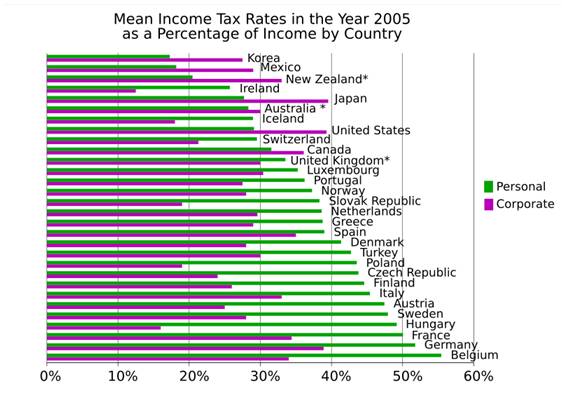
Source: Alan’s Money Blog (U.S. has high corporate tax rate)
But at what point is taxing the rich unfair and counterproductive? Currently the top 10% of the nation that earns more than $92,400 a year, pay about 72% of the country’s income taxes. Ari Fleischer, former G.W. Bush Press Secretary compares the current tax policy to an “inverted pyramid scheme” in a Wall street Journal Op-Ed earlier this year. Like an upside spinning top, the whirling pyramid is supported by a narrow, pointy pinnacle.
Fleischer goes onto add:
“According to the CBO, those who made less than $44,300 in 2001 — 60% of the country — paid a paltry 3.3% of all income taxes. By 2005, almost all of them were excused from paying any income tax. They paid less than 1% of the income tax burden. Their share shrank even when taking into account the payroll tax. In 2001, the bottom 60% paid 16.3% of all taxes; by 2005 their share was down to 14.3%. All the while, this large group of voters made 25.8% of the nation’s income. When you make almost 26% of the income and you pay only 0.6% of the income tax, that’s a good deal, courtesy of those who do pay income taxes.”
Cheaters Should Not Be Exempt (See Celebrity Tax Evader Article)
Certainly loopholes and undeserving credits for multinationals and the wealthy should be removed as well. The House of Representatives recently approved a $387 million boost for the IRS to fund a high-wealth unit focusing on trusts, real estate investments, privately held companies and other business entities controlled by rich individuals (read Reuters article). The IRS is also opening new criminal offices in Beijing, Panama City and Sydney to focus on international enforcement of tax cheaters. At the center of the IRS’ offshore effort is the legal cases against Swiss banking giant UBS (stands for Union Bank of Switzerland), which resulted in UBS agreeing to turn over almost 5,000 client names and pay $780 million to settle tax evasion charges.
Taxes in 2010 and Beyond
When it comes to future taxes, a lot of details remain up in the air. What we do know is that the 2001 Bush tax cuts are set to expire in 2010 and the Obama administration has indicated they want to raise taxes on the rich (those earning more than $250,000) and keep the cuts static for those in the lower paying tax brackets.
- Healthcare: If healthcare reform will indeed pass, those benefits won’t be free. The Obama administration is backing a House bill that creates a 5.4% surtax on income over $500,000 for single filers or $1 million for couples.
- Income Taxes: On the income tax front, Obama and some Democrats are pushing to have the two highest tax brackets revert back to the pre-2001 levels of 36% and 39.6%.
- Capital Gains: If the Obama administration gets its way, capital-gains tax rates would go back to 20% for wealthier individuals and qualified dividends would be taxed as ordinary income up to the top rate of 39.6%.
- Estate Taxes: The House passed a bill earlier this month that makes the 2009 estate tax provisions permanent (i.e., a 45% top marginal rate on estates larger than $3.5 million or $7 million for married couples). If the Senate were not to pass the bill, current law has the estate tax rate reverting to a 55% rate on estates worth more than $1 million after next year.
Given the exploding deficits and weary economy, which is recovering from a severe economic crisis, getting our tax policy situation back in order is critical. Having politicians make tough tax policy decisions runs contrary to their partisan reelection agendas, however our country needs to pluck more feathers from our taxpaying geese to face these monumental economic challenges…even if it requires listening to irritating hissing from our citizens.
Ari Fleischer WSJ Op-Ed From Earlier This Year
Article on Tax Policy Issues for 2010 and Beyond
Wade W. Slome, CFA, CFP®
Plan. Invest. Prosper.
DISCLOSURE: Sidoxia Capital Management (SCM) and some of its clients own certain exchange traded funds, but at time of publishing had no direct positions in an security referenced, including UBS. No information accessed through the Investing Caffeine (IC) website constitutes investment, financial, legal, tax or other advice nor is to be relied on in making an investment or other decision. Please read disclosure language on IC “Contact” page.
More Eggs in Basket May Crack Portfolio

NOT putting all your eggs in one basket makes intuitive sense to many investors. Burton Malkiel, Princeton Professor, economist, and author, summed it up succinctly, “Diversity reduces adversity.” Diversification acts like shock absorbers on a car – it smoothens out the ride on a bumpy financial road (read more on diversification). Jason Zweig, Wall Street Journal writer, acknowledges the academic findings that underpin these diversification benefits by stating the following:
“As many studies have shown, at least 40% of the variability in returns can be reduced by moving from a single company to 20. Once a portfolio contains 20 or 30 stocks, adding more does little to damp the fluctuations in wealth over time.”
Despite the evidence, Jason Zweig explores the conventional views on diversification more closely.
Turning the Diversification Concept on its Head
Zweig, not satisfied with the standard thinking on the topic, decided to explore the work of Don Chance, a finance professor at the Louisiana State University business school. Professor Chance asked more than 200 students to consecutively select stocks until they each held a portfolio of 30 positions. Here are two of the main findings:
1) Averages Hold Firm: On average, for the group of students, diversifying from a single stock to 20 reduced portfolio risk by roughly 40% – just as would be expected from the academic research.
2) Individual Portfolios Riskier: After the first few initial stock picks, for each individual portfolio, were made from a list of large cap household names (e.g., XOM, SBUX, NKE), Professor Chance found in many instances students dramatically increased portfolio risk. These students juiced up the octane in their portfolios by venturing into much smaller, more volatile stock selections.
Deceiving Diversification
Gur Huberman, a Columbia Finance Professor also points out a tendency for investors to clump stock selections together in groups with similar risk profiles, thereby reducing diversification benefits. Diversifying from one banking stock to 20 banking stocks may actually do more damage. Statistically, Zweig points out, “Thirteen percent of the time, a 20-stock portfolio generated by computer will be riskier than a one-stock portfolio.”
Professor Chance found similar results according to Zweig:
“One in nine times, they [students] ended up with 30-stock portfolios that were riskier than the single company they had started with. For 23%, the final 30-stock basket fluctuated more than it had with only five stocks.”
Diversified Views on Diversification
Chance and Huberman are not the only professionals to question the benefits of diversification:
Warren Buffett: A diversification skeptic declares, “Put all your eggs in one basket and then watch that basket very carefully.” Alternatively, Buffett says, “Diversification is protection against ignorance.”
Peter Lynch: He referred to diversification as “deworsification,” especially when it came to companies diversifying into non-core businesses.
Charlie Munger: “Wide diversification, which necessarily includes investment in mediocre businesses, only guarantees ordinary results.”
Zweig’s Solution:
“If you want to pick stocks directly, put 90% to 95% of your money in a total stock-market index fund. Put the rest in three to five stocks, at most, that you can follow closely and hold patiently. Beyond a handful, more companies may well leave you less diversified.”
Portfolio diversification and concentration have been issues studied for decades. As you can see, there are different viewpoints regarding the benefits. As Zweig establishes, through the research of Don Chance, putting more eggs in your basket may actually crack your portfolio, not protect it.
Read Complete WSJ Jason Zweig Article
Wade W. Slome, CFA, CFP®
Plan. Invest. Prosper.
DISCLOSURE: Sidoxia Capital Management (SCM) and some of its clients own certain exchange traded funds, but at time of publishing had no direct positions in XOM, SBUX, BRKA/B or NKE. No information accessed through the Investing Caffeine (IC) website constitutes investment, financial, legal, tax or other advice nor is to be relied on in making an investment or other decision. Please read disclosure language on IC “Contact” page.
Secure Your GPS (Global Portfolio Specialist)

We’ve all been there, our head in our hands, lost in the middle of nowhere. One reason for blame can be overconfidence in the directions provided or our map reading abilities. Now we have GPS (Global Positioning System) devices – a tool I now could never live without. In the investment world, with the damage that has been done, intelligent advice is needed more than ever. Unfortunately, there is no GPS device to guide our investments, but many individuals would do their self a favor by finding the right experienced professional advisor to act as your GPS device (Global Portfolio Specialist).
Getting from point A to point B in the real world can be quite simple. In the investment world, the roadways are constantly shifting. Changes in interest rates, tax policies, unemployment, fiscal initiatives can represent obstacles, the equivalent of road construction barriers, potholes, erosion, mudslides, and earthquakes in our quest for financial freedom. Navigating these winding paths can require a GPS advice. Asking for help or directions can be embarrassing and castigating for some, especially for some proud males. Stubbornly appearing to have the answer can be more important for some, and can cloud the decision making process – even if assistance can lead to the most efficient path to prosperity.
Having a guide at your fingertips as you meet unknown forks in the road is a nice asset to have. Unfortunately finding the right guide is much easier said than done, many guides can have ulterior motives and hidden agendas that conflict with yours. So although, having a guide may be ideal, finding the right guide requires a lot of research (read how to find an advisor). The scope of qualifications between the capabilities of one advisor compared to another can be like comparing a plastic butter knife with a stainless steel swiss-army knife. The cheap butter knife may handle a few simple needs, but most investors would be better served by someone with a breadth of tools that can assist you with a diverse set of circumstances.

The old cliché states men hate to get directions while women seek a security blanket (a plan). GPS is not full proof, as occasionally the software is not updated or gets confused. But tech geeks like me have grown to love the assistance and benefit from the heightened efficiency and safety it provides. Not only am I more confident, but it also gets me to where I want to go in less time.
Having your guide is important when it comes to investments, but having someone with expertise in tax planning (should I consider Roth conversion in 2010?); estate planning (what impact will the expected changes in the estate tax rate have on my future?); and insurance planning (do I have adequate life, health, and business insurance?) can be critical. All these areas can have a profound impact on whether you achieve your personal and financial goals.
Along the road of life, there can be many bumps, twists and turns. If you would like the assistance of a professional advisor, consider doing your homework and finding the appropriate GPS. Here is a checklist:
1) Where are You Now? This means taking inventory of your assets and liabilities, getting a handle on your income and expenses, and having a firm understanding of your tax and family planning issues (will, trust, powers of attorneys, etc.)
2) Where are You Going? Next you need to know where you want to go? You may have a rough idea, but in order to create a coherent plan, goals need to be defined.
3) Create a Plan. Everyone’s map or blueprint will look different. Some will need highly detailed directions, while others due to different circumstances may have less complex needs or shorter distances to travel. Some may need guidance and directions to reach an adjacent state, while others may have more ambitious goals or planning needed to reach the peak of Mount Everest. Different destinations and circumstances will require different planning.
4) Monitor and Adjust Plan as Necessary. Road conditions, weather, breakdowns, flight cancellations, among many other unforeseen circumstances can change the path to your goal. That’s why it’s so important to review, not only the changes in external circumstances, such as the financial markets, but also any individual changes whether it’s health, family, personal, or goal related.
Some people prefer to do things the old-fashion way or are happy with subpar technology (i.e., compass). However, if you do not want to get lost, or want a clearer defined map, then it’s time to shop for that new Global Portfolio Specialist who can help guide you to your destination.
Wade W. Slome, CFA, CFP®
Plan. Invest. Prosper.
DISCLOSURE: Sidoxia Capital Management (SCM) or its clients owns certain exchange traded funds, but currently has no direct position in GRMN. No information accessed through the Investing Caffeine (IC) website constitutes investment, financial, legal, tax or other advice nor is to be relied on in making an investment or other decision. Please read disclosure language on IC “Contact” page.
One Size Does Not Fit All

When you go shopping for a pair of shoes or clothing what is the first thing you do? Do you put on a blindfold and feel for the right size? Probably not. Most people either get measured for their personal size or try on several different outfits or shoes. When it comes to investments, the average investor makes uninformed decisions and in many instances relies more on what other advisors recommend. Sometimes this advice is not in the best interest of the client. For example, some broker recommendations are designed to line their personal pockets with fees and/or commissions. In some cases the broker may try to unload unpopular product inventory that does not match the objectives and constraints of the client. Because of the structure of the industry, there can be some inherent conflicts of interest. As the famous adage goes, “You don’t ask a barber if you need a haircut.”
Tabulate Inventory
A more appropriate way of managing your investment portfolio is to first create a balance sheet (itemizing all your major assets and liabilities) individually or with the assistance of an advisor (see “What to Do” article) – I recommend a fee-only Registered Investment Advisor (RIA)* who has a fiduciary duty towards the client (i.e., legally obligated to work for the best interest of the client). Some of the other major factors to consider are your short-term and long-term income needs (liquidity important as well) and your risk tolerance.
Risk Appetites
The risk issue is especially thorny because the average investor appetite for risk changes over time. Typically there is also a significant difference between perceived risk and actual risk.
For many investors in the late 1990s, technology stocks seemed like a low risk investment and everyone from cab drivers to retired teachers wanted into the game at the exact worst (riskiest) time. Now, as we have just suffered through the so-called Great Recession, the risk pendulum has swung back in the opposite direction and many investors have piled into what historically has been perceived as low-risk investments (e.g., Treasuries, corporate bonds, CDs, and money market accounts). The problem with these apparently safe bets is that some of these securities have higher duration characteristics (higher price volatility due to interest rate changes) and other fixed income assets have higher long-term inflation risk.
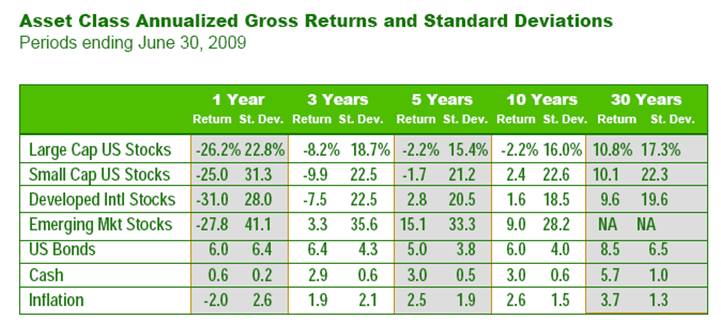
Source (6/30/09): Morningstar Encorr Analyzer (Ibbotson Associates) via State Street SPDR Presentation
A more objective way of looking at risk is by looking at the historical risk as measured by the standard deviation (volatility) of different asset classes over several time periods. Many investors forget risk measurements like standard deviation, duration, and beta are not static metrics and actually change over time.
Diversification Across Asset Classes Key
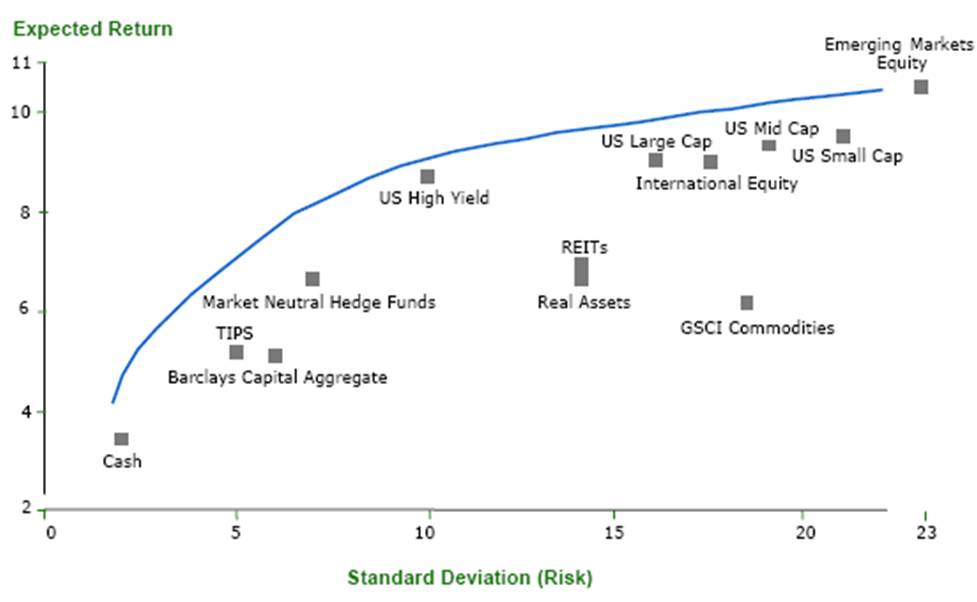
Source: State Street Global Advisors (June 30, 2009)
Correlation, which measures the price relationship between different asset classes, increased dramatically across asset classes in 2008, as the global recession intensified. However, over longer periods of time important diversification benefits can be achieved with a proper mixture of risky and risk-free assets, as measured by the Efficient Frontier (above). Conceptually, an investor’s main goal should be to find an optimal portfolio on the edge of the frontier that coincides with their risk tolerance.
Tailor Portfolio to Changing Circumstances
 In my practice, I continually run across clients or prospects that initially find themselves at the extreme ends of the risk spectrum. For example, I was confronted by an 80 year old retiree needing adequate income for living expenses, but improperly forced by their broker into 100% equities. On the flip side, I ran into a 40 year old who decided to allocate 100% of their retirement assets to fixed income securities because they are unsure of stocks. Both examples are inefficient in achieving their different investment objectives, yet there are even larger masses of the population suffering from similar issues.
Financial markets and client circumstances are constantly changing, so the objectives of the portfolio should be periodically revisited. One size does not fit all, so it’s important to construct the most efficient customized portfolio of assets that meets the objectives and constraints of the investor. Take it from me, I’m constantly re-tailoring my wardrobe (like my investments) to meet the needs of my ever-changing waistline.
Wade W. Slome, CFA, CFP®
Plan. Invest. Prosper.
*DISCLOSURE: For disclosure purposes, Sidoxia Capital Management, LLC is a Registered Investment Advisor (RIA) certified in the State of California. No information accessed through the Investing Caffeine (IC) website constitutes investment, financial, legal, tax or other advice nor is to be relied on in making an investment or other decision. Please read disclosure language on IC “Contact” page.
Style Drift: Hail Mary Investing

The mutual fund investing game is extraordinarily competitive. According to The Financial Times, there were 69,032 global mutual funds at the end of 2008. With the extreme competitiveness comes lucrative compensation structures if you can win (outperform) – I should know since I was a fund manager for many years. However, the compensation incentive structures can create style drift and conflicts of interest. You can think of style drift as the risky “Hail Mary” pass in football – you are a hero if the play (style drift) works, but a goat if it fails. When managers typically drift from the investment fund objective and investment strategy, typically they do not get fired if they outperform, but the manager is in hot water if drifting results in underperformance. Occasionally a fund can be a victim of its own success. A successful small-cap fund can have positions that appreciate so much the fund eventually becomes defined as a mid-cap fund – nice problem to have.
Drifting Issues
Why would a fund drift? Take for example the outperformance of the growth strategy in 2009 versus the value strategy. The Russell 1000 Growth index rose about +28% through October 23rd (excluding dividends) relative to the Russell 1000 Value index which increased +14%. The same goes with the emerging markets with some markets like Brazil and Russia having climbed over +100% this year. Because of the wide divergence in performance, value managers and domestic equity managers could be incented to drift into these outperforming areas. In some instances, managers can possibly earn multiples of their salary as bonuses, if they outperform their peers and benchmarks.
The non-compliance aspect to stated strategies is most damaging for institutional clients (you can think of pensions, endowments, 401ks, etc.). Investment industry consultants specifically hire fund managers to stay within the boundaries of a style box. This way, not only can consultants judge the performance of multitudes of managers on an apples-to-apples basis, but this structure also allows the client or plan participant to make confident asset allocation decisions without fears of combining overlapping strategies.
For most individual investors however, a properly diversified asset allocation across various styles, geographies, sizes, and asset classes is not a top priority (even though it should be). Rather, absolute performance is the number one focus and Morningstar ratings drive a lot of the decision making process.
What is Growth and Value?
Unfortunately the style drift game is very subjective. Growth and value can be viewed as two sides of the same coin, whereby value investing can simply be viewed as purchasing growth for a discount. Or as Warren Buffet says, “Growth and value investing are joined at the hip.” The distinction becomes even tougher because stocks will often cycle in and out of style labels (value and growth). During periods of outperformance a stock may get categorized as growth, whereas in periods of underperformance the stock may change its stripes to value. Unfortunately, there are multiple third party data source providers that define these factors differently. The subjective nature of these style categorizations also can provide cover to managers, depending on how specific the investment strategy is laid out in the prospectus.
What Investors Can Do?
1) Read Prospectus: Read the fund objective and investment strategy in the prospectus obtained via mailed hardcopy or digital version on the website.
2) Review Fund Holdings: Compare the objective and strategy with the fund holdings. Not only look at the style profile, but also evaluate size, geography, asset classes and industry concentrations. Morningstar.com can be a great tool for you to conduct your fund research.
3) Determine Benchmark: Find the appropriate benchmark for the fund and compare fund performance to the index. If the fund is consistently underperforming (outperforming) on days the benchmark is outperforming (underperforming), then this dynamic could be indicating a performance yellow flag.
4) Rebalance: By periodically reviewing your fund exposures and potential style drift, rebalancing can bring your asset allocation back into equilibrium.
5) Seek Advice: If you are still confused, call the fund company or contact a financial advisor to clarify whether style drift is occurring in your fund(s) (read article on finding advisor).
Style drift can potentially create big problems in your portfolio. Misaligned incentives and conflicts of interest may lead to unwanted and hidden risk factors in your portfolio. Do yourself a favor and make sure the quarterback of your funds is not throwing “Hail Mary” passes – you deserve a higher probability of success in your investments.
Wade W. Slome, CFA, CFP®
Plan. Invest. Prosper.
DISCLOSURE: No information accessed through the Investing Caffeine (IC) website constitutes investment, financial, legal, tax or other advice nor is to be relied on in making an investment or other decision. Wade W. Slome, CFA, CFP is a contributing writer for Morningstar.com. Please read disclosure language on IC “Contact” page.
Compounding: A Penny Saved is Billions Earned
What is “compounding” and why is it so great? It sounds like such a fancy financial term. One can think of compounding as a snowball rolling down a hill – the longer the snowball rolls (or the higher up the mountain you begin), the more compounding will expand the size of your snowball. Expanding your investment portfolio through compounding should be your major goal.
Albert Einstein, arguably one of the most intelligent people to walk this planet, was asked to describe mankind’s greatest discovery. His answer: “compound interest.” He went so far as to call it one of the “Eight Wonders of the World.” The benefits of compounding can be demonstrated via famous explorer, Christopher Columbus.
We all know the story, “In 1492, Christopher Columbus sailed the ocean blue.” To emphasize the benefits of compounding, let us suppose that Christopher Columbus made an investment in the historic year of 1492. If Chris had placed a single penny in a 6% interest-bearing account and instructed someone to remove the interest every year and put it in a piggybank, the total value collected in that piggybank would eventually accumulate to more than 30 cents. A pretty nice multiplier-effect on one penny, but not too much absolute cold hard cash to write home about…agreed?

"It's magic, I can turn pennies into billions."
However, if the young explorer had placed the same paltry investment of one cent into the same interest-bearing account, but LEFT the remaining earned interest to compound (thereby earning interest upon the previously earned interest) the results would be drastically different.
What would you guess the compounded account would be worth in 2009?
$10,000? $100,000? $1 million? $10 million? $100 million?
“NO” is the correct answer to all these guesses.
The correct answer: $121,096,709,346.21! Your eyes do not deceive you. That one penny invested in 1492 would have grown to $121 billion dollars today. If you don’t believe me, pull out your calculator and multiply $.01 * 1.06%, and repeat 517 times. Surely, we will not live 517 years to collect on an investment of such long duration. However, with proper planning everyone has the ability to invest quite a bit more than one cent to significantly build future wealth.
As an advisor, the problems related to compounding I see investors commit most are two-fold:
1) Investors are constantly shifting money in and out of their accounts (usually at suboptimal points) due to apprehension and greed, thereby nullifying the benefits of compounding.
2) Because of overpowering fear relating to current economic conditions, investors are parking their money in low yielding CDs (Certificates of Deposit), savings accounts, checking accounts, money market accounts, or other low returning investment vehicles. This strategy is equivalent to pushing the aforementioned snowball over the sidewalk, rather than down a long, steep hill.
In order to reap the rewards of compounding and dramatically expand your investment portfolio, a systematic, disciplined approach to investing needs to be followed. A system that more likely than not has a 20 year horizon rather than 20 days. Now go start saving those pennies!
Super Sizing May Be Hazardous to Your Portfolio’s Health

You may be familiar with the 2004 Academy Award nominated documentary titled Super Size Me, in which the creator Morgan Spurlock decides to film his 30 day journey of eating McDonalds (MCD) for breakfast, lunch, and dinner, making sure he samples every item on the menu. In addition, any time a McDonald’s employee asked Mr. Spurlock whether he wanted to “Super Size” his beverage or French fry order, he complied by ordering the larger size. What was the result from this gluttonous, month-long, fast food binge?
Mr. Spurlock ended up gaining about 25 pounds in weight, his cholesterol sky-rocketed, his liver function deteriorated dramatically, he experienced heart palpitations, and became depressed, among other symptoms. At one point a doctor told him if he continued overindulging at the same pace, he could die.
Well, over the years, investors, governments, and corporations have been doing their own form of “Super-Sizing,” but not by eating Big Macs, Apple Turnovers, and Fish Fillets, but rather consuming too much debt, real estate, and other risky assets, like stocks and hedge funds. Now, like Morgan Spurlock, investors are “de-toxing” by saving more and creating a better balanced portfolio diet. Investors have learned their lessons from our “Great Recession” and are dieting on lower risk assets and consuming a broader set of asset classes. An investor’s diet should cover a broad spectrum of options, including diversified choices across asset class, size, style, and geography. Alternative asset classes, like real estate, commodities, and loans should be evaluated as well.

After the massive crash post-Lehman Brothers, many investors and academics have cast doubts about the relative benefits of diversification, arguing there was no investment class or segment to hide – everything fell equally. There is some truth to the argument, with some exceptions like treasuries, cash, and certain commodities. Globalization and the tighter inter-connectedness between countries can shoulder part of the blame of the synchronized freefall in late 2008 and early 2009. Nonetheless, unless you were short the market, even if you were relatively diversified, pain was spread out generously across many investors.
What countless investors fail to recognize is the constant variability in historical relationship data (e.g., correlations, standard deviation, and covariance) – all the better reason to be broadly diversified. Nobel Prize winners Robert Merton and Myron Scholes know first-hand what can happen when you rely too heavily on historical correlations. Their over-reliance on their quantitative models led to the economic collapse of Long Term Capital Management, which nearly brought the entire economic globe to its knees. Importantly, the magnitude of diversification benefit varies throughout an economic cycle. Since the market rebound in March of this year, we have clearly seen the advantages of diversification.
From a geographical perspective, emerging markets like Russia, which is up over +117% (excluding dividends), are trouncing the domestic averages. Diversification benefits across particular industries and sectors are also evident in areas like technology. For example, the NASDAQ and IIX (Internet Index) are up about +34% and +52% in 2009, respectively. In relation to style characteristics, “Growth” is trouncing “Value” as measured by the Russell 1000 Growth and Value benchmarks. “Growth” is up +25% this year, more than double the appropriate Russell “Value” benchmark. It comes as no surprise that the conservative investments that outperformed in the market collapse, like fixed income and utilities, have generally lagged the other segments.
Like Morgan Spurlock, investors need to resist the “Super Size” temptations in their concentrated portfolios and learn from the binging mistakes experienced by others. A more balanced investment diet across asset class, size, style, and geography will lead to a healthier portfolio and steadier return profile. Now if you will excuse me, I would like to get a bite to eat – perhaps a wholesome McGarden Burger.
Wade W. Slome, CFA, CFP®
Plan. Invest. Prosper.
DISCLOSURE: Sidoxia Capital Management has a short position in MCD at the time this article was originally posted. No information accessed through the Investing Caffeine (IC) website constitutes investment, financial, legal, tax or other advice nor is to be relied on in making an investment or other decision. Please read disclosure language on IC “Contact” page.
Tips for Survival and Prosperity in Challenging Economic Times

Survival requires multiple strategies
We have all been impacted in some shape or form by the worst financial crisis experienced in a generation. The question now becomes what did we learn from this mess and how can we better prepare for a more prosperous financial future?
Here are some important tips to follow:
Save and Invest: Before paying others, pay yourself first. You can achieve this goal by saving and investing your money. Given the weak state of our government “safety net” programs, such as Medicare and Social Security, it has become more important than ever to save. Life spans are extending as well, meaning a larger “nest egg” is needed for retirement. If you don’t have the time, discipline, or emotional make-up to manage your own money, then seek out a fee-only advisor* who does not have a conflict of interest in regards to building your wealth.
Tighten Belt: In order to save and invest you need to be in a position where you are creating excess income. Cutting costs is one way to generate additional income. Eating out less, buying used, taking more affordable vacations, conserving energy, purchasing private label goods are a few easy ways to save money that will accumulate over time. If those efforts are still not adequate, one should then contemplate adjusting their living situation (i.e., down-size) or pursue additional income opportunities – either through a pay raise or higher paying job alternatives.
Pay Down Debt: If your credit card company is charging you a 15-20% rate on unpaid credit card balances and gouging you for late-fees and cash advances, then look for other sources of affordable financing. A home equity line of credit or second mortgage may make sense for some, if the fees and lower interest rates make economic sense. Contact a financial planner or tax professional to determine the appropriateness of these debt alternatives. Ultimately, the goal is to reduce debt and create more financial flexibility.
Take Free Money: If your employer offers matching payments to your retirement plan contributions, they are effectively offering you free money. Take it! The government offers you some tax deferral savings through IRA (Individual Retirement Account) contributions, so take advantage of that benefit as well.
Form a 6-Month Emergency Fund: The economy may be in a bottoming-out phase; however we are not out of the woods yet. Unemployment is approaching 10% and many companies and industries continue to struggle. Build a protective financial cushion should you or your family hit a bump in the road.
Invest in Yourself: Investing for retirement is crucial, however investing in yourself is just as, if not more, important than traditional investing. What I’m referring to is job training, education, and health awareness. We live in a globalized economy and in order to compete against those starving for our jobs, we need to improve our skills and education. Lastly, we cannot neglect our health. Finances need to be put in perspective. Our health should be a top priority and a disciplined balance between diet and exercise will not only reduce stress, but it will also improve mental health.
Times have been challenging, but when the going gets rough, the tough go saving. Take control of your financial future rather than letting economic circumstances control you. Financial success however should not come at the expense of your health, so also focus on a balanced program of diet and exercise. There are no free lunches in this world, but following these steps will help lead you on a path to prosperity – even in these challenging economic times.
Wade W. Slome, CFA, CFP®
Plan. Invest. Prosper.
*DISCLOSURE: Wade W. Slome, CFA, CFP is President and Founder of Sidoxia Capital Management, LLC (www.Sidoxia.com), a fee-only Registered Investment Advisory firm headquartered in Newport Beach, California.
Philosophical Friday: Investing is Like Religion

Nothing like the subject of religion to make people feel uncomfortable, so why not dive in!
Investing Is Like Religion: Everyone believes their religion will lead them down the right path to spiritual prosperity. Adherants.com divides religions into 22 separate groupings. If you look at the loosely grouped big five (Christianity, Judaism, Islam, Hinduism, and Buddhism), these cover the vast majority of religious practitioners globally – an estimated 4 billion to 5.5 billion people.
In investing, most individuals stubbornly believe their philosophy is the right way to make money. With the hopes of creating order, the investment industry relies on tools like Morningstar’s nine style box categories, which places investors in tidy, clean groups. Unfortunately, not every strategy fits nicely into a style box, especially if you try to integrate investment vehicles like hedge funds and quantitative funds.

Can’t We All Just Get Along?: I believe religions can co-exist just like different investing philosophies can co-exist. Certainly there are less worthy religions, for example you can think of cults that prey on vulnerable individuals. The same can be said for investing – as long as greed continues to exist (a certainty), there will be unscrupulous crooks and shady businesses looking to take advantage of people for a quick buck.
Regulation: I suppose our law enforcement agencies and courts serve as regulators over a small minority of churches who break the law, but given the recent collapse of parts of our financial system it makes sense we are retooling and recalibrating our oversight and regulations. There is no doubt that negative trends like the unfettered growth of toxic mortgages (including subprime), over leveraging of investment banks (ala Bear Stearns, and Lehman), and exponential growth of complex derivative products (such as CDS and CDOs) need to be controlled with more oversight. There needs to consequences to improper actions – some religions have been known to discipline their members too.
Investing Takes Faith: We have gone through an extremely trying year and a half and iconic experts like Warren Buffett have had the wherewithal to invest successfully through uncertain economic cycles because of faith in capitalism. Even at the other side of the investing spectrum, in areas like quantitative and technical trading, the practitioner still needs to have enough faith in their systems and models with the belief they have an edge that can help them outperform. Regardless of the approach, one must have faith in their investment philosophy to be successful over the long-term.
Although there countless versions of religions all over the world, I’m confident that the Church of Money Under the Mattress (CMUM) will not lead the majority of investors to the Promise Land. Even for those risk averse savers, there are ways to heighten your expected return without assuming undue risk. Irrespective of your religious beliefs, may your spiritual journey bring you hefty profits…
Wade W. Slome, CFA, CFP® (Sidoxia Capital Management, LLC)
Plan. Invest. Prosper.
DISCLOSURE: Sidoxia Capital Management and client accounts do not have direct positions in BRKA/B at the time the article was published. No information accessed through the Investing Caffeine (IC) website constitutes investment, financial, legal, tax or other advice nor is to be relied on in making an investment or other decision. Please read disclosure language on IC “Contact” page.
Studies Show Investors Ready to Look at New Advisors

Breaking Up a Relationship Doesn't Have to be Difficult
Breaking up is tough to do, especially when you’ve had a chummy relationship with your financial advisor. BusinessWeek recently ran an article urging investors to seek a second opinion, much the same way people do when they request opinions from more than one doctor.
Read BusinessWeek Article: Thinking of Switching Financial Planners?
“Just as a good doctor should respect your decision to see a second opinion, so should your financial adviser be open to review.”
Unfortunately, when it comes to money, the average investor focuses more on the emotional aspects of the client –advisor relationship rather than the objective facts. Given the volatility in the financial markets, investors continue to sift through the rubble over the last 18 months, only to find commissions, fees, taxes, and misallocated portfolios.
A Wall Street Journal article in April highlighted the survey from Prince & Associates Inc., which showed more than 75% of investors with more than $1 million to invest plan to move some money away from their investors – more than 50% intend to leave their advisors altogether. According to the Spectrem Group (July 2009 BusinessWeek article), only 36% of millionaires believe their advisors performed well through the financial crisis of 2008-2009. Another study done by the Wharton School of Business and State Street Advisors showed that only 31% of investing clients are extreme satisfied, even though their Advisors think 65% of the clients are very satisfied.

Now is the time to check under the hood to review advisor fees and performance
Over our lives, we have switched CPAs, attorneys, hair-stylists and auto-mechanics, so why the difficulty in considering advisor change? The emotional aspects and uncertainty of the financial markets can cloud the decision making process. That’s why now, better than ever, it is an ideal time to ask tough questions and shop around for the top advice you deserve. In addition to bad advice, commissions and fees could be eating away at your investment returns, forcing a later than anticipated retirement or a lower quality of life. I myself prefer filet mignon over macaroni & cheese.
Given the unabated free-fall of last fall appears to have abated and the economy appears to be finding firmer footing, do yourself a favor and get a second opinion – there’s not a lot of downside.
Wade W. Slome, CFA, CFP®
Plan. Invest. Prosper.




 Investing Caffeine
