Posts filed under ‘Financial Planning’
Sleeping like a Baby with Your Investment Dollars

Amidst the recent, historically high volatility in the financial markets, there have been a large percentage of investors who have been sleeping like a baby – a baby that stays up all night crying! For some, the dream-like doubling of equity returns achieved from the first half of 2009 through the first half of 2011 quickly turned into a nightmare over the last few weeks. We live in an inter-connected, globalized world where news travels instantaneously and fear spreads like a damn-bursting flood. Despite the positive returns earned in recent years, the wounds of 2008-2009 (and 2000 to a lesser extent) remain fresh in investors’ minds. Now, the hundred year flood is expected every minute. Every European debt negotiation, S&P downgrade, or word floating from Federal Reserve Chairman Ben Bernanke’s lips, is expected to trigger the next Lehman Brothers-esque event that will topple the global economy like a chain of dominoes.
Volatility Victims
The few hours of trading that followed the release of the Federal Reserve’s August policy statement is living proof of investors’ edginess. After initially falling approximately -400 points in a 30 minute period late in the day, the Dow Jones Industrial Average then climbed over +600 points in the final hour of trading, before experiencing another -400 point drop in the first hour of trading the next day. Many of the day traders and speculators playing with the explosively leveraged exchange traded funds (e.g., TNA, TZA, FAS, FAZ), suffered the consequences related to the panic selling and buying that comes with a VIX (Volatility Index) that climbed about +175% in 17 days. A VIX reading of 44 or higher has only been reached nine times in the last 25 years (source: Don Hays), and is normally associated with significant bounce-backs from these extreme levels of pessimism. Worth noting is the fact that the 2008-2009 period significantly deteriorated more before improving to a more normalized level.
Keys to a Good Night’s Sleep
The nature of the latest debt ceiling negotiations and associated Standard & Poor’s downgrade of the United States hurt investor psyches and did little to boost confidence in an already tepid economic recovery. Investors may have had some difficulty catching some shut-eye during the recent market turmoil, but here are some tips on how to sleep comfortably.
• Panic is Not a Strategy: Panic selling (and buying) is not a sustainable strategy, yet we saw both strategies in full force last week. Emotional decisions are never the right ones, because if they were, investing would be quite easy and everyone would live on their own personal island. Rather than panic-sell, investments should be looked at like goods in a grocery store – successful long-term investors train themselves to understand it is better to buy goods when they are on sale. As famed growth investor Peter Lynch said, “I’m always more depressed by an overpriced market in which many stocks are hitting new highs every day than by a beaten-down market in a recession.”
• Long-Term is Right-Term: Everybody would like to retire at a young age, and once retired, live like royalty. Admirable goals, but both require bookoo bucks. Unless you plan on inheriting a bunch of money, or working until you reach the grave, it behooves investors to pull that money out from under the mattress and invest it wisely. Let’s face it, entitlements are going to be reduced in the future, just as inflation for food, energy, medical, leisure and other critical expenses continue eroding the value of your savings. One reason active traders justify their knee-jerk actions and derogatory description of long-term investors is based on the stagnant performance of U.S. equity markets over the last decade. Nonetheless, the vast number of these speculators fail to recognize a more than tripling in average values in markets like Brazil, India, China, and Russia over similar timeframes. Investing is a global game. If you do not have a disciplined, systematic long-term investment strategy in place, you better pray you don’t lose your job before age 70 and be prepared to eat Mac & Cheese while working as a Wal-Mart (WMT) greeter in your 80s.
• Diversification: Speaking of sleep, the boring topic of diversification often puts investors to sleep, but in periods like these, the power of diversification becomes more evident than ever. Cash, metals, and certain fixed income instruments were among the investments that cushioned the investment blow during the 2008-2009 time period. Maintaining a balanced diversified portfolio across asset classes, styles, size, and geographies is crucial for investment survival. Rebalancing your portfolio periodically will ensure this goal is achieved without taking disproportionate sized risks.
• Tailored Plan Matching Risk Tolerance: An 85 year-old wouldn’t go mountain biking on a tricycle, and a 10 year-old shouldn’t drive a bus to his fifth grade class. Sadly, in volatile times like these, many investors figure out they have an investment portfolio mismatched with their goals and risk tolerance. The average investor loves to take risk in up-markets and shed risk in down-markets (risk in this case defined as equity exposure). Regrettably, this strategy is designed exactly backwards for long-term investors. Historically, actual risk, the probability of permanent losses, is much lower during downturns; however, the perceived risk by average investors is viewed much worse. Indeed, recessions have been the absolute best times to purchase risky assets, given our 11-for-11 successful track record of escaping post World War II downturns. Could this slowdown or downturn last longer than expected and lead to more losses? Absolutely, but if you are planning for 10, 20, or 30 years, in many cases that issue is completely irrelevant – especially if you are still adding funds to your investment portfolio (i.e., dollar-cost averaging). On the flip side, if an investor is retired and entirely dependent upon an investment portfolio for income, then much less attention should be placed on risky assets like equities.
If you are having trouble sleeping, then one of two things is wrong: 1.) You are taking on too much risk and should cut your equity exposure; and/or 2.) You do not understand the risk you are taking. Volatile times like these are great for reevaluating your situation to make sure you are properly positioned to meet your financial goals. Talking heads on TV will tell you this time is different, but the truth is we have been through worse times (see History Never Repeats, but Rhymes), and lived to tell the tale. All this volatility and gloom may create anxiety and cause insomnia, but if you want to quietly sleep through the noise like a content baby, make yourself a long-term financial bed that you can comfortably sleep in during good times and bad. Focusing on the despondent headline of the day, and building a portfolio lacking diversification will only lead to panic selling/buying and results that would keep a baby up all night crying.
Wade W. Slome, CFA, CFP®
Plan. Invest. Prosper.
DISCLOSURE: Sidoxia Capital Management (SCM) and some of its clients own certain exchange traded funds (including emerging market ETFs) and WMT, but at the time of publishing SCM had no direct position in TNA, TZA, FAS, FAZ, or any other security referenced in this article. No information accessed through the Investing Caffeine (IC) website constitutes investment, financial, legal, tax or other advice nor is to be relied on in making an investment or other decision. Please read disclosure language on IC “Contact” page.
Getting & Staying Rich 101

Fred J. Young worked 27 years as a professional money manager and investment counselor in the trust department at Harris Bank in Chicago. While working there he learned a few things about wealth accumulation and preservation, which he outlines in his book How to Get Rich and Stay Rich.
There is more than one way to skin a cat, and when it comes to getting rich, Young describes the only three ways of getting loaded:
1.) Inherit It: Using this method on the path to richness generally doesn’t take a lot of blood, sweat, and tears (perhaps a little brown-nosing wouldn’t hurt), but young freely admits you can skip his book if you are fortunate enough to garner boatloads of cash through your ancestry.
2.) Marry It: This approach to wealth accumulation can require a bit more effort than method number one. However, Young explains that if the Good Lord intended you to find your lifetime lover through destiny, then if your soul-mate has a lot of dough Young advises, “You [should] graciously accept the situation. Don’t fight it.”
3.) Spend < Earn: Normally this avenue to champagne and caviar requires the most effort. How does one execute option number three? “You spend less than you earn and invest the difference in something you think will increase in value and make you rich,” simply states Young. Sounds straightforward, but what does one invest their excess cash in? Young succinctly lists the customary investment tools of choice for wealth creation:
- Real estate
- Own their own business
- Common stocks
- Savings accounts (thanks to the magic of compound interest rates) – see also Penny Saved is Billions Earned
Rich Luck
If faced with choosing between good luck and good judgment, here is Fred Young’s response:
“You should take good luck. Good luck, by definition, denotes success. Good judgment can still go wrong.”
Like many endeavors, it’s good to have some of both (good luck and good judgment).
The Role of Courage
Courage is especially important when it comes to equity investing because buying stocks includes a very counterintuitive behavioral aspect that requires courage. Following the herd of average investors and buying stocks at new highs is easy and does not require a lot of courage. Young describes the various types of courage required for successful investing:
“The courage to buy when others are selling; the courage to buy when stocks are hitting new lows; the courage to buy when the economy looks bad; courage to buy at the bottom…The times when the gloom was the thickest invariably turned out to have been the best times to buy stocks.”
Keeping the Cash
Becoming rich is only half the challenge. In many cases staying rich can be just as difficult as accumulating the wealth. Young points out the intolerable pain caused by transitioning from wealth to poverty. What is Young’s solution to this tricky problem? Seek professional help. The risks undertaken to build wealth still exist when you are rich, and those same risks have the capability of tearing financial security away.
There are three paths to riches according to Fred Young (inheritance, marriage, and prudent investing). Some of these directions leading to mega-money require more effort than others, but if you are lucky enough to have deep pockets of riches, make sure you have the discipline and focus necessary to maintain that wealth – those deep pockets could have a hole.
Wade W. Slome, CFA, CFP®
Plan. Invest. Prosper.
DISCLOSURE: Sidoxia Capital Management (SCM) and some of its clients own certain exchange traded funds, but at the time of publishing SCM had no direct position in any other security referenced in this article. No information accessed through the Investing Caffeine (IC) website constitutes investment, financial, legal, tax or other advice nor is to be relied on in making an investment or other decision. Please read disclosure language on IC “Contact” page.
The Annuity Trap

Like the infamous Roach Motel, annuities allow investors to check-in while making it very difficult to check out. In many instances, getting out of annuities can be cost prohibitive (fees, charges, commissions, expenses, etc.), even if escaping these fee-laden products is in the investors’ best financial interest.
In an article dated April 13th, 2010, Jay Peroni warned others by outlining a typical annuity fee structure as follows:
- Mortality and Expense Charge 1.50%
- Sub Account Management Fees 1.00%
- Unreported trading costs 0.78%
- Annual Administrative Expenses 0.15%
TOTAL ANNUAL EXPENSES 3.43%
What aren’t included in these numbers above are the surrender charges, which effectively can lock you into the annuity if you are averse to paying hefty surrender charges. Normally, the surrender charges vary from up to a 10% charge for large withdrawals in year one, decreasing to something like 1% in year 10. Worth noting, steep sales commissions can be layered on top of the previous charges or mysteriously embedded in the fee structure categories above.
The Big Sell

Driving the push for these 3%+ annual fees are lucrative financial institutions hiring aggressive salespeople. Typically annuities are sold under the guise of safe tax shelter investments. What the broker won’t tell you is that only a fraction (“exclusion ratio”) of the annuity payments is shielded from taxes, and the rest of the payments are taxed at the higher, unfavorable ordinary income tax rate (relative to qualified dividends and capital gains from other securities). Much of the time, many of the salespeople, who call themselves “financial advisors,” know little about these complex annuity products (see Financial Sharks article). What these brokers do understand are the big, fat commissions they stand to collect upon fleecing unsuspecting investors.
Scores of these so-called advisors are actually “registered representatives” who do not carry a fiduciary duty (meaning they are NOT required to make investment decisions in the best interest of their clients). Certainly, there are some situations where annuities might be appropriate, but from my experience there are very few cases where the egregious charges and expenses outweigh the benefits. I believe the vast majority of brokers/registered reps/salespeople are more concerned about padding their wallets than building and protecting client portfolios.
The Alternatives
If safety and tax advantages are features you are looking for then I encourage you to look at more efficient options such as the following:
- 401k Defined Contribution Retirement Plan (or other “Qualified Plan”): Allows you to achieve tax deferral often with free money given to you in the form of a match to your contributions.
- IRA (Individual Retirement Account): Whether you consider a traditional or Roth IRA, there are tax deferral advantages with lower fees.
- Low Turnover, High Dividend Portfolios: Using a tax efficient management strategy with better tax treatment of income is another approach that I firmly believe will outperform most annuities.
- Tax-Exempt Muni Bonds or Corporates: The tax-exempt status of municipal bonds affords investors a tax advantaged status. The after-tax yield on corporate bonds can be compared to the returns promised on annuities (AFTER all fees, charges, and commissions). Holding individual bonds until maturity can help avoid interest rate risk.
- Ladder Zero Coupon Bonds: If safe fixed payments are what you are looking for, then staggered purchases of zero coupon bonds can be purchased as well.
These are only a few options that could and should be considered when reviewing your personal objectives and circumstances. With regard to the insurance component of an annuity contract, there are more cost effective ways of paying for insurance – most notably, term insurance.
At the end of the day, no matter the financial product, it is important you understand the underlying fees charged on any strategy, along with how the person selling you stuff is compensated. If you don’t do your homework on these extremely complex products (many not regulated by the NASD or SEC), then you may find yourself checking into the annuity hotel, but unable to check out.
Wade W. Slome, CFA, CFP®
Plan. Invest. Prosper.
*DISCLOSURE: Sidoxia Capital Management (SCM) and some of its clients own certain exchange traded funds, but at the time of publishing SCM had no direct positions in any other security referenced in this article. No information accessed through the Investing Caffeine (IC) website constitutes investment, financial, legal, tax or other advice nor is to be relied on in making an investment or other decision. Please read disclosure language on IC “Contact” page.
Do as I Say, Not as I Do

“Be smart…but don’t pay attention to me.”
Watching Goldman Sachs (GS) executives sweat it out under the hot lamps of Senator questioning makes for gripping television (see Goldman article), but as we all know the ethical standing of a significant number of politicians calls into question whether the pot should be calling the kettle black. Ever since I was a kid, I was told by seemingly responsible adults to “do as I say and not what I do.” I suppose the Goldman execs should follow the advice of Congress, but not their actions.
Based on a recent Wall Street Journal article that studied the investment activity of Congressional members (and spouses) during the financial crisis, the analysis discovered 13 of them were betting against the market. Just as Goldman and hedge fund manager John Paulson partnered to bet against the housing market via shorting synthetic CDOs (Collateralized Debt Obligations), Congressmen and their spouses were wagering against the market through the use of debt loaded (leveraged) exchange traded funds, which integrate derivatives.
Were any of the Congressional investment activities illegal? Likely not, but some question the ethical appearance of such behavior. The former head of the House Ethics Committee and past Representative Joel Hefley of Colorado believes such conduct “doesn’t look real great when the economy is tanking and people are blaming the government.” Facing similar challenges, the SEC’s (Security and Exchange Commission’s) squishy fraud charge complaint against Goldman Sachs is expected to encounter significant difficulty in proving the investment bank’s guilt.
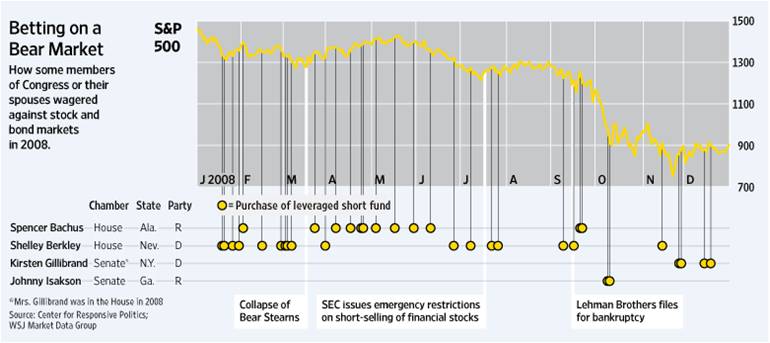
Source: The Wall Street Journal (Yellow Dots = Shorting Exposure Trades)
Other politicians were critical of Wall Street too, despite apparent hypocritical behavior. For example, Representative Shelley Berkley of Nevada chided Wall Street for its reckless activities. “No casino on the planet behaves as irresponsibly and recklessly as Wall Street does. Wall Street ought to be ashamed, and take a lesson from the casino industry.” Nearly at the same time, Shelley’s husband Lawrence Lehrner placed 57 bearish trades.
I find it very amusing the same politicians shredding apart the Wall Street firms are in many cases the same politicians stretching the bounds of ethical behavior. Various politicians do a great job pontificating about the latest shortcomings of the financial industry, but fail to take some accountability for missing one of the greatest real estate booms of all-time. Where were the regulators and politicians when the debt bubble was bursting? Unfortunately, “reactive” is a much larger part of a politician’s lexicon than “proactive.” Responding to populist fervor is easier than leaning against consensus views, even if going against consensus makes more strategic sense.
For those having difficulty in deciphering the advice given by esteemed Congressmen, just remember to “do what they say, and not what they do.”
Read Full Wall Street Journal Article
Wade W. Slome, CFA, CFP®
Plan. Invest. Prosper.
*DISCLOSURE: Sidoxia Capital Management (SCM) and some of its clients own certain exchange traded funds, but at the time of publishing SCM had no direct positions in GS, or any security referenced in this article. No information accessed through the Investing Caffeine (IC) website constitutes investment, financial, legal, tax or other advice nor is to be relied on in making an investment or other decision. Please read disclosure language on IC “Contact” page.
Filet or Mac & Cheese? Investing for Retirement

The financial crisis of 2008-2009 placed a large swath of investors into paralysis based on a fear the United States and the rest of the world was on the verge of irreversible destruction. Regardless of what the newspaper headlines are reading and television pundits are spouting, individuals have to shrewdly plan for retirement no matter what the economy is doing. So then the question becomes, do you want to be eating macaroni & cheese in retirement, or does filet mignon or alternate five-star cuisine sound more appealing? I vote for the latter.
Despite what the government statistics are saying about the current state of benign inflation, you do not need to be a genius to see medical costs are exploding, energy charges have skyrocketed, and even more innocuous items such as movie ticket prices continue to rise. If that’s not a burden enough, depending on your age, there’s a legitimate concern the Social Security and Medicare safety nets may not be there for you in retirement. It is more important than ever to take control of your financial future by investing your money in a more efficient manner (see Fusion), focusing on long-term, low-cost, tax-efficient strategies. Whatever the direction of the financial markets (up, down, or sideways), if you don’t wisely invest your money, you will run the risk of working as a Wal-Mart (WMT) greeter into your 80s and relegated to eating mac & cheese (for lunch and dinner).
Broaden Your Horizons
The last decade has been tough for domestic equities. It’s true that not a lot of compounding of returns has occurred in the domestic equity markets over the last decade (see Lost Decade), but that weakness is not necessarily representative of the next decade’s performance or the past relative strength seen in areas like emerging markets, materials and certain fixed income markets. These alternatives, including cash, would have added significant diversification benefits to investor portfolios during previous years. Rather than focusing on what’s best for the investor, so much financial industry attention has been placed on high cost, high fee, high commission domestic stock funds or insurance-based products. Due to many inherent conflicts of interest, many individual investors have lost sight of other more attractive opportunities, like exchange traded funds, international strategies, and fixed-income investment vehicles.
Rule of 72
Depending on your risk profile, objectives and constraints, the “Rule of 72” implies your retirement portfolio should double from a $100,000 investment now to roughly $200,000 in seven years (to $400,000 in 14 years, $800,000 in 21 years, etc.), assuming your portfolio can earn a 10% annual return. Unfortunately, this snowballing effect of money growth does not work if you are paying out significant chunks of your returns to aggressive brokers and salespeople in the forms of high commissions, fees, and taxes (see a Penny Saved is Billions Earned). For example, if you are paying out total annual expenses of 2-3% to a broker, advisor, or investment manager, the doubling effect of the Rule of 72 will be stretched out to 9-10 years (rather than the above mentioned seven years). If you do not know what you are paying in fees and expenses (like the majority of people), then do yourself a favor and educate yourself about the fee structures and tax strategies utilized in your investments (see also Investor Confusion). If you haven’t started investing, or you are shoveling out a lot of money in fees, expenses, and taxes, then you should reconsider your current investment stretegy. Otherwise, you may just want to begin stockpiling a lot of macaroni & cheese in your retirement pantry.
Wade W. Slome, CFA, CFP®
Plan. Invest. Prosper.
*DISCLOSURE: Sidoxia Capital Management (SCM) and some of its clients own certain exchange traded funds and shares in WMT, but at the time of publishing SCM had no direct positions in any security referenced in this article. No information accessed through the Investing Caffeine (IC) website constitutes investment, financial, legal, tax or other advice nor is to be relied on in making an investment or other decision. Please read disclosure language on the IC “Contact” page for more information.
Simmons Wants to Kiss Life Insurance Worries Away

The Makeup Master
Gene Simmons, lead singer of rock group Kiss, was born as Chaim Witz in Israel 60 years ago. After 40 years of rocking & rolling, the band is still alive and well and touring this spring in the U.K. I am no stranger to Gene Simmons – as a matter of fact, Kiss was the first concert I attended as a kid at the San Francisco Cow Palace in the 1970s. Despite his early professional career success, all the limelight and money was not enough for Gene Simmons, so he put his entrepreneurial skills to the test and aggressively added a broad Kiss merchandising line (over 3,000 licensed/merchandise items), including everything from Kiss baby clothing and Kiss wine to Kiss dart boards and Kiss caskets. Yep, soup to nuts, from the cradle to the grave, and you can even purchase the merchandise with your Kiss Visa credit card!
All Aboard the Premium Financing Train
Now, Mr. Simmons has expanded his business interests to a broader set of financial services. Specifically, Simmons has co-founded a company (Cool Springs Life) that sells premium finance life insurance targeted at high net worth individuals. Simmons and CEO Samuel Watson stopped off at Bloomberg to spread the premium finance gospel:
Premium financing arrangements set up for life insurance are primarily designed for wealthy individuals with large, multi-million dollar estates. This explains a little about whom are the prime targets for life insurance premium financing, but why would wealthy individuals potentially want this financing tool?
Premium Financing Benefits:
- Pay for Estate Taxes: The primary advantage of life insurance for the wealthy is to provide liquidity to beneficiaries (in the form of a death benefit) at the death of the “insured” to fund future estate taxes. Estate tax legislation is still up in the air, but in my view will likely increase to a hefty 45% to 55% rate over the next year. The tax-free liquidity (see a knowledgeable CPA to confirm tax status) provided to the surviving beneficiary by the insurance policy can be especially important if the deceased person’s assets are tied up in illiquid assets like real estate. The government is impatient in regards to tax collections, so gaining immediate access to the death benefit proceeds is a more attractive alternative than forced sales of illiquid assets (potentially at fire-sale prices).
- Other People’s Money: Some people prefer to purchase things with other people’s money. The cost of the financing can be another benefit to the strategy. The interest rate owed on a premium financing deal may be lower than the return a client can earn on alternative investments. If the investment strategy proves successful, the borrower will earn a positive spread on the loan (borrow low, invest high).
- Lower Estate Value: By gifting life insurance assets to a trust (e.g., an Irrevocable Life Insurance Trust – ILIT), there are ways for a wealthy donor to lower his estate value by employing gifting strategies and other estate planning structures. These estate planning tactics often preserve asset values for designated beneficiaries, rather than forking over unnecessarily high taxes to the IRS (Internal Revenue Service). In some cases a knowledgeable attorney can structure premium payments in such a fashion that exemption allowances alleviate any potential gift tax consequence.
Normally nothing in life comes risk-free and the same principle applies to life insurance premium financing.
Premium Financing Risks:
- Interest Rate Risk: Many of these contracts are constructed based on a floating interest rate structure like LIBOR (London Interbank Offered Rate) , therefore if interest rates rise, the borrowers could expose themselves to higher interest payments.
- Credit Risk of Lender: Heaven forbid we go through another financial crisis of the same scale as 2008-2009, but insurance players such as AIG were large players in the premium financing market during this period and caused significant disruption to all relevant participants in the premium financing food chain. Failure of a lender could compromise the integrity of the life insurance and estate planning strategy.
- Risk of Deteriorating Borrower Assets: Depending on the circumstances and facts surrounding the premium financing structure, the lender may require different forms of borrower collateral (i.e., stocks, bonds, real estate, letter of credit, etc.) on top of the cash value/surrender value of the life insurance policy. If the borrower’s collateral value decreases below a certain threshold, the borrower may be forced to supply additional collateral.
For those people who want to rock and roll all night and party every day, perhaps life insurance premium financing is not for you. However, if you got a lot of dough and want to preserve the value of your estate, maybe you should give Gene Simmons a call. With a signed contract, he might even include a Kiss casket for your future funeral plans.
Wade W. Slome, CFA, CFP®
Plan. Invest. Prosper.
DISCLOSURE: Sidoxia Capital Management (SCM) and some of its clients own certain exchange traded funds and a derivative security of an AIG insurance subsidiary, but at time of publishing had no direct positions in AIG. No information accessed through the Investing Caffeine (IC) website constitutes investment, financial, legal, tax or other advice nor is to be relied on in making an investment or other decision. Please read disclosure language on IC “Contact” page.
Markowitz’s Five Dimensions of Risk

Eighty-two year old Harry Markowitz, 1990 Nobel Prize winner, is best known for his creation of Modern Portfolio Theory (MPT) in the 1950s. MPT elegantly combines mathematical variables such that investors can theoretically maximize returns while minimizing risk with the aid of diversification. Markowitz’s Efficient Frontier research eventually led to the future breakthrough of the Capital Asset Pricing Model (CAPM).
The Different Faces of Risk
Before we dive further into Markowitz’s dimensions of risk, let’s explore the definitions of the word “risk.” Just like the word “love” is interpreted differently by different people, so too does risk. To some, risk is defined as the probability of loss. To mathematicians, risk often means the historical volatility in returns as measured by standard deviation or Beta. For many individual investors, risk is frequently mischaracterized by emotions – risk is believed to be high after market collapse and low after extended market rallies (see also Wobbling Risk Tolerances article).
The Five Dimensions of Risk
With the procedural definitions of risk behind us, we can take a deeper look at risk from the eyes of Markowitz. Beyond the complex mathematical equations, Markowitz also understands risk from the practical investor’s standpoint. In a recent Financial Advisor magazine article Markowitz reviews the five dimensions of risk exposure:
1) Time Horizon
2) Liquidity Needs
3) Net Income
4) Net Worth
5) Investing Knowledge/Attitudes on Risk
Rather than pay attention to these practical dimensions of individual risk tolerance, countless investors adjust their risk exposure (equity allocation) by speculating on the direction of the stock market, which usually means buying high and selling low at inopportune times. Although it can be entertaining to guess the direction of the market, we all know market timing is a loser’s game in the long-run (see also Market Timing Treadmill article). Markowitz’s first four risk exposures are fairly straightforward, measurable factors, however the fifth exposure (“knowledge and attitude”) is much more difficult to measure. Determining risk attitude can be an arduous process if risk tolerance constantly wavers through the winds of market volatility.
The Double Whammy
Rather than becoming a nervous Nelly, constantly chomping on your finger nails, your investment focus should be on action, and the things you can control. The number one goal is simple….SAVE. How does one save? All one needs to do is spend less than they take in. Like dieting, saving is easy to understand, but difficult to execute. You can either make more money, spend less, or better yet… do both.
The Baby Boomers are not completely out of the woods, but the next generations (X, Y, Z, etc.) is even worse off because they face the “Double Whammy.” Not only are life expectancies continually increasing but the Social Security safety net is becoming bankrupt. Consider the average life expectancy was roughly 30 years old in 1900 and in developed countries today we stand at about 78 years. Some actuarial tables are peaking out at 120 years now (see also Brutal Reality to Aging Demographics). So when considering Markowitz’s risk exposure #1 (time horizon), it behooves you to calibrate your risk tolerance to match a realistic life expectancy (with some built-in cushion if modern medicine does a better job).
Taming the Wild Beast
Every investor’s risk profile is multi-dimensional and constantly evolving due to changes in Markowitz’s five risk exposures (time horizon, liquidity needs, net income, net worth, and knowledge/attitude). Risk can be a wild animal difficult to tame, but if you can create a disciplined, systematic investment plan, you too can reach your financial goals without getting bitten by the numerous retirement hazards.
Read the complete Financial Advisor article on Harry Markowitz
Wade W. Slome, CFA, CFP®
Plan. Invest. Prosper.
*DISCLOSURE: Sidoxia Capital Management (SCM) and some of its clients own certain exchange traded funds, but at the time of publishing had no direct positions in any security mentioned in this article. No information accessed through the Investing Caffeine (IC) website constitutes investment, financial, legal, tax or other advice nor is to be relied on in making an investment or other decision. Please read disclosure language on IC “Contact” page.
Dealing with Wobbling Risk Tolerances

The words “risk tolerance” are often used loosely, but unfortunately many investors and advisors look at these terms as an objectively definable statistic, like your blood pressure or cholesterol level. Not only is risk tolerance not a definable statistic, but for most people it is also constantly changing.
Given that investment advisors themselves have a great deal of difficulty maintaining an even emotional keel, it should come as no surprise that most invidual investors have even more volatile risk appetites. Because of the nature surrounding the markets – 24/7 news coverage and non-stop tick by tick price scorekeeping –emotions continually tug at investors’ risk tolerances.
Average Investor NOT on Best Behavior
Certainly in my practice, I’ve seen the direct psychological (and physical) impacts volatile financial markets can have on people’s investment decisions. What makes deciphering risk tolerance even more difficult is the absence of any substantive profile definitions (except for vague categories like conservative, moderate, and aggressive). The foggy risk categorizations are compounded by the aforementioned fluctuating risk tolerances, which usually switch in the wrong direction, at the wrong time. Case in point: the technology bubble bursting. In the late 1990s, risk aversion completely disappeared – everyone and their mother wanted to invest in technology stocks. If you fast-forward to the mid-2000s, you will also recall Bessie the hair salonist and Jimmy the cab-driver taking excessive risk at the peak of the housing bubble.
In a recent Simoleon Sense post, an astute guest contributor (Tim Richards) points to research developed by Carrie Pan and Meir Statman (Santa Clara University – Department of Finance) showing the shortcomings implicit in investor behavior:
“… investors’ risk tolerance varies by circumstances and associated emotions. High past stock returns endow stocks with positive affect and inflate investors’ exuberance, misleading them into the belief that the future holds high stock returns coupled with low risk. Risk tolerance questions asked after periods of high stock returns are likely to elicit answers exaggerating investors’ risk tolerance. Conversely, low past stock returns burden stocks with negative affect and inflate investors’ fear, misleading them into the belief that the future holds low stock returns coupled with high risk. Risk tolerance questions asked following periods of low stock returns are likely to elicit answers underestimating investors’ risk tolerance.”
In addition to ill-advised investor timing, Richards correctly highlights the lack of comparability across various investor types, even if you apply acceptable definitions or numeric levels of risk. Simple allocation to various stock/bond exposure does not adequately capture a client’s risk tolerance. A portfolio with 60% invested in Blue Chip dividend paying companies is a tad different than a portfolio invested 60% in Russian stocks. What an 82-year old retiree in Florida thinks is “aggressive” may differ 180 degrees from what a 32-year old trader on Wall Street may think is “aggressive.”
The Failure of Risk Equations
Academics have attempted to boil the market into elegant mathematical equations, but with the acknowledgement that investing mixes science with behavior, it becomes apparent that the mathematical equations must also incorporate art. However, it can become quite difficult to create an ever changing artistic equation. A perfect example of an equation gone awry is the debacle that unfolded at Long Term Capital Management. Robert Merton and Myron Scholes were world renowned Nobel Prize winners who single handedly brought the global financial markets to its knees in 1998 when it lost $500 million in one day and required a $3.6 billion bailout from a consortium of banks (see also why investors get hurt and Butter in Bangladesh articles).
Even if you are a smart economist who can artistically mix quantitative numbers with investing, the problem becomes people’s preferences and decisions change as the infinite number of variables adjust in the marketplace over time. There certainly are some rules of thumb investors tend to gravitate towards (such as cheap companies with sustainable growth in profits and cash flows), but even for those companies successful at generating income, nobody can unequivocally predict exactly how and when investors will react by pushing prices higher.
Here is what Tim Richardshad to add on the subjects of mathematical models and market efficiency in his Simoleon Sense post:
“So, in recent decades the industry’s approach has been to develop mathematical models which can relegate human behaviour to a set of probability equations, thus allowing profitability and risk to be actuarially managed: fraud is no longer unacceptable – it’s now just a number to be factored into earnings forecasts. This is simply the latest in a long line of industry fads, using the ideas of efficient market theories to design approaches which are right quite a lot of the time and then very, very wrong all at once.”
——————————————————————————————————
“[Markets] are not remotely efficient and it’s just a shame the world had to be brought to the edge of financial meltdown before anyone started listening.”
——————————————————————————————————
“When everyone thinks that markets can’t fail is the time to be very risk adverse, when no-one wants to invest is the time to be greedy. Yet what’s an advisor to do when the know-your-customer questionnaire tells them to do exactly the opposite of what’s in the customer’s best interests?”
Equations can produce detrimental results, so a healthy dosage of skepticism is prescribed.
The Solution: Education, Liquidity, and Income Can Allow More Beauty Sleep
Education about logic pitfalls and the integration of liquidity-based needs into clients’ investment plans is key. Controlling and understanding one’s personal biases can reduce or eliminate common repeated investment mistakes. Covering the investors’ income needs is another essential and practical aspect to investing, especially when it can prevent forced position sales at inopportune times. Extending oneself along the riskier end of the spectrum may have felt comfortable in the mid 2000s, but losses and sleepless nights overwhelmed many investors in 2008 and early 2009. In a bull market, adding too much equity and other risky assets to a portfolio is like pimping heroine to a drug addict – it behooves the advisor to point out the potential dangers of positioning a portfolio too aggressively. Rebalancing your investment portfolio can also act as a natural hedge to prevent exposures from exploding in size or evapaporating away. On the other hand, pitching Armageddon and piling into overpriced risk-free assets during the tail end of a bear market can be just as negligent.
Risk tolerance is an amorphous concept that can lead to suboptimal, knee-jerk investment actions. If you want to earn higher returns, I strongly urge you to pick up a behavioral finance book to sharpen your investment decision-making skills and firm up your wobbling risk tolerance foundation.
Read the whole Simoleon Sense article.
Wade W. Slome, CFA, CFP®
Plan. Invest. Prosper.
*DISCLOSURE: Sidoxia Capital Management (SCM) and some of its clients own certain exchange traded funds, but at the time of publishing had no direct positions in any security mentioned in this article. No information accessed through the Investing Caffeine (IC) website constitutes investment, financial, legal, tax or other advice nor is to be relied on in making an investment or other decision. Please read disclosure language on IC “Contact” page.
Beating off the Financial Sharks

There is blood in the water and financial sharks will do their best to consume any weak, floating prey. Now, greater than ever, investors are looking for answers in these perilous economic waters, so it behooves investors to arm themselves with the knowledge and questions necessary in dealing with financial predators.
Unlike other professions, like medicine, law, or accounting, the hurdle in becoming a “broker,” “advisor,” “financial consultant,” or other glorified title is much lower than some other professions. Basically, if you pass an exam or two, you are ready to do business and handle the financial future of virtually anybody.
Not all practitioners are evil, and there is a segment of investment professionals that take their craft very seriously. Separating the wheat from the chaff can be very challenging, so here is a list to follow when reviewing the management of your finances:
1) Experience Matters: Find an advisor with investment experience. Someone who has actually invested money. Don’t partner with a financial salesperson good at shoveling high-cost, high-commission products and strategies. When you fly in a plane, do you want an inexperienced stewardess or veteran pilot flying the plane? If you were ever to need surgery, would you want the nurse using the knife, or a trained, educated surgeon? Your investment future is a serious proposition, but many investors do not treat it that way.
2) Education and Relevant Credentials Matter: Find an advisor with credible, relevant investment credentials. Not all investment letters are created equally, and interpreting the alphabet soup of financial industry designations can be thorny. Two credentials in the investment industry that rise to the top are the CFA (Chartered Financial Analyst) and CFP® (Certified Financial Planner) designations. Less than 10% of the industry has one of these credentials and less than a few percent have both. An advanced degree like a master’s degree wouldn’t hurt either.
3) Low-Cost & Tax Efficiency: Find an advisor who uses a low-cost, tax-efficient strategy, including the integration of passive investment vehicles, such as exchange trade funds (ETFs), index funds, and/or individual securities that are invested over long-term investment horizons (read more about passive investing). Not only are low-cost products important, but low-cost activity is vital too – meaning there should be no churning of the account with high commissions or transaction costs.
4) Find an Advisor Who Eats Cooking: It is important to find an advisor who eats his/her own cooking (i.e., he/she is invested in the same investment products and strategies as the client). Commissions can often be the number one motivation for the advisor, rather than what is best for the client’s future. When offered a new investment product, one way to cut to the chase is by asking, “Oh, that’s great you will make an immediate $10,000 commission off the sale of this product to me, but do you own this same investment in your personal portfolio?” It is crucial to have someone in the bunker with you as you invest.
5) Fee-Only – The Way to Go: Find a “fee-only” advisor with a transparent fee structure who can honestly answer what fees you are paying. A fee-only investment advisor mitigates the conflict of interests because if the client portfolio declines, then the investment manager’s compensation is also reduced. There is a built-in incentive for the advisor to preserve and grow the client portfolio in accordance with the client’s risk-tolerance and objectives.
6) Find an RIA (“Fiduciary Duty”): Find out if the advisor is working with an RIA advisory firm (Registered Investment Advisor), which is required by law to have its advisors make investment decisions in the sole interest of the client. Most brokers/advisors/financial consultants (or other euphemism) – working at firms such as UBS, Merrill Lynch, Wells Fargo/Wachovia, Edward Jones, and Morgan Stanley/SmithBarney, have a much lower “suitability” standard in managing client money.
7) Don’t Become Chopped Liver: Find out how many clients the advisor serves. Some brokers attempt to service a client list of 100 or more (many brokers have hundreds of clients). Typically the highest revenue-generating clients are given service, and the smaller accounts are treated like chopped liver or swept under the rug.
8) Get References: You will likely not be forwarded bad references, but see if you can get beyond, “Johnny is such a nice broker” talk and find out how the portfolios have performed versus the relevant benchmarks. Getting this data can be difficult, but you can ask the advisor for an anonymous sample of an appropriate portfolio that you would be invested in.
9) Background Check: With proper research, investors can become more comfortable with the professional chosen and the status of the firm employing the manager/professional. Several government and professional regulatory organizations, such as the National Association of Securities Dealers (NASD), the Securities & Exchange Commission (SEC), your state insurance and securities departments, and CFP Board keep records on the disciplinary history of the investment and financial planning advisors. Ask what organizations the professional is regulated by and contact these groups to conduct a background check.
Getting all this information may take time, but protecting yourself from the masses of financial predatory sharks is imperative. Compiling data from the checklist will act as a shark cage, helping safeguard you from potential harm.
Remember, it’s your financial future, so invest wisely!
Wade W. Slome, CFA, CFP®
Plan. Invest. Prosper.
DISCLOSURE: Sidoxia Capital Management (SCM) and some of its clients own certain exchange traded funds, but at time of publishing had no direct positions in UBS, Merrill Lynch (BAC), Wells Fargo/Wachovia (WFC), Ameriprise (AMP), Edward Jones, and Morgan Stanley/SmithBarney (MS). No information accessed through the Investing Caffeine (IC) website constitutes investment, financial, legal, tax or other advice nor is to be relied on in making an investment or other decision. Please read disclosure language on IC “Contact” page.
Fees, Exploitation and Confusion Hammer Investors

The financial industry is out to hammer you. If you haven’t figured that out, then it’s time to wake up to the cruel realities of the industry. Let’s see what it takes to become the hammer rather than receiving the brunt of the pounding, like the nail.
Fees, Fees, Fees

I interface with investors of all stripes and overwhelmingly the vast majority of them have no idea what they are paying in fees. When I ask investors what fees, commissions, and transactions costs are being siphoned from their wallets, I get the proverbial deer looking into the headlight response. And who can blame them? Buried in the deluge of pages and hiding in the fine print is a list of load fees, management fees, 12b-1 fees, administrative fees, surrender charges, transaction costs, commissions, and more. One practically is required to obtain a law degree in order to translate this foreign language.
Wolf in Sheep’s Clothing

These wolves don’t look like wolves. These amicable individuals have infiltrated your country clubs, groups, volunteer organizations, and churches. The following response is what I usually get: “Johnny, my financial consultant, is such a nice man – we have known him for so long.” Yeah, well maybe the reason why Johnny is so nice and happy is because of the hefty fees and commissions you are paying him. Rather than paying for an expensive friend, maybe what you need is someone who can accelerate your time to retirement or improve your quality of life. If you prefer eating mac and cheese over filet mignon, or are looking to secure a position at Wal-Mart as a greeter in your 80s, then don’t pay any attention to the fees you may be getting gouged on.
I don’t want to demonize all practitioners and aspects of the financial industry, but like Las Vegas, there is a reason the industry makes so much money. The odds and business practices are stacked in their favor, so focus on protecting yourself.
Confusion

Investors face a very challenging environment these days, needing to decipher everything from Dubai debt defaults and PIIGS sovereign risk (Portugal-Ireland-Italy-Greece-Spain) to proposed new banking regulation and massive swings in the U.S. dollar. If our brightest economists and government officials can’t decipher these issues and “time the market,” then how in the heck are aggressive financial salesmen and casual investors supposed to digest all this ever-changing data? Making matters worse, the media continuously pours gasoline on fear-inducing uncertainties and shovels piles of greed-motivating fodder, which only serves to make matters more confusing for investors. Do yourself a favor and turn off the television. There are better ways of staying informed, without succumbing to sensationalized media stories, like reading Investing Caffeine!
Pushy financial salespeople complicate the situation by attempting to “wow” clients with fancy acronyms and industry jargon in hopes of impressing a prospect or client. In some situations, this superficial strategy may confuse an investor into thinking the consultant is knowledgeable, but in more instances than not, if the salesperson doesn’t know how to explain the investment concept in terms you understand, then there’s a good chance they are just blowing a lot of hot air.
Here’s what famous growth investor William O’Neil has to say about advice:
“Since the market tends to go in the opposite direction of what the majority of people think, I would say 95% of all these people you hear on TV shows are giving you their personal opinion. And personal opinions are almost always worthless … facts and markets are far more reliable.”
Amen.
Mistake of Trying to Time Market

My best advice to you is not to try and time the market. Even for the speculators with correct timing on one trade rarely get the move right the next time. As previously mentioned, even the smartest people on our planet have failed miserably, so I don’t recommend you trying it ether.
Here are a few examples of timing gone awry:
- Nobel Prize winners Robert Merton and Myron Scholes incorrectly predicted the direction of various economic variables in 1998, while investing client money at Long Term Capital Management. As a result of their poor timing, they single-handedly almost brought the global financial markets to their knees.
- Former Federal Reserve Chairman, Alan Greenspan, is famously quoted for his “irrational exuberance” speech in 1996 when the NASDAQ index was trading around 1,300. Needless to say, the index went on to climb above 5,000 in the coming years. Not such great timing Al.
- More recently, Ben Bernanke assumed the Federal Reserve Chairman role (arguably the most powerful financial position in our Universe) in February 2006. Unfortunately even he could not identify the credit and housing bubble that soon burst right under his nose.
Some of the best advice I have come across comes from Peter Lynch, former Fidelity manager of the Magellan Fund. From 1977-1990 his fund’s investment return averaged +29% PER YEAR. Here’s what he has to say about investment timing in the market:
“Worrying about the stock market 14 minutes per year is 12 minutes too many.”
“Anyone can do well in a good market, assume the market is going nowhere and invest accordingly.”
Rather than attempting to time the market, I would encourage you to focus on discovering a disciplined, systematic investment approach that can work in various market environments (see also, One Size Does Not Fit All).
Financial Carnage

The long-term result for investors playing the game, with rules stacked against them, is financial carnage.
If you don’t believe me, then just ask John Bogle, chairman of one of the fastest growing and most successful large financial firms in the industry. His 1984-2002 study shows how badly the average investor gets slammed, thanks to aggressive fees peddled by forceful financial salesmen and the urging into destructive emotional decisions. Specifically, the study shows the battered average fund investor earning a meager 2.7% per year while the overall stock market earned +12.9% annually over the period.

Source: Bogle Financial Center
It’s Your Investment Future
Given the economic times we are experiencing now, there is more confusion than ever in the marketplace. Insistent financial salespeople are using aggressive smoke and mirror tactics, which in many cases leads to unfortunate and damaging investment outcomes. Do your best to prepare and educate yourself, so you can become the hammer and not the nail.
It’s your investment future – invest it wisely.
Wade W. Slome, CFA, CFP®
Plan. Invest. Prosper.
DISCLOSURE: Sidoxia Capital Management (SCM) and some of its clients own certain exchange traded funds (including Vanguard ETFs and funds), but at time of publishing had no direct positions in securities mentioned in this article. No information accessed through the Investing Caffeine (IC) website constitutes investment, financial, legal, tax or other advice nor is to be relied on in making an investment or other decision. Please read disclosure language on IC “Contact” page.