Posts filed under ‘Financial Planning’
Markowitz’s Five Dimensions of Risk

Eighty-two year old Harry Markowitz, 1990 Nobel Prize winner, is best known for his creation of Modern Portfolio Theory (MPT) in the 1950s. MPT elegantly combines mathematical variables such that investors can theoretically maximize returns while minimizing risk with the aid of diversification. Markowitz’s Efficient Frontier research eventually led to the future breakthrough of the Capital Asset Pricing Model (CAPM).
The Different Faces of Risk
Before we dive further into Markowitz’s dimensions of risk, let’s explore the definitions of the word “risk.” Just like the word “love” is interpreted differently by different people, so too does risk. To some, risk is defined as the probability of loss. To mathematicians, risk often means the historical volatility in returns as measured by standard deviation or Beta. For many individual investors, risk is frequently mischaracterized by emotions – risk is believed to be high after market collapse and low after extended market rallies (see also Wobbling Risk Tolerances article).
The Five Dimensions of Risk
With the procedural definitions of risk behind us, we can take a deeper look at risk from the eyes of Markowitz. Beyond the complex mathematical equations, Markowitz also understands risk from the practical investor’s standpoint. In a recent Financial Advisor magazine article Markowitz reviews the five dimensions of risk exposure:
1) Time Horizon
2) Liquidity Needs
3) Net Income
4) Net Worth
5) Investing Knowledge/Attitudes on Risk
Rather than pay attention to these practical dimensions of individual risk tolerance, countless investors adjust their risk exposure (equity allocation) by speculating on the direction of the stock market, which usually means buying high and selling low at inopportune times. Although it can be entertaining to guess the direction of the market, we all know market timing is a loser’s game in the long-run (see also Market Timing Treadmill article). Markowitz’s first four risk exposures are fairly straightforward, measurable factors, however the fifth exposure (“knowledge and attitude”) is much more difficult to measure. Determining risk attitude can be an arduous process if risk tolerance constantly wavers through the winds of market volatility.
The Double Whammy
Rather than becoming a nervous Nelly, constantly chomping on your finger nails, your investment focus should be on action, and the things you can control. The number one goal is simple….SAVE. How does one save? All one needs to do is spend less than they take in. Like dieting, saving is easy to understand, but difficult to execute. You can either make more money, spend less, or better yet… do both.
The Baby Boomers are not completely out of the woods, but the next generations (X, Y, Z, etc.) is even worse off because they face the “Double Whammy.” Not only are life expectancies continually increasing but the Social Security safety net is becoming bankrupt. Consider the average life expectancy was roughly 30 years old in 1900 and in developed countries today we stand at about 78 years. Some actuarial tables are peaking out at 120 years now (see also Brutal Reality to Aging Demographics). So when considering Markowitz’s risk exposure #1 (time horizon), it behooves you to calibrate your risk tolerance to match a realistic life expectancy (with some built-in cushion if modern medicine does a better job).
Taming the Wild Beast
Every investor’s risk profile is multi-dimensional and constantly evolving due to changes in Markowitz’s five risk exposures (time horizon, liquidity needs, net income, net worth, and knowledge/attitude). Risk can be a wild animal difficult to tame, but if you can create a disciplined, systematic investment plan, you too can reach your financial goals without getting bitten by the numerous retirement hazards.
Read the complete Financial Advisor article on Harry Markowitz
Wade W. Slome, CFA, CFP®
Plan. Invest. Prosper.
*DISCLOSURE: Sidoxia Capital Management (SCM) and some of its clients own certain exchange traded funds, but at the time of publishing had no direct positions in any security mentioned in this article. No information accessed through the Investing Caffeine (IC) website constitutes investment, financial, legal, tax or other advice nor is to be relied on in making an investment or other decision. Please read disclosure language on IC “Contact” page.
Dealing with Wobbling Risk Tolerances

The words “risk tolerance” are often used loosely, but unfortunately many investors and advisors look at these terms as an objectively definable statistic, like your blood pressure or cholesterol level. Not only is risk tolerance not a definable statistic, but for most people it is also constantly changing.
Given that investment advisors themselves have a great deal of difficulty maintaining an even emotional keel, it should come as no surprise that most invidual investors have even more volatile risk appetites. Because of the nature surrounding the markets – 24/7 news coverage and non-stop tick by tick price scorekeeping –emotions continually tug at investors’ risk tolerances.
Average Investor NOT on Best Behavior
Certainly in my practice, I’ve seen the direct psychological (and physical) impacts volatile financial markets can have on people’s investment decisions. What makes deciphering risk tolerance even more difficult is the absence of any substantive profile definitions (except for vague categories like conservative, moderate, and aggressive). The foggy risk categorizations are compounded by the aforementioned fluctuating risk tolerances, which usually switch in the wrong direction, at the wrong time. Case in point: the technology bubble bursting. In the late 1990s, risk aversion completely disappeared – everyone and their mother wanted to invest in technology stocks. If you fast-forward to the mid-2000s, you will also recall Bessie the hair salonist and Jimmy the cab-driver taking excessive risk at the peak of the housing bubble.
In a recent Simoleon Sense post, an astute guest contributor (Tim Richards) points to research developed by Carrie Pan and Meir Statman (Santa Clara University – Department of Finance) showing the shortcomings implicit in investor behavior:
“… investors’ risk tolerance varies by circumstances and associated emotions. High past stock returns endow stocks with positive affect and inflate investors’ exuberance, misleading them into the belief that the future holds high stock returns coupled with low risk. Risk tolerance questions asked after periods of high stock returns are likely to elicit answers exaggerating investors’ risk tolerance. Conversely, low past stock returns burden stocks with negative affect and inflate investors’ fear, misleading them into the belief that the future holds low stock returns coupled with high risk. Risk tolerance questions asked following periods of low stock returns are likely to elicit answers underestimating investors’ risk tolerance.”
In addition to ill-advised investor timing, Richards correctly highlights the lack of comparability across various investor types, even if you apply acceptable definitions or numeric levels of risk. Simple allocation to various stock/bond exposure does not adequately capture a client’s risk tolerance. A portfolio with 60% invested in Blue Chip dividend paying companies is a tad different than a portfolio invested 60% in Russian stocks. What an 82-year old retiree in Florida thinks is “aggressive” may differ 180 degrees from what a 32-year old trader on Wall Street may think is “aggressive.”
The Failure of Risk Equations
Academics have attempted to boil the market into elegant mathematical equations, but with the acknowledgement that investing mixes science with behavior, it becomes apparent that the mathematical equations must also incorporate art. However, it can become quite difficult to create an ever changing artistic equation. A perfect example of an equation gone awry is the debacle that unfolded at Long Term Capital Management. Robert Merton and Myron Scholes were world renowned Nobel Prize winners who single handedly brought the global financial markets to its knees in 1998 when it lost $500 million in one day and required a $3.6 billion bailout from a consortium of banks (see also why investors get hurt and Butter in Bangladesh articles).
Even if you are a smart economist who can artistically mix quantitative numbers with investing, the problem becomes people’s preferences and decisions change as the infinite number of variables adjust in the marketplace over time. There certainly are some rules of thumb investors tend to gravitate towards (such as cheap companies with sustainable growth in profits and cash flows), but even for those companies successful at generating income, nobody can unequivocally predict exactly how and when investors will react by pushing prices higher.
Here is what Tim Richardshad to add on the subjects of mathematical models and market efficiency in his Simoleon Sense post:
“So, in recent decades the industry’s approach has been to develop mathematical models which can relegate human behaviour to a set of probability equations, thus allowing profitability and risk to be actuarially managed: fraud is no longer unacceptable – it’s now just a number to be factored into earnings forecasts. This is simply the latest in a long line of industry fads, using the ideas of efficient market theories to design approaches which are right quite a lot of the time and then very, very wrong all at once.”
——————————————————————————————————
“[Markets] are not remotely efficient and it’s just a shame the world had to be brought to the edge of financial meltdown before anyone started listening.”
——————————————————————————————————
“When everyone thinks that markets can’t fail is the time to be very risk adverse, when no-one wants to invest is the time to be greedy. Yet what’s an advisor to do when the know-your-customer questionnaire tells them to do exactly the opposite of what’s in the customer’s best interests?”
Equations can produce detrimental results, so a healthy dosage of skepticism is prescribed.
The Solution: Education, Liquidity, and Income Can Allow More Beauty Sleep
Education about logic pitfalls and the integration of liquidity-based needs into clients’ investment plans is key. Controlling and understanding one’s personal biases can reduce or eliminate common repeated investment mistakes. Covering the investors’ income needs is another essential and practical aspect to investing, especially when it can prevent forced position sales at inopportune times. Extending oneself along the riskier end of the spectrum may have felt comfortable in the mid 2000s, but losses and sleepless nights overwhelmed many investors in 2008 and early 2009. In a bull market, adding too much equity and other risky assets to a portfolio is like pimping heroine to a drug addict – it behooves the advisor to point out the potential dangers of positioning a portfolio too aggressively. Rebalancing your investment portfolio can also act as a natural hedge to prevent exposures from exploding in size or evapaporating away. On the other hand, pitching Armageddon and piling into overpriced risk-free assets during the tail end of a bear market can be just as negligent.
Risk tolerance is an amorphous concept that can lead to suboptimal, knee-jerk investment actions. If you want to earn higher returns, I strongly urge you to pick up a behavioral finance book to sharpen your investment decision-making skills and firm up your wobbling risk tolerance foundation.
Read the whole Simoleon Sense article.
Wade W. Slome, CFA, CFP®
Plan. Invest. Prosper.
*DISCLOSURE: Sidoxia Capital Management (SCM) and some of its clients own certain exchange traded funds, but at the time of publishing had no direct positions in any security mentioned in this article. No information accessed through the Investing Caffeine (IC) website constitutes investment, financial, legal, tax or other advice nor is to be relied on in making an investment or other decision. Please read disclosure language on IC “Contact” page.
Beating off the Financial Sharks

There is blood in the water and financial sharks will do their best to consume any weak, floating prey. Now, greater than ever, investors are looking for answers in these perilous economic waters, so it behooves investors to arm themselves with the knowledge and questions necessary in dealing with financial predators.
Unlike other professions, like medicine, law, or accounting, the hurdle in becoming a “broker,” “advisor,” “financial consultant,” or other glorified title is much lower than some other professions. Basically, if you pass an exam or two, you are ready to do business and handle the financial future of virtually anybody.
Not all practitioners are evil, and there is a segment of investment professionals that take their craft very seriously. Separating the wheat from the chaff can be very challenging, so here is a list to follow when reviewing the management of your finances:
1) Experience Matters: Find an advisor with investment experience. Someone who has actually invested money. Don’t partner with a financial salesperson good at shoveling high-cost, high-commission products and strategies. When you fly in a plane, do you want an inexperienced stewardess or veteran pilot flying the plane? If you were ever to need surgery, would you want the nurse using the knife, or a trained, educated surgeon? Your investment future is a serious proposition, but many investors do not treat it that way.
2) Education and Relevant Credentials Matter: Find an advisor with credible, relevant investment credentials. Not all investment letters are created equally, and interpreting the alphabet soup of financial industry designations can be thorny. Two credentials in the investment industry that rise to the top are the CFA (Chartered Financial Analyst) and CFP® (Certified Financial Planner) designations. Less than 10% of the industry has one of these credentials and less than a few percent have both. An advanced degree like a master’s degree wouldn’t hurt either.
3) Low-Cost & Tax Efficiency: Find an advisor who uses a low-cost, tax-efficient strategy, including the integration of passive investment vehicles, such as exchange trade funds (ETFs), index funds, and/or individual securities that are invested over long-term investment horizons (read more about passive investing). Not only are low-cost products important, but low-cost activity is vital too – meaning there should be no churning of the account with high commissions or transaction costs.
4) Find an Advisor Who Eats Cooking: It is important to find an advisor who eats his/her own cooking (i.e., he/she is invested in the same investment products and strategies as the client). Commissions can often be the number one motivation for the advisor, rather than what is best for the client’s future. When offered a new investment product, one way to cut to the chase is by asking, “Oh, that’s great you will make an immediate $10,000 commission off the sale of this product to me, but do you own this same investment in your personal portfolio?” It is crucial to have someone in the bunker with you as you invest.
5) Fee-Only – The Way to Go: Find a “fee-only” advisor with a transparent fee structure who can honestly answer what fees you are paying. A fee-only investment advisor mitigates the conflict of interests because if the client portfolio declines, then the investment manager’s compensation is also reduced. There is a built-in incentive for the advisor to preserve and grow the client portfolio in accordance with the client’s risk-tolerance and objectives.
6) Find an RIA (“Fiduciary Duty”): Find out if the advisor is working with an RIA advisory firm (Registered Investment Advisor), which is required by law to have its advisors make investment decisions in the sole interest of the client. Most brokers/advisors/financial consultants (or other euphemism) – working at firms such as UBS, Merrill Lynch, Wells Fargo/Wachovia, Edward Jones, and Morgan Stanley/SmithBarney, have a much lower “suitability” standard in managing client money.
7) Don’t Become Chopped Liver: Find out how many clients the advisor serves. Some brokers attempt to service a client list of 100 or more (many brokers have hundreds of clients). Typically the highest revenue-generating clients are given service, and the smaller accounts are treated like chopped liver or swept under the rug.
8) Get References: You will likely not be forwarded bad references, but see if you can get beyond, “Johnny is such a nice broker” talk and find out how the portfolios have performed versus the relevant benchmarks. Getting this data can be difficult, but you can ask the advisor for an anonymous sample of an appropriate portfolio that you would be invested in.
9) Background Check: With proper research, investors can become more comfortable with the professional chosen and the status of the firm employing the manager/professional. Several government and professional regulatory organizations, such as the National Association of Securities Dealers (NASD), the Securities & Exchange Commission (SEC), your state insurance and securities departments, and CFP Board keep records on the disciplinary history of the investment and financial planning advisors. Ask what organizations the professional is regulated by and contact these groups to conduct a background check.
Getting all this information may take time, but protecting yourself from the masses of financial predatory sharks is imperative. Compiling data from the checklist will act as a shark cage, helping safeguard you from potential harm.
Remember, it’s your financial future, so invest wisely!
Wade W. Slome, CFA, CFP®
Plan. Invest. Prosper.
DISCLOSURE: Sidoxia Capital Management (SCM) and some of its clients own certain exchange traded funds, but at time of publishing had no direct positions in UBS, Merrill Lynch (BAC), Wells Fargo/Wachovia (WFC), Ameriprise (AMP), Edward Jones, and Morgan Stanley/SmithBarney (MS). No information accessed through the Investing Caffeine (IC) website constitutes investment, financial, legal, tax or other advice nor is to be relied on in making an investment or other decision. Please read disclosure language on IC “Contact” page.
Fees, Exploitation and Confusion Hammer Investors

The financial industry is out to hammer you. If you haven’t figured that out, then it’s time to wake up to the cruel realities of the industry. Let’s see what it takes to become the hammer rather than receiving the brunt of the pounding, like the nail.
Fees, Fees, Fees

I interface with investors of all stripes and overwhelmingly the vast majority of them have no idea what they are paying in fees. When I ask investors what fees, commissions, and transactions costs are being siphoned from their wallets, I get the proverbial deer looking into the headlight response. And who can blame them? Buried in the deluge of pages and hiding in the fine print is a list of load fees, management fees, 12b-1 fees, administrative fees, surrender charges, transaction costs, commissions, and more. One practically is required to obtain a law degree in order to translate this foreign language.
Wolf in Sheep’s Clothing

These wolves don’t look like wolves. These amicable individuals have infiltrated your country clubs, groups, volunteer organizations, and churches. The following response is what I usually get: “Johnny, my financial consultant, is such a nice man – we have known him for so long.” Yeah, well maybe the reason why Johnny is so nice and happy is because of the hefty fees and commissions you are paying him. Rather than paying for an expensive friend, maybe what you need is someone who can accelerate your time to retirement or improve your quality of life. If you prefer eating mac and cheese over filet mignon, or are looking to secure a position at Wal-Mart as a greeter in your 80s, then don’t pay any attention to the fees you may be getting gouged on.
I don’t want to demonize all practitioners and aspects of the financial industry, but like Las Vegas, there is a reason the industry makes so much money. The odds and business practices are stacked in their favor, so focus on protecting yourself.
Confusion

Investors face a very challenging environment these days, needing to decipher everything from Dubai debt defaults and PIIGS sovereign risk (Portugal-Ireland-Italy-Greece-Spain) to proposed new banking regulation and massive swings in the U.S. dollar. If our brightest economists and government officials can’t decipher these issues and “time the market,” then how in the heck are aggressive financial salesmen and casual investors supposed to digest all this ever-changing data? Making matters worse, the media continuously pours gasoline on fear-inducing uncertainties and shovels piles of greed-motivating fodder, which only serves to make matters more confusing for investors. Do yourself a favor and turn off the television. There are better ways of staying informed, without succumbing to sensationalized media stories, like reading Investing Caffeine!
Pushy financial salespeople complicate the situation by attempting to “wow” clients with fancy acronyms and industry jargon in hopes of impressing a prospect or client. In some situations, this superficial strategy may confuse an investor into thinking the consultant is knowledgeable, but in more instances than not, if the salesperson doesn’t know how to explain the investment concept in terms you understand, then there’s a good chance they are just blowing a lot of hot air.
Here’s what famous growth investor William O’Neil has to say about advice:
“Since the market tends to go in the opposite direction of what the majority of people think, I would say 95% of all these people you hear on TV shows are giving you their personal opinion. And personal opinions are almost always worthless … facts and markets are far more reliable.”
Amen.
Mistake of Trying to Time Market

My best advice to you is not to try and time the market. Even for the speculators with correct timing on one trade rarely get the move right the next time. As previously mentioned, even the smartest people on our planet have failed miserably, so I don’t recommend you trying it ether.
Here are a few examples of timing gone awry:
- Nobel Prize winners Robert Merton and Myron Scholes incorrectly predicted the direction of various economic variables in 1998, while investing client money at Long Term Capital Management. As a result of their poor timing, they single-handedly almost brought the global financial markets to their knees.
- Former Federal Reserve Chairman, Alan Greenspan, is famously quoted for his “irrational exuberance” speech in 1996 when the NASDAQ index was trading around 1,300. Needless to say, the index went on to climb above 5,000 in the coming years. Not such great timing Al.
- More recently, Ben Bernanke assumed the Federal Reserve Chairman role (arguably the most powerful financial position in our Universe) in February 2006. Unfortunately even he could not identify the credit and housing bubble that soon burst right under his nose.
Some of the best advice I have come across comes from Peter Lynch, former Fidelity manager of the Magellan Fund. From 1977-1990 his fund’s investment return averaged +29% PER YEAR. Here’s what he has to say about investment timing in the market:
“Worrying about the stock market 14 minutes per year is 12 minutes too many.”
“Anyone can do well in a good market, assume the market is going nowhere and invest accordingly.”
Rather than attempting to time the market, I would encourage you to focus on discovering a disciplined, systematic investment approach that can work in various market environments (see also, One Size Does Not Fit All).
Financial Carnage

The long-term result for investors playing the game, with rules stacked against them, is financial carnage.
If you don’t believe me, then just ask John Bogle, chairman of one of the fastest growing and most successful large financial firms in the industry. His 1984-2002 study shows how badly the average investor gets slammed, thanks to aggressive fees peddled by forceful financial salesmen and the urging into destructive emotional decisions. Specifically, the study shows the battered average fund investor earning a meager 2.7% per year while the overall stock market earned +12.9% annually over the period.

Source: Bogle Financial Center
It’s Your Investment Future
Given the economic times we are experiencing now, there is more confusion than ever in the marketplace. Insistent financial salespeople are using aggressive smoke and mirror tactics, which in many cases leads to unfortunate and damaging investment outcomes. Do your best to prepare and educate yourself, so you can become the hammer and not the nail.
It’s your investment future – invest it wisely.
Wade W. Slome, CFA, CFP®
Plan. Invest. Prosper.
DISCLOSURE: Sidoxia Capital Management (SCM) and some of its clients own certain exchange traded funds (including Vanguard ETFs and funds), but at time of publishing had no direct positions in securities mentioned in this article. No information accessed through the Investing Caffeine (IC) website constitutes investment, financial, legal, tax or other advice nor is to be relied on in making an investment or other decision. Please read disclosure language on IC “Contact” page.
Bashful Path to Female Bankruptcy

The unrelenting expansion in bankruptcies does not discriminate on gender – you either have the money or you do not. Naomi Wolf, author of Give Me Liberty: A Handbook for American Revolutionaries, recently shed light on the underbelly of those suffering severe financial pain in this economic crisis…middle-class women.
How bad is it for middle class women?
“A new report shows that a million American middle-class women will find themselves in bankruptcy court this year. This is more women than will ‘graduate from college, receive a diagnosis of cancer, or file for divorce,’ according to the economist Elizabeth Warren.”
Wolf explores multiple factors in trying to explain this phenomenon. Surprisingly, higher education levels does not appear to prevent a higher percentage of bankruptcies in this large demographic.
If education levels are not a contributing factor, then what is? Here are some Wolf’s findings:
1) Awash in Debt: One explanation for the extra debt reliance is many of these positions occupied by this class of women are lower-paying, which requires women to tap credit lines more frequently. Also, many women have been targeted by luxury-goods manufacturers and credit-card companies. Repeated contacts by the marketers have led to more women succumbing to the consumerism messages shoveled to them.
2) Credit Card Legislation: Wolf makes the case that financial credit card legislation introduced in 2005 disproportionately negatively impacts divorced wives because credit card companies get priority in the repayment line over critical child support payments. In other words, child support payments go to the credit card company rather than to the child, thereby creating an undue financial burden on the female caregiver.
3) Skewed Emotional Beliefs about Money: The biggest issue regarding the emotional connection to finances is working-women “find it embarrassing to talk about money.” The article even acknowledges that many current generation women earn more than previous generations, but financial security has largely not improved because of the “money taboo.” I discover this taboo dynamic in my practice all the time. Part of the blame should be placed on the financial industry’s use of endless acronyms as smoke and mirrors to confuse and intimidate clients on the subject of money. I believe the better way to financial success is to empower clients through education and understanding, not deception and misinformation.
Wolf goes onto explain some of the confused financial thought processes held by this segment of women:
- Negotiating salary increases is difficult for these women because it makes them feel “unfeminine.”
- This class often fails to save because they falsely assume marriage will save them financially.
Unfortunately, the lack of financial literacy and dependence on the spouse leaves these women vulnerable to divorce and widowhood.
Working Class Women Better Prepared
Interestingly, Wolf’s findings point to working class women being much more financially literate and prepared in part because they have erased the notion of a knight in shining armor saving the day from their financial responsibilities. Bolstering her argument, Wolf references the success of the micro-finance programs being instituted to lower-class, working women in developing countries.
Wolf’s Solution
How do middle-class working women break this negative financial cycle? Wolf delivers the medicine directly by directing these women to break the “social role that casts middle-class women as polite, economically vague, underpaid, shopping-dazed dependents.” Opening their eyes to these issues will not erase all of the contributing factors, but women will be better equipped to deal with their financial problems.
From my perspective, there is no quick fix for immediate financial literacy. For those interested in learning more, I encourage you to read my article on personal finance, What to Do Now? Time to Get Your House in Order.
Regardless of your financial knowledge maturity, like any discipline, the more time you put in to it, the more benefits you will receive.
Read Complete Naomi Wolf Article Here
Wade W. Slome, CFA, CFP®
Plan. Invest. Prosper.
DISCLOSURE: Sidoxia Capital Management (SCM) and some of its clients own certain exchange traded funds, but at time of publishing had no direct positions in any company mentioned in this article. No information accessed through the Investing Caffeine (IC) website constitutes investment, financial, legal, tax or other advice nor is to be relied on in making an investment or other decision. Please read disclosure language on IC “Contact” page.
Plucking the Feathers of Taxpaying Geese

“The art of taxation consists in so plucking the goose as to get the most feathers with the least hissing.” ~Jean Baptist Colbert
With exploding deficits, multiple wars, healthcare reform, and a sluggish economy, there are two logical immediate choices on how to improve our current financial situation:
1) Cut spending. This is not a desirable option for politicians since benefit cuts to voters are not appreciated come re-election period.
2) Raise Taxes. Not desirable from a voter standpoint either, but the Obama administration has chosen to target the rich – the smaller voting population. This can of course backfire, when many of these wealthy individuals are campaign contributors or have ties to lobbyists who are backing the President’s agendas.
The tax-paying geese are getting fatter, but before the goose can be put in the oven, the feathers need plucking with the goal of minimizing hissing. Sure, I am an advocate for tax cuts like most taxpayers. I’m even a larger proponent, if Congress had the political gumption to cut spending to fund the tax drops. Unfortunately, politicians view expense reduction as suicide because cutting programs or benefits will only lead to fewer reelection votes. Congressmen are perfectly fine letting taxpayers live high on the hog for now, and just saddle future generations with our mounting debt problems.
What’s Fair?
The current strategy is based on taxing the wealthy to fund deficits, healthcare, wars, debt, etc. Since the rich represent a smaller proportion of voters, from the egotistical politician standpoint (reelection is paramount), this wealth distribution strategy appears more palatable to incumbent legislators. Democrats would rather focus on squeezing a narrower demographic footprint of voters versus an across the board tax increase, which would impact all taxpayers. Merely taxing the rich can certainly backfire however, especially if the wealthy demographic getting taxed is the exact population paying for the politicians’ reelection and lobbying agendas.
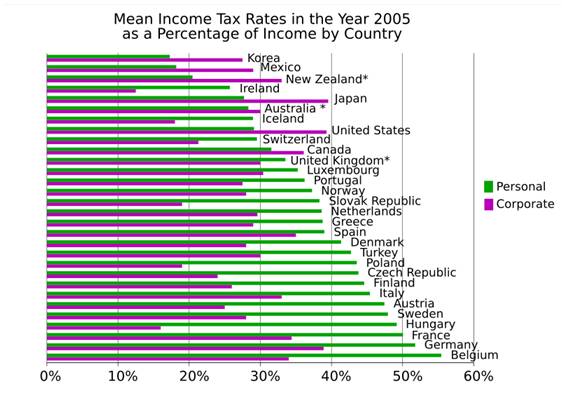
Source: Alan’s Money Blog (U.S. has high corporate tax rate)
But at what point is taxing the rich unfair and counterproductive? Currently the top 10% of the nation that earns more than $92,400 a year, pay about 72% of the country’s income taxes. Ari Fleischer, former G.W. Bush Press Secretary compares the current tax policy to an “inverted pyramid scheme” in a Wall street Journal Op-Ed earlier this year. Like an upside spinning top, the whirling pyramid is supported by a narrow, pointy pinnacle.
Fleischer goes onto add:
“According to the CBO, those who made less than $44,300 in 2001 — 60% of the country — paid a paltry 3.3% of all income taxes. By 2005, almost all of them were excused from paying any income tax. They paid less than 1% of the income tax burden. Their share shrank even when taking into account the payroll tax. In 2001, the bottom 60% paid 16.3% of all taxes; by 2005 their share was down to 14.3%. All the while, this large group of voters made 25.8% of the nation’s income. When you make almost 26% of the income and you pay only 0.6% of the income tax, that’s a good deal, courtesy of those who do pay income taxes.”
Cheaters Should Not Be Exempt (See Celebrity Tax Evader Article)
Certainly loopholes and undeserving credits for multinationals and the wealthy should be removed as well. The House of Representatives recently approved a $387 million boost for the IRS to fund a high-wealth unit focusing on trusts, real estate investments, privately held companies and other business entities controlled by rich individuals (read Reuters article). The IRS is also opening new criminal offices in Beijing, Panama City and Sydney to focus on international enforcement of tax cheaters. At the center of the IRS’ offshore effort is the legal cases against Swiss banking giant UBS (stands for Union Bank of Switzerland), which resulted in UBS agreeing to turn over almost 5,000 client names and pay $780 million to settle tax evasion charges.
Taxes in 2010 and Beyond
When it comes to future taxes, a lot of details remain up in the air. What we do know is that the 2001 Bush tax cuts are set to expire in 2010 and the Obama administration has indicated they want to raise taxes on the rich (those earning more than $250,000) and keep the cuts static for those in the lower paying tax brackets.
- Healthcare: If healthcare reform will indeed pass, those benefits won’t be free. The Obama administration is backing a House bill that creates a 5.4% surtax on income over $500,000 for single filers or $1 million for couples.
- Income Taxes: On the income tax front, Obama and some Democrats are pushing to have the two highest tax brackets revert back to the pre-2001 levels of 36% and 39.6%.
- Capital Gains: If the Obama administration gets its way, capital-gains tax rates would go back to 20% for wealthier individuals and qualified dividends would be taxed as ordinary income up to the top rate of 39.6%.
- Estate Taxes: The House passed a bill earlier this month that makes the 2009 estate tax provisions permanent (i.e., a 45% top marginal rate on estates larger than $3.5 million or $7 million for married couples). If the Senate were not to pass the bill, current law has the estate tax rate reverting to a 55% rate on estates worth more than $1 million after next year.
Given the exploding deficits and weary economy, which is recovering from a severe economic crisis, getting our tax policy situation back in order is critical. Having politicians make tough tax policy decisions runs contrary to their partisan reelection agendas, however our country needs to pluck more feathers from our taxpaying geese to face these monumental economic challenges…even if it requires listening to irritating hissing from our citizens.
Ari Fleischer WSJ Op-Ed From Earlier This Year
Article on Tax Policy Issues for 2010 and Beyond
Wade W. Slome, CFA, CFP®
Plan. Invest. Prosper.
DISCLOSURE: Sidoxia Capital Management (SCM) and some of its clients own certain exchange traded funds, but at time of publishing had no direct positions in an security referenced, including UBS. No information accessed through the Investing Caffeine (IC) website constitutes investment, financial, legal, tax or other advice nor is to be relied on in making an investment or other decision. Please read disclosure language on IC “Contact” page.
More Eggs in Basket May Crack Portfolio

NOT putting all your eggs in one basket makes intuitive sense to many investors. Burton Malkiel, Princeton Professor, economist, and author, summed it up succinctly, “Diversity reduces adversity.” Diversification acts like shock absorbers on a car – it smoothens out the ride on a bumpy financial road (read more on diversification). Jason Zweig, Wall Street Journal writer, acknowledges the academic findings that underpin these diversification benefits by stating the following:
“As many studies have shown, at least 40% of the variability in returns can be reduced by moving from a single company to 20. Once a portfolio contains 20 or 30 stocks, adding more does little to damp the fluctuations in wealth over time.”
Despite the evidence, Jason Zweig explores the conventional views on diversification more closely.
Turning the Diversification Concept on its Head
Zweig, not satisfied with the standard thinking on the topic, decided to explore the work of Don Chance, a finance professor at the Louisiana State University business school. Professor Chance asked more than 200 students to consecutively select stocks until they each held a portfolio of 30 positions. Here are two of the main findings:
1) Averages Hold Firm: On average, for the group of students, diversifying from a single stock to 20 reduced portfolio risk by roughly 40% – just as would be expected from the academic research.
2) Individual Portfolios Riskier: After the first few initial stock picks, for each individual portfolio, were made from a list of large cap household names (e.g., XOM, SBUX, NKE), Professor Chance found in many instances students dramatically increased portfolio risk. These students juiced up the octane in their portfolios by venturing into much smaller, more volatile stock selections.
Deceiving Diversification
Gur Huberman, a Columbia Finance Professor also points out a tendency for investors to clump stock selections together in groups with similar risk profiles, thereby reducing diversification benefits. Diversifying from one banking stock to 20 banking stocks may actually do more damage. Statistically, Zweig points out, “Thirteen percent of the time, a 20-stock portfolio generated by computer will be riskier than a one-stock portfolio.”
Professor Chance found similar results according to Zweig:
“One in nine times, they [students] ended up with 30-stock portfolios that were riskier than the single company they had started with. For 23%, the final 30-stock basket fluctuated more than it had with only five stocks.”
Diversified Views on Diversification
Chance and Huberman are not the only professionals to question the benefits of diversification:
Warren Buffett: A diversification skeptic declares, “Put all your eggs in one basket and then watch that basket very carefully.” Alternatively, Buffett says, “Diversification is protection against ignorance.”
Peter Lynch: He referred to diversification as “deworsification,” especially when it came to companies diversifying into non-core businesses.
Charlie Munger: “Wide diversification, which necessarily includes investment in mediocre businesses, only guarantees ordinary results.”
Zweig’s Solution:
“If you want to pick stocks directly, put 90% to 95% of your money in a total stock-market index fund. Put the rest in three to five stocks, at most, that you can follow closely and hold patiently. Beyond a handful, more companies may well leave you less diversified.”
Portfolio diversification and concentration have been issues studied for decades. As you can see, there are different viewpoints regarding the benefits. As Zweig establishes, through the research of Don Chance, putting more eggs in your basket may actually crack your portfolio, not protect it.
Read Complete WSJ Jason Zweig Article
Wade W. Slome, CFA, CFP®
Plan. Invest. Prosper.
DISCLOSURE: Sidoxia Capital Management (SCM) and some of its clients own certain exchange traded funds, but at time of publishing had no direct positions in XOM, SBUX, BRKA/B or NKE. No information accessed through the Investing Caffeine (IC) website constitutes investment, financial, legal, tax or other advice nor is to be relied on in making an investment or other decision. Please read disclosure language on IC “Contact” page.
Secure Your GPS (Global Portfolio Specialist)

We’ve all been there, our head in our hands, lost in the middle of nowhere. One reason for blame can be overconfidence in the directions provided or our map reading abilities. Now we have GPS (Global Positioning System) devices – a tool I now could never live without. In the investment world, with the damage that has been done, intelligent advice is needed more than ever. Unfortunately, there is no GPS device to guide our investments, but many individuals would do their self a favor by finding the right experienced professional advisor to act as your GPS device (Global Portfolio Specialist).
Getting from point A to point B in the real world can be quite simple. In the investment world, the roadways are constantly shifting. Changes in interest rates, tax policies, unemployment, fiscal initiatives can represent obstacles, the equivalent of road construction barriers, potholes, erosion, mudslides, and earthquakes in our quest for financial freedom. Navigating these winding paths can require a GPS advice. Asking for help or directions can be embarrassing and castigating for some, especially for some proud males. Stubbornly appearing to have the answer can be more important for some, and can cloud the decision making process – even if assistance can lead to the most efficient path to prosperity.
Having a guide at your fingertips as you meet unknown forks in the road is a nice asset to have. Unfortunately finding the right guide is much easier said than done, many guides can have ulterior motives and hidden agendas that conflict with yours. So although, having a guide may be ideal, finding the right guide requires a lot of research (read how to find an advisor). The scope of qualifications between the capabilities of one advisor compared to another can be like comparing a plastic butter knife with a stainless steel swiss-army knife. The cheap butter knife may handle a few simple needs, but most investors would be better served by someone with a breadth of tools that can assist you with a diverse set of circumstances.

The old cliché states men hate to get directions while women seek a security blanket (a plan). GPS is not full proof, as occasionally the software is not updated or gets confused. But tech geeks like me have grown to love the assistance and benefit from the heightened efficiency and safety it provides. Not only am I more confident, but it also gets me to where I want to go in less time.
Having your guide is important when it comes to investments, but having someone with expertise in tax planning (should I consider Roth conversion in 2010?); estate planning (what impact will the expected changes in the estate tax rate have on my future?); and insurance planning (do I have adequate life, health, and business insurance?) can be critical. All these areas can have a profound impact on whether you achieve your personal and financial goals.
Along the road of life, there can be many bumps, twists and turns. If you would like the assistance of a professional advisor, consider doing your homework and finding the appropriate GPS. Here is a checklist:
1) Where are You Now? This means taking inventory of your assets and liabilities, getting a handle on your income and expenses, and having a firm understanding of your tax and family planning issues (will, trust, powers of attorneys, etc.)
2) Where are You Going? Next you need to know where you want to go? You may have a rough idea, but in order to create a coherent plan, goals need to be defined.
3) Create a Plan. Everyone’s map or blueprint will look different. Some will need highly detailed directions, while others due to different circumstances may have less complex needs or shorter distances to travel. Some may need guidance and directions to reach an adjacent state, while others may have more ambitious goals or planning needed to reach the peak of Mount Everest. Different destinations and circumstances will require different planning.
4) Monitor and Adjust Plan as Necessary. Road conditions, weather, breakdowns, flight cancellations, among many other unforeseen circumstances can change the path to your goal. That’s why it’s so important to review, not only the changes in external circumstances, such as the financial markets, but also any individual changes whether it’s health, family, personal, or goal related.
Some people prefer to do things the old-fashion way or are happy with subpar technology (i.e., compass). However, if you do not want to get lost, or want a clearer defined map, then it’s time to shop for that new Global Portfolio Specialist who can help guide you to your destination.
Wade W. Slome, CFA, CFP®
Plan. Invest. Prosper.
DISCLOSURE: Sidoxia Capital Management (SCM) or its clients owns certain exchange traded funds, but currently has no direct position in GRMN. No information accessed through the Investing Caffeine (IC) website constitutes investment, financial, legal, tax or other advice nor is to be relied on in making an investment or other decision. Please read disclosure language on IC “Contact” page.
One Size Does Not Fit All

When you go shopping for a pair of shoes or clothing what is the first thing you do? Do you put on a blindfold and feel for the right size? Probably not. Most people either get measured for their personal size or try on several different outfits or shoes. When it comes to investments, the average investor makes uninformed decisions and in many instances relies more on what other advisors recommend. Sometimes this advice is not in the best interest of the client. For example, some broker recommendations are designed to line their personal pockets with fees and/or commissions. In some cases the broker may try to unload unpopular product inventory that does not match the objectives and constraints of the client. Because of the structure of the industry, there can be some inherent conflicts of interest. As the famous adage goes, “You don’t ask a barber if you need a haircut.”
Tabulate Inventory
A more appropriate way of managing your investment portfolio is to first create a balance sheet (itemizing all your major assets and liabilities) individually or with the assistance of an advisor (see “What to Do” article) – I recommend a fee-only Registered Investment Advisor (RIA)* who has a fiduciary duty towards the client (i.e., legally obligated to work for the best interest of the client). Some of the other major factors to consider are your short-term and long-term income needs (liquidity important as well) and your risk tolerance.
Risk Appetites
The risk issue is especially thorny because the average investor appetite for risk changes over time. Typically there is also a significant difference between perceived risk and actual risk.
For many investors in the late 1990s, technology stocks seemed like a low risk investment and everyone from cab drivers to retired teachers wanted into the game at the exact worst (riskiest) time. Now, as we have just suffered through the so-called Great Recession, the risk pendulum has swung back in the opposite direction and many investors have piled into what historically has been perceived as low-risk investments (e.g., Treasuries, corporate bonds, CDs, and money market accounts). The problem with these apparently safe bets is that some of these securities have higher duration characteristics (higher price volatility due to interest rate changes) and other fixed income assets have higher long-term inflation risk.
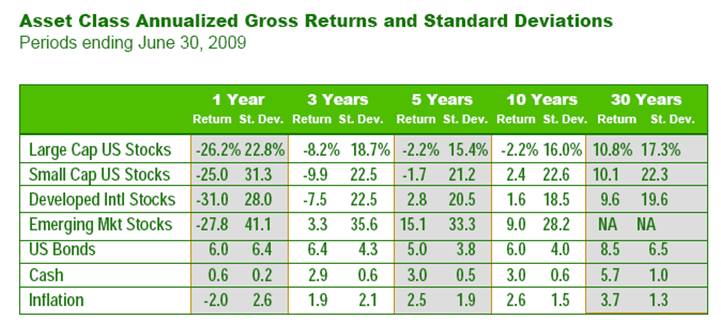
Source (6/30/09): Morningstar Encorr Analyzer (Ibbotson Associates) via State Street SPDR Presentation
A more objective way of looking at risk is by looking at the historical risk as measured by the standard deviation (volatility) of different asset classes over several time periods. Many investors forget risk measurements like standard deviation, duration, and beta are not static metrics and actually change over time.
Diversification Across Asset Classes Key
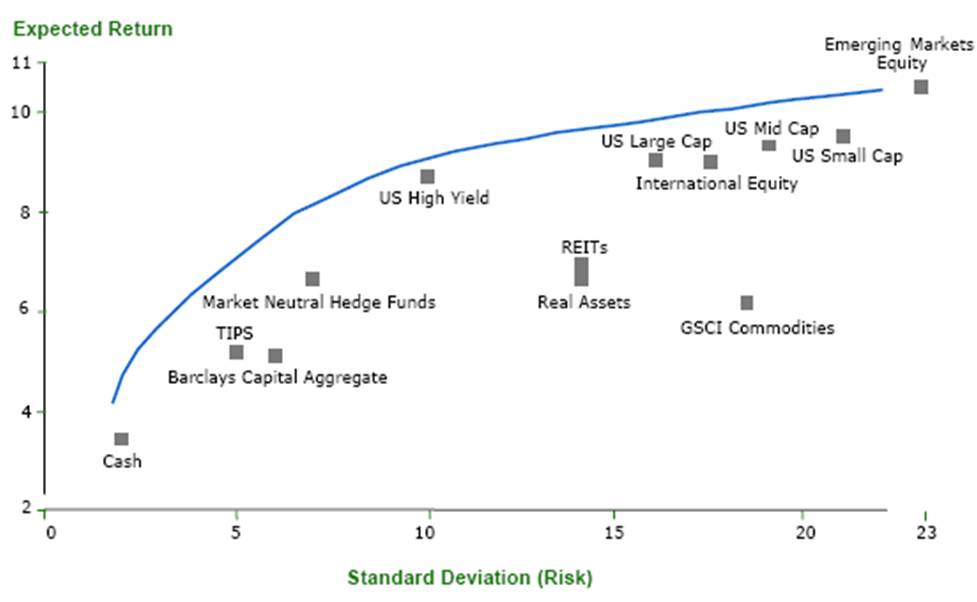
Source: State Street Global Advisors (June 30, 2009)
Correlation, which measures the price relationship between different asset classes, increased dramatically across asset classes in 2008, as the global recession intensified. However, over longer periods of time important diversification benefits can be achieved with a proper mixture of risky and risk-free assets, as measured by the Efficient Frontier (above). Conceptually, an investor’s main goal should be to find an optimal portfolio on the edge of the frontier that coincides with their risk tolerance.
Tailor Portfolio to Changing Circumstances
 In my practice, I continually run across clients or prospects that initially find themselves at the extreme ends of the risk spectrum. For example, I was confronted by an 80 year old retiree needing adequate income for living expenses, but improperly forced by their broker into 100% equities. On the flip side, I ran into a 40 year old who decided to allocate 100% of their retirement assets to fixed income securities because they are unsure of stocks. Both examples are inefficient in achieving their different investment objectives, yet there are even larger masses of the population suffering from similar issues.
Financial markets and client circumstances are constantly changing, so the objectives of the portfolio should be periodically revisited. One size does not fit all, so it’s important to construct the most efficient customized portfolio of assets that meets the objectives and constraints of the investor. Take it from me, I’m constantly re-tailoring my wardrobe (like my investments) to meet the needs of my ever-changing waistline.
Wade W. Slome, CFA, CFP®
Plan. Invest. Prosper.
*DISCLOSURE: For disclosure purposes, Sidoxia Capital Management, LLC is a Registered Investment Advisor (RIA) certified in the State of California. No information accessed through the Investing Caffeine (IC) website constitutes investment, financial, legal, tax or other advice nor is to be relied on in making an investment or other decision. Please read disclosure language on IC “Contact” page.
Style Drift: Hail Mary Investing

The mutual fund investing game is extraordinarily competitive. According to The Financial Times, there were 69,032 global mutual funds at the end of 2008. With the extreme competitiveness comes lucrative compensation structures if you can win (outperform) – I should know since I was a fund manager for many years. However, the compensation incentive structures can create style drift and conflicts of interest. You can think of style drift as the risky “Hail Mary” pass in football – you are a hero if the play (style drift) works, but a goat if it fails. When managers typically drift from the investment fund objective and investment strategy, typically they do not get fired if they outperform, but the manager is in hot water if drifting results in underperformance. Occasionally a fund can be a victim of its own success. A successful small-cap fund can have positions that appreciate so much the fund eventually becomes defined as a mid-cap fund – nice problem to have.
Drifting Issues
Why would a fund drift? Take for example the outperformance of the growth strategy in 2009 versus the value strategy. The Russell 1000 Growth index rose about +28% through October 23rd (excluding dividends) relative to the Russell 1000 Value index which increased +14%. The same goes with the emerging markets with some markets like Brazil and Russia having climbed over +100% this year. Because of the wide divergence in performance, value managers and domestic equity managers could be incented to drift into these outperforming areas. In some instances, managers can possibly earn multiples of their salary as bonuses, if they outperform their peers and benchmarks.
The non-compliance aspect to stated strategies is most damaging for institutional clients (you can think of pensions, endowments, 401ks, etc.). Investment industry consultants specifically hire fund managers to stay within the boundaries of a style box. This way, not only can consultants judge the performance of multitudes of managers on an apples-to-apples basis, but this structure also allows the client or plan participant to make confident asset allocation decisions without fears of combining overlapping strategies.
For most individual investors however, a properly diversified asset allocation across various styles, geographies, sizes, and asset classes is not a top priority (even though it should be). Rather, absolute performance is the number one focus and Morningstar ratings drive a lot of the decision making process.
What is Growth and Value?
Unfortunately the style drift game is very subjective. Growth and value can be viewed as two sides of the same coin, whereby value investing can simply be viewed as purchasing growth for a discount. Or as Warren Buffet says, “Growth and value investing are joined at the hip.” The distinction becomes even tougher because stocks will often cycle in and out of style labels (value and growth). During periods of outperformance a stock may get categorized as growth, whereas in periods of underperformance the stock may change its stripes to value. Unfortunately, there are multiple third party data source providers that define these factors differently. The subjective nature of these style categorizations also can provide cover to managers, depending on how specific the investment strategy is laid out in the prospectus.
What Investors Can Do?
1) Read Prospectus: Read the fund objective and investment strategy in the prospectus obtained via mailed hardcopy or digital version on the website.
2) Review Fund Holdings: Compare the objective and strategy with the fund holdings. Not only look at the style profile, but also evaluate size, geography, asset classes and industry concentrations. Morningstar.com can be a great tool for you to conduct your fund research.
3) Determine Benchmark: Find the appropriate benchmark for the fund and compare fund performance to the index. If the fund is consistently underperforming (outperforming) on days the benchmark is outperforming (underperforming), then this dynamic could be indicating a performance yellow flag.
4) Rebalance: By periodically reviewing your fund exposures and potential style drift, rebalancing can bring your asset allocation back into equilibrium.
5) Seek Advice: If you are still confused, call the fund company or contact a financial advisor to clarify whether style drift is occurring in your fund(s) (read article on finding advisor).
Style drift can potentially create big problems in your portfolio. Misaligned incentives and conflicts of interest may lead to unwanted and hidden risk factors in your portfolio. Do yourself a favor and make sure the quarterback of your funds is not throwing “Hail Mary” passes – you deserve a higher probability of success in your investments.
Wade W. Slome, CFA, CFP®
Plan. Invest. Prosper.
DISCLOSURE: No information accessed through the Investing Caffeine (IC) website constitutes investment, financial, legal, tax or other advice nor is to be relied on in making an investment or other decision. Wade W. Slome, CFA, CFP is a contributing writer for Morningstar.com. Please read disclosure language on IC “Contact” page.




 Investing Caffeine
