Posts filed under ‘Financial Markets’
Cap and Tax Passes in the House

The U.S. House of Representatives passed The American Clean Energy and Security Act of 2009 (ACES), also named the “Waxman- Markey” bill, by a 219-212 vote. The masses are calling it the “Cap and Trade” bill, while detractors are blasting it as the “Cap and Tax” bill.
Joe Petrowsky, CEO of Gulf Oil, sees this bill costing businesses $50-100 per ton of carbon created, which will be passed through as a tax to energy consumers in the form of an annual $1,000+ tax (about $250-$350 per individual). Robert Murray, CEO of Murray Energy Corporation, calls it a $2 trillion tax on consumers over 8 years.
The House passed this bill just as the economy is shuttering on its knees and a rising skepticism is brewing over the validity of global warming – see Kimberley Strassel’s, journalist at The Wall Street Journal, article entitled, The Climate Change Climate Change dated June 26, 2009. Australia is in the process of killing its “Cap and Trade” proposals and many critics point to Spain’s failing carbon initiatives and 18% unemployment as evidence for the program’s shortcomings.
Despite one’s views on the validity of global warming, what cannot be disputed is our reliance (addiction) to oil as we import 70% of our oil demand. Is the time and scope of this bill the silver bullet for our crude dependence as we try to survive through this “Great Recession?” I think not.
Billions of humans across the globe are aspiring to achieve our standard of living here in the U.S., so even those against a “Cap and Trade” system, including myself, need to appreciate the massive energy investment we need to make. The U.S. is considered the “Saudi Arabia” of coal due to our vast reserves, and therefore we must find efficient and cleaner ways to use this abundant commodity. We need to throw the kitchen sink at nuclear, wind, solar, hydrogen, bio-fuels and other alternative energy technologies, even as we look to expand our fossil fuel resources.
But rather than forming randomly created silos of hoarded research across hundreds of universities, why not create domestic centers of excellence that collaborate with both academic and private sector participants. By integrating monetary incentives (i.e., exclusive commercial patent rights), incredible advancements and breakthroughs can be achieved. Historically, when the United States has focused on a task, we’ve been able to achieve greatness – for example sending a man to the moon. Heck, recently NASA mastered the art of converting urine into water!
Bold new steps need to be taken to solve our energy crisis, but I’m afraid this “Cap and Tax” bill is not the right answer.
Jack Welch University: Diploma or Black Belt?
You too can get your name plastered across a university (or online) for a measly $2 million. That’s what Jack Welch did when he purchased a 12% stake in the primarily online Masters of Business Administration Program (MBA) of Chancellor University. The name of the school according to The Wall Street Journal will be the Jack Welch Institute (JWI).
According to the WSJ:
Boston research firm EduVentures Inc. estimates that 11% of the roughly 18.5 million U.S. college students took most of their classes online in the fall of 2008, up from 1% a decade ago.Online higher education will generate revenue of $11.5 billion this year, EduVentures says. But “there is a concern about quality,” says EduVentures Chief Executive Tom Dretler, because there’s “much, much less selectivity” of students in the admissions process.
So what does a Jack Welch student receive upon graduation – a diploma or a General Electric (GE) Six Sigma Black Belt? And what about Jack’s hard-nosed, no-nonsense business approach? Will all students learn how to negotiate like Jack, especially when it comes to retirement perks? The $21,000 tuition bill sounds steep on the surface, but well worth it if graduates can finagle exit package perks like Welch’s $86,000 a year consultant fee, use of an $80,000 per month Manhattan apartment, court-side seats to the New York Knicks and U.S. Open, seating at Wimbledon, box seats at Red Sox and Yankees baseball games, country club fees, security services and restaurant bills (The New York Times), not to mention a limousine, a cook, free flowers, country-club memberships and a charge account at Jean Georges restaurant.
Now that’s an MBA degree that may attract interest.
Wade W. Slome, CFA, CFP® www.Sidoxia.com
U.S. to China, “What’s Wrong With a Little Porn and Anarchy?”
The U.S. recently scheduled talks with the Chinese government to discuss the appropriateness of automated personal computer (PC) content filtering (including, pornography, Falun Gong, and governmental protest content). Falun Gong is a meditatitve spiritual discipline frowned down upon by the Chinese government.
I can picture it now, U.S. officials calling up Chinese President Hu Jintao and saying, “Hey Hu, why not lighten up a bit on the freedom crackdowns – what’s the big deal with a little pornography and anarchy?” The Chinese government feels that in the absence of structured laws, which would limit access to inappropriate content, the natives will become restless and ultimately disruptive. PC manufacturers would prefer not to reengineer PCs and increase the embedded costs to consumers by adding additional components. However, given the size of the Chinese PC market, the dominant foreign manufacturers are likely to cave to Chinese government demands, given the massive long-term potential of this Asian market. We have already seen Google (GOOG), Yahoo (YHOO), and Microsoft (MSFT) make concessions to the Chinese government in the algorithmic search arena.
 The thematic parallels presently occurring in China apply to William Golding’s Lord of the Flies (1954) as well. Lord of the Flies is a story about a group of stranded kids (surviving a plane crash) that battle for survival on a deserted island. Due to the lack of law, adult supervision and questionable tendencies, all hell eventually breaks loose. The Chinese government, managing a population of 1.3 billion people, fears a similarly hellacious outcome if an uncontrolled, lawless population consumes unfettered, unhealthy content. Given mistakes we’ve made abroad (e.g., Abu Ghraib, and Guantanomo), the Chinese and other countries are questioning the strength of our moral compass in judging or guiding other countries’ policies.
Although the U.S. government’s intentions are in the right place to protect the personal freedoms of people globally, we are not currently in the strongest moral position right now to cram our beliefs down other’s throats. Even the freest of societies such as our own limits certain actions – such as underage voting, underage drinking, and public nudity (O.K., I’m stretching a bit).
Regardless of your political views, one can appreciate the fear of anarchy in the hearts of the Chinese government. Practically speaking however, given the openness and rapid expansion of the global internet, the Chinese can only slow the expansion of individuals’ freedoms – recent events in the Middle East just provide additional evidence to this premise.
DISCLOSURE: At the time of publishing, in addition to owning certain exchange traded funds, Sidoxia Capital Management and some of its clients also owned GOOG, but had no direct positions in YHOO, MSFT, or any other security referenced. No information accessed through the Investing Caffeine (IC) website constitutes investment, financial, legal, tax or other advice nor is to be relied on in making an investment or other decision. Please read disclosure language on IC “Contact” page.
Oil + Addiction = 50 Consecutive Day Price Hike in Gasoline
 Gas Prices Rise for 50th Straight Day (CLICK HERE to read full article)
With 70% of our oil imported (much of it from countries with different human right beliefs), it is not very difficult to realize we are addicted to oil. Sure crude prices have declined dramatically from its peak of close to $150 per barrel to around $70 a barrel today, but nonetheless, gasoline prices have increased for 50 consecutive days (article above)! The amazing streak can be chalked up to the incredible rise in crude oil prices in recent months from the low $30s per barrel. This 50 day streak would even make Pete Rose proud in light of his 44 consecutive Major League Baseball League game hitting-streak achieved in 1978. Next up, Joe DiMaggio’s 56 game streak (we’re almost there!).
Time will tell if currently more cost prohibitive energy alternatives can be efficiently implemented. However, if current gasoline price trends continue skyrocketing, then the economics and probability of realization becomes much more compelling. At this rate you may even see my pending hydrogen-solar hybrid car passing you on the highway fast lane!
Government Looks to Strengthen Regulatory Web

As the chart from the Financial Times shows (BELOW), our messy regulatory cobweb system needs to be straightened out, so it can efficiently function. Not only to encourage risk taking and capitalism, but to also deter and punish those that take advantage of the U.S. system and its citizens. The President and Treasury Secretary Timothy Geithner will address the inefficient, entangled set of regulatory issues surrounding the intertwined agencies in our financial regulatory system. With a mix of federal, regional, and state- driven oversight, the current structure leaves potential gaps for rule-breakers to slide through.

Source: The Financial Times
As the FT article explains (http://is.gd/13YuS), a “council of regulators,” comprised of the agency heads, will be formed along with another consumer-related agency designed to protect areas such as home mortgages and credit cards. Will new unproductive layers be added to merely bog down risk-taking and innovation (i.e., Sarbanes-Oxley legislation), or will substantive reform occur, thereby allowing businesses to innovate and grow. The proof will be in the pudding when Geithner reveals the details of his plan.
What should regulatory reform include?
1) Consolidation: You can call me crazy, but simply looking at the layers of agencies cries for consolidation. Do we really need six different sets of regulators overseeing the banks?
2) Transparency/Capital Requirement Changes: When it comes to derivatives, heightened transparency and capital requirements feel like moves in the right direction. We have perfectly functioning options and futures markets that integrate margin and capital requirements for the various constituencies; I do not see why Credit Default Swaps should be any different. For more customized, exotic over-the-counter products, you could avoid much of the AIG debacle by increasing the capital requirements of the counterparties. I believe these aims without stifling innovation.
3) FDIC of Mega-Institutions: FDIC insurance has succeeded in managing the failures of retail depository institutions, so I see no reason why the same model for mega financial institutions. Certainly, managing the collapse of a global money center bank would be more convoluted; however a system to handle an orderly failure would limit the fallout effect we experienced with the folding of Lehman and crumbling of Bear Stearns.
Although many lawmakers will hunt for a silver bullet, we all know that in this complex global economy a path for reform will involve more evolution rather than revolution. Most controversial will be the consumer protection agency, as details still remain sparse. In my a healthy regulatory system boils down to more simplified structures with tighter oversight, mixed in with proper incentives and harsher punishments for criminals. We’ll know soon enough whether the government can weave a solution tight enough to capture the Bernie Madoffs and Allen Stanfords of the world without sacrificing our position as the global financial capitol of the world.
GM Fatigue Setting In

Yaaaawn. Sorry to be cold-hearted and insensitive, but I have to admit all this bankruptcy car talk is making me tired and fatigued. According to the Associated Press, General Motors is cutting 21,000 jobs in North America, about 34% of the total workforce – these cuts include pending dealership, plant, and warehouse closings. Twenty-one thousand certainly is not a minor number, but how do you think the other 6,000,000 Americans feel who have lost their jobs in this economic recession since the beginning of 2008?
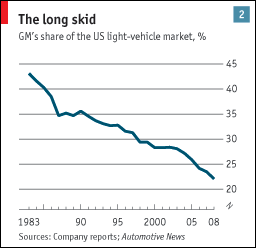
Chart Source: The Economist
Don’t get me wrong, I like every other American do not want to see our historic industry vanish into thin air, but as the chart above shows, we have been witnessing this slow motion train wreck developing for decades. Detroit’s combined market share in 1980 was around 75%, and today that share amounts to less than 50%…ouch. Our auto industry needs to become more competitive, and to do so will require tough decisions like the ones being made today.
Does $65 billion in government bailout feel right? Definitely not, especially vis-a-vis the industry track record of government bailouts (i.e., 1980 Chrysler lifeline). History and current industry trends tell us that the odds of taxpayers earning any reasonable return off our bailout contributions will be extremely challenging to salvage.
Politics and votes always play a role when large numbers of jobs are impacted by government decisions, and this case has proved no different. On the flip side, nobody can say the automakers are not suffering tremendously from this bankruptcy solution. I truly believe the surviving entities will be much leaner and meaner to compete in this dog-eat-dog global economy. Sacrifices have been immense, but we’ll never know the true net economic effect had the administration not bestowed the billions and billions upon this selective slice of industries.
Money goes where it is treated best, and I would have preferred seeing the capital naturally migrating to its most productive use. Perhaps the $65 billion could have provided 65,000 different companies access to $1,000,000 each in financing for creative, and innovative job creating purposes? Only time will tell if our billions in taxes were properly used, but in the mean time I’m going to turn off the CNBC car debate and take a nap. Zzzzzz….
U.S. the Next Zimbabwe? Faber Thinks So…

Imagine paying $2 for a tube of toothpaste today and then $4,600,000 for that same tube one year from now – well that’s what happened in Zimbabwe. Zimbabwe is the first country in the 21st century to hyperinflate. In February 2007, Zimbabwe’s inflation rate topped 50% per month and according to Bloomberg, the latest official figures on Zimbabwe’s inflation rate registered 231 million percent in July 2008.
“I am 100 percent sure that the U.S. will go into hyperinflation,” Marc Faber, a.k.a. “Dr Doom”, creator of the Gloom Boom & Doom Report said. “The problem with government debt growing so much is that when the time will come and the Fed should increase interest rates, they will be very reluctant to do so and so inflation will start to accelerate.”
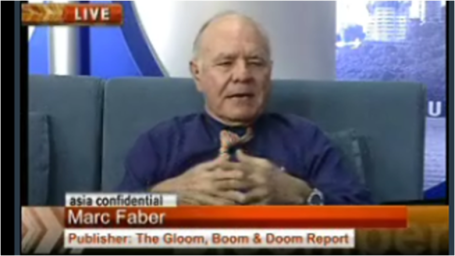
Dr. Gloom - Marc Faber
Click Here For Video (Bloomberg)
Faber goes on to say the U.S. economy will enter “hyperinflation” approaching the levels in Zimbabwe because the Federal Reserve will be reluctant to raise interest rates, investor Faber said. Prices may increase at rates “close to” Zimbabwe’s gains, Faber said in an interview in Hong Kong. Zimbabwe’s inflation rate reached 231 million percent in July, the last annual rate published by the statistics office.
I’m not sure if the United States should be included in the same camp as Zimbabwe? Haven’t check recently, but do they have a comparable financial system producing the likes of Microsoft, Genentech, Starbucks, and Pfizer? I think not. Our economic situation is no box of chocolates, as our deficits expand and national debt balloons, but our problems are well documented. More appropriately, I would say we are the tallest midget (or “little people” to be politically correct) and some growth hormone is on the way.
Debt: The New Four-Letter Word
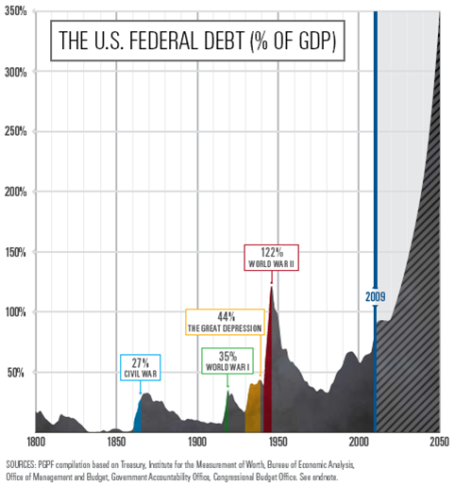
D-E-B-T, our country’s new four-letter word, used to be a fun toy the masses played and danced with to buy all kinds of goods and services. Debt was creatively utilized for all types of things, including, our super-sized McMansions purchased with Option ARM (Adjustable Rate Mortgage) Countrywide loans; our 0% financing car binges (thanks to now-bankrupt Chrysler and General Motors); and our no-payment-for-two-years, big screen plasma TVs (financed at now-bankrupt Circuit City). Eventually consumers, corporations, and governments realized excessive debt creates all kinds of lingering problems – especially in recessionary periods. We are by no means out of the woods yet, but consumers are now spending less than they are taking in, as evidenced by a positive and rising savings rate. This slowdown in spending is bad for short-term demand, but eventually these savings will be recycled into our economy leading to productive and innovative value creating jobs that will jumpstart the economy back on a path to sustainable growth.
Click Here For Excellent Article from the Peterson Foundation
In our hot-cold society, where the pendulum of greed and fear swing dramatically from one side to the next, we are also observing an unhealthy level of risk aversion by financial institutions. This excessive caution is unfortunately choking off the health of legitimate businesses that need capital/debt in order to survive. As we continue to see a pickup in the leading indicators for an economic recovery, banks should loosen up the credit purse strings to provide capital for profitable, growing businesses – even if there are hiccups along the way.
National Debt “Blob” Must Be Slowed

In the famous 1958 sci-fi horror film, “The Blob”, a gelatinous, ever-growing creature from outer space threatens to take over the town of Downingtown, Pennsylvania by methodically engulfing everything in its path. Steve McQueen eventually learns that freezing the Blob will halt its progression. In our country, entitlements, in the form of Medicare and Social Security, serve as our 21st century Blob. As the chart above shows, entitlements have expanded dramatically over the last 40 years and stand to expand faster, as the 76 million Baby Boomers reach retirement and demand more Social Security and Medicare benefits. Clearly the current path we are travelling on is not sustainable, and beyond breakthroughs in technology, the only way we can suitably address this problem is by cutting benefits or raising taxes. We only dug ourselves in a deeper financial hole with the enactment of Medicare Part D (prescription drug benefits for Medicare participants). I must admit I have great difficulty in understanding how we are going to expand health care coverage for the vast majority of Americans in the face of exploding deficits and debt burdens. I eagerly await specifics.
With an enlarging national debt burden and widening deficits, the U.S. is only becoming more reliant on foreign investors to finance our shortcomings. This trend too cannot last forever (see chart below). At some point, foreigners will either balk by not providing us the financing, or demanding prohibitively high interest rates on any funding we request – thereby negatively escalating our already high interest payment streams to bondholders.
 Regardless of your political view, the problem pretty simply boils down to elementary school math. The government either needs to cut expenses or raise revenue (taxes or growth initiatives). Politically, the stimulative spending path is easier to rationalize, but as we see in California, eventually the game ends and tough cuts are forced to be made.
Let’s hope the painful lessons learned from this financial crisis will steer us back on path to more responsible borrowing – a point where D-E-B-T is no longer considered a dirty four-letter word.
Chasing Profits – Can Fund Managers Beat the Game?

Achieving Long-Term Excess Returns is a Tough Race
How someone invests their money should fundamentally be based on their view of what’s the best way of playing the investment game. Before playing, the investor should answer the following key question: “Is the market efficient?” Efficient market followers believe active managers – professionals that periodically buy and sell with a profit motive – CANNOT consistently earn excess returns over longer periods of time, in part because market prices reflect all available information. If you fall into the efficiency camp, then you should dial 1-800-VANGUARD to simply buy some index funds. However, if you believe the market is inefficient, then invest in an exploitable strategy or hire an active investment manager you believe can outperform the market after fees and taxes.
For me personally, I fall somewhere in between both camps. I opportunistically invest my hedge fund in areas where I see superior return potential. However, in other areas of my investment practice (outside my main circle of expertise), I choose to side with the overwhelming body of evidence from academics that show passive/indexing slaughters about 75% of professionals.
Richard Roll, renowned economist and thought leader on the efficient market hypothesis, said this:
“I have personally tried to invest money, my client’s and my own, in every single anomaly and predictive result that academics have dreamed up. And I have yet to make a nickel on any of these supposed market inefficiencies. An inefficiency ought to be an exploitable opportunity. If there’s nothing investors can exploit in a systematic way, time in and time out, then it’s very hard to say that information is not being properly incorporated into stock prices. Real money investment strategies don’t produce the results that academic papers say they should.”
—(Wall Street Journal, 12/28/00)
The market gurus du jour blanket the media airwaves, but don’t hurt your back by hastily bowing. Having worked in the investment industry for a long time, you learn very quickly that many of the celebrated talking-heads on the TV today rotate quickly from the penthouse to the outhouse. Certainly, there are the well regarded professional money managers that survive the walk across the burning-coals and have performed great feats with their clients’ money over long periods of time. But even the legendary ones take their lumps and suffer droughts when their style or strategy falls out of favor.
The professional investing dynamics are no different than professional baseball. There are a relatively few hitters in the Major Leagues who can consistently achieve above a .300 batting average. In 2007, AssociatedContent.com did a study that showed there were only 12 active career .300 hitters in Major League Baseball. The same principle applies to investing – there is a narrow slice of managers that can consistently beat the market over longer periods of time.

There Are Only So Many .300 Hitters
Some statisticians point to the “law of large numbers” when describing long term investor success (a.k.a. “luck”) or ascribe the anomaly to statistical noise. Peter Lynch might have something to say about that. Peter Lynch managed the Fidelity Magellan Fund from 1977 – 1990, while he visited 200 companies per year and read about 700 company reports annually. Over that period Lynch averaged a 29% annual return for his investors vs. a 15% return for the S&P 500 index. Luck? How about Bill Miller from Legg Mason who outperformed the major industry benchmark for 15 consecutive years (1991-2005). Perhaps that too was good fortune? Or how about investor extraordinaire Warren Buffet who saw his stock price go from $33 per share in 1967 to $14,972 in 2007 – maybe that was just an accident too? An average schmuck off the street achieving Warren’s Buffett performance over a multi-decade period is equivalent to me batting .357 against Nolan Ryan and Randy Johnson…pure fantasy.
Academics also have difficulty with their efficiency arguments when it comes to explaining events like the “1987 Crash,” the technology bubble bursting in 2000, or the recent subprime derivative security meltdown. If all available information was already reflected in the market prices, then it would be unlikely the markets would experience such rapid and dramatic collapses.
What these bubbles show me is no matter how much academic research is conducted, the behavioral aspects of greed and fear will always create periods of inefficiency in the marketplace. These periods of inefficiency generate windows of profit opportunity that can be exploited by a subset of skillful managers. In the short-run, luck plays a great role; in the long-run sklill level determines ultimate performance. Benjamin Graham, summed it up best when he said, “In the short-term, the stock market is a voting machine; in the long-term a weighing machine.”
Wade W. Slome, CFA, CFP®
Plan. Invest. Prosper.
DISCLOSURE: Sidoxia Capital Management and client accounts do not have direct positions in LM or BRKA/B at the time the article was published.No information accessed through the Investing Caffeine (IC) website constitutes investment, financial, legal, tax or other advice nor is to be relied on in making an investment or other decision. Please read disclosure language on IC “Contact” page.
Steepening Yield Curve – Disaster or Recovery?

Various Treasury Maturities in 2006 Highlighting Inversion
Wait a second, aren’t we suffering from the worst financial crisis in some seven decades; our GDP (Gross Domestic Product) is imploding; real estate prices are cratering; and we are hemorrhaging jobs faster than we can say “bail-out”? We hear it every day – our economy is going to hell in a hand basket.
If Armageddon is indeed upon us, then why in the heck is the yield-curve steepening more than a Jonny Moseley downhill ski run? Bears typically point to one or all of the following reasons for the rise in long-term rates:
- Printing Press: The ever-busy, government “Printing Press” is working overtime and jacking up inflation expectations.
- Debt Glut: Our exploding debt burden and widening budget and trade deficits are rendering our dollar worthless.
- Foreign “Nervous Nellies”: Foreign Treasury debt buyers (the funders of our excessive spending) are now demanding higher yields for their lending services, particularly the Chinese.
- Yada, Yada, Yada: Other frantic explanations coming from nervous critics hiding in their bunkers.
All these explanations certainly hold water; however, weren’t these reasons still in place 3, 6, or even 9 months ago? If so, perhaps there are some other causes explaining steepening yield curve.
One plausible explanation for expanding long-term rates stems from the idea that the bond market actually does integrate future expectations and is anticipating a recovery. Let us not forget the “inverted yield curve” we experienced in 2006 (see Chart ABOVE) that accurately predicted the looming recession in late 2007. Historically, when short-term rates have exceeded long-term rates, this dynamic has been a useful tool for determining the future direction of the economy. Now we are arguably observing the reverse take place – the foundations for recovery are forming.

Treasury Yield Curve (June 2009)
Alternatively, perhaps the trend we are currently examining is merely a reversal of the panic rotation out of equities last fall. If Japanese style deflation is less of a concern, it makes sense that we would see a rebound in rates. The appetite for risk was non-existent last year, and now there have been some rays of sunlight that have glimmered through the dark economic clouds. Therefore, the selling of government guaranteed securities, which pushed prices down and yields upward, is a logical development. This trend doesn’t mean the equity markets are off to the races, but merely reflects investors’ willingness to rotate a toe (or two) back into stocks.




 Investing Caffeine