Posts filed under ‘Financial Markets’
Bears Hibernate During Melt-Up

Source: Photobucket
Here we are 719 days from the market bottom of March 2009, and the S&P 500 has more than doubled from its index low value of 666 to 1343 today. Noticeably absent during the meteoric rise have been the hibernating bears, like economist Nouriel Roubini (aka “Dr. Doom”) or Peter Schiff (see Emperor Schiff Has No Clothes), who blanketed the airwaves in 2008-2009 when financial markets were spiraling downwards out of control. The mere fact that I am writing about this subject may be reason enough to expect a 5-10% correction, but with a +100% upward move in stock prices I am willing to put superstition aside and admire the egg on the face of the perma-bears.
Shape of Recovery
After it became clear that the world was not coming to an end, in late 2009 and throughout 2010, the discussion switched from the likelihood of a “Great Depression” to a debate over the shape of the alphabet letter economic recovery. Was the upturn going to be an L-shaped, V-shaped, square root-shaped, or what Roubini expected – a U-shaped (or bathtub-shaped) recovery? You be the judge — does six consecutive quarters of GDP expansion with unemployment declining look like a bathtub recovery to you?
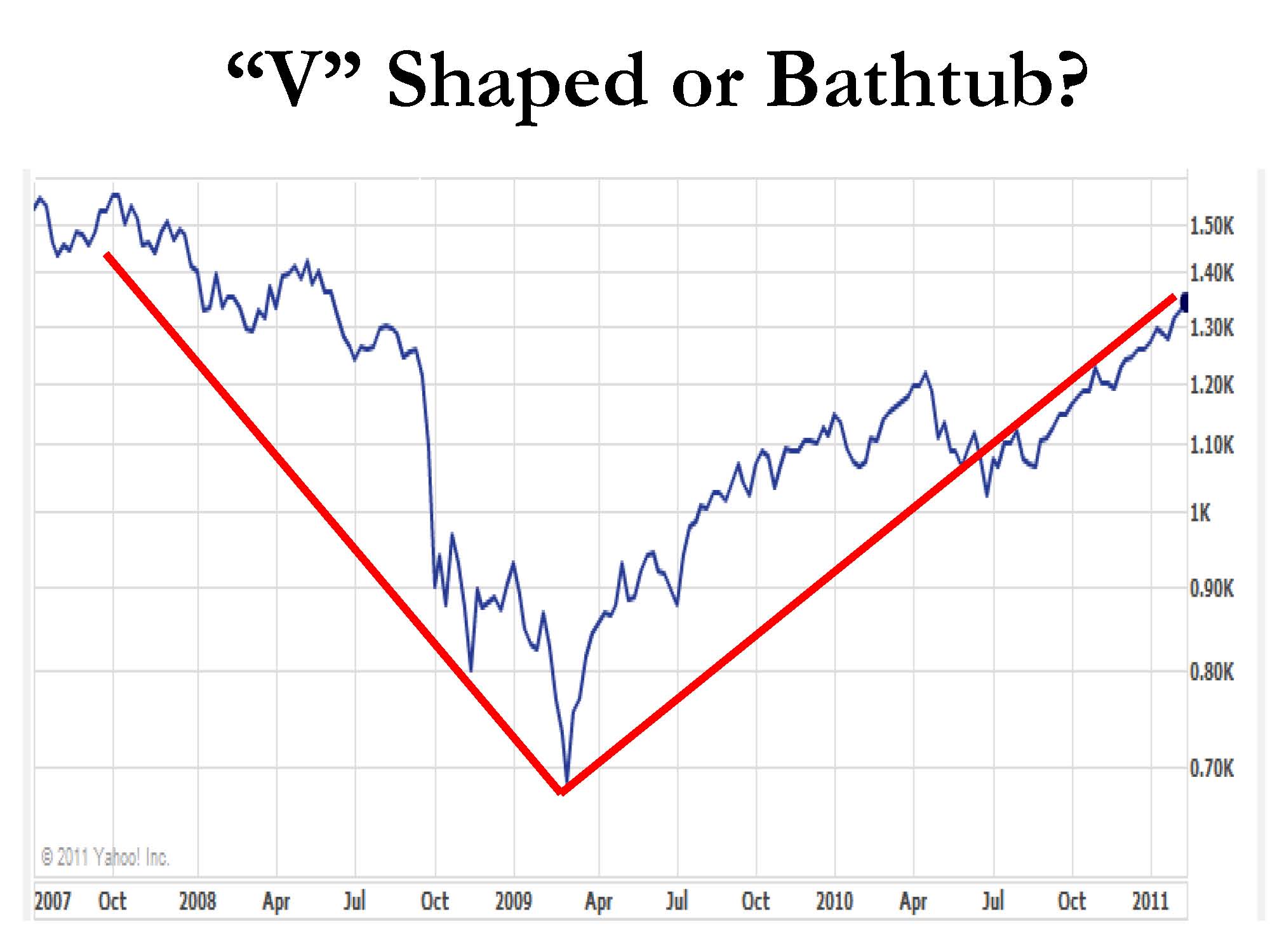
Chart Source: Yahoo Finance
This picture above looks more like a “V” to me, and the recently reported Institute for Supply Management’s (ISM) manufacturing index figure of 60.8 in January (the highest reading in seven years) lends credence to a stronger resurgence in the economy. Apparently the PIMCO bear brothers, Mohamed El-Erian and Bill Gross, are upwardly adjusting their view of a “New Normal” environment as well. Just recently, the firm raised its 2011 GDP forecast by 40-50% to a growth rate of 3-3.5% in 2011.
The Bears’ Logic
Bears continually explain away the market melt-up as a phenomenon caused by excessive and artificial liquidity creation (i.e., QE2 money printing, and 0% interest rate policy) Bernanke has provided the economy. Similar logic could be used to describe the excessive and artificial debt creation generated by individuals, corporations, and governments during the 2008-2009 meltdown. Now that leveraged positions are beginning to unwind (banks recapitalizing, consumers increasing savings rate, state and government austerity and tax measures, etc.), the bears still offer little credit to these improving trends.
Are we likely to experience another +100% upward move in stock prices in the broader indexes over the next two years? Unlikely. Our structural government debt and deficits, coupled with elevated unemployment and fiercer foreign competition are all factors creating economic headwinds. Moreover, inflation is starting to heat up and a Federal Funds rate policy cannot stay at 0% forever.
The Shapes of Rebounds
To put the two-year equity market recovery in historical perspective, the Financial Times published a 75-year study which showed the current market resurgence (solid red line) only trailing the post-Great Depression rebound of 1935-1938.
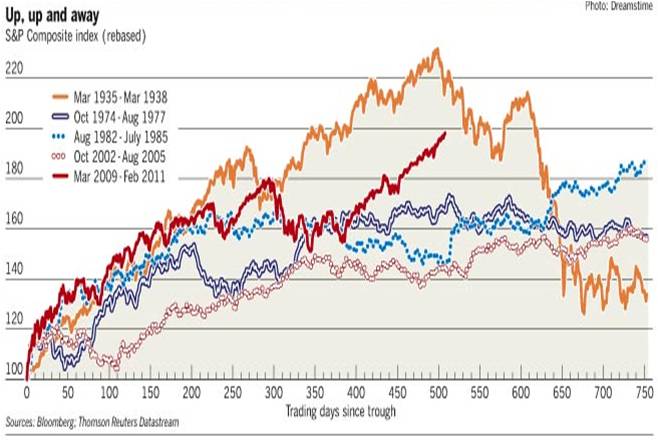
Source: Financial Times
Although we are absolutely not out of the economic woods and contrarian sentiment indicators (i.e., Volatility Index and Put-Call ratio) are screaming for a pullback, the foundation of a sustainable global recovery has firmed despite the persisting chaos occurring in the Middle East. Fourth quarter 2010 corporate profits (and revenues) once again exceeded expectations, valuations remain attractive, and floods of itchy retail cash still remain on the sidelines just waiting to jump in and chase the upward march in equity prices. Although the trajectory of stock prices over the next two years is unlikely to look like the last two years, there is still room for optimism (as I outlined last year in Genesis of Cheap Stocks). The low-hanging equity fruit has been picked over the last few years, and I’m certain that bears like Roubini, Schiff, El-Erian, Gross, et.al. will eventually come out of hibernation. For those investors not fully invested, I believe it would be wise to wait for the inevitable growls of the bears to resurface, so you can take further advantage of attractive market opportunities.
Click Here for More on the PIMCO Downhill Marathon Machine
Wade W. Slome, CFA, CFP®
Plan. Invest. Prosper.
DISCLOSURE: Sidoxia Capital Management (SCM) and some of its clients own certain exchange traded funds, but at the time of publishing SCM had no direct position in any other security referenced in this article. No information accessed through the Investing Caffeine (IC) website constitutes investment, financial, legal, tax or other advice nor is to be relied on in making an investment or other decision. Please read disclosure language on IC “Contact” page.
Historical Trampoline Cycles of Fear & Greed

What goes up, eventually comes down, and what goes down, eventually comes up. Like an adolescent jumping on a trampoline, emotions in the financial markets jump sky high before crashing down to earth…and then the process repeats itself. The underlying reasons behind every market gyration are different, but the emotions of fear and greed are similar. Since 1919, there have been 29 recessions, and 29 recoveries (pretty good recovery batting average). Over that 92 year period we have also witnessed the Dow Jones Industrial Average go from around 100 in 1919 to over 12,300 today – not too shabby.
The blood curdling panic experienced in 2008 and early 2009 has turned to ordinary fear among retail investors – although the doubling of the equity markets from two years ago has instilled a good dosage of animal spirits into professional traders and speculators. When trillions of low yielding cash and Treasuries ultimately come barreling into equity markets, thereby extending equity valuations, then I will become extra nervous. Until then, plenty of opportunities still exist – there just is not nearly as much low-hanging fruit as two years ago.
More of the Same
To make the point that “the more things change, the more things stay the same,” you can go all the way back to 1932 and read the words of Dean Witter – I also wrote about the history of panic in the 1970s (see Rhyming History).
Even some 80 years ago, Witter was keenly aware of the doomsday bears:
“People are deterred from buying good stocks and bonds now only because of an unwarranted terror…All sorts of bugaboos are paraded to destroy the last vestige of confidence. Stories of disaster which are incredible and untrue are told to foolish and credulous listeners, who appear willing to believe the worst.”
The bugaboo purveyors I called out in 2009 included Peter Schiff, Nouriel Roubini, Meredith Whitney, and Jimmy Rogers. I’m not sure who the next genius du jour(s) will be, but I am confident they will be prominently paraded over the media airwaves.
Cherry Price for Consensus
As firmer signs of an economic recovery finally take hold, investors slowly regain confidence about investing in risky assets. The only problem is that prices have skyrocketed! Witter captures this dynamic beautifully back in 1932:
“Some people say that they wish to await a clearer view of the future. When the future is again clear the present bargains will no longer be available. Does anyone think that present prices will continue when confidence has been fully restored? Such bargains exist only because of terror and distress.”
Herd Gets Slaughtered
History proves over and over again…the general investing public suffers the consequences of following the herd of fear and greed. Or as Witter states:
“It is easy to run with the crowd. The path of least resistance is to join in the wailings that are now so popular. The constructive policy, however, is to maintain your courage and your optimism, to have faith in the ultimate future of your country and to proclaim your faith and to recommend the purchase of good bonds and good stocks, which are inordinately depreciated.”
In the short-run, markets move up and down in an unpredictable fashion, like an irresponsible teenager jumping on a trampoline. In the long-run, investors can do themselves a favor by ignoring the masses, and sticking to a disciplined, systematic investment approach that includes controlled valuation metrics and contrarian sentiment factors. That way, you won’t fall off the investment trampoline and permanently break your portfolio.
Wade W. Slome, CFA, CFP®
Plan. Invest. Prosper.
DISCLOSURE: Sidoxia Capital Management (SCM) and some of its clients own certain exchange traded funds, but at the time of publishing SCM had no direct position in any other security referenced in this article. No information accessed through the Investing Caffeine (IC) website constitutes investment, financial, legal, tax or other advice nor is to be relied on in making an investment or other decision. Please read disclosure language on IC “Contact” page.
Dow Déjà Vu – Shining Rainbow or Bad Nightmare?

Excerpt from Free January Sidoxia Monthly Newsletter (Subscribe on right-side of page)
The Dow Jones Industrial Average is sitting at 11,577 points. Dick Fuld is still CEO of Lehman Brothers, AIG is still trading toxic CDS derivative contracts, and the $700 billion TARP bailout is a pre-idea about to be invented in the brain of Treasury Secretary Hank Paulson. Oops, wait a second, this isn’t the Dow 11,577of September 2008, but rather this is the Dow 11,577 of December 2010 (+11% for the year, excluding dividends). Was the -50% drop we experienced in the equity markets during 2008-2009 all just a bad dream? If not, how in the heck has the stock market climbed spectacularly? Most people don’t realize that stocks have about doubled over the last 21 months (and up roughly +20%-25% in the last 6 months) – all in the face of horrendously depressing news swirling around the media (i.e., jobs, debt, deficits, N. Korea, Iran, “New Normal,” etc.). Market volatility often does not make intuitive sense, and as a result, many market observers have been caught flat-footed.
Here are a few basic factors that average investors have not adequately appreciated:
1) Headlines are in Rearview Mirror: News that everyone reads in newspapers and magazines and hears on the television and radio is all backward looking. It’s always best to drive while looking forward through the windshield and try to anticipate what’s around the corner – not obsess with backward looking activity in the rearview mirror. That’s how the stock market works – tomorrow’s news (not yesterday’s or today’s) is what drives prices up or down. As the economy teetered on the verge of a “Great Depression-like” scenario in 2008-2009, investors became overly pessimistic and stocks became dramatically oversold. More recently, news has been perking up. Previous recessions have seen doubters slowly convert to believers and push prices higher – eventually stocks become overbought and euphoria slows the bull market. I believe we are in phase II of this three-part economic recovery.
2) Ignore Emerging Markets at Own Peril: We Americans tend to wear blinders when it comes to focusing on domestic issues. We focus more on healthcare reform and political issues, such as “Don’t Ask, Don’t Tell,” rather than the billions of foreigners chasing us as they climb the global economic ladder. Citizens in emerging markets are more concerned about out-competing and out-innovating us through educated workforces, so they can steal our jobs and buy more toasters, iPods, and cars – things we Americans have already taken for granted. The insatiable appetite of the expanding global middle class for a better standard of living is also driving ballooning commodity prices – everything from coal to copper and corn to cotton (the 4 Cs). This universal sandbox that we play in offers tremendous opportunities to grasp and tremendous threats to avoid, if investors open their eyes to these emerging market trends.
3) Capital Goes Where it’s Treated Best: Many voters are fed-up with the political climate in Washington and the sad state of economic affairs. The great thing about the global capitalistic marketplace we live in is that it does not discriminate – capital flows to where it is treated best. On a macro basis, money flows to countries that are fiscally responsible, support pro-growth initiatives, harbor educated work forces, control valuable natural resources, and honor the rule of law. On a micro basis, money flows to companies that are attractively priced and/or capable of sustainably growing earnings and cash flow. Voters and politicians will ultimately figure it out, or capital will go where it’s treated best.
Today’s Dow 11,577 is no bad dream, but rather resembles the emergence of a bright shining rainbow after a long, cold, and dark storm. The rainbow won’t stick around forever, but if investors choose to ignore the previously mentioned factors, like so many investors have overlooked, portfolio performance may turn into an ugly nightmare.
Wade W. Slome, CFA, CFP®
Plan. Invest. Prosper.
DISCLOSURE: Sidoxia Capital Management (SCM) and some of its clients own certain exchange traded funds, AAPL, and an AIG derivative security, but at the time of publishing SCM had no direct position in GS, any security referenced in this article. No information accessed through the Investing Caffeine (IC) website constitutes investment, financial, legal, tax or other advice nor is to be relied on in making an investment or other decision. Please read disclosure language on IC “Contact” page.
Strategist Predictions and MacGyver Credo
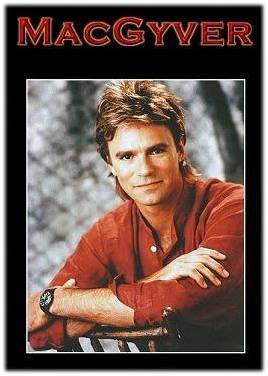
MacGyver: Resourceful dude with sweet mullet (Source: Photobucket).
“Only a fool is sure of anything, a wise man keeps on guessing.” – MacGyver
We have gotten to the part of the year when strategists gather for the annual dart throwing ritual of 2011 price targets. S&P projections get chucked around with the hopes of sticking – like cooked spaghetti to the wall. MacGyver appreciates the fine art of guessing, and so do Wall Street strategists.
How the Game’s Played
You don’t have to be a brain surgeon to figure out how the Wall Street astrology game works. When in doubt, just say the market will be up +10% next year. Hmmm, why +10%?
1) Well, first of all, these strategists work for employers who are in the business of hawking financial products and services to the masses, so if you want to generate revenues, you better attempt to line up some believers with some rosy scenarios.
2) History is on the strategists’ side. Equity markets move up about 70% of the time, so why not make an optimistic bet. Data from Crestmont Research and Roger Ibbotson support the average return over the last 100 years or so has averaged approximately +10% (with a lot of peaks and valleys). Obviously, that hasn’t been the case over the last decade. The PIMCO bond brothers of Bill Gross and Mohamed El-Erian blame the “New Normal” environment despite recently raising their 2011 GDP forecasts to a “Less Sluggish New Normal.” More likely, the decade of the 2000s is more like the “Old Normal” of boom-busts like we experienced in the 1930s and 1970s.
3) The other cardinal rule to be followed religiously: Forecasts made by any Wall Street type need to be made in tight packs like a herd. There is comfort in numbers, and why in the world would someone risk embarrassment or career risk. Fat paychecks abound for these strategists and hugging consensus views is OK, as long as a logical story can be patched together in explaining it.
With all this discussion about +10% average stock market returns, guess what type of returns this year’s Barron’s strategist survey is forecasting? You guessed it…+10% – what a shocker! Let’s hope this guess is more accurate than Barron’s +10% strategist return forecast for 2008 (S&P 500 was actually down -38.5% in 2008). Strategists don’t always get it wrong – the sanguine +12% outlook for 2010 is basically spot on with a few days left in the year. The sanguine 2002 outlook of +13%, however, was about -35% too sanguine (S&P plummeted about -23% that year).
Although most strategists feign absolute knowledge and precision, history shows these projections rarely prove accurate. Like predicting weather, guessers may get the long-term climate forecast fairly close, but the short-term estimates are generally pure speculation. In my book, 12 months is very short-term. Famed investor and author Charles Ellis captures the challenge of market forecasts:
“Predicting the stock market roughly is not hard, but predicting it accurately is truly impossible.”
I ascribe to the Peter Lynch view that speculating about the direction of the market is futile:
“If you spend more than 13 minutes analyzing economic and market forecasts, you’ve wasted 10 minutes.”
Kass Gets Hall Pass
Even though I may relish in flogging strategists, I provide certain professionals a hall pass under the following conditions:
- The educated guesser is putting real, hard-earned money behind their assertions.
- The guesses do not hug a tightly-knit herd.
- Guesses are made transparent and guessers make themselves accountable for bold statements.
- Those making guesses freely admit to the fallibility of making non-consensus suppositions.
One man whom embodies these principles is famed hedge fund manager Doug Kass, whom I have written about on several occasions (read more). Not only are Kass’s 2011 predictions provocative, they are also entertaining. His self proclaimed 40% batting average in 2010 may be a little higher than reality, but I will let you be the judge of his 2010 calls on the dollar, gold, Fed actions, Iran, Goldman Sachs, utilities, Warren Buffett, mutual funds, short-selling, New York Yankees, and more (read full 2010 Kass list).
The herd of strategists may continue having trouble making accurate market forecasts in the future, but perhaps resourcefully adding some duct tape and a Swiss Army knife to their repertoire like MacGyver will help improve accuracy. If not, rest assured, the strategists will sleep well making their +10% forecasts while continuing to collect big fat paychecks.
Wade W. Slome, CFA, CFP®
Plan. Invest. Prosper.
DISCLOSURE: Sidoxia Capital Management (SCM) and some of its clients own certain exchange traded funds, but at the time of publishing SCM had no direct position in any security referenced in this article. No information accessed through the Investing Caffeine (IC) website constitutes investment, financial, legal, tax or other advice nor is to be relied on in making an investment or other decision. Please read disclosure language on IC “Contact” page.
Opening the Broker Departure Floodgates

Even though the equity markets have rebounded massively, investors remain in a sour mood in light of sluggish domestic economic headlines. Technology, for example High Frequency Trading (HFT – read more), along with the harsh realities of financial regulatory reform is creating profit growth challenges for the global financial gargantuans. More specifically, the floodgates have sprung open with respect to broker departures from the big four brokerage firms.
According to Bloomberg, more than 7,300 brokers have left the four largest full-service brokerage firms (Merrill Lynch [BAC], Morgan Stanley Smith Barney [MS], UBS Wealth Management [UBS], and Wells Fargo Advisors [WFC]) since the beginning of 2009. But the brokers have not floated away quietly – more than $1 trillion in assets have fled these major brokerage firms and followed the brokers to their new employers.
Several factors have led to the deluge of departures of bodies and bucks:
1) Mergers: The financial crisis triggered an all-out economic assault on the brokerage firm industry. A subsequent game of musical chairs resulted in the marriage of disparate cultures (e.g., B of A-Merrill; Morgan Stanley-Smith Barney; Wells Fargo-Wachovia). Not only did the clashing cultures rub brokers the wrong way, but the surviving executives were left with redundant and unproductive brokers to cut.
2) Heightened Recruiting: With a shrinking pie and less growth comes more fierce competition. The discount brokerage firms have realized the Darwinian challenges and reacted to them accordingly. Take TD Ameritrade (AMTD) for example. In the first seven months of 2010, the discount brokerage firm added 212 independent advisers to its network, a +44% increase over the previous year. Charles Schwab Corp. (SCHW) with its network of 6,000 independent advisers is also ratcheting up its efforts to poach brokers away from the large brokerage firms.
3) Economics: Would you like 40-50% of profits generated from new clients, or 80-100%? In many instances, the broker from the large branded institution funnels the majority of the commissions to the mother-ship. Sure, the broker receives back-office, marketing, and branding support, but some brokers are now asking themselves is the brand an asset or liability? Wall Street has gotten a large black eye and it will take time to heal their corporate images…if they ever manage to succeed at all.
4) Customer Choice: Lastly, and most importantly, customers are voting with their dollars. As I have indicated in the past, I strongly believe the current system is structurally flawed (see Financial Sharks article). Financial institutions craft incentives designed to line the pockets of brokers (salespeople) and prioritize corporate profits over client wealth creation and preservation. The existing failed industry structure is based upon smoke, mirrors, opacity, and small print. Many independent, fee-only advisors are structuring financial relationships that align with portfolio performance and make transparency a top priority. Customers appreciate these benefits and are shifting dollars away from the brokerage firms.
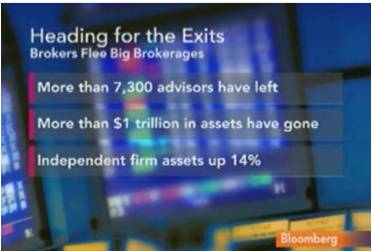
LPL Loving IPO Life
If you are having a difficult time processing the magnitude of this investment advice shift, then consider the $4.4 billion estimated value being placed on the planned IPO (Initial Public Offering) of LPL Financial, the independent brokerage firm of 12,000+ financial advisors. LPL serves as a conduit for legacy brokers to become independent, and still allow them to benefit from an array of ala carte support services. Growth has been strong too – over the last decade the advisor count at LPL has more than tripled and assets under their umbrella now exceed $250 billion.
The Wall Street broker floodgates have opened, so unless regulatory changes are enacted, the old flawed way of doing things will require a life support raft. If not, independent, fee-only advisors like Sidoxia Capital Management will benefit from the current sinking migration of brokers.
Wade W. Slome, CFA, CFP®
Plan. Invest. Prosper.
DISCLOSURE: Sidoxia Capital Management (SCM) and some of its clients own certain exchange traded funds, but at the time of publishing SCM had no direct position in BAC, MS, UBS, WFC, AMTD, SCHW, LPL Financial or any other security referenced in this article. No information accessed through the Investing Caffeine (IC) website constitutes investment, financial, legal, tax or other advice nor is to be relied on in making an investment or other decision. Please read disclosure language on IC “Contact” page.
P/E Binoculars, Not Foggy Rearview Mirror

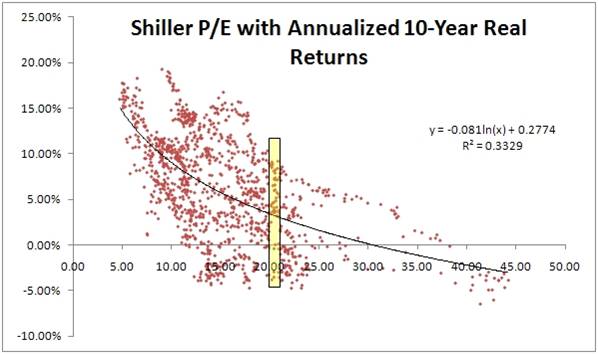
Robert Shiller is best known for his correctly bearish forecasts on the housing market, which we are continually reminded of through the ubiquitous Case-Shiller housing index, and his aptly timed 2000 book entitled Irrational Exuberance. Shiller is also well known for his cyclically adjusted 10-year price-earnings tool, also known as P/E-10. This tool chooses to take a rearview mirror look at the 10-year rolling average of the S&P composite stock index to determine whether the equity market is currently a good or bad buy. Below average multiples are considered to be predictive of higher future returns, and higher than average multiples are considered to produce lower future returns (see scatterplot chart).
Source: http://www.mebanefaber.com (June 2010)
Foggy Mirror
If you were purchasing a home, would the price 10 years ago be a major factor in your purchase decision? Probably not. Call me crazy, but I would be more interested in today’s price and even more interested in the price of the home 10 years into the future. The financial markets factor in forward looking data (not backward looking data). Conventional valuation techniques applied to various assets, take for example a bond, involve the discounting of future cash flow values back to the present – in order to determine the relative attractiveness of today’s asset price. The previous 10-years of data are irrelevant in this calculation.
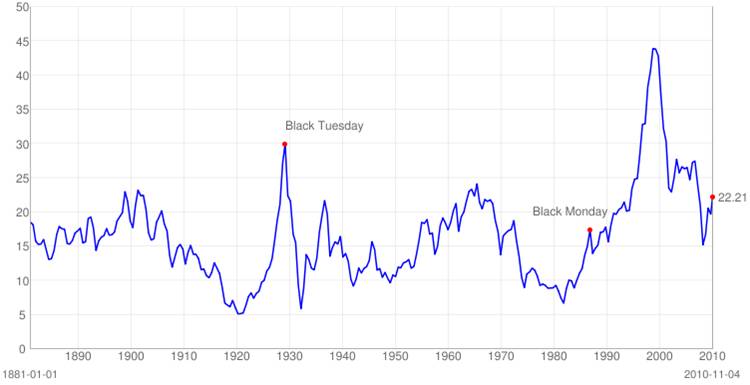
Although I believe current and future expectations are much more important than stale historical data, I can appreciate the insights that can be drawn by comparing current information with historical averages. In other words, if I was purchasing a house, I would be interested in comparing today’s price to the historical 10-year average price. Currently, the P/E-10 ratio stands at a level around 22x – 38% more expensive than the 16x average value for the previous decade. That same 22x current P/E-10 ratio compares to a current forward P/E ratio of 13x. A big problem is the 22x P/E-10 is not adequately taking into account the dramatic growth in earnings that is taking place (estimated 2010 operating earnings are expected to register in at a whopping +45% growth).
Mean P/E 10 Value is 16.4x Source: http://www.multpl.com
Additional problems with P/E-10:
1) The future 10 years might not be representative of the extreme technology and credit bubble we experienced over the last 10 years. Perhaps excluding the outlier years of 2000 and 2009 would make the ratio more relevant.
2) The current P/E-10 ratio is being anchored down by extreme prices from a narrow sector of technology a decade ago. Value stocks significantly outperformed technology over the last 10 years, much like small cap stocks outperformed in the 1970s when the Nifty Fifty stocks dominated the index and then unraveled.
3) Earnings are rising faster than prices are increasing, so investors waiting for the P/E-10 to come down could be missing out on the opportunity cost of price appreciation. The distorted P/E ratios earlier in the decade virtually guarantee the P/E-10 to drop, absent a current market melt-up, because P/E ratios were so high back then.
4) The tool has been a horrible predictor over very long periods of time. For example, had you followed the tool, the red light would have caused you to miss the massive appreciation in the 1990s, and the green light in the early 1970s would have led to little to no appreciation for close to 10 years.
Shiller himself understands the shortcomings of P/E-10:
“It is also dangerous to assume that historical relations are necessarily applicable to the future. There could be fundamental structural changes occurring now that mean that the past of the stock market is no longer a guide to the future.”
How good an indicator was P/E-10 for the proponent himself at the bottom of the market in February 2009? Shiller said he would get back in the market after another 30% drop in the ratio (click here for video). As we know, shortly thereafter, the market went on a near +70% upwards rampage. I guess Shiller just needs another -55% drop in the ratio from here to invest in the market?
Incidentally, Shiller did not invent the cyclically adjusted P/E tool, as famed value investor Benjamin Graham also used a similar tool. The average investor loves simplicity, but what P/E-10 offers with ease-of-use, it lacks in usefulness. I agree with the P/E-10 intent of smoothing out volatile cycle data (artificially inflated in booms and falsely depressed in recessions), but I recommend investors pull out a pair of binoculars (current and forward P/Es) rather than rely on a foggy rearview mirror.
Wade W. Slome, CFA, CFP®
Plan. Invest. Prosper.
DISCLOSURE: Sidoxia Capital Management (SCM) and some of its clients own certain exchange traded funds, but at the time of publishing SCM had no direct position in any other security referenced in this article. No information accessed through the Investing Caffeine (IC) website constitutes investment, financial, legal, tax or other advice nor is to be relied on in making an investment or other decision. Please read disclosure language on IC “Contact” page.
Flying to the Moon via Hyperinflation

With Ben Bernanke and his fellow Fed friends about to crank up the printing presses to overdrive, QE2 (quantitative easing part II) is top of mind among investors. QE2 talks of purchasing Treasuries and mortgage backed securities to pump more dollars into the financial system has been cited by many observers as a key factor in the upward progression in the equity markets over the last couple months. But is too much of a good thing in the short-run, detrimental in the long run due to inflationary pressures?
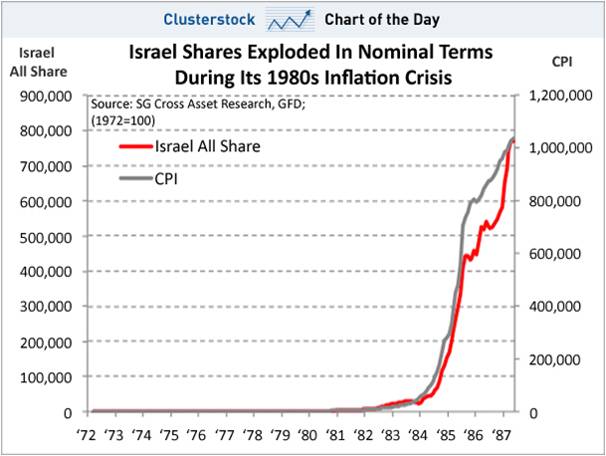
Not necessarily, if you consider the path of stocks in the hyperinflationary Israeli market of the 1970s and 1980s. Dylan Grice from Societe Generale notes that Israeli inflation averaged 84% from 1972 – 1987. During that period, Israeli equity markets managed to increase by a factor of 6,500 times according to Grice. So while inflation skyrocketed to the moon, so did stock prices. Will QE2 ignite dormant core inflation, which is hovering around 1%? If a declining U.S. dollar and rising commodity prices are the canary in the coalmine, then maybe piling into bonds like the majority of Americans is not the best idea?
Source: Business Insider - Clusterstock
Grice may be worried about inflation in the U.S., but Japan is at the forefront on his radar. Supporting that view, he has a modest 63,00,000.00 target on the Nikkei index by 2025 (the index sits at 9,160 today). That’s right…63 million. A near 7,000-fold increase may sound insane, but with exploding debt levels and deficits, coupled with declining demographics from an aging population, perhaps hyperinflation is not out of the question?
If push comes to shove, the Japanese government may print enough money to monetize debt the marketplace cannot absorb. Crazier things have happened in world history – during 1923 in the Weimar Republic of Germany hyperinflation led to a 4,200,000,000,000 German Mark to $1 U.S. dollar exchange rate. More recently we experienced a 79,600,000,000% inflation rate in Zimbabwe and the government actually issued a $100 trillion note. These astronomical inflation rates make our domestic inflationary worries seem like kids-play, but eventually the simple laws of economics will take over, if we do not get our fiscal house in order.
Double digit inflation in the U.S. during the stagflation era of the 1970s crimped Price-Earnings (P/E) ratios to single-digit levels, but this is not surprising with a Federal Funds rate that hit 20% in 1980 – 1981. Today the Fed Funds rate is at 0%, so I don’t think single-digit P/Es will be upon us anytime soon.
The great thing about money is it goes where it is treated best over the long run. In the short-run, money will slosh around and chase performance based on speculative animal spirits, but over time what Adam Smith called the “invisible hand” directs capital to appropriate investments. It was just a few months ago that pundits were talking about double-dip and deflation scenarios (see Double-Dip Guesses), and now on the brink of QE2, the pendulum has swung back to inflation fears. Printing excess amounts of money may provide temporarily fuel to help lift the economy off the ground, but if irresponsible fiscal decisions continue, then the economic rocket scheduled for the moon may come crashing back down with the economy. Do yourself a favor and pack a parachute filled with an adequate amount of equities – they will help protect you if your bond portfolio comes crashing down on higher rates and inflation.
Wade W. Slome, CFA, CFP®
Plan. Invest. Prosper.
DISCLOSURE: Sidoxia Capital Management (SCM) and some of its clients own certain exchange traded funds, but at the time of publishing SCM had no direct position in any other security referenced in this article. No information accessed through the Investing Caffeine (IC) website constitutes investment, financial, legal, tax or other advice nor is to be relied on in making an investment or other decision. Please read disclosure language on IC “Contact” page.
From Merger Wedding to eHarmony

Source: Photobucket
“Keep your eyes wide open before marriage, and half-shut afterwards.”
– Benjamin Franklin
Stocks share a lot of the same dynamics with dating and marriage. Some may choose to play the field through partnerships and joint ventures, while others may choose to remain independent as eternal bachelors/bachelorettes. Others, however, are willing to take the plunge. Unfortunately some marriages don’t last. But if things don’t work out, there is no need to worry because eHarmony.com (or resident investment bank) will always be there to help find your next perfect match.
Unlucky in Love
An example of a bloody divorce is the mega-merger between AOL Inc. and Time Warner (TWX) in 2000. The relationship was so destructive that investors witnessed AOL’s peak value of $222 billion in December 1999 (Fortune) plummet to around $3 billion today…ooooph!
Compared to some relationships, AOL lasted much longer. In fact Yahoo! Inc. (YHOO) didn’t even get to celebrate a honeymoon with Microsoft Corp. (MSFT) in February 2008 when the behemoth software company offered a +62% premium ($31 per share) for the gigantic portal. Microsoft’s $45 billion cash and stock offer was ruled unworthy by Yahoo’s board, so the company decided to leave Microsoft at the altar. Even after considering Yahoo’s latest price spike on acquisition rumors, Microsoft’s original bid is still almost double Yahoo’s current stock price of $16 per share.
Merger Scuttlebutt
As I discussed in my earlier mergers and acquisitions article (M&A) conditions are ripening with large corporate cash piles, a continued economic recovery, improved capital markets availability, and cheap credit costs (at least for those that qualify). With the clouds slowly lifting in the M&A world, suitors are shaking the trees for more potential opportunities.
While some acquirers may have altruistic intentions in combining companies, some marriages are done for pure gold-digging purposes. Private equity firms Blackstone Group (BX) and Silver Lake are rumored to be circling the Yahoo wagons and courting AOL as a potential partner in a joint bid. Whatever the expectations, if private equity plays a role in a Yahoo bid, the internet company should not become disillusioned with romantic warm and fuzzies – private equity firms like to get straight down to dirty business. Yahoo owns a 35% stake in Yahoo Japan and a 43% interest in leading Chinese e-commerce company, Alibaba Group. If a joint private equity bid were ever to win, I believe there would be a strong impetus to realize shareholder value by carving up these non-operating stakes. Consolidating overhead and streamlining expenses would likely be a top priority as well.
The Perfect Marriage
A “perfect marriage” could almost be called an oxymoron because like any relationship, there is significant work required by both parties. The divorce rate is estimated at around 40-50% in North America (Europe around the same), however mergers even fail at a higher 70% rate, according to Bain and Company study. I would argue successfully integrating larger deals are even more difficult, hampering the success rate even further. Merging two poorly managed companies purely for cost purposes is probably not the best way to go. Crashing two garbage trucks together is not going to create a Ferrari. I wouldn’t go as far as to say Yahoo and AOL are garbage trucks, but they face numerous, substantial challenges. Maybe these two companies are more akin to Mazdas transforming into a Toyota Camry (TM).
From my perspective, if companies really are dead set on engaging in acquisitions, then I urge management teams to focus on smaller digestible deals. Specifically, concentrate on those deals with experienced senior management teams who understand and respect the unique culture of the acquirer. Mergers also often fail due to excessive optimism and overly optimistic assumptions. This is an area in which Warren Buffett excels. Rarely do you observe the Oracle of Omaha overpaying for an acquisition, but rather he patiently waits for his fat pitch, and when it floats over the plate, Buffett is quick to throw out a lowball offer that will dramatically increase the probabilities of long-term merger success (think Geico, Sees Candy, Burlington Northern, etc.).
In the end, a joint relationship may not be forged between Yahoo, AOL and private equity firms, but if talks disintegrate, no need to worry – alternative partnerships can be explored on eHarmony.
Wade W. Slome, CFA, CFP®
Plan. Invest. Prosper.
DISCLOSURE: Sidoxia Capital Management (SCM) and some of its clients own certain exchange traded funds, but at the time of publishing SCM had no direct position in YHOO, MSFT, TWX, BX, BRKA, TM, Alibaba, or any other security referenced in this article. No information accessed through the Investing Caffeine (IC) website constitutes investment, financial, legal, tax or other advice nor is to be relied on in making an investment or other decision. Please read disclosure language on IC “Contact” page.
September Surge: Stop, Go, or Proceed Cautiously?

The stock market just posted its strongest September and third quarter performance in more than seven decades (S&P 500 +8.8% and +10.7%, respectively), yet people are still waiting for a clear green light to signal blue investment skies ahead. Well of course, once it is apparent to everyone that the economy is obviously back on track, the opportunities persisting today will either be gone or vastly diminished. I’m not a blind optimist, but a sober realist that understands, like Warren Buffett, that it pays to “buy fear and sell greed.” And fear is exactly what we are witnessing today. The $2.6 trillion sitting in CDs earning a horrendously low 1% is simple proof (Huffington Post).
Like the fresh memory of a recent hand burned on the stove, the broader general public is still feeling the pain and recovering from the financial crisis. Each gloomy real estate or unemployment headline triggers agonizing flashbacks (read Unemployment Hypochondria) of the 2008-2009 financial collapse and leads to harmful emotional investment decisions. However, for some of us finance geeks that have cut through the monotony of “pessimism porn” blasted over the airwaves, we have discovered plenty of positive leading economic indicators bubbling up below the surface, like the following:
- Continued Economic Growth: Gross Domestic Product (GDP) grew +1.7% in the second quarter and current estimates stand in the +2.0% to +2.5% range for third quarter GDP, which will mark the fifth consecutive quarter of growth.
- Growing Corporate Profits: S&P 500 earnings are estimated to expand by +45.6% in 2010 and are estimated to grow by another +15% or so next year (Standard & Poor’s September 2010).
- Escalating M&A: Mergers and acquisitions activity increased to $566.5 billion in the third quarter. The value of announced transactions is up +60% from a year ago according to Bloomberg. If you have a tough time comprehending the pickup in M&A, then take a peek here.
- Record Cash Piles: The top 1,000 largest global corporations held a whopping $2.87 trillion in cash (Bloomberg).
- Accelerating Share Buybacks: Share buybacks totaled $77.6 billion in the second quarter, up +221% from a record low last year – Barron’s).
- Dividends Galore: S&P 500 companies have lifted their payouts by $15 billion so far this year versus a reduction of $40 billion for the same period last year (The Wall Street Journal). Tech giant Cisco Systems Inc. (CSCO) announced the pending initiation of a dividend, while Microsoft Corp. (MSFT) increased its dividend by a significant +23%.
I’m not naïve enough to believe choppy waters will disappear for good, but despite the depressing headlines there are constructive undercurrents. Beyond the points above, equity market prices remain attractive relative to the broader fixed-income markets (see Bubblicious Bonds) . More specifically, the S&P 500 is priced at about a 25% discount to historic valuation averages over the last 55 years (currently trading at about 12.5 Price/Earnings ratio vs 16.5x historic Price/Earnings ratio – Bloomberg). Now may not be the time to recklessly run a red light, but if you fearfully remain halted in front of the green light then prepare to receive a pricey ticket.
Wade W. Slome, CFA, CFP®
Plan. Invest. Prosper.
DISCLOSURE: Sidoxia Capital Management (SCM) and some of its clients own certain exchange traded funds and CSCO, but at the time of publishing SCM had no direct position in MSFT, or any other security referenced in this article. No information accessed through the Investing Caffeine (IC) website constitutes investment, financial, legal, tax or other advice nor is to be relied on in making an investment or other decision. Please read disclosure language on IC “Contact” page.
Why it’s NOT Different This Time

“Those who don’t know history are destined to repeat it.”
– Edmund Burke – British Statesman and Philosopher (1729-1797)
I wasn’t a history major in college, but I’ve learned two things by studying history books: 1) The unchanging psyche of human nature leads history consistently to repeats itself; and 2) There is never a shortage of goofballs willing to make zany predictions.
Robert Zuccaro is no exception to lesson number two, as evidenced by his 2001 book, Why it’s Different this Time…Dow 30,000 by 2008! Sticking one’s neck out is never too difficult when you have a multi-decade trend behind your back – I guess Dow “14,000” just didn’t sound sexy enough back then. Unfortunately the herd reacting to these bold, extreme predictions eventually realize (usually post-mortem) that they are quickly approaching a tail-end of a cycle. The cab driver, hair dresser, and mechanic realized the dangers of following the “New Economy” cheerleaders in 1999 when everyone was piling into dot-com stocks (see Bubblicious technology table ).
Dow 1,000 Here We Come!

- Source: Yahoo! Finance

Today, the Zuccaros of the world have been washed to the curb, and new “Armageddon” extremists have sprouted up to the surface, like perma-bear Peter Schiff and his call for Dow 2,000 or his $5,000 per ounce gold estimate. More recently, Robert Prechter has one-upped Schiff by forecasting Dow 1,000 with the assistance of the not-so ironclad Elliott Wave Theory philosophy (see Technical Analysis: Astrology or Lob Wedge). If you’re in the Prechter camp, either crawl back into your bunker or start digging that dream cave you always wanted.

Source: Elliott Wave International
“Hey, Look Here at My Crazy Forecast!”
Publicity doesn’t necessarily rain praise on those parroting the consensus view (although the warmth of job security is appreciated), but rather the extreme outliers love to bask in the glow of media attention. The extremists consistently repeat “why it’s different this time.” What is different is the set of circumstances, but what history shows us over and over again is the emotions of fear and greed feeding the bubbles of excess are exactly the same. Whether you’re talking about the Tulip-Mania of the 1630s, the Nifty Fifty stocks of 1973-1974, the technology Four Horsemen of the mid-1990s, or the Icelandic Banks of 2008, what we learn from the lessons of history is that human nature will never change and fear and greed will continue creating and bursting future bubbles.
People playing the game long enough understand, “It’s NOT different this time.” Not only have we endured repeated wars, recessions, banking crises, currency crises, but we have also survived every exotic animal disease known to man, including Mad Cow, Swine Flu, Bird Flu, West Nile, etc.
Robert Zuccaro and Robert Prechter may get an “A” for their attention grabbing forecasts, but thus far the grade earned on accuracy is closer to an “F.” More specifically, Zuccaro’s prediction never came close to 30,000 by the end of 2008 (only off by about 21,000 points), and guess what, Bob Prechter has a long way to go before reaching his Dow 1,000 target. So here is my proposition: Why don’t we just split the difference between Zuccaro’s 2008 and Prechter’s 2016 forecasts and take the average? If it turns out they are equally bad forecasters, then Dow 15,500 by 2012 should be no problem ([30,000 + 1,000] ÷ 2)!
Regardless of the ultimate outcome of this market (double-dip or sustained recovery), what I do know is there will continue to be wacky outlandish forecasters rationalizing why a trend will go on for infinity and why “this time is different.” In reality these attention mongers will always be around ensuring this time (or next time) will never be different…just the same fear and greed as always.
Wade W. Slome, CFA, CFP®
Plan. Invest. Prosper.
DISCLOSURE: Sidoxia Capital Management (SCM) and some of its clients own certain exchange traded funds, but at the time of publishing SCM had no direct position in any other security referenced in this article. No information accessed through the Investing Caffeine (IC) website constitutes investment, financial, legal, tax or other advice nor is to be relied on in making an investment or other decision. Please read disclosure language on IC “Contact” page.




 Investing Caffeine
