Posts filed under ‘Education’
Fees, Exploitation and Confusion Hammer Investors

The financial industry is out to hammer you. If you haven’t figured that out, then it’s time to wake up to the cruel realities of the industry. Let’s see what it takes to become the hammer rather than receiving the brunt of the pounding, like the nail.
Fees, Fees, Fees

I interface with investors of all stripes and overwhelmingly the vast majority of them have no idea what they are paying in fees. When I ask investors what fees, commissions, and transactions costs are being siphoned from their wallets, I get the proverbial deer looking into the headlight response. And who can blame them? Buried in the deluge of pages and hiding in the fine print is a list of load fees, management fees, 12b-1 fees, administrative fees, surrender charges, transaction costs, commissions, and more. One practically is required to obtain a law degree in order to translate this foreign language.
Wolf in Sheep’s Clothing

These wolves don’t look like wolves. These amicable individuals have infiltrated your country clubs, groups, volunteer organizations, and churches. The following response is what I usually get: “Johnny, my financial consultant, is such a nice man – we have known him for so long.” Yeah, well maybe the reason why Johnny is so nice and happy is because of the hefty fees and commissions you are paying him. Rather than paying for an expensive friend, maybe what you need is someone who can accelerate your time to retirement or improve your quality of life. If you prefer eating mac and cheese over filet mignon, or are looking to secure a position at Wal-Mart as a greeter in your 80s, then don’t pay any attention to the fees you may be getting gouged on.
I don’t want to demonize all practitioners and aspects of the financial industry, but like Las Vegas, there is a reason the industry makes so much money. The odds and business practices are stacked in their favor, so focus on protecting yourself.
Confusion

Investors face a very challenging environment these days, needing to decipher everything from Dubai debt defaults and PIIGS sovereign risk (Portugal-Ireland-Italy-Greece-Spain) to proposed new banking regulation and massive swings in the U.S. dollar. If our brightest economists and government officials can’t decipher these issues and “time the market,” then how in the heck are aggressive financial salesmen and casual investors supposed to digest all this ever-changing data? Making matters worse, the media continuously pours gasoline on fear-inducing uncertainties and shovels piles of greed-motivating fodder, which only serves to make matters more confusing for investors. Do yourself a favor and turn off the television. There are better ways of staying informed, without succumbing to sensationalized media stories, like reading Investing Caffeine!
Pushy financial salespeople complicate the situation by attempting to “wow” clients with fancy acronyms and industry jargon in hopes of impressing a prospect or client. In some situations, this superficial strategy may confuse an investor into thinking the consultant is knowledgeable, but in more instances than not, if the salesperson doesn’t know how to explain the investment concept in terms you understand, then there’s a good chance they are just blowing a lot of hot air.
Here’s what famous growth investor William O’Neil has to say about advice:
“Since the market tends to go in the opposite direction of what the majority of people think, I would say 95% of all these people you hear on TV shows are giving you their personal opinion. And personal opinions are almost always worthless … facts and markets are far more reliable.”
Amen.
Mistake of Trying to Time Market

My best advice to you is not to try and time the market. Even for the speculators with correct timing on one trade rarely get the move right the next time. As previously mentioned, even the smartest people on our planet have failed miserably, so I don’t recommend you trying it ether.
Here are a few examples of timing gone awry:
- Nobel Prize winners Robert Merton and Myron Scholes incorrectly predicted the direction of various economic variables in 1998, while investing client money at Long Term Capital Management. As a result of their poor timing, they single-handedly almost brought the global financial markets to their knees.
- Former Federal Reserve Chairman, Alan Greenspan, is famously quoted for his “irrational exuberance” speech in 1996 when the NASDAQ index was trading around 1,300. Needless to say, the index went on to climb above 5,000 in the coming years. Not such great timing Al.
- More recently, Ben Bernanke assumed the Federal Reserve Chairman role (arguably the most powerful financial position in our Universe) in February 2006. Unfortunately even he could not identify the credit and housing bubble that soon burst right under his nose.
Some of the best advice I have come across comes from Peter Lynch, former Fidelity manager of the Magellan Fund. From 1977-1990 his fund’s investment return averaged +29% PER YEAR. Here’s what he has to say about investment timing in the market:
“Worrying about the stock market 14 minutes per year is 12 minutes too many.”
“Anyone can do well in a good market, assume the market is going nowhere and invest accordingly.”
Rather than attempting to time the market, I would encourage you to focus on discovering a disciplined, systematic investment approach that can work in various market environments (see also, One Size Does Not Fit All).
Financial Carnage

The long-term result for investors playing the game, with rules stacked against them, is financial carnage.
If you don’t believe me, then just ask John Bogle, chairman of one of the fastest growing and most successful large financial firms in the industry. His 1984-2002 study shows how badly the average investor gets slammed, thanks to aggressive fees peddled by forceful financial salesmen and the urging into destructive emotional decisions. Specifically, the study shows the battered average fund investor earning a meager 2.7% per year while the overall stock market earned +12.9% annually over the period.

Source: Bogle Financial Center
It’s Your Investment Future
Given the economic times we are experiencing now, there is more confusion than ever in the marketplace. Insistent financial salespeople are using aggressive smoke and mirror tactics, which in many cases leads to unfortunate and damaging investment outcomes. Do your best to prepare and educate yourself, so you can become the hammer and not the nail.
It’s your investment future – invest it wisely.
Wade W. Slome, CFA, CFP®
Plan. Invest. Prosper.
DISCLOSURE: Sidoxia Capital Management (SCM) and some of its clients own certain exchange traded funds (including Vanguard ETFs and funds), but at time of publishing had no direct positions in securities mentioned in this article. No information accessed through the Investing Caffeine (IC) website constitutes investment, financial, legal, tax or other advice nor is to be relied on in making an investment or other decision. Please read disclosure language on IC “Contact” page.
Financial Statements: Monetary X-Rays for Decision Makers

Virtually everyone has been to a doctor’s office or hospital, and at some point gotten an x-ray. Typically, multiple x-rays are taken to give the doctor adequate data for determining a patient’s health and well-being. For example, a dentist will take numerous views in searching for disease and cavities, above and below the surface of the mouth. When it comes to financial markets, the same diagnostic principles apply to securities analysis. But rather than x-rays, we have financial statements. The income statement, balance sheet, and cash flow statement provide analysts multiple angles for making a proper company diagnosis. Each financial statement provides the user a unique perspective, and together, the statements paint a more complete picture into the financial condition of a company. In the coming weeks (and months), I will take a deeper dive into the world of financial statement analysis.
Financial Statement Reporting
What is the purpose of financial statement analysis?
“The primary goal in financial reporting is the dissemination of financial statements that accurately measure the profitability and financial condition of a company.” -Howard Schilit (author of Financial Shenanigans)
Sounds simple and pure in its aim, but as we will find out, there can be more to financial statements than meets the eye (see also EPS Tricks of the Trade). In order to profit (and protect oneself), financial statement users need to read between the lines.
The Bookkeeper Police
Policing the integrity of the financial bookkeeping process are the FASB (Financial Accounting Standards Board) – the entity behind the creation of GAAP (Generally Accepted Accounting Principles) – and the SEC (Securities and Exchange Commission). Unfortunately the goals of management (maximize wealth and shareholder value) do not always align with the objectives of financial statement users (accuracy and transparency). As we found out from the case of Bernie Madoff, investors cannot always rely on the SEC for law enforcement. A deep-rooted foundation in financial statement analysis mixed in with some common sense may protect you from some major financial pitfalls.
Why are Financial Statements so Important?
Transparency of Capital Markets: Our capitalistic society is based on the trust and transparency of available financial information, so key decision makers can make informed decisions. In many emerging markets, standards are more lax and well-versed decisions are more difficult to make. Ultimately, if you believe in free markets, money migrates to where it is treated best. Reliable and transparent financial systems build investor confidence and make our system work. When companies like AIG and Enron have complex derivatives and opaque off balance sheet structures that are not clearly disclosed, then investors and key decision makers are at a disadvantage. The companies generally suffer as well, since investors afford lower valuations for complex organizations.
Investment Bankers / Sell Side Research: Investment bankers rely heavily on financial statements when determining the suitability of corporate marriage. A company cannot be bought or sold without determining an agreed-upon valuation. Financial statements help bankers establish an appropriate price for transactions.
Competitors: We live in a dog eat dog world. Assessing the strength and effectiveness of various competitor initiatives can lead to better decision making. For example, one can simply compare the revenue growth rates of two companies to determine who is gaining market share. In tough times like now, an analyst can look at items such as debt load on the balance sheet or cash generation on the cash flow statement to determine how a company is positioned to weather a potential cash crunch.
Employment/Compensation: Astute financial analysis by job seekers can lead to tremendous insights into a company’s financial condition. The process can also trigger shrewd questions to bounce back at the interviewers. Executives can also look at financial and proxy statements to uncover compensation practices of a company.
Fraud/Inaccuracies: The SEC and other regulatory agencies need tools to hunt down the bad guys and notify those stretching the letter of the law. The SEC and FASB are supposed to act as the industry financial cops. Our trust in these institutions took a deep hit when these organizations failed to catch the corrupt actions of Bernie Madoff, despite the multiple times outsiders waved red flags to the SEC.
IRS/Tax Collection: Uncle Sam wants to collect his revenue, especially in these times of large and expanding deficits. Verifying and auditing the correctness of a company’s tax liabilities can ensure correct tax revenues are accumulated.
Bankers/Creditors: Banks are becoming even more tight-fisted these days, and in order to provide loans to borrowers, financial statements become a key component of the loan equation.
Internal Finance Staff & Consultants: Chief Financial Officers and corporate finance department professionals need financial statements to steer strategy in the right direction. Many companies develop a six sigma type of approach whereby margin and cash flow improvements are targeted. In that vein, internal and external benchmarking can highlight areas of strengths and weaknesses.
For many, financial statement analysis is not the sexiest endeavor. However, I think when properly applied, the process engenders clearer and more confident decision-making. A doctor feels much the same way upon reviewing a set of accurate x-rays and making an informed patient diagnosis. Do yourself a favor and don’t ignore the financial statement components. With appropriate financial analysis, I am confident you can make healthy investment decisions too.
Wade W. Slome, CFA, CFP®
Plan. Invest. Prosper.
DISCLOSURE: Sidoxia Capital Management (SCM) and some of its clients own certain exchange traded funds, but at the time of publishing had no direct positions in AIG or other securities mentioned. No information accessed through the Investing Caffeine (IC) website constitutes investment, financial, legal, tax or other advice nor is to be relied on in making an investment or other decision. Please read disclosure language on IC “Contact” page.
Metrics Mix-Up: Stocks and Real Estate Valuation

When it comes to making money, investors choose from a broad menu of investment categories, ranging all the way from baseball cards and wines to collectible cars and art. Two of the larger and more popular investment categories are stocks and real estate. Unfortunately for those poor souls (such as me) analyzing these two classes of assets, the stock and real estate investor bigwigs have not come together to create an integrated metric system. Much the same way the United States has chosen to go it alone on a proprietary customary unit measurement system with Burma and Liberia – choosing inches and feet over centimeters and meters. On the subject of stock and real estate valuation, investors and industry professionals have been stubbornly defiant in designing unique and cryptic terminology, despite sharing the exact same financial principles.
Who Cares About Real Estate?
Well, apparently everyone. Southern California doesn’t have a monopoly on real estate, but through my practice in Orange County, I find it difficult to not trip over real estate investors on a daily basis. I work in effectively what was “ground zero” of the subprime debacle and the commercial real estate pains continue to ripple through “the OC.”
Ramping up the real estate learning curve reminds me of my high school Spanish class – I understood enough Spanish to work my way through a Taco Bell menu but little else. In order to actually learn Spanish I had to completely immerse myself in the language, even if it meant continually speaking to my classmates in Spanish through my alias (Paco).
Real Estate Foundational Terms
Despite being a relative new resident in the Orange County area, engrossing myself in real estate hasn’t been much of a challenge. Over a brief period, my interactions and conversations taught me my financial degrees and credentials were just as applicable in the realty world as they were in the stock market world. While evaluating real estate valuation techniques, I discovered two new key terms:
1) NOI (Net Operating Income): Unlike stock analysis, which uses “Net Income” as a core driver in determining an asset’s value, real estate relies on NOI. Net operating income is generally derived by calculating income before depreciation and interest expense. In finance, there are many versions of income. I’m sure there are more explanations, but two reasons behind the selection of NOI in real estate valuation over other metrics is due to the following: a) NOI may be used as a proxy for cash flow, which can be integral in many valuation techniques; and b) NOI is “capital structure neutral” if comparing multiple properties. Therefore, NOI allows an investor to compare varying properties on an apples-to-apples basis regardless of whether a property is massively leveraged or debt-free.
2) Cap Rate (Capitalization Rate): This ratio is computed by taking the NOI and dividing it by a property’s initial cost (or value). In stock market language, you can think of a “cap rate” as an inverted P/E (Price – Earnings) ratio – an inverted P/E ratio has also been called the “earnings yield.” Complicating terminology matters is the interchangeable use of income and earnings in the investment world. In the case of the P/E ratio, the denominator generally used is “Net Income.”
A shortcoming to the cap rate ratio, in my view, is the failure to deduct taxes. Although comparability across properties may get muddied, if determining profit availability to investors is the main goal, then I think an adjusted NOI (subtracting taxes) would be a more useful proxy for valuation purposes. Tax benefits associated with REITS (Real Estate Investment Trusts) complicates the metric usage issue further.
The simplistic beauty of marrying NOI and a cap rate is that a crude valuation estimate can be constructed by merely blending these two metrics together. For example, a commercial real estate property generating $500,000 in NOI that applies a 5% cap rate to the property can arrive at a valuation estimate of $10,000,000 ($500,000/.05).
Similarities between Stocks & Real Estate
At the end of the day, the theoretical value of ANY asset can be calculated by taking the projected after-tax cash flows and discounting that stream back into today’s dollars – whether we are talking about a stock, bond, derivative, real estate property, or other asset. Both stock and real estate analysis use readily available income numbers and price ratios to estimate cash flows and valuations. Regrettably, since real estate and equity investors generally play in different leagues, the rules and language are different.
The lingo used for analyzing separate asset classes may be unique, but the math and fundamental examination are the same. The formula for learning real estate is similar to that of Spanish – you need to dive in and immerse yourself into the new language. If you don’t believe me, just ask Paco.
Wade W. Slome, CFA, CFP®
Plan. Invest. Prosper.
DISCLOSURE: Sidoxia Capital Management (SCM) and some of its clients own certain exchange traded funds, but at the time of publishing had no direct positions in YUM or any other security mentioned. No information accessed through the Investing Caffeine (IC) website constitutes investment, financial, legal, tax or other advice nor is to be relied on in making an investment or other decision. Please read disclosure language on IC “Contact” page.
Sports & Investing: Why Strong Earnings Can Hurt Stock Prices

There are many similarities between investing in stocks and handicapping in sports betting. For example, investors (bettors) have opposing views on whether a particular stock (team) will go up or down (win or lose), and determine if the valuation (point spread) is reflective of the proper equilibrium (supply & demand). And just like the stock market, virtually anybody off the street can place a sports bet – assuming one is of legal age and in a legal betting jurisdiction.
Right now investors are poring over data as part of the critical, quarterly earnings ritual. Thus far, roughly 20% of the companies in S&P 500 index have reported their results and 78% of those companies have beaten Wall Street expectations (CNBC). Unfortunately for the bulls, this trend has not been strong enough to push market prices higher in 2010.
So how and why can market prices go down on good news? There are many reasons that short-term price trends can diverge from short-run fundamentals. One major reason for the price-fundamental gap is the following factor: expectations. Just last week, the market had climbed over +70% in a ten month period, before issues surrounding the Massachusetts Senatorial election, President Obama’s banking reform proposals, and Federal Reserve Bank Chairman Ben Bernanke’s re-appointment surfaced. With such a large run-up in the equity markets come loftier expectations for both the economy and individual companies. So when corporate earnings unveiled from companies like Google (GOOG), J.P. Morgan (JPM), and Intel (INTC) outperform relative to forecasts, one explanation for an interim price correction is due to a significant group of investors not being surprised by the robust profit reports. In sports betting lingo, the sports team may have won the game this week, but they did not win by enough points (“cover the spread”).
Some other reasons stock prices move lower on good news:
- Market Direction: Regardless of the underlying trends, if the market is moving lower, in many instances the market dip can overwhelm any positive, stock- specific factors.
- Profit Taking: Many times investors holding a long position will have price targets or levels, if achieved, that will trigger selling whether positive elements are in place or not.
- Interest Rates: Certain valuation techniques (e.g. Discounted Cash Flow and Dividend Discount Model) integrate interest rates into the value calculation. Therefore, a climb in interest rates has the potential of lowering stock prices – even if the dynamics surrounding a particular security are excellent.
- Quality of Earnings: Sometimes producing winning results is not enough (see also Tricks of the Trade article). On occasion, items such as one-time gains, aggressive revenue recognition, and lower than average tax rates assist a company in getting over a profit hurdle. Investors value quality in addition to quantity.
- Outlook: Even if current period results may be strong, on some occasions a company’s outlook regarding future prospects may be worse than expected. A dark or worsening outlook can pressure security prices.
- Politics & Taxes: These factors may prove especially important to the market this year, since this is a mid-term election year. Political and tax policy changes today may have negative impacts on future profits, thereby impacting stock prices.
- Other Exogenous Items: Natural disasters and security attacks are examples of negative shocks that could damage price values, irrespective of fundamentals.
Certainly these previously mentioned issues do not cover the full gamut of explanations for temporary price-fundamental gaps. Moreover, many of these factors could be used in reverse to explain market price increases in the face of weaker than anticipated results.
For those individuals traveling to Las Vegas to place a wager on the NFL Super Bowl, betting on the hot team may not be enough. If expectations are not met and the hot team wins by less than the point spread, don’t be surprised to see a decline in the value of the bet.
Wade W. Slome, CFA, CFP®
Plan. Invest. Prosper.
DISCLOSURE: Sidoxia Capital Management (SCM) and some of its clients own certain exchange traded funds and GOOG, but at the time of publishing had no direct positions in JPM and INTC. No information accessed through the Investing Caffeine (IC) website constitutes investment, financial, legal, tax or other advice nor is to be relied on in making an investment or other decision. Please read disclosure language on IC “Contact” page.
Mauboussin Takes the Outside View

Michael Mauboussin, Legg Mason Chief Investment Strategist and author of Think Twice, is a behavioral finance guru and in his recent book he explores the importance of seriously considering the “outside view” when making important decisions.
What is Behavioral Finance?
Behavioral finance is a branch of economics that delves into the non-numeric forces impacting a diverse set of economic and investment decisions. Often these internal and external influences can lead to sub-optimal decision making. The study of this psychology-based discipline is designed to mitigate economic errors, and if possible, improve investment decision making.
Two instrumental contributors to the field of behavioral finance are economists Daniel Kahneman and Amos Tversky. In one area of their research they demonstrated how emotional fears of loss can have a crippling effect in the decision making process. In their studies, Kahneman and Tversky showed the pain of loss is more than twice as painful as the pleasure from gain. How did they illustrate this phenomenon? Through various hypothetical gambling scenarios, they highlighted how irrational decisions are made. For example, Kahneman and Tversky conducted an experiment in which participating individuals were given the choice of starting with an initial $600 nest egg that grows by $200, or beginning with $1,000 and losing $200. Both scenarios created the exact same end point ($800), but the participants overwhelmingly selected the first option (starting with lower $600 and achieving a gain) because starting with a higher value and subsequently losing money was not as comfortable.
The impression of behavioral finance is burned into our history in the form of cyclical boom, busts, and bubbles. Most individuals are aware of the technology bubble of the late 1990s, or the more recent real estate/credit craze, however investors tend to have short memories are unaware of previous behavioral bubbles. Take the 17th century tulip mania, which witnessed Dutch citizens selling land, homes, and other assets in order to procure tulip bulbs for more than $70,000 (on an inflation-adjusted basis), according to Stock-Market-Crash.net. We can attempt to delay bubbles, but they will forever be a part of our economic fabric.
The Outside View
 Click here for Michael Mauboussin interview with Morningstar
In his book Think Twice Mauboussin takes tenets from behavioral finance and applies it to individual’s decision making process. Specifically, he encourages people to consider the “outside view” when making important decisions.
Mauboussin makes the case that our decisions are unique, but share aspects of other problems. Often individuals get trapped in their heads and internalize their own problems as part of the decision making process. Since decisions are usually made from our personal research and experiences, Mauboussin argues the end judgment is usually biased too optimistically. Mauboussin encourages decision makers to access a larger outside reference class of diverse opinions and historical situations. Often, situations and problems encountered by an individual have happened many times before and there is a “database of humanity” that can be tapped for improved decision making purposes. By taking the “outside view,” he believes individual judgments will be tempered and a more realistic perspective can be achieved.
In his interview with Morningstar, Mauboussin provides a few historical examples in making his point. He uses a conversation with a Wall Street analyst regarding Amazon (AMZN) to illustrate. This particular analyst said he was forecasting Amazon’s revenue growth to average 25% annually for the next ten years. Mauboussin chose to penetrate the “database of humanity” and ask the analyst how many companies in history have been able to sustainably grow at these growth rates? The answer… zero or only one company in history has been able to achieve a level of growth for that long, meaning the analyst’s projection is likely too optimistic.
Mean reversion is another concept Mauboussin addresses in his book. I consider mean reversion to be one of the most powerful principles in finance. This is the idea that upward or downward moving trends tend to revert back to an average or normal level over time. In describing this occurrence he directs attention to the currently, overly pessimistic sentiment in the equity markets (see also Pessimism Porn article). At end of 1999 people were wildly optimistic about the previous decade due to the significantly above trend-line returns earned. Mean reversion kicked in and the subsequent ten years generated significantly below-average returns. Fast forward to today and now the pendulum has swung to the other end. Investors are presently overly pessimistic regarding equity market prospects after experiencing a decade of below trend-line returns (simply look at the massive divergence in flows into bonds over stocks). Mauboussin, and I concur, come to the conclusion that equity markets are likely positioned to perform much better over the next decade relative to the last, thanks in large part to mean reversion.
Behavioral finance acknowledges one sleek, unique formula cannot create a solution for every problem. Investing includes a range of social, cognitive and emotional factors that can contribute to suboptimal decisions. Taking an “outside view” and becoming more aware of these psychological pitfalls may mitigate errors and improve decisions.
Wade W. Slome, CFA, CFP®
Plan. Invest. Prosper.
DISCLOSURE: Sidoxia Capital Management (SCM) and some of its clients own certain exchange traded funds and AMZN, but at time of publishing had no direct positions in LM, or MORN. No information accessed through the Investing Caffeine (IC) website constitutes investment, financial, legal, tax or other advice nor is to be relied on in making an investment or other decision. Please read disclosure language on IC “Contact” page.
Technical Analysis – Astrology or Lob Wedge?

Investing comes in many shapes and sizes. And like religion (see Investing Religion article), most investment strategies are built on the essential belief that following certain rules and conventions will eventually lead to profit enlightenment. When it comes to technical analysis (TA), a discipline used with the principal aim of predicting future prices from past patterns, some consider it a necessity for making money in the market. Others, regard the practice of TA as a pseudoscience, much like astrology.
I feel there is a proper place for TA on selective basis, which I will describe later, but for the most part I agree with some of the legendary investors who have chimed in on the subject:
Warren Buffett: “I realized technical analysis didn’t work when I turned the charts upside down and didn’t get a different answer.”
Peter Lynch: “Charts are great for predicting the past.”
Technical Analysis Linguistics
Fundamental analysis, the antithesis of technical analysis, strives to predict future price direction by analyzing facts and data surrounding a company, industry, and/or economy. It too comes with its own syntax and versions, for example: value, growth, top-down, bottom-up, quantitative, etc.
I do not claim to be a TA expert, however in my many years of investing I have come across a smorgasbord of terms and flavors surrounding the discipline. Describing and explaining the density of material surrounding TA would encompass too large of a scope for this article, but here are some prevalent terms one should come to grips with if you want to become a technical analysis guru:
Technical analysis Approaches
- Elliot Wave
- Relative strength / Momentum (see Momentum Investing article)
- MACD (Moving Average Convergence / Divergence)
- Fibonacci retracement
- Dow Theory
- Stochastics
- Bollinger bands
Price Patterns
- Head and shoulders
- Double bottom
- Cup and handle
- Channels
- Breakouts
- Pivot points
- Candlesticks
- Resistance/Support
- Dead cat bounce (my personal favorite)
Each of these patterns are supposes to provide insight into the future direction of price. At best, I would say the academic research surrounding the subject is “inconclusive,” and at worst I’d say it’s considered a complete “sham.”
The Lob Wedge

As I’ve stated earlier, I fall in the skeptical camp when it comes to TA, since fundamental analysis is the main engine I use for generating and tracking my investment ideas. For illustrative purposes, you may consider fundamental analysis as my group of drivers and irons. I do, however, utilize selective facets of TA much like I use a lob wedge in golf for a limited number of specific situations (e.g., shots over high trees, downhill lies, and fast greens). When it comes to trading, I do believe there is some value in tracking the relationship of extreme trading volume (high or low), especially when it is coupled with extreme price movement (high or low). The economic laws of supply and demand hold true for stock trades just as they do for guns and butter, and sharp moves in these components can provide insights into the psychological mindset of investors with respect to a security (or broader market). Beyond trading volume, there are a few other indicators that I utilize as part of my trading strategies, but these tactics play a relatively minor role, since most of my core positions are held on a multi-year time horizon.
Overall, there is a stream of wasteful noise, volatility, and misinformation that permeates the financial markets on a daily basis. A major problem with technical analysis is the many false triggered signals, which in many cases lead to excessive trading, transaction costs, and ultimately subpar investment returns. Although I remain a skeptic on the subject of technical analysis and I may not read my horoscope today, I will continue to keep a lob wedge in my golf bag with the hopes of finding new, creative ways of using it to my advantage.
Wade W. Slome, CFA, CFP®
Plan. Invest. Prosper.
DISCLOSURE: Sidoxia Capital Management (SCM) and some of its clients own exchange traded funds and various securities, but at time of publishing had no direct position in BRKA/B or any company mentioned in this article. No information accessed through the Investing Caffeine (IC) website constitutes investment, financial, legal, tax or other advice nor is to be relied on in making an investment or other decision. Please read disclosure language on IC “Contact” page.
Lessons Learned from Financial Crisis Management 101

For many investors the financial crisis over the last 24 months was an expensive education. Rather than have to enroll and take the courses all over again, I am hopeful we can put that past education to good use. Here are some valuable lessons I learned from my two year degree in Financial Crisis Management 101.
Investors Don’t Get Paid For Emotions: In investing, emotional decisions generally lead to suboptimal  decisions. Over the financial crisis, despite the market rebound last year, many investors fell prey to fear. This queasiness (see Queasy Investors article) resulted in money being stuffed under the mattress – earning subpar yields – and asset allocations dramatically shifting towards bonds. Not surprisingly, the Barclays Aggregate Bond Index fell -1% in 2009 as the herd piled in. On the flip side, those willing to brave the equity markets were rewarded with a +23% gain in the S&P500 index. Certainly this bond-equity picture looked different in 2008, but unfortunately many mainstream portfolios lacked adequate bond exposure then. As famed Fidelity Magellan fund manager Peter Lynch points out, fretting about your portfolio can work against you: “Your ultimate success or failure will depend on your ability to ignore the worries of the world long enough to allow your investments to succeed.”
Martin Luther King Jr. put anxious emotions into perspective by expressing, “Normal fear protects us; abnormal fear paralyses us.” Prudent conservatism makes sense, but panicked alarm can lead you astray. Behavioral economists Daniel Kahneman and Amos Tversky punctuated this idea by showing the impact that “loss” has on peoples’ psyches. Through their research, Kahneman and Tversky demonstrated the pain of loss is more than twice as painful as the pleasure from gain. Euphoria, whether for homes or for other forms of credit-induced spending, is not a desirable emotion when investing either – just ask any house-flipping Florida or California resident looking for work. The moral of the story: plan for a rainy day and don’t succumb to the elation of the herd. Create a disciplined systematic approach that relies less on your gut. Emotional decisions, as we’ve seen over the last few years, generally do not fare well.
Quality Doesn’t Die in a Crisis: Good companies with solid growth prospects don’t disappear in a bear market. On  the contrary, they typically are in much better position to invest, step on the throats of their competitors, and steal market share. Many of the quality companies left for dead last year have risen from the ashes. Leveraged financials and debt laden companies were hit the hardest, and bounced nicely last year, but the market leaders are the companies that endure through bull and bear markets.
Buy and Hold is Not Dead: Catching fish  can be difficult if one constantly dips their line in and out of the water. Academic research falls pretty bluntly on the shoulders of “day traders,” and I’m still searching for a Warren Buffett equivalent to show up on Oprah or Charlie Rose espousing the virtues of speculation – oh wait, maybe Jim Cramer qualifies?
Long-term investors are a rare but dying breed – just look at the average fund manager’s holding period, which has dropped from about five years in the 1960s to less than one year today. The 1980s and 1990s weren’t too bad for buy and holders (about a +1,400% increase), but the strategy has subsequently gone in hibernation for a decade. Warren Buffett may be pushing a bit too far when he says, “Our favorite holding period is forever,” but directionally this posture may actually work well over the next ten years. Patience can pay off – even if you arrive late to the game. For example, if you bought Wal-Mart shares (WMT) after it rose 10-fold during its first 10 years, you still could have achieved a 60x return over the next 30 years. I, myself, believe there is a happy medium between high frequency trading (see HFT article) and “forever” investing. Regardless of your time horizon, I agree with late Sir John Templeton who said, “The only way to avoid mistakes is not to invest – which is the biggest mistake of all.”
Cyclical is Not Secular: Party crashers may be optimistic about the prospects of a gathering, but if they arrive too  late to the event, there may be no more food or wine left. The same principle applies to investment themes, as well-known value manager Bill Miller states, “Latecomers are usually persuaded that the cyclical has become the secular.” Over the last few years, the secular arguments of “real estate prices will never go down nationally,” and the belief that emerging markets like China would “decouple” from the U.S. market in 2008, simple were proved wrong. Time will tell if the gold-bugs will be right regarding their call for continued secular increases, or if the spike is a crescendo on a return to more normalized levels. On the whole, I much rather prefer to arrive at a big party prematurely, rather than showing up late sifting through the crumbs and scraping the bottom of the punch bowl.
Turn Off the TV: Fanning the flames of our daily emotions are media outlets. Thanks to globalization, the internet,  and the 24/7 news cycle, we are bombarded with some type of daily fear factor to worry about. Typically, an eloquent strategist or economist pontificates on the direction of the market. In many instances these talking heads don’t even manage client money or are not held accountable for their predictions (see Peter Schiff article). I like Barron’s Michael Santoli’s description of these story-telling market mavens, “A strategist’s first job is to have a plausible, defensible case to shop around client conference rooms globally. Being right is gravy.” Although intellectually stimulating, I advise you to limit your consumption and delivery of strategist commentary to cocktail parties and don’t let their advice sway your portfolio decisions. You’ll be much better served by listening to veteran investors who have successfully navigated choppy market cycles. Famed growth investor William O’Neil shrewdly chimes in on the subject too, “Since the market tends to go in the opposite direction of what the majority of people think, I would say 95% of all these people you hear on TV shows are giving you their personal opinion. And personal opinions are almost always worthless … facts and markets are far more reliable.”
Bad Loans are Made in Good Times: Markus Brunnermeier, a Princeton economist known for studying financial bubbles, declared this observation regarding loans. Hindsight is 20-20, but it’s no wonder that boat loads of no-doc, no down-payment, teaser rate subprime loans and overleveraged risky private equity loans were being made when unemployment was at 5% — not today’s 10% rate. Now with the loan spigots shut, the tables have been turned. Relatively few loans are now being made, but with a massively steep yield curve, surviving financial institutions are in a golden age for bringing on new wildly lucrative assets onto their balance sheets. Sure, the industry is still saddled with toxic legacy assets, but the negative impact should begin fading in coming quarters if the economy can continue building a firmer foundation.
Diversification Matters: Contrary to current thinking, which believes diversification didn’t help investors through  the crisis, owning certain asset classes like treasuries, certain commodities, and cash did help in 2008. Certainly, the correlations between many asset classes converged in the heat of the panic, but I’m convinced the benefits of diversification provide beneficial shock absorbers for most investment portfolios. Princeton professor and economist Burton Gordon Malkiel sums it up succinctly, “Diversity reduces adversity.”
The Herd is Often Led to the Slaughterhouse: The technology and housing bubble implosions serve as gentle  reminders of the slaughterhouse fate for those who follow the herd. Avoiding consensus thinking is virtually a requirement of long-term outperformance. As Sir John Templeton stated, “It’s impossible to produce superior performance unless you do something different from the majority.” John Paulson can also attest to this fact. If aggressively shorting the housing market and loading up on CDS insurance was the consensus, his firm would not have made $20 billion over 2007 and 2008.
These are obviously not all the lessons to be learned from the financial crisis, and by following a philosophy of continual learning, future mistakes should provide additional insights to help guard against losses and capitalize on potential opportunities. Having freshly graduated from Financial Crisis Management 101, I hope to immediately implement this education to land on the financial market’s Dean’s List.
Wade W. Slome, CFA, CFP®
Plan. Invest. Prosper.
DISCLOSURE: Sidoxia Capital Management (SCM) and some of its clients own certain exchange traded funds (including fixed income ETFs and FXI). Also at time of publishing SCM and some of its clients had a direct long position in WMT, but no position in BEN or BRKA/B. No information accessed through the Investing Caffeine (IC) website constitutes investment, financial, legal, tax or other advice nor is to be relied on in making an investment or other decision. Please read disclosure language on IC “Contact” page.
Bashful Path to Female Bankruptcy

The unrelenting expansion in bankruptcies does not discriminate on gender – you either have the money or you do not. Naomi Wolf, author of Give Me Liberty: A Handbook for American Revolutionaries, recently shed light on the underbelly of those suffering severe financial pain in this economic crisis…middle-class women.
How bad is it for middle class women?
“A new report shows that a million American middle-class women will find themselves in bankruptcy court this year. This is more women than will ‘graduate from college, receive a diagnosis of cancer, or file for divorce,’ according to the economist Elizabeth Warren.”
Wolf explores multiple factors in trying to explain this phenomenon. Surprisingly, higher education levels does not appear to prevent a higher percentage of bankruptcies in this large demographic.
If education levels are not a contributing factor, then what is? Here are some Wolf’s findings:
1) Awash in Debt: One explanation for the extra debt reliance is many of these positions occupied by this class of women are lower-paying, which requires women to tap credit lines more frequently. Also, many women have been targeted by luxury-goods manufacturers and credit-card companies. Repeated contacts by the marketers have led to more women succumbing to the consumerism messages shoveled to them.
2) Credit Card Legislation: Wolf makes the case that financial credit card legislation introduced in 2005 disproportionately negatively impacts divorced wives because credit card companies get priority in the repayment line over critical child support payments. In other words, child support payments go to the credit card company rather than to the child, thereby creating an undue financial burden on the female caregiver.
3) Skewed Emotional Beliefs about Money: The biggest issue regarding the emotional connection to finances is working-women “find it embarrassing to talk about money.” The article even acknowledges that many current generation women earn more than previous generations, but financial security has largely not improved because of the “money taboo.” I discover this taboo dynamic in my practice all the time. Part of the blame should be placed on the financial industry’s use of endless acronyms as smoke and mirrors to confuse and intimidate clients on the subject of money. I believe the better way to financial success is to empower clients through education and understanding, not deception and misinformation.
Wolf goes onto explain some of the confused financial thought processes held by this segment of women:
- Negotiating salary increases is difficult for these women because it makes them feel “unfeminine.”
- This class often fails to save because they falsely assume marriage will save them financially.
Unfortunately, the lack of financial literacy and dependence on the spouse leaves these women vulnerable to divorce and widowhood.
Working Class Women Better Prepared
Interestingly, Wolf’s findings point to working class women being much more financially literate and prepared in part because they have erased the notion of a knight in shining armor saving the day from their financial responsibilities. Bolstering her argument, Wolf references the success of the micro-finance programs being instituted to lower-class, working women in developing countries.
Wolf’s Solution
How do middle-class working women break this negative financial cycle? Wolf delivers the medicine directly by directing these women to break the “social role that casts middle-class women as polite, economically vague, underpaid, shopping-dazed dependents.” Opening their eyes to these issues will not erase all of the contributing factors, but women will be better equipped to deal with their financial problems.
From my perspective, there is no quick fix for immediate financial literacy. For those interested in learning more, I encourage you to read my article on personal finance, What to Do Now? Time to Get Your House in Order.
Regardless of your financial knowledge maturity, like any discipline, the more time you put in to it, the more benefits you will receive.
Read Complete Naomi Wolf Article Here
Wade W. Slome, CFA, CFP®
Plan. Invest. Prosper.
DISCLOSURE: Sidoxia Capital Management (SCM) and some of its clients own certain exchange traded funds, but at time of publishing had no direct positions in any company mentioned in this article. No information accessed through the Investing Caffeine (IC) website constitutes investment, financial, legal, tax or other advice nor is to be relied on in making an investment or other decision. Please read disclosure language on IC “Contact” page.
Decade in Review

We laughed, we cried, we kissed another ten years goodbye. It is virtually impossible to cram ten years into one article, nonetheless I will attempt to chronicle some of the central and silly events that bubble up in my memory bank.
2000

Capture of Elian Gonzalez
- Technology-heavy NASDAQ index peaks at 5,132 before completing its -78% decline by late 2002.
- Y2K (Year 2000) fears do not materialize and technology orders begin downward slide.
- AOL buys Time Warner for $164 Billion in hopes of converging media and internet worlds.
- Al Gore Democratic nominee for the Presidency wins popular vote but loses election to George Bush after effort for Florida recount fails.
- Elian Gonzalez, six-year old boy returned to Cuba.
- Reality TV show Survivor finishes first season with Richard Hatch winning prize.
2001

Enron Logo at Headquarters
- Apple introduces iPod digital music player.
- Enron files Chapter 11 bankruptcy.
- Wikipedia online community encyclopedia launches.
- 9/11 attacks occur pushing economy further down.
- Alan Greenspan starts 1st of 11 rate cuts in 2001.
- China joins WTO (World Trade Organization).
2002

- Severe Acute Respiratory Syndrome (SARS), an atypical form of pneumonia, rears its ugly head in the Guangdong Province of China.
- SEC files charges against WorldCom and Tyco international in connection with accounting irregularities
- United Airlines files for bankruptcy.
- American Idol television singing contest begins first season.
- Guantanomo Bay detention camp is opened.
2003

- Federal Funds rate reaches a 45 year low at 1.00% – fuel for future credit bubble.
- $350 billion in tax cuts approved, spanning a ten year period.
- Iraqi Gulf War II commences with “shock and awe” military campaign.
- Space Shuttle Columbia disintegrates upon attempted reentry into the Earth’s atmosphere.
- Broad stock market recovery (>90% of stocks in S&P500 climb), including a +50% rise in the NASDAQ index.
- Martha Stewart indicted for using privileged investment information and then obstructing a federal investigation.
- Arnold Schwarzenegger, movie star, becomes governor of California.
2004

- Google (GOOG) goes public with IPO at $85 per share.
- Mark Zuckerberg unveils Facebook and people begin “friending” each other.
- Comcast makes failing unsolicited bid for Disney. K-Mart buys Sears with aid of Eddie Lampert
- Ronald Reagan, 40th President, dies at 93.
- Janet Jackson and Justin Timberlake experience “wardrobe malfunction” on Super Bowl halftime show.
- Boston Red Sox win their first World series since 1918.
2005

- P&G announces $57 billion acquisition of Gillette. Conoco Philips buys Burlington Resources for over $30 billion. Bank of America buys credit card company MBNA.
- Ben Bernanke is nominated as new Federal Reserve Chairman.
- Hurricane Katrina overwhelms New Orleans as 80% of city becomes covered with water.
- North Korea announces its nuclear weapons arsenal.
- YouTube starts sharing online videos before Google Inc. eventually buys company.
- Lance Armstrong wins 7th consecutive Tour de France.
2006

- Inverted yield curve turns out to be an accurate leading indicator for 2008 recession despite markets advance.
- Internet activity accelerates: Google buys YouTube after News Corp buys MySpace. Twitter is introduced.
- Playstation 3 (PS3) and Nintendo Wii unveiled.
- Merger & acquisition activity reaches $3.79 trillion worldwide, surpassing previous 2000 peak (Thomson).
- Options backdating takes center stage. United Health and technology companies were among those dragged into controversy.
- Housing market peaks.
2007

- Markets continue multi-year rally with three major indexes holding single-digit gains. Emerging markets build on previous year gains – Shanghai composite +97%.
- Monoline insurers MBIA and rival Ambac become early canaries in the coal mine given the greater than $1 trillion in exposure on insuring securities.
- Apple presents the iPhone – part phone, part music, part computer.
- KKR (Kohlberg Kravis Roberts & Co.) and TPG complete $44.4 billion buyout of Texas power company TXU Corp.
- Microsoft Vista operating system introduced after five years of development.
- Housing decline accelerates as Countrywide Financial announces 12,000 job cuts (20% of its workforce), New Century Financial (#2 subprime lender at one point) files Chapter 11 bankruptcy, and two Bear Stearns mortgage based hedge funds go under.
- Chuck Prince, Citigroup CEO, steps down.
2008

- Bank of America agrees to buy Countrywide mortgage company for about $4 billion.
- JPMorgan Chase agrees to buy Bear Stearns for $2 per share in a sale brokered by the Fed and the U.S. Treasury – eventually bid revised upwards to $10 per share (~$1.1 billion) to appease angry shareholders.
- Lehman Brothers goes bankrupt.
- Bank of America agrees to acquire Merrill Lynch for about $50 billion.
- Government takes over AIG after providing insurance company $85 billion loan.
- Goldman Sachs and Morgan Stanley become bank holding companies to improve access to capital.
- Washington Mutual Inc. is seized by FDIC and sold to JPMorgan Chase in the biggest U.S. bank failure in history.
- Wells Fargo & Co., agrees to purchase Wachovia for about $15.1 billion, trumping Citigroup’s bid.
- $700 billion TARP (Troubled Asset Relief Program) eventually approved by Congress to stabilize financial system.
- Eliot Spitzer resigns after prostitution scandal.
- Michael Phelps wins eight gold medals at the 2008 Beijing Summer Olympics.
2009

- Barack Obama inaugurated in as 44th President of the United States. Healthcare reform bills pass in both the House and Senate.
- GM and Chrysler declare bankruptcy.
- Recession ends as stimulus kicks in and inventories rebuild. Government announces new PPIP and TALF programs.
- Warren Buffett pays $26 billion to buy Burlington Northern Santa Fe. Other announcements include: Oracle /Sun Microsystems; Pfizer/Wyeth; Merck/Schering Plough; and Pulte Homes/Centex.
- Commodities and emerging markets rebound. Gold tops $1,000 per ounce.
- Signs of housing bottoming as low mortgage rates, tax credits, and declining inventories create a more constructive environment.
- Madoff goes to prison after he was convicted for a $65 billion Ponzi Scheme.
- Chesley B. “Sully” Sullenberger successfully carries out the treacherous crash-landing of US Airways Flight 1549 into the Hudson River.
- Dubai debt debacle forces Abu Dhabi to lend support to calm global markets.
- Tiger Woods admits transgressions after car crash pushes him into spotlight.
2010 ???
Time will tell what the new year will bring. Stay tuned for some iron clad 2010 predictions coming to an Investing Caffeine blog near you in the not too distant future!
Wade W. Slome, CFA, CFP®
Plan. Invest. Prosper.
DISCLOSURE: Sidoxia Capital Management (SCM) and some of its clients own certain exchange traded funds and BAC, AAPL, and GOOG, but did not have any direct positions in the following stocks mentioned in this article at time of publication (including AOL/TWX, VIA/CBS, NWS, TYC, UAUA, MSO, CMCSA, DIS, SHLD, PG, COP, Nintendo, MBI, ABK, MSFT, C, JPM, AIG, MS, WFC, GM, Chrysler, BRKA, ORCL, JAVA, PFE, MRK, PHM, BNI, LCC, GLD, and NKE). No information accessed through the Investing Caffeine (IC) website constitutes investment, financial, legal, tax or other advice nor is to be relied on in making an investment or other decision. Please read disclosure language on IC “Contact” page.
Passive vs. Active Investing: Darts, Monkeys & Pros

Bob Turner is founder of Turner Investments and a manager of several funds at the investment company. In a recent article he reintroduces the all-important, longstanding debate of active management (“hands-on”) versus passive management (“hands off”) approaches to investing.
Mr. Turner makes some good arguments for the active management camp, however some feel differently – take for example Burton Malkiel. The Princeton professor theorizes in his book A Random Walk Down Wall Street that “a blindfolded monkey throwing darts at a newspaper’s stock page could select a portfolio that would do just as well as one carefully selected by experts.” In fact, The Wall Street Journal manages an Investment Dartboard contest that stacks up amateur investors’ picks against the pros’ and random stock picks selected by randomly thrown darts. In many instances, the dartboard picks outperform the professionals.
Given the controversy, who’s right…the darts, monkeys, or pros? Distinguishing between the different categorizations can be difficult, but we will take a stab nevertheless.
Arguments for Active Management
Turner contends, active management outperforms in periods of high volatility and he believes the industry will be entering such a phase:
“Active managers historically have tended to perform best in a market in which the performance of individual stocks varies widely.”
He also acknowledges that not all active managers outperform and admits there are periods where passive management will do better:
“The reason why most active investors fail to outperform is because they in fact constitute most of the market. Even in the best of times, not all active managers can hope to outperform…The business of picking stocks is to some degree a zero-sum game; the results achieved by the best managers will be offset at least somewhat by the subpar performance of other managers.”
Buttressing his argument for active management, Turner references data from Advisor Perspectives showing an inconclusive percentage (40.5%-67.8%) of the actively managed funds trailing the passively managed indexes from 2000 to 2008.
The Case for Passive Management
Turner cites one specific study to support his active management cause. However, my experience gleaned from the vast amounts of academic and industry data point to approximately 75% of active managers underperforming their passively managed indexes, over longer periods of time. Notably, a recent study conducted by Standard & Poor’s SPIVA division (S&P Indices Versus Active Funds) discovered the following conclusions over the five year market cycle from 2004 to 2008:
- S&P 500 outperformed 71.9% of actively managed large cap funds;
- S&P MidCap 400 outperformed 79.1% of mid cap funds;
- S&P SmallCap 600 outperformed 85.5% of small cap funds.
Read more about the dirty secrets shrinking your portfolio.
According to the Vanguard Group and the Investment Company Institute, about 25% of institutional assets and about 12% of individual investors’ assets are currently indexed (passive strategies). If you doubt the popularity of passive investment strategies, then look no further than the growth of Exchange Traded Funds (ETFs – see chart), index funds, or Vanguard Groups more than $1 trillion dollars in assets under management.
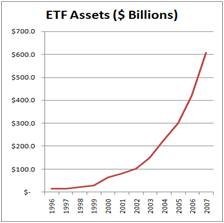
Although I am a firm believer in passive investing, one of its shortcomings is mean reversion. This is the idea that upward or downward moving trends tend to revert back to an average or normal level over time. Active investing can take advantage of mean reversion, conversely passive investing cannot. Indexes can get very top-heavy in weightings of outperforming sectors or industries, meaning theoretically you could be buying larger and larger shares of an index in overpriced glamour stocks on the verge of collapse. We experienced these lopsided index weightings through the technology bubbles in the late 1990s and financials in 2008. Some strategies may be better than other over the long run, but every strategy, even passive investing, has its own unique set of deficiencies and risks.
Professional Sports and Investing
As I discuss in my book, there are similarities that can be drawn between professional sports and investing with respect to active vs. passive management. Like the scarce number of .300 hitters in baseball, I believe there are a select few investment managers who can consistently outperform the market. In 2007, AssociatedContent.com did a study that showed there were only 22 active career .300 hitters in Major League Baseball. I recognize in the investing world there can be a larger role for “luck,” which is difficult, if not impossible, to measure (luck won’t help me much in hitting a 100 mile per hour fastball thrown by Nolan Ryan). Nonetheless, in the professional sports arena, there are some Hall of Famers (prospects) that have proved they could (can) consistently outperform their peers for extended durations of time.
Experience is another distinction I would highlight in comparing sports and investing. Unlike sports, in the investment world I believe there is a positive correlation between age and ability. The more experience an investor gains, generally the better long-term return achieved. Like many professions, the more experience you gain, the more valuable you become. Unfortunately, in many sports, ability deteriorates and muscles atrophy over time.
Size Matters
Experience alone will not make you a better investor. Some investors are born with an innate gift or intellect that propels them ahead of the pack. However, most great investors eventually get cursed by their own success thanks to accumulating assets. Warren Buffet knows the consequences of managing large amounts of dollars, “gravity always wins.” Having managed a $20 billion fund, I fully appreciate the challenges of investing larger sums of money. Managing a smaller fund is similar to navigating a speed boat – not too difficult to maneuver and fairly easy to dodge obstacles. Managing heftier pools of money can be like captaining a supertanker, but unfortunately the same rapid u-turn expectations of the speedboat remain. Managing large amounts of capital can be crippling, and that’s why captaining a supertanker requires the proper foresight and experience.
Room for All
As I’ve stated before, I believe the market is efficient in the long run, but can be terribly inefficient in the short-run, especially when the behavioral aspects of emotion (fear and greed) take over. The “wait for me, I want to play too” greed from the late 1990s technology craze and the credit-based economic collapse of 2008-2009 are further examples of inefficient situations that can be exploited by active managers. However, due to multiple fees, transaction costs, taxes, not to mention the short-term performance/compensation pressures to perform, I believe the odds are stacked against the active managers. For those experienced managers that have played the game for a long period and have a track record of success, I feel active management can play a role.
At Sidoxia Capital Management, I choose to create investment portfolios that blend a mixture of passive and active investment strategies. Although my hedge fund has outperformed the S&P 500 in 2009, that fact does not necessarily mean it’s the appropriate sole approach for all clients. As Warren Buffet states, investors should stick to their “circle of competence” so they can confidently invest in what they know. That’s why I generally stick to the areas of my expertise when I’m actively investing in stocks, and fill in the remainder of client portfolios with transparent, low-cost, tax-efficient equity and fixed income products (i.e., Exchange Traded Funds).
Even though the actively managed Turner Funds appear to have a mixed-bag of performance numbers relative to passively managed strategies, I appreciate Bob Turner’s article for addressing this important issue. I’m sure the debate will never fully be resolved. In the meantime, my client portfolios will aim to mix the best of both worlds within active and passive management strategies in the eternal quest of outwitting the darts, monkeys, and other pros.
Read the full Bob Turner article on Morningstar.com
Wade W. Slome, CFA, CFP®
Plan. Invest. Prosper.
DISCLOSURE: Sidoxia Capital Management (SCM) and some of its clients own certain exchange traded funds but had no direct position in stocks mentioned in this article. No information accessed through the Investing Caffeine (IC) website constitutes investment, financial, legal, tax or other advice nor is to be relied on in making an investment or other decision. Please read disclosure language on IC “Contact” page.




 Investing Caffeine
