Posts tagged ‘Trading’
King of Controversy Reveals Maverick Solution

Mark Cuban, provocative and brash owner of the Dallas Mavericks basketball team and #400 wealthiest person in the world ($2.4 billion net worth), according to Forbes, has never been shy about sharing his opinion. In fact, this multi-billionaire’s opinions have been discouraged on multiple occasions, as evidenced by the NBA (National Basketball Association) slapping Cuban with more than $1.6 million in fines for his outbursts.
Cuban doesn’t only provide his views on basketball, as a serial entrepreneur who cashed in his former company Broadcast.com to Yahoo! (YHOO) for $5.9 billion, he also is providing his thoughts on Wall Street and the 1,000 point “fat finger” trading meltdown from last week. What does Cuban say is the answer to the rampant speculation conducted by idiot financial engineers? “Tax the Hell Out of Wall Street,” says Cuban in his recent blog flagged by TRB’s Josh Brown.
A Taxing Solution
Specifically, Cuban wants to tax investors 25 cents per share (and 5 cents per share for stocks trading at $5 per share or less) in hopes of encouraging myopic speculating traders to become longer-term shareholders. Cuban believes this approach will weed out the day traders and investment renters who in reality “don’t add anything to the markets.” Seems like a reasonable belief to me.
According to Cuban’s math, here are some of the benefits the tax would bring to the financial system:
“If the NYSE, Nasdaq, Amex and OTC are trading 2 Billion shares a day or more, like today, thats $ 500 Million Dollars PER DAY. If there are 260 trading days a year. Thats about 130 Billion dollars a year. If volumes drop because of the tax. It is still 10s of Billions of dollars per year. Thats real money for the US Treasury. Thats also an annual payment towards the next time Wall Street screws up and we have a black swan event that no one planned on.”
Practically speaking, a flat rate 25 cent tax per share is probably not the best way to go if you were to introduce a transaction tax, but the crux of Cuban’s argument essentially would not change. Creating a flat percentage tax (e.g., 1%) would likely make more sense, even if complexity may increase relative to the 25 cent tax. Take for example Citigroup (C) and Berkshire Hathaway Class A (BRKA). Cuban’s plan would result in paying 1.2% tax on a $4.17 share of Citigroup versus only 0.00022% tax for a $116,000.00 share of Berkshire Hathaway. Simple accounting maneuvers such as reverse stock splits and slowing of stock dividends, along with reducing company dilution through share and option issuance, may be methods of circumventing some of the tax burden created under Cuban’s described proposal.
Politically, adding any tax to investing voters could be re-election suicide, so rather than calling it a trading tax, I suppose the politicians would have to come up with some other euphemism, such as “charitable administrative fee for speculative trading.” The financial industry has already become experts in taxing investors with fees (read Fees, Exploitation and Confusion), so maybe Congress could give the banks and fund companies a call for some marketing ideas.
Step 1: Transparency
The murkiness and lack of transparency across derivatives markets is becoming more and more evident by the day. Some recent events that bolster the argument include: a) New CDO (Collateralized Debt Obligation) derivative allegations surfacing against Morgan Stanley (MS); b) The SEC (Securities and Exchange Commission) charges against Goldman Sachs (GS) in the Abacus synthetic CDO deal (see Goldman Sachs article); c) The collapse of AIG’s Credit Default Swap (CDS) department and subsequent push to transfer trading to open exchanges; and d) Now we’re dealing with last week’s cascading collapse of the equity markets within minutes. The brief cratering of multiple indexes points to a potential order entry blunder and/or absence of adequate and consistent circuit breakers across a web of disparate exchanges and ECNs (Electronic Communication Networks).
The mere fact we stand here five days later with no substantive explanation for the absurd trading anomalies (see Making Megabucks 13 Minutes at a Time) is proof positive changes in derivative and exchange transparency are absolutely essential.
Step 2: Incentives
In Freakonomics, the best-selling book authored by Steven Levitt, we learn that “Incentives are the cornerstone of modern life,” and “Economics is, at root, the study of incentives.” Incentives are crucial in that they permeate virtually all aspects of financial markets, not only in assisting economic growth, but also the negative aspects of bursting financial bubbles.
Michael Mauboussin, the Chief Investment Strategist at Legg Mason (read more on Mauboussin), also expands on the role incentives played in the housing collapse:
“Many, if not most, of the parties involved in the mortgage meltdown were doing what makes sense for them—even if it wasn’t good for the system overall. Homeowners got to live in fancier homes, mortgage brokers earned fees on the mortgages they originated without having to worry about the quality of the loans, investment banks earned tidy fees buying, packaging, and selling these loans, rating agencies made money, and investors earned extra yield on so-called AAA securities. So it’s a big deal to watch and unpack incentives.”
Regulation, penalties, and fines are means of creating preventative incentives against improper or unfair behavior. Just as people have no incentive to wash a rental car, nor do high frequency traders have an incentive to invest in equity securities for any extended period of time. Adding a Cuban tax may not be a cure-all for all our country’s financial woes, but as the regulatory reform debate matures in Congress, this taxing idea emanating from the King of Controversy may be a good place to start.
Read full blog article written by Mark Cuban
Wade W. Slome, CFA, CFP®
Plan. Invest. Prosper.
*DISCLOSURE: Sidoxia Capital Management (SCM) and some of its clients own certain exchange traded funds and an AIG subsidary structured security, but at the time of publishing SCM had no direct positions in YHOO, C, AIG, LM, GS, BRKA, or any security referenced in this article. No information accessed through the Investing Caffeine (IC) website constitutes investment, financial, legal, tax or other advice nor is to be relied on in making an investment or other decision. Please read disclosure language on IC “Contact” page.
Making +457,425,000% – 13 Minutes at a Time

I love investing, but sometimes the shear boredom can get a little tiresome. I mean, a puny little -500 point collapse in the Dow Jones Industrial Average every five minutes can be so 1987. Thank goodness for yesterday’s largest, intra-day point-drop in history (almost 1,000 points) because without out such a meltdown, I might fall asleep at the trading desk and there would be no way to make an annualized +457,425,000% (~457 million percent) trade in a single day. Earning a well-deserved return like that will not only exceed the rates achieved on T-Bills, but will also likely outpace inflation as well. Making that kind of money is not bad work, if you can get it.
Executing the Tricky Trade
Sound difficult to do? Well, not really. All you need to do is find a stock or security that has fallen more than 99% in a single day, then buy the security for 10 cents per share and then sell it immediately, minutes later at $61.09. Repeat this process another 390 times per day for 52 weeks, and you’re well on your way of turning $1 into $4.5 million over a year.
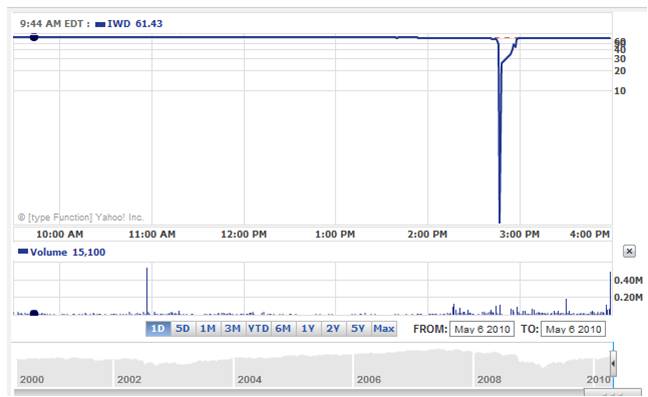
IWD Chart (Source: Yahoo! Finance)
Take for example, the iShares Russell 1000 Value Exchange Traded Fund (ETF), IWD, which yesterday traded for pennies at 3:47 p.m. Eastern Standard Time (EST) and skyrocketed over +600x fold in the subsequent 13 minutes. Fortunately (or unfortunately), depending on how you perceive the situation, the irregular trading activity was not limited to IWD. Other securities showing severe abnormal trading patterns include, Accenture (ACN), Boston Beer (SAM), Exelon (EXC), CenterPoint Energy (CNP), Eagle Material (EXP), Genpact Ltd (G), ITC Holdings (ITC), Brown & Brown (BRO), and Casey’s General (CASY). In full disclosure, I did not take advantage of any 99% pullbacks yesterday, but now that I know how the game works, I will be on full alert.
What the F*%$# Happened?
Initially reports pointed to a Citigroup (C) trader who entered into an inadvertent $16 billion (with a “b”) E-Mini futures trade order, when the trader meant to enter a trade for $16 million (with an “m”)…ooops! This alleged transaction purportedly triggered a wave of selling, culminating in a select group of stocks temporarily trading down to pennies in value. There is a related, yet more plausible, potential explanation. Quite possibly, as a function of excessive trading volume overwhelming the New York Stock Exchange, the overflow of trades migrated to less liquid ECNs (Electronic Communication Networks) and over-the-counter markets. Chances are the high frequency traders were not blindly jumping in front of the train. Whom really got screwed were the retail investors that had stop loss orders at “market” prices, which likely were triggered at unattractive prices.
I’m not sure if we will ever find out what truly happened, but whatever explanations are provided, rest assured there will be multiple more conspiracy theories on top of the legitimate guesses. The top 5 conspiracies I’m pushing are the following:
1) Frustrated by the fraud charges filed by the SEC (Securities and Exchange Commission), Goldman Sachs intentionally tripped over a power cord at the New York Stock Exchange (NYSE), which triggered a wave of bogus trades.
2) High Frequency Traders (see HFT Article) were upgrading their computers from Windows Vista to Windows 7 and experienced an outage causing global disruption.
3) In order to pay for the potential upcoming lawsuit liabilities and SEC fines, Goldman shorted the Dow Jones Industrial index at 10,800 and then went long once the index broke 10,000.
4) Warren Buffett was rumored to suffer a heart attack, but after realizing belching relieved his chest pain, the markets recovered dramatically.
5) Worried that regulatory reform may not pass, a secret group of Congressmen shorted stocks (see Do As I Say, Not As I Do article) to push stocks lower, then distributed TARP (Troubled Asset Relief Program) assets to voters minutes later in order to buy November votes and push stock prices higher.
Political Aftermath

Politicians will be frothing at the mouth or be pressured into approving financial reform. Even if markets manage to stabilize in the coming days and weeks, the pressure to ram regulatory reform through Capitol Hill will be mind-numbing. Mary Shapiro, Chairman of the SEC, and politicians will also be pushing to produce a clear scapegoat to throw under the bus, whether it is a trader at Citi, a high frequency traders at Goldman Sachs, the CEO at the NYSE (Duncan Niederauer), or a talking baby from the E-TRADE commercials. Regardless, depending on how quickly a credible explanation is unearthed, we will know how much, if any, reform is needed. If the markets are genuinely transparent, following the paper trail of responsibility to the stocks that dropped to $.00 or $.01 a share should be a piece of cake. If the systems are too complex to explain why handfuls of stocks are trading to $0, then even I am willing to look up to the skies and say heaven help us with some tighter oversight.
Over the last few years, there have been very few dull, financial moments and the markets did very little to disappoint yesterday. Irrespective of the political mudslinging, scapegoating, or irresponsible behavior, the SEC needs to get to the bottom of these issues rapidly in order to protect the integrity and trust of global players in our markets. What we don’t need is a political knee-jerk reaction that merely creates unintended, negative consequences. No matter what happens, I will at least be equipped to test a new strategy designed to make +457,425,000%.
Wade W. Slome, CFA, CFP®
Plan. Invest. Prosper.
*DISCLOSURE: Sidoxia Capital Management (SCM) and some of its clients own certain exchange traded funds, but at the time of publishing SCM had no direct positions in GS, IWD, C, BRKA/B, CNP, EXP, G, ITC, BRO, and CASY, or any security referenced in this article. No information accessed through the Investing Caffeine (IC) website constitutes investment, financial, legal, tax or other advice nor is to be relied on in making an investment or other decision. Please read disclosure language on IC “Contact” page.
Getting off the Market Timing Treadmill

Most investors have been stuck on the financial treadmill of the 2000s and have nothing to show for it, other than battle scars from the 2008-2009 financial crisis. A lot of running, sweating, and jumping has produced effectively no results. Most media outlets continue to focus on the “lost decade” (see other Lost Decade story) in which investors have earned nothing in the equity markets. After a decade of excess in the 1990s should the majority of investors be surprised? Investing is no different than dieting and exercise – those topics are easy to understand but difficult to execute.
Where are the Billionaire Market Timers?
The financial industry oversimplifies investing and sells market timing as an effortless path to riches – even in tough times. In the search of the financial Holy Grail, the industry constantly crams new software bells and whistles and so-called “can’t lose” strategies down the throats of individual investors. Sadly, there is no miracle system, wonder algorithm, or get rich scheme that can sustainably last the test of time. Sure, a minority of speculators can get lucky and make money by following a risky strategy in the short-run, but as the global economic disaster caused by LTCM (Long Term Capital Management) taught us, even certain successful trading strategies or computer algorithms can stop working in a heartbeat and lead to a widespread bloodbath.
Are you still a believer in market timing? If so, then where are all the billionaire market timers? Famed growth manager, Peter Lynch astutely noted:
“I can’t recall ever once having seen the name of a market timer on Forbes‘ annual list of the richest people in the world. If it were truly possible to predict corrections, you’d think somebody would have made billions by doing it.”
Certainly, there are some hedge fund managers that have hit home runs with amazing market calls, but time will be the arbiter in determining whether they can stay on top.
Sage Speak on Market Timing
If you don’t believe me about market timing, then listen to what knowledgeable investors and thought leaders have to say on the subject. Larry Swedroe, a principal at Buckingham Asset Management, compiled a list including the following quotes:
- Warren Buffett (Investor extraordinaire): “We continue to make more money when snoring than when active.” He adds, “The only value of stock forecasters is to make fortune-tellers look good.”
- Jason Zweig (Columnist): “Whenever some analyst seems to know what he’s talking about, remember that pigs will fly before he’ll ever release a full list of his past forecasts, including the bloopers.” (See also Peter Schiff and Meredith Whitney stories)
- Bernard Baruch (Financier): “Only liars manage to always be out during bad times and in during good times.”
- Jonathan Clements (Columnist): “What to do when the market goes down? Read the opinions of the investment gurus who are quoted in the WSJ. And, as you read, laugh. We all know that the pundits can’t predict short-term market movements. Yet there they are, desperately trying to sound intelligent when they really haven’t got a clue.”
- David L. Babson (Investment Manager): “It must be apparent to intelligent investors that if anyone possessed the ability to do so [forecast the immediate trend of stock prices] consistently and accurately he would become a billionaire so quickly he would not find it necessary to sell his stock market guesses to the general public.”
- Peter Lynch (Retired Growth Manager): “Far more money has been lost by investors preparing for corrections, or trying to anticipate corrections, than has been lost in corrections themselves.”
Market Timing Road Rules
Rather than make guesses regarding the direction of the market, here are some investment rules to follow:
- Rule #1: Do not attempt to market time. Statistically it is a certainty that a minority of the millions of investors can time the market in the short-run – the problem is that very few, if any, can time the market for sustainable periods of time. Don’t try to be the hero, because often you will become the goat.
- Rule #2: Patiently make good investments, regardless of the economic conditions. It is best to assume the market will go nowhere and invest accordingly. Paying attention to a hot or cold economy leads to investors chasing their tails. Good investments should outperform in the long-run, regardless of the macroeconomic environment.
- Rule #3: Diversify. In the midst of the crisis, diversification didn’t cure simultaneous drops in most asset classes, however ownership of government Treasuries, cash, and certain commodities provided a cushion from the economic blows. Longer-term, the benefits of diversification become more apparent – it makes absolute sense to spread your risk around.
In some respects, there is always an aspect of timing to investing, but as referenced by some of the intelligent professionals previously, the driving force behind an investment decision should not be, “I think the market is going up,” or “I think the market is going down” – those thought processes are recipes for disaster. I strongly believe an investment process that includes patience, discipline, diversification, valuation sensitivity, and low-cost/ tax-efficient products and strategies will get you off the financial treadmill and move you closer to reaching your financial goals.
Read the Full Larry Swedroe Story
Wade W. Slome, CFA, CFP®
Plan. Invest. Prosper.
DISCLOSURE: Sidoxia Capital Management (SCM) and some of its clients own certain exchange traded funds, but at time of publishing had no direct positions in BRKA or any other security mentioned. No information accessed through the Investing Caffeine (IC) website constitutes investment, financial, legal, tax or other advice nor is to be relied on in making an investment or other decision. Please read disclosure language on IC “Contact” page.




 Investing Caffeine
