Posts tagged ‘technology’
Technology Does Not Sleep in a Recession

Our economy may be coming out of a long economic hibernation; however technology does not sleep through a recession. Gordon Moore, co-founder of Intel Corporation, has proven this trend true through his groundbreaking piece written in the April 1965 issue of Electronics Magazine. In the article Mr. Moore predicted transistor densities would double about every two years (“Moore’s Law”). Transistors can be thought of as the brains of electronics devices, and the industry (Intel and other semiconductor manufacturers) has been boosting the brain power of electronics for decades. How far has the industry come? The number of transistors contained on a chip has gone from 16 in 1960s to over 600 million today – now that’s what I call progress!
These achievements have been nothing short of revolutionary, and many people consider the introduction of the transistor as the greatest invention of the 20th century. According to many industry experts, Mr. Moore’s forecasts have been shockingly accurate and many believe “Moore’s Law” will hold true for years to come – despite challenging technological limitations.

Source: The Financial Times
We may curse at our computers (I absolutely despise Vista), but there is no arguing with the huge productivity and standard of living improvements we have experienced over the last forty years – since the introduction of the transistor. Many take their GPS, Tivo, WiFi laptop, iPhone, and HiDef TVs for granted, however I for one thank Gordon Moore and those diligent engineers for making my geeky tech dreams come true.
However the cost of further advancements is becoming pricier. As line widths (the ability to add more transistors) narrow, the costs of building fabrication plants (“fabs”) with the necessary equipment are running in the multi-billion range. The Financial Times (FT) article talking about semiconductor trends mentions a $4.2 billion state-of-the-art factory in upstate New York that is just beginning construction. The FT notes that only two players (Intel and Samsung) have firm plans to build 20 nanometer fabs. For comparison purposes, one nanometer is equal to one-billionth of a meter and a human hair is 100,000 nanometers wide. In other words, a nanometer is pretty darn tiny. To further illustrate the point, Intel has managed to fit up to 11 Intel Atom processors – each packed with 47 million transistors – on the face of an American penny.
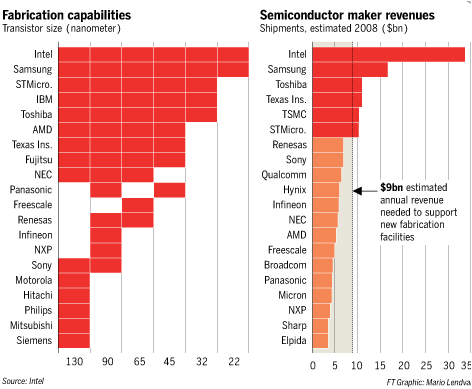
Source: The Financial Times
As the chip making industry become more costly, fewer semiconductor manufacturers will be playing in the sandbox:
“Intel argues that only companies with about $9bn in annual revenues can afford to be in the business of building new fabs, given the costs of building and operating the factories and earning a decent 50 per cent margin. That leaves just Intel, Samsung, Toshiba, Texas Instruments and STMicroelectronics.”
The economy may still be in the doldrums, but the $60 trillion global economy (as measured by Gross Domestic Product) never sleeps – technologies created by Gordon Moore and others continue to propel amazing advancements.
Wade W. Slome, CFA, CFP®
Plan. Invest. Prosper.
Calamos Still “Growing” Strong

Calamos Investments recently came out with their quarterly Market Review and Outlook. John P. Calamos, Sr., the Company founder, began investing his family’s money over 50 years ago and is well known for their successful “growth” style of investing. Calamos founded Calamos Asset Management in 1977, and won BusinessWeek’s best manager for 2003 and 2004. Over the years, the company diversified from its bread and butter convertibles into equity, enhanced fixed-income, global and international, core bond, cash management and alternative strategies. Overall, the newsletter offers a fairly sobering outlook (“Longterm Scared”); however there are some excellent investing nuggets, especially when it comes to the firm’s current positioning:
“Because we are not in a secular bull market, investing discipline is even more important. We believe these are the rules for today’s environment”:
1. Washington D.C. is the new growth city
2. Valuations will not get as stretched in the equity markets and growth expectations will be revised down considerably
3. Old-fashioned dividends mean something
4. G7 competitive devaluations and protectionist legislation will become the norm
5. To grow, emerging nations must become consumption driven and attempt to become independent of the developed nations
6. Knowledge is free, but capital may be much harder to get
7. Real returns after tax will take on new meaning
8. Baby boomers will reprioritize spending
9. The rules will change often!
Technology Exposure: For those that have followed my writings in the past, you are familiar with my positive bias towards technology. The technology sector is littered with land mines and risks. Nonetheless, through technology, our country has and will continue to innovate new products and services that will improve our standard of living. The “Technology Revolution” is not only benefiting our society, we are exporting the fruits of our discoveries to developing countries across the world. Take Intel Corporation (INTC) for example – it garnered about 85% of its revenues in 2008 from international markets.
Here is what Calamos has to say about their “Significant Overweight” exposure to the Technology sector:
“Productivity enhancement and cost controls should help technology spending.”
- We see consumers remaining willing to purchase certain “special” products such as iPhones, laptops and flat-screens.
- We have found software companies offering stable revenue streams, strong balance sheets with lots of cash, and products that offer solutions for cost reduction and productivity.
- The sector will also benefit from global infrastructure stimulus spending.
- Stock valuations are attractive and the risk/reward is compelling.
- The sector may be re-establishing its leadership position in the equity market for the first time since last decade’s collapse.”
Materials and Energy Exposure: Developing countries are joining the party too, albeit later than the rest of the partygoers. The price of admission to the party is access to valuable commodities. Calamos has other reasons to be overweight the Materials and Energy sectors:
- Muted recovery implied in stock valuations.
- Further U.S. dollar devaluation and global stimulus spending should help boost commodity prices.
- The small capitalization of this sector and volatility of commodity prices will again make it prone to large price swings.
- U.S. dollar devaluation should help support energy prices.
- Mid-East turmoil adds to the attractiveness of this sector as it can hedge unforeseen energy price spikes.
- Stock valuations appear reasonable but government intervention will make this a difficult sector to value.
Like all great managers, Calamos has taken his lumps, but through it all his firm is still “growing” strong.
Wade W. Slome, CFA, CFP®
Plan. Invest. Prosper.




 Investing Caffeine
