Posts tagged ‘S&P 500’
The Halloween Indicator Buried at Cemetery in 2009

Boo!
Statisticians, economists, speculators, and superstitious investors have been known to get spooked by scary patterns. Tomorrow marks the end of the menacing six month period of supposed underperformance that starts in May and ends on Halloween. The so-called “Halloween Indicator” has popularized the expression of “sell in May and walk away.” The indicator obviously has not followed the alleged tendency in 2009, as there has been more “treat” than “trick” for investors over the last six months. The S&P has rallied about +22% (excluding dividends) with only one day left in the trading period. Numerous academics have studied the phenomenon and not surprisingly there is some debate regarding the validity of various studies (see past study) – differing opinions have risen to the surface, depending on the number of years compiled in the data.
Here is what Mark Hulbert at MarketWatch had to say on the subject:
“Over the Dow’s history up until the last 12 months, there were no fewer than 17 occasions (15% of the years) in which both the winter months turned in a net loss for the stock market and the summer months produced a gain. There furthermore were 45 years (41% of the time) in which the stock market during the summer period did better than it did over the winter months that immediately preceded it. So the stock market’s performance over the last 12 months is hardly exceptional. It would take a lot more than the recent seasonal missteps to convince a statistician that this long-term pattern has stopped working for good. “
Other calendar effects besides the Halloween Indicator include, the January Effect, Monday Effect, and Presidential Cycle. Even though some pundits point to evidence supporting calendar effects, in many cases the data is proved to be statistically insignificant.
With Halloween just around the corner, here’s Sidoxia Capital Management wishing you a larger bag of treats rather than tricks in your quest in following calendar effects.
Wall Street Halloween Costume Ideas:
Short of ideas for Halloween costumes this year? No need to fear. Here are a few bloodcurdling Wall Street costume ideas with the help of Joshua Brown at The Reformed Broker and our friends at Forbes:

Top Ten Scariest Wall Street Halloween Costumes
Halloween Index:
For those that would rather get there treats from the stock market rather than a candy bowl, perhaps you may find a sweet idea from Stockerblog’s Halloween Stock Index.
Have a happy and safe Halloween!
Wade W. Slome, CFA, CFP®
Plan. Invest. Prosper.
DISCLOSURE: Sidoxia Capital Management and client accounts do not have direct positions in any of the Halloween Stock Index companies with the exception of long positions in WMT for some Sidoxia accounts. No information accessed through the Investing Caffeine (IC) website constitutes investment, financial, legal, tax or other advice nor is to be relied on in making an investment or other decision. Please read disclosure language on IC “Contact” page
Dry Powder Piled High

Money goes where it is treated best. Sometimes idle cash contributes to the inflation of speculative bubbles, while sometimes that same capital gets buried in a bunker out of fear. The mood-swing pendulum is constantly changing; however with the Federal Funds Rate at record lows, some of the bunker money is becoming impatient. With the S&P 500 up +60% since the March lows, investors are getting antsy to put some of the massive mounds of dry powder back to work – preferably in an investment vehicle returning more than 1%.
How much dry powder is sloshing around? A boatload. Bloomberg recently referenced data from ICI detailing money market accounts flush with a whopping $3.5 trillion. This elevated historical number comes despite a $439.5 million drop from the record highs experienced in January of this year.
From a broader perspective, if you include cash, money-market, and bank deposits, the nation’s cash hoard reached $9.55 trillion in September. What can $10 trillion dollars buy? According to Bloomberg, you could own the whole S&P 500 index, which registers in at a market capitalization price tag of about $9.39 trillion. The article further puts this measure in context:
“Since 1999, so-called money at zero maturity has on average accounted for 62 percent of the stock index’s worth. … Before the collapse of New York-based Lehman Brothers Holdings Inc. last year, the amount of cash never exceeded the value of U.S. equities.”
Cash levels remain high, but the 60% bounce from the March lows is slowly siphoning some money away. According to ICI data, $15.8 billion has been added to domestic-equity funds since March. Trigger shy fund managers, fearful of the macro-economic headlines, have been slow to put all their cash to work, as well. Jeffrey Saut, chief investment strategist at Raymond James & Associates adds “Many of the fund managers I talk to that have missed this rally or underplayed this rally are sitting with way too much cash.”
With so much cash on the sidelines, what do valuations look like since the March rebound?
“The index [S&P 500] trades for 2.18 times book value, or assets minus liabilities, 33 percent below its 15-year average, data compiled by Bloomberg show. The S&P 500 was never valued below 2 times net assets until the collapse of Lehman, data starting in 1994 show. The index fetches 1.15 times sales, 22 percent less than its average since 1993.”
On a trailing P/E basis (19x’s) the market is not cheap, but the Q4 earnings comparisons with last year are ridiculously easy and companies should be able to trip over expectations. The proof in the pudding comes in 2010 when growth in earnings is projected to come in at +34% (Source: Standard & Poor’s), which translates into a much more attractive multiple of 14 x’s earnings. Revenue growth is the missing ingredient that everyone is looking for – merely chopping an expense path to +34% earnings growth will be a challenging endeavor for corporate America.
Growth outside the U.S. has been the most dynamic and asset flows have followed. With some emerging markets up over +100% this year, the sustainability will ultimately depend on the shape of the global earnings recovery. At the end of the day, with piles of dry powder on the sidelines earning next to nothing, eventually that capital will operate as productive fuel to drive prices higher in the areas it is treated best.
Read the Complete Bloomberg Article Here.
Wade W. Slome, CFA, CFP®
Plan. Invest. Prosper.
Stock Market Nirvana: Butter in Bangladesh

Hallelulah to Jason Zweig at The Wall Street Journal for tackling the subject of data mining through his interview with David Leinweber, author of Nerds on Wall Street. All this talk about Goldman Sachs, High Frequency Trading (HFT) and quantitative models is making my head spin and distorting the true value of data modeling. Quantitative modeling should serve as a handy device in your tool-box, not a robotic “black box” solely relied on for buy and sell recommendations. As the article points out, all types of sites and trading platforms are hawking their proprietary tools and models du jour.
The problem with many of these models, even for the ones that work, is that financial market behavior and factors are constantly changing. Therefore any strategy exploiting outsized profits will eventually be discovered by other financial vultures and exploited away. As Mr. Leinweber points out, these models become meaningless if the data is sliced and diced to form manipulated relationships and predictive advice that make no sense.
Butter in Bangladesh: To drive home the shortcomings of data mining, Leinweber uses a powerful example in his book, Nerds on Wall Street, of butter production in Bangladesh. In searching for the most absurd data possible to explain the returns of the S&P 500 index, Leinweiber discovered that butter production in Bangladesh was an excellent predictor of stock market returns, explaining 75% of the variation of historical returns. The Wall Street Journal goes onto add:
By tossing in U.S. cheese production and the total population of sheep in both Bangladesh and the U.S., Mr. Leinweber was able to “predict” past U.S. stock returns with 99% accuracy.
For some money managers, the satirical stab Leinweber was making with the ridiculous analysis was lost in translation – after the results were introduced Leinweber had multiple people request his dairy-sheep model. “A distressing number of people don’t get that it was a joke,” Leinweber sighed.
Super Bowl Crystal Ball: Leinweber is not the first person to discover the illogical use of meaningless factors in quantitative models. Industry observers have noticed stocks tend to perform well in years the old National Football league team wins the Super Bowl. Unfortunately, this year we had two “old” NFL teams play each other (Pittsburgh Steelers and Arizona Cardinals). Oops, I guess we need to readjust those models again.
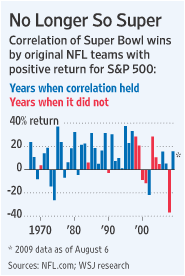
Other bizarre studies have been done linking stock market performance to the number of nine-year-olds living in the U.S. and another linking positive stock market returns to smog reduction.
Data Mining Avoidance Rules:
1) Sniff Test: The data results have to make sense. Correlation between variables does not necessarily equate to causation.
2) Cut Data into Slices: By dividing the data into pieces, you can see how robust the relationships are across the whole data set.
3) Account for Costs: The results may look wonderful, but the model creator must verify the inclusion of all trading costs, fees, and taxes to increase confidence results will work in the real world.
4) Let Data Brew: What looks good on paper might not work in real life. “If a strategy’s worthwhile,” Mr. Leinweber says, “then it’ll still be worthwhile in six months or a year.”
Not everyone has a PhD in statistics, however you don’t need one to skeptically ask tough questions. Doing so will help avoid the buried land mines in many quantitative models. Happy butter churning…
Wade W. Slome, CFA, CFP®
Plan. Invest. Prosper.
V-Shaped Recovery or Road to Japan Lost Decades?
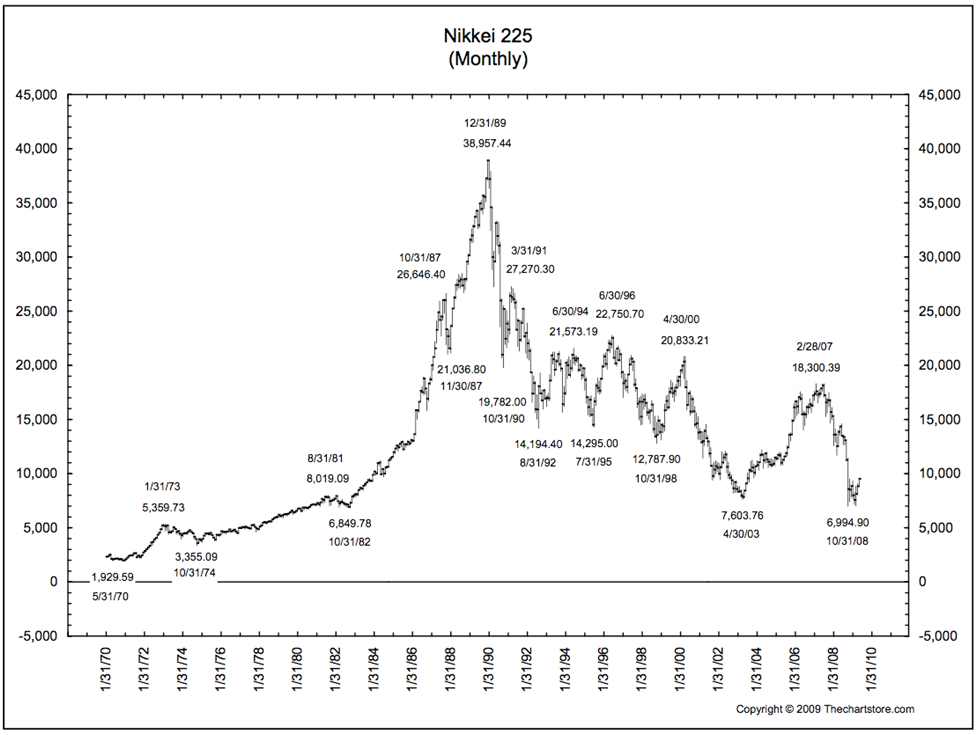
The Lost Decades from the 1989 Peak
On the 6th day of March this year, the S&P 500 reached a devilish low of 666. Now the market has rebounded more than 50% over the last five months. So is this a new bull market throttled into gear, or is it just a dead-cat bounce on route to a lost two decades, like we saw in Japan?
Smart people like Nobel Prize winner and economist Paul Krugman make the argument that like Japan, the bigger risk for the U.S. is deflation (NY Times Op-Ed), not inflation.
Now I’m no Nobel Prize winner, but I will make a bold argument of why Professor Krugman is out to lunch and why we will not go in a Japanese death-like, deflationary spiral.
Let’s review why our situation is dissimilar from our South Pacific friends.
Major Differences:
- Japanese Demographics: The Japanese population keeps getting older (see UN chart), which will continue to pressure GDP growth. According to the National Institute of Population and Social Security Research, by 2055 the Japanese population will fall 30% to 90 million (equivalent to 1955 level). Over the same time frame, the number of elderly under age 65 is expected to halve. To minimize the effects of the contraction of the working population, it will be necessary both to increase labor productivity, loosen immigration laws, and to promote the employment of woman and people over 65. Japan’s population is expected to expected contraction in Japan’s labor force of almost 1% a year in 2009-13.

Source: The Financial Times/UN (Declining Workforce Per 65 Year Old)
- Bank of Japan Was Slow to React: Japan recognized the bubble occurring and as a result hiked its key lending discount rate from 1989 through May 1991. The move had the desired effect by curbing the danger of inflation and ultimately popped the Nikkei-225 bubble. Stock prices soon plummeted by 50% in 1990, and the economy and land prices began to deteriorate a year later. Belatedly, Japan’s central bank began a series of interest rate-cuts, lowering its discount rate by 500-basis points to 1% by 1995. But the Japanese economy never recovered, despite $1-trillion in fiscal stimulus programs.
- The Higher You Fly, the Farther You Fall: The relative size of the Japanese bubble was gargantuan in scale compared to what we experienced here in the United States. The Nikkei 225 Index traded at an eye popping Price-Earnings ratio of about 60x before the collapse. The Nikkei increased over 450% in the eight years leading up to the peak in 1989, from the low of about 6,850 in October 1982 to its peak of 38,957 in December 1989. Compare those extreme bubble-icious numbers with the S&P 500 index, which rose approximately a more meager 20% from the end of 1999 to the end of 2007 (U.S. peak) and was trading at more reasonable 18x’s P-E ratio.
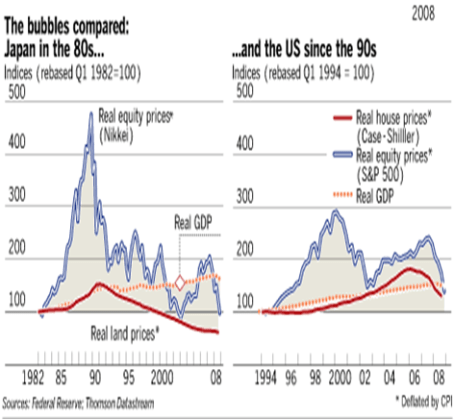
Source: Dow Jones
- Debt Levels not Sustainable: Japan is the most heavily indebted nation in the OECD. Japan is moving towards that 200% Debt/GDP level rapidly and the last time Japanese debt went to 200% of GDP (during WWII), hyper-inflation ensued and forced many fixed income elderly into poverty. Although our debt levels have yet to reach the extremes seen by Japan, we need to recognize the inflationary pressure building. Japan’s debt bubble cannot indefinitely sustain these debt increases, leaving little option but to eventually inflate their way out of the problem.
- Banking System Prolongs Japanese Deflation: Despite the eight different stimulus plans implemented in the 1990s, Japan lacked the fortitude to implement the appropriate corrective measures in their banking system by writing off bad debts. An article from July 2003 Barron’s article put it best:


After the collapse of the property bubble, many families and businesses had debts that far exceeded their devalued assets. When a version of this happened in America in the savings-and-loan crisis, the resulting mess was cleaned up quickly. The government seized assets, sold them off, bankrupted ailing banks and businesses, sent a few crooks to jail and everything started fresh, so that deserving new businesses could get loans. The process is like a tooth extraction — painful but mercifully short. In Japan this process has barely begun. Dynamic new businesses cannot get loans, because banks use available credit to lend to bankrupt businesses, so they can pretend they are paying their debts and avoid the pain of write-offs. This is self-deception. The rotten tooth is still there. And the Japanese people know it.
The Future – Rise of the Rest: Fareed Zakaria, Newsweek editor wrote about the “Rise of the Rest” in an incredible article (See Sidoxia Website) describing the rising tide of globalization that is pulling up the rest of the world. The United States population represents only 5% of the global total, and as the technology revolution raises the standard of living for the other 95%, this trend will only accelerate the demand of scarce resources, which will create a constant inflationary headwind.
For those countries in decline, like Japan, demand destruction raises the risk of deflation, but historically the innovative foundation of capitalism has continually allowed the U.S. to grow its economic pie. Economic legislation by our Congress will help or hinder our efforts in dealing with these inflationary pressures. One way is to incentivize investment in innovation and productive technologies. Another is to expand our targeted immigration policies towards attracting college educated foreigners, thereby relieving aging demographics pressures (as seen in Japan). These are only a few examples, but regardless of political leanings, our country has survived through wars, assassinations, terrorist attacks, banking crises, currency crises, and yes recessions, to only end up in a stronger global position.
This crisis has been extremely painful, but so have the many others we have survived. I believe time will heal the wounds and we will eventually conquer this crisis. I’m confident that historians will look at the coming years in favorable light, not the lost decades of pain as experienced in Japan.
Wade W. Slome, CFA, CFP®
Plan. Invest. Prosper.
Mountains of Cash Starting to Trickle Back

The month of July was an interesting month because investors opened their 401k and investment statements for the first time in a long while to notice an unfamiliar trend… account values were actually up. Like a child that has burnt their hand on a stove, the wounds and memories are still too fresh – more time must pass before investors decide to get back into the market in full force.
As you can see from the charts below, as investors globally panicked throughout 2008 and early 2009, money earning next to nothing in CDs and Money Market accounts was stuffed under the mattress in droves. The fear factor of last fall has caused current liquid assets to stand near 10 year highs at a level near 120% of the S&P 500 total market capitalization (Thomson Reuters) and at more extreme levels last fall if you just look at Money Market assets (bottom chart) . Now that the Armageddon scenario has been temporarily put to rest, we’re starting to see some of that cash to trickle back into the market. The silver lining is that there is still plenty of dry powder left to drive the market higher – not overnight, but once sustained confidence returns. If the earnings outlook continues to improve, come the beginning of October when 3rd quarter statements arrive in the mail, the pain of not being in the market will overwhelm the fear of burning another hand on the stove like in 2008.

It is funny how the sentiment pendulum can swing from the grips of despair a year ago. There is still headroom for the market to climb higher before the pendulum swings too far in the bullish direction – if you don’t believe me just look on the horizon at the mountain of cash.

Source: SentimenTrader.com (Fall 2008)
Wade W. Slome, CFA, CFP®
Plan. Invest. Prosper.
Quarterly Earnings Avalanche – What the %&*$# is Going On?

Last week we received an avalanche of earnings reports (with a ton more reporting this week) and investors are now interpreting the data.
The recent stock market rally can be simply boiled down to companies releasing better than expected quarterly earnings. As my great pal Peter Lynch says, “People may bet on hourly wiggles of the market but it’s the earnings that waggle the wiggle long term.” A whopping 77% of S&P 500 companies that have reported Q2 (June) earnings thus far have reported earnings results better than Wall Street expectations. Earnings estimates are being ratcheted up for the first time since August 2007. Intel got the party started in the technology world, trouncing both top and bottom line estimates. Certainly, overall, the top line results for corporations have been more challenging and mixed. However, with additional earnings available to companies, more resources can be plowed back into future marketing and revenue generating activities. Moreover, due to the extreme cost-cutting measures taken, once the economy recovers, corporations will be able to tap into the enormous earnings power potential created.
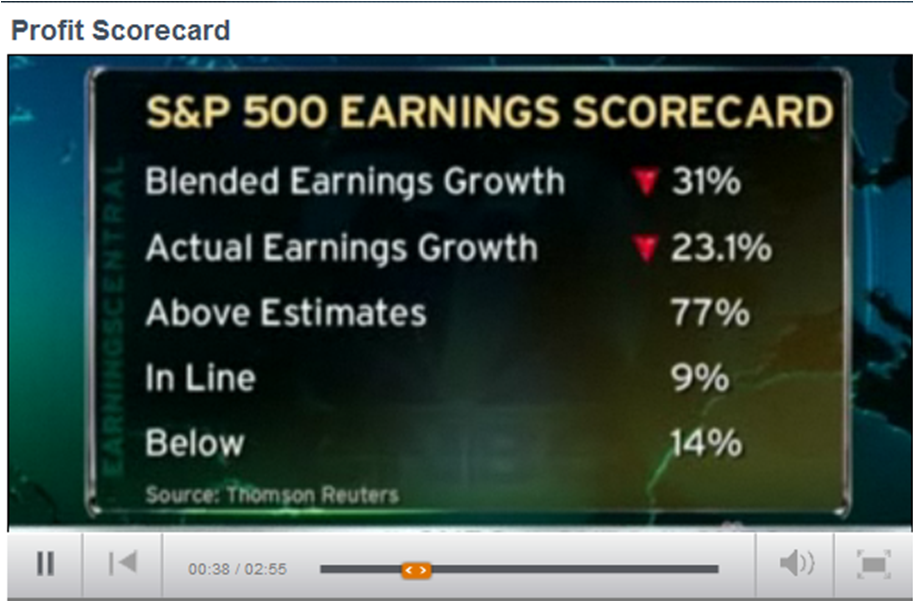
Click Here for CNBC Quarterly Earnings Recap
Across all industries, whether it’s Fred Smith (CEO at FedEx) or Eric Schmidt (CEO at Google), we’re hearing a common theme that although the environment remains challenging, we have stabilized with the worst behind us. When and by what degree the economy turns around is still unclear, but all I know is that great companies don’t disappear in bear markets and as a country we have persevered through many, many recessions and financial crises in our history. In times like these, market leaders and industry innovators use their competitive advantages to step on the throats of their competitors and do whatever it takes to gain market share, so that when things actually do turn, the tide will carry them to the front of the pack.
Although the quarterly reported earnings coming out have in general been relatively anemic, investors should not sit idle. I continue to scour income statements, balance sheets, and cash flow statements to see who is gaining share at the expense of their peers. At the end of the day those share gainers are the ones that will be growing earnings and cash flows the fastest when the economy turns. Investors shouldn’t forget the lessons of 2008 and 2009. Although not all the economic news headlines were bad in the first half of 2008 (as the stock market began its rapid descent), the same principle applies in reverse – as the market has rebounded from the March lows, not all the economic news has been encouraging. Volatility can in fact be a beautiful thing, if you have a disciplined systematic approach in place that opportunistically takes advantage of appealing prospects as they arise. Without doubt, the relative attractiveness of the overall market is less than it was in March 2009, but let’s not forget the stock market is still more than 35% below the market highs of late 2007.
Wade W. Slome, CFA, CFP®
Plan. Invest. Prosper.




 Investing Caffeine
