Posts tagged ‘regulatory reform’
Opening the Broker Departure Floodgates

Even though the equity markets have rebounded massively, investors remain in a sour mood in light of sluggish domestic economic headlines. Technology, for example High Frequency Trading (HFT – read more), along with the harsh realities of financial regulatory reform is creating profit growth challenges for the global financial gargantuans. More specifically, the floodgates have sprung open with respect to broker departures from the big four brokerage firms.
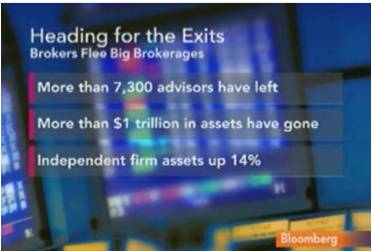
According to Bloomberg, more than 7,300 brokers have left the four largest full-service brokerage firms (Merrill Lynch [BAC], Morgan Stanley Smith Barney [MS], UBS Wealth Management [UBS], and Wells Fargo Advisors [WFC]) since the beginning of 2009. But the brokers have not floated away quietly – more than $1 trillion in assets have fled these major brokerage firms and followed the brokers to their new employers.
Several factors have led to the deluge of departures of bodies and bucks:
1) Mergers: The financial crisis triggered an all-out economic assault on the brokerage firm industry. A subsequent game of musical chairs resulted in the marriage of disparate cultures (e.g., B of A-Merrill; Morgan Stanley-Smith Barney; Wells Fargo-Wachovia). Not only did the clashing cultures rub brokers the wrong way, but the surviving executives were left with redundant and unproductive brokers to cut.
2) Heightened Recruiting: With a shrinking pie and less growth comes more fierce competition. The discount brokerage firms have realized the Darwinian challenges and reacted to them accordingly. Take TD Ameritrade (AMTD) for example. In the first seven months of 2010, the discount brokerage firm added 212 independent advisers to its network, a +44% increase over the previous year. Charles Schwab Corp. (SCHW) with its network of 6,000 independent advisers is also ratcheting up its efforts to poach brokers away from the large brokerage firms.
3) Economics: Would you like 40-50% of profits generated from new clients, or 80-100%? In many instances, the broker from the large branded institution funnels the majority of the commissions to the mother-ship. Sure, the broker receives back-office, marketing, and branding support, but some brokers are now asking themselves is the brand an asset or liability? Wall Street has gotten a large black eye and it will take time to heal their corporate images…if they ever manage to succeed at all.
4) Customer Choice: Lastly, and most importantly, customers are voting with their dollars. As I have indicated in the past, I strongly believe the current system is structurally flawed (see Financial Sharks article). Financial institutions craft incentives designed to line the pockets of brokers (salespeople) and prioritize corporate profits over client wealth creation and preservation. The existing failed industry structure is based upon smoke, mirrors, opacity, and small print. Many independent, fee-only advisors are structuring financial relationships that align with portfolio performance and make transparency a top priority. Customers appreciate these benefits and are shifting dollars away from the brokerage firms.
LPL Loving IPO Life
If you are having a difficult time processing the magnitude of this investment advice shift, then consider the $4.4 billion estimated value being placed on the planned IPO (Initial Public Offering) of LPL Financial, the independent brokerage firm of 12,000+ financial advisors. LPL serves as a conduit for legacy brokers to become independent, and still allow them to benefit from an array of ala carte support services. Growth has been strong too – over the last decade the advisor count at LPL has more than tripled and assets under their umbrella now exceed $250 billion.
The Wall Street broker floodgates have opened, so unless regulatory changes are enacted, the old flawed way of doing things will require a life support raft. If not, independent, fee-only advisors like Sidoxia Capital Management will benefit from the current sinking migration of brokers.
Wade W. Slome, CFA, CFP®
Plan. Invest. Prosper.
DISCLOSURE: Sidoxia Capital Management (SCM) and some of its clients own certain exchange traded funds, but at the time of publishing SCM had no direct position in BAC, MS, UBS, WFC, AMTD, SCHW, LPL Financial or any other security referenced in this article. No information accessed through the Investing Caffeine (IC) website constitutes investment, financial, legal, tax or other advice nor is to be relied on in making an investment or other decision. Please read disclosure language on IC “Contact” page.
Making +457,425,000% – 13 Minutes at a Time

I love investing, but sometimes the shear boredom can get a little tiresome. I mean, a puny little -500 point collapse in the Dow Jones Industrial Average every five minutes can be so 1987. Thank goodness for yesterday’s largest, intra-day point-drop in history (almost 1,000 points) because without out such a meltdown, I might fall asleep at the trading desk and there would be no way to make an annualized +457,425,000% (~457 million percent) trade in a single day. Earning a well-deserved return like that will not only exceed the rates achieved on T-Bills, but will also likely outpace inflation as well. Making that kind of money is not bad work, if you can get it.
Executing the Tricky Trade
Sound difficult to do? Well, not really. All you need to do is find a stock or security that has fallen more than 99% in a single day, then buy the security for 10 cents per share and then sell it immediately, minutes later at $61.09. Repeat this process another 390 times per day for 52 weeks, and you’re well on your way of turning $1 into $4.5 million over a year.
IWD Chart (Source: Yahoo! Finance)
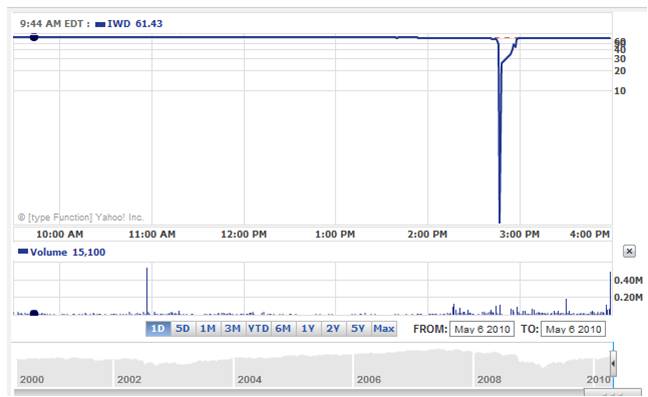
Take for example, the iShares Russell 1000 Value Exchange Traded Fund (ETF), IWD, which yesterday traded for pennies at 3:47 p.m. Eastern Standard Time (EST) and skyrocketed over +600x fold in the subsequent 13 minutes. Fortunately (or unfortunately), depending on how you perceive the situation, the irregular trading activity was not limited to IWD. Other securities showing severe abnormal trading patterns include, Accenture (ACN), Boston Beer (SAM), Exelon (EXC), CenterPoint Energy (CNP), Eagle Material (EXP), Genpact Ltd (G), ITC Holdings (ITC), Brown & Brown (BRO), and Casey’s General (CASY). In full disclosure, I did not take advantage of any 99% pullbacks yesterday, but now that I know how the game works, I will be on full alert.
What the F*%$# Happened?
Initially reports pointed to a Citigroup (C) trader who entered into an inadvertent $16 billion (with a “b”) E-Mini futures trade order, when the trader meant to enter a trade for $16 million (with an “m”)…ooops! This alleged transaction purportedly triggered a wave of selling, culminating in a select group of stocks temporarily trading down to pennies in value. There is a related, yet more plausible, potential explanation. Quite possibly, as a function of excessive trading volume overwhelming the New York Stock Exchange, the overflow of trades migrated to less liquid ECNs (Electronic Communication Networks) and over-the-counter markets. Chances are the high frequency traders were not blindly jumping in front of the train. Whom really got screwed were the retail investors that had stop loss orders at “market” prices, which likely were triggered at unattractive prices.
I’m not sure if we will ever find out what truly happened, but whatever explanations are provided, rest assured there will be multiple more conspiracy theories on top of the legitimate guesses. The top 5 conspiracies I’m pushing are the following:
1) Frustrated by the fraud charges filed by the SEC (Securities and Exchange Commission), Goldman Sachs intentionally tripped over a power cord at the New York Stock Exchange (NYSE), which triggered a wave of bogus trades.
2) High Frequency Traders (see HFT Article) were upgrading their computers from Windows Vista to Windows 7 and experienced an outage causing global disruption.
3) In order to pay for the potential upcoming lawsuit liabilities and SEC fines, Goldman shorted the Dow Jones Industrial index at 10,800 and then went long once the index broke 10,000.
4) Warren Buffett was rumored to suffer a heart attack, but after realizing belching relieved his chest pain, the markets recovered dramatically.
5) Worried that regulatory reform may not pass, a secret group of Congressmen shorted stocks (see Do As I Say, Not As I Do article) to push stocks lower, then distributed TARP (Troubled Asset Relief Program) assets to voters minutes later in order to buy November votes and push stock prices higher.
Political Aftermath

Politicians will be frothing at the mouth or be pressured into approving financial reform. Even if markets manage to stabilize in the coming days and weeks, the pressure to ram regulatory reform through Capitol Hill will be mind-numbing. Mary Shapiro, Chairman of the SEC, and politicians will also be pushing to produce a clear scapegoat to throw under the bus, whether it is a trader at Citi, a high frequency traders at Goldman Sachs, the CEO at the NYSE (Duncan Niederauer), or a talking baby from the E-TRADE commercials. Regardless, depending on how quickly a credible explanation is unearthed, we will know how much, if any, reform is needed. If the markets are genuinely transparent, following the paper trail of responsibility to the stocks that dropped to $.00 or $.01 a share should be a piece of cake. If the systems are too complex to explain why handfuls of stocks are trading to $0, then even I am willing to look up to the skies and say heaven help us with some tighter oversight.
Over the last few years, there have been very few dull, financial moments and the markets did very little to disappoint yesterday. Irrespective of the political mudslinging, scapegoating, or irresponsible behavior, the SEC needs to get to the bottom of these issues rapidly in order to protect the integrity and trust of global players in our markets. What we don’t need is a political knee-jerk reaction that merely creates unintended, negative consequences. No matter what happens, I will at least be equipped to test a new strategy designed to make +457,425,000%.
Wade W. Slome, CFA, CFP®
Plan. Invest. Prosper.
*DISCLOSURE: Sidoxia Capital Management (SCM) and some of its clients own certain exchange traded funds, but at the time of publishing SCM had no direct positions in GS, IWD, C, BRKA/B, CNP, EXP, G, ITC, BRO, and CASY, or any security referenced in this article. No information accessed through the Investing Caffeine (IC) website constitutes investment, financial, legal, tax or other advice nor is to be relied on in making an investment or other decision. Please read disclosure language on IC “Contact” page.




 Investing Caffeine
