Posts tagged ‘operating earnings’
Another Hot Month, Another Fresh Record

Summer is coming to a close, but the weather is not the only thing that remains hot. The stock market has been scorching hot as well. Both the S&P 500 and Dow Jones Industrial Average blazed to all-time record highs last month. In fact, both of these indexes have risen seven out of eight months this year, including gains in the last four consecutive months. More specifically, the S&P 500 was up +2.8% last month and +18.4% this year, while the Dow Jones has advanced +1.8% for the month and +10.3% for the year.
How can this surging bull market be in existence while undergoing a war between Russia and Ukraine; military conflict in Gaza; a nasty Japanese Yen Carry Trade unwind; a highly divisive upcoming presidential election; a weakening economy; and rising unemployment (see chart below)?

Source: Calafia Beach Pundit
For all investors and traders, there is never a shortage of issues to worry about, even when times are good. However, despite the long laundry list of concerns, there are plenty of opposing tailwinds supporting the upswell in stock prices, starting with growing record corporate profits with strength forecasted through 2026 (see chart below).

Source: Yardeni.com (Yardeni Research)
Another factor underpinning the strength of stocks has been the decline in the inflation rate. The latest headline inflation rate (CPI – Consumer Price Index) fell to 2.9% in July, and if you exclude shelter costs, inflation has fallen below the Federal Reserve’s 2% target rate.

Source: Calafia Beach Pundit
Conversely, the story was quite different in 2022 when the Federal Reserve began its crusade against out-of-control inflation (see chart below) by starting its first of 11 interest rate hikes that spanned from January 2022 through July of 2023. The net result was a stock market that tanked -19% in 2022. More recently, the Fed has clearly signaled that inflation is more under control with traders predicting a 100% probability of a -0.25% or -0.50% cut in the targeted Federal Funds interest rate on September 18th. The Federal Reserve Chairman Jerome Powell gave a dovish speech at the annual policy meeting in Jackson Hole, Wyoming strongly portending September action – the first cut in four years since the pandemic.

AI Arms Race on Spending
Another dynamic contributing to new stock market record highs is the boom in AI (Artificial Intelligence) spending by the technology behemoths like Amazon.com Inc. (AMZN), Microsoft Corporation (MSFT), Meta Platforms Inc. (META), and Google – Alphabet Inc. (GOOGL). As I have been talking and writing about for some time (see World of AI), there is an arms race in spending to create the next, latest-greatest large language model (LLM) like ChatGPT. The goal is to bring more efficiency and accuracy to businesses and provide consumers more pleasure and time savings at both work and home. As you can see from the chart below, the four colossal technology companies previously mentioned are currently on a run-rate of spending more than a mind-boggling $200 billion annually, much of that going to the king of AI GPU (Graphics Processing Unit) manufacturing, NVIDIA Corporation (NVDA).
Why are companies spending so much on AI? Because they agree with NVIDIA CEO, Jensen Huang, who last week stated, “Generative AI will revolutionize every industry.” Despite all the spoils migrating to NVIDIA, traders were still looking for warts on the AI supermodel when they reported 2nd quarter results last week. Nonetheless, NVIDIA still delivered its 5th consecutive quarter of greater than 100% revenue growth, while generating revenues of almost $100 billion over the last 12 months – not too shabby. Although greedy investors wanted more, the stock was still up +2% for the month and +141% so far this year.

Source: Sherwood News
While economic, political and geopolitical concerns have been boiling over around the world, the stock market continues to sizzle higher. Declining inflation and interest rates, escalating business profits, and spiking artificial intelligence expenditures across corporate America have kept stocks cooking to record highs. It’s been a sweltering summer but not yet too hot for investors to get roasted out of the stock market kitchen.
Wade W. Slome, CFA, CFP®
Plan. Invest. Prosper.
This article is an excerpt from a previously released Sidoxia Capital Management complimentary newsletter (September 3, 2024). Subscribe Here to view all monthly articles.
DISCLOSURE: Sidoxia Capital Management (SCM) and some of its clients hold positions in individual stocks , certain exchange traded funds (ETFs), including AMZN, MSFT, META, GOOGL, NVDA, but at the time of publishing had no direct position in any other security referenced in this article. No information accessed through the Investing Caffeine (IC) website constitutes investment, financial, legal, tax or other advice nor is to be relied on in making an investment or other decision. Please read disclosure language on IC Contact page.
Choosing Your Favorite Dental Procedure: Recession or Inflation?

Going to the dentist can be a pleasurable or painful experience, depending on whether you have been properly brushing and flossing your teeth. If the stock market was a patient, its 2024 checkup would produce a large smile. Why so happy? Because the S&P 500 index is up a healthy +5.6% in the first four months of the year, thanks to a resilient economy, robust employment, and record corporate profits (see chart below). The smiles were even larger a month ago before the S&P 500’s five-month, almost +30% winning streak was broken from October to March.

Source: Yardeni.com
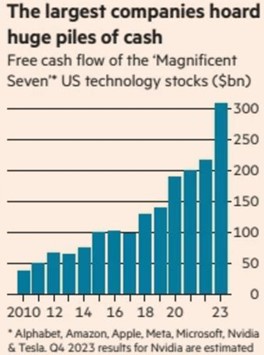
Driving the overall record profits of the stock market are the “Magnificent Seven” (see Fight the Fed or Risk Going Dead), which include mega-technology companies such as AI (Artificial Intelligence) stalwarts like NVIDIA Corp., Microsoft Corp., Alphabet Inc. (Google), and Meta Platforms Inc. As you can see in the chart below, these tech behemoths are generating gargantuan mounds of cash that are piling up at flabbergasting rate of over $300 billion per year.
Source: The Financial Times
How are these Silicon Valley titans achieving such colossal results? The short answer is: The AI Wave. As I pointed out in a previous post of mine, The World of AI, artificial intelligence projects are so large that Meta Platforms CEO Mark Zuckerberg committed to purchasing upwards of a jaw-dropping $10 billion in NVIDIA H100 chips by year-end. To put some of this AI craze into perspective, we learned over the last week that the combined 2024 capital expenditure plans of four companies (Microsoft, Alphabet, Meta and Amazon) are forecasted to exceed $200 billion – much of that driven by generative AI projects.
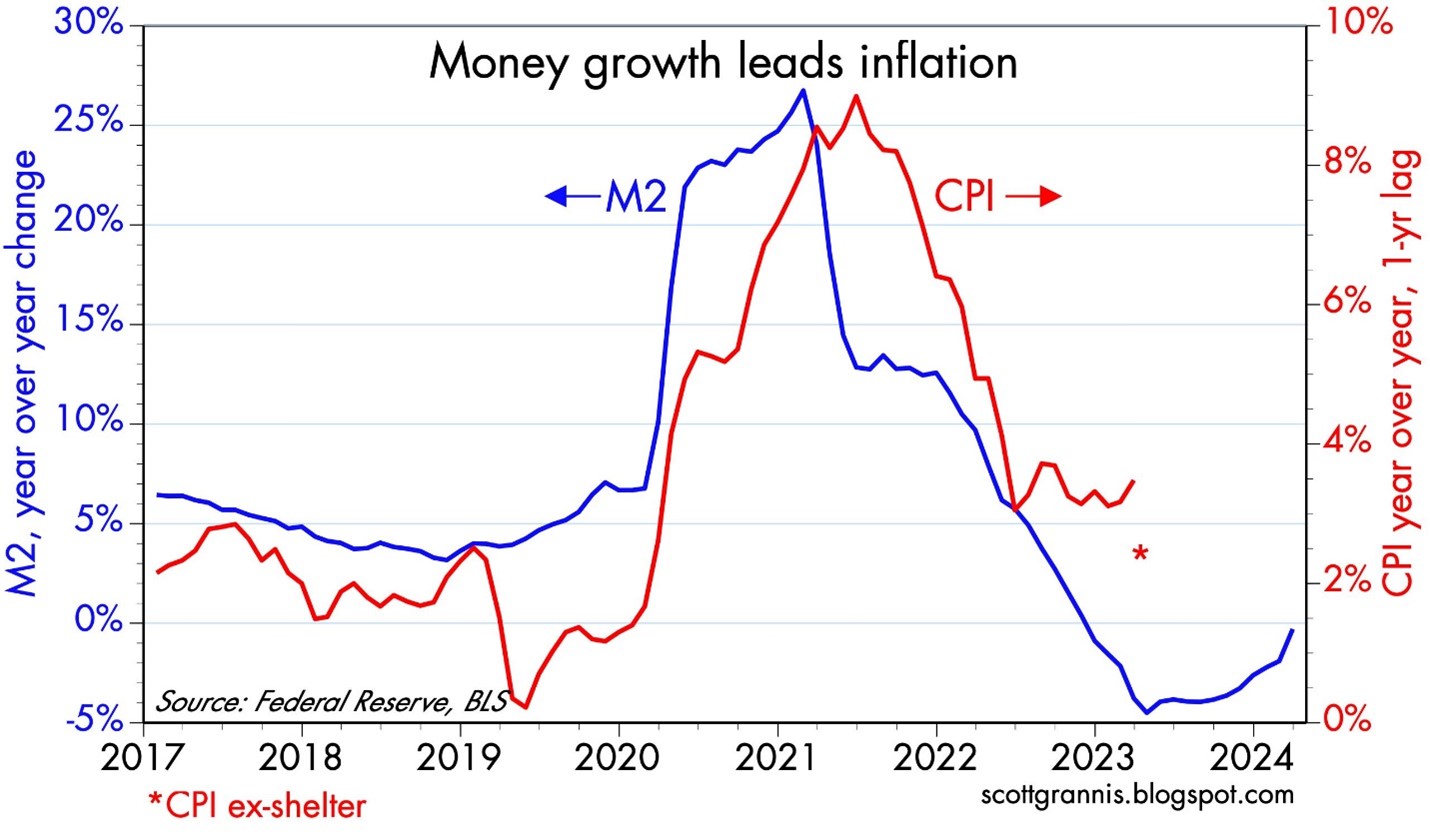
While many of these aforementioned companies are benefitting disproportionately from their exposure to AI, what has really been giving investors a toothache has been stubbornly high and sticky inflation (see red line on chart below), which has pushed up interest rates higher on the 10-Year Treasury Note yield by approximately +0.5% this month, near a 17-year high of 4.69%. Higher interest rates are bad for long-term bond prices (e.g., TLT down -6.8% last month) and generally troublesome for stocks as well. That’s why the S&P 500 took a breather last month with the S&P declining -4.2%, the Dow Jones Industrial Average falling -5.0%, and the technology-heavy NASDAQ index dropping -4.4%.
Source: Calafia Beach Pundit
Your Favorite Dental Procedure?
Investors definitely don’t want higher interest rates, but stock traders should be careful what they wish for. If low interest rates are really what investors want, this scenario could result in an undesirable package deal that includes a recession. So, if pain can come from different scenarios, what is your favorite economic dental procedure?
• A hot economy giving rise to high inflation/high interest rates?
• A cold economy triggering a recession with low interest rates?
I don’t know about you, but both these procedures sound painful to me.
Traders would certainly love to get some anesthesia in the form of Federal Reserve interest rate cuts to relieve the recent stock market pain. Nevertheless, Federal Reserve Chairman, Jerome Powell, has been hawkishly candid in his recent commentary, indicating he will be “data dependent” and let the forthcoming economic numbers guide the Fed’s monetary policy on future interest rate decisions.
Coming into 2024, most pundits were calling for a series of seven interest rate cuts by the end of the year. However, due to the hotter and more resilient economy, now the pendulum of investor sentiment has swung to an expectation of only one or two cuts. We will learn more today when the Fed concludes a two-day meeting with a published interest rate policy decision followed by a subsequent press conference with Jerome Powell.
Of course, not all financial scenarios necessarily have to lead to what feels like a painful root canal or tooth extraction. There is a legitimate path to a so-called “soft-landing.” This would be a goldilocks scenario in which our current elevated interest rates (i.e., Federal Funds target of 5.25% – 5.50%) gradually slow the economy to a level that continues the previous downward inflation trajectory towards the Fed’s long-term objective of 2.0%. If the “soft-landing” were achieved, the Fed could then begin cutting rates again to stimulate the economy.
Regardless of our country’s economic outcome, we can probably agree there is a lot of uncertainty out in the world. These unknowns include Russia-Ukraine, Israel-Hamas, our elections, inflation, Fed monetary policy, bond volatility, stock volatility, and a whole host of other variables. With this backdrop in mind, it’s more important than ever to ensure you have a diversified portfolio and detailed financial plan in place to achieve your long-term life goals. Do yourself a favor and get a financial check-up with an independent, experienced advisor like Sidoxia Capital Management (www.Sidoxia.com). That way, you can smile with a healthy set of pearly whites, rather than grimace in pain as you would from an undesirable dental procedure.
Wade W. Slome, CFA, CFP®
Plan. Invest. Prosper.
DISCLOSURE: Sidoxia Capital Management (SCM) and some of its clients hold positions in individual stocks , certain exchange traded funds (ETFs), including NVDA, MSFT, META, and AMZN, but at the time of publishing had no direct position in any other security referenced in this article. No information accessed through the Investing Caffeine (IC) website constitutes investment, financial, legal, tax or other advice nor is to be relied on in making an investment or other decision. Please read disclosure language on IC Contact page.
Armageddon or Time to Get In?

Halloween is a scary time, and the stock market has experienced a frightening 2022 as well. If you turn on the television or read the news, you may think Armageddon has arrived, the last battle of biblical proportion between good and evil. Fortunately, reality is often less dire than the headlines make it appear. Given the horrific -19% decline in the stock market (S&P 500 index) this year, arguably much of the current and future dreadful news is already expected and discounted into today’s stock market prices. So, perhaps, the end of the world is not upon us, and the sentiment is shifting from “Armageddon” to “time to get in!” The soaring +4,007 point increase (+14%) in the Dow Jones Industrial Average this month, the best month since 1976, may be an indication of changing investor attitudes.
We may not be completely out of the woods just yet, however a lot of the bad cat news is arguably out of the bag. For example, the Federal Reserve has already been hiking interest rates with reckless abandon since March, and this week another increase of 0.75% to roughly 4.00% is widely expected. This move should get us much closer to a Fed “pause” or “pivot”, which could soon turn the perception of a half-empty economic glass into a half-full one?
Inflation has also been running wild for months, but many indicators have shown price levels peaking or declining (i.e., commodities, housing, autos, transportation costs, etc.). Mortgage rates that have more than doubled this year to 7.08% (see chart below) are contributing to declines in home price growth.

High mortgages and high home prices have cooled the white-hot housing market because affordability has been reduced, thereby forcing rental rates to soar. And as a result, stubbornly high rents have been a major factor contributing to persistently high inflation in recent months. If home prices continue to decline (month-to-month) as shown below, this should provide some much-needed relief to rental prices, and ultimately inflation.

And although there does not appear to be a clear end in sight to the Russia-Ukraine war, Ukraine’s recently successful land recapture accomplishments from the Russians could pressure both parties to settle at the negotiation table.
Sweet October Treats
Stock market investors received a sugar high this month with sweet index gains of +8.0% and +14.0% for the S&P 500 and Dow Jones, respectively. While it has been mostly gloomy in 2022, some of the sunshine beaming through the clouds this month came in the form of better-than-expected GDP economic figures that measure the health of the overall economy. Rather than show an impending recession, the freshest 3rd quarter data shows the economy growing at a very respectable +2.6% annualized rate after falling -0.6% in the 2nd quarter (see chart below).

And contrary to many of the doomsday-er recession forecasting mongers, corporate profits have remained tenaciously high near record levels (see chart below), with no sign of collapsing as in 2020 (COVID) or 2008 (Financial Crisis). That doesn’t mean profits can’t contract further, because the dampening effect of higher interest rates could take some time before working its way through the economic python like a pig.

One month does not make a trend, but the largest one month gain in 46 years may be evidence that the world is actually not coming to an end anytime soon. Therefore, it might be a great time to “get in” before booking your fresh trip to “Armageddon”.

Wade W. Slome, CFA, CFP®
Plan. Invest. Prosper.
DISCLOSURE: Sidoxia Capital Management (SCM) and some of its clients hold positions in certain exchange traded funds (ETFs), but at the time of publishing had no direct position in any other security referenced in this article. No information accessed through the Investing Caffeine (IC) website constitutes investment, financial, legal, tax or other advice nor is to be relied on in making an investment or other decision. Please read disclosure language on IC Contact page.
Operating Earnings: Half-Empty or Half-Full?

A continual debate goes on between bulls and bears about which earnings metric is more important: reported earnings based on GAAP (Generally Accepted Accounting Principles) or “operating earnings,” which exclude one-time charges and gains, along with non-cash charges, such as options expenses. Bulls generally prefer operating earnings (glass half-full) because they are typically higher than GAAP earnings (glass half-empty), and therefore operating earnings make valuation metrics more attractive. This disparity between earnings choice is even broader over the last few years due to the massive distortions created by the financial crisis – gigantic write-downs at the vast majority of financial institutions and enormous restructurings at non-financial companies.
Options Smoptions
The options expense issue can also become a religious argument, similar to the paradoxical question that asks if God can create a rock big enough that he himself cannot budge? Logic would dictate that operating earnings should adequately account for option issuance in the denominator of the earnings per share calculation (Net Income / Shares Outstanding). As far as I’m concerned, the GAAP method reducing the numerator of EPS (Earnings Per Share) with an expense, and increasing the denominator by increasing shares from option issuance is merely double counting the expense, thereby distorting reality. Reading through an annual report and/or proxy may not be a joyous experience, but the exercise will help you triangulate share issuance estimates to forecast the drag on future EPS.
On a trailing 12-month basis (Sep’09 – Sep’10), Standard & Poor’s calculated reported earnings with about a -9% differential from operating earnings, equating to approximately a 1.5 Price/Earnings multiple point differential (17.8x’s for reported earnings and 16.2 x’s for operating earnings). For the half-glass full bulls, the picture looks even prettier based on 2011 operating earnings forecasts – the S&P 500 index is priced at roughly 13.6x’s the 2011 index earnings value of $95.45.
Forward More Important Than Backwards
As I make the case in my P/E binoculars article, the market is like a game of chess – a good player doesn’t care nearly as much about an opponent’s last moves as he/she cares about the opponent’s future moves. Financial markets operate in the same fashion, future earnings are much more important than prior earnings. From a practical standpoint, GAAP earnings are relatively useless. Market purists can evangelize about the merits of GAAP earnings until they are blue in the face, but the fact of the matter is that investors are whipping prices all over the place based on Wall Street EPS forecasts – based on operating earnings (not GAAP). In many instances, especially throughout much of the financial crisis, operating earnings will more closely align with the cash flows of a company relative to GAAP earnings, but detailed fundamental analysis is needed.
As far as I’m concerned, much of this GAAP vs Non-GAAP earnings debate is moot because both reported earnings and operating earnings can both be manipulated and distorted. I prefer using cash flows (see Cash Flow Statement article) because cash register accounting – the analysis of money coming in and out of a company – limits the ability of bean counters to use smoke and mirror strategies traditionally saved for the income statement. In other words, you cannot compensate employees, do acquisitions, distribute dividends, or buyback stock with GAAP earnings…all these functions require cold, hard cash. The key metric, rather than EPS, should be free cash flow per share. Growth companies with high return prospects should be given some leeway, but if the projects don’t earn a return, eventually cash resources will dry up. When EPS is materially higher than free cash flow per share, yellow flags fly up and I do additional research to understand the dynamics causing the differential.
These earnings-based arguments will likely never get resolved, but if investors focus on bottom-up analysis on individual security cash flows, determining whether the glass is half-empty or half-full will become much easier.
Wade W. Slome, CFA, CFP®
Plan. Invest. Prosper.
DISCLOSURE: Sidoxia Capital Management (SCM) and some of its clients own certain exchange traded funds, but at the time of publishing SCM had no direct position in any security referenced in this article. The trailing 12 month data was calculated by S&P as of 1/19/2011. Forward 2011 operating earnings were calculated as of 1/18/2011. No information accessed through the Investing Caffeine (IC) website constitutes investment, financial, legal, tax or other advice nor is to be relied on in making an investment or other decision. Please read disclosure language on IC “Contact” page.




 Investing Caffeine
