Posts tagged ‘lending’
Draghi & ECB Pass Trash and Serve Brussels Sprouts
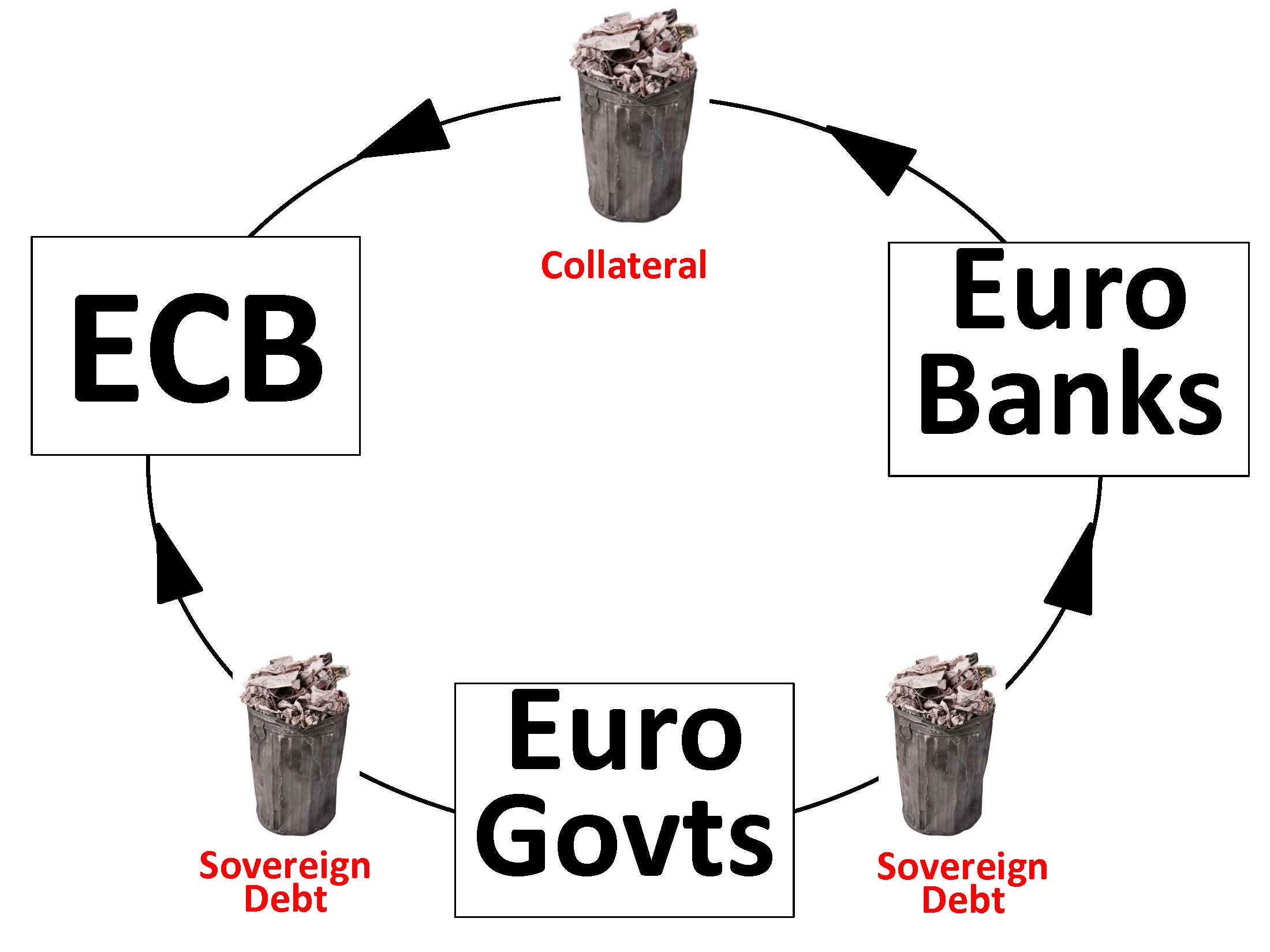
ECB (European Central Bank) President Mario Draghi made it clear with his most recent monetary banking announcements that he is perfectly willing to shovel the sovereign debt trash around the financial system, but he just doesn’t want the ECB to gobble up heaps of the smelly debt.
On the same day that Draghi lowered the key benchmark interest rate by -0.25% to 1.00%, he also reduced the lending credit rating threshold for acceptable banking collateral to “single-A” and offered banks endless three-year loans with . But wait…there’s more! In typical infomercial fashion, Draghi had an additional stimulative gift offering – he halved the reserve requirement ratios for European banks.
Although Draghi is handing out lots of hugs and kisses to the banks, including infinite amounts of three-year loans, he is also providing very little direct love to European debt-laden governments. In other words, Draghi isn’t ready to pull out the printing press bazooka to sop up mounds of trashy sovereign debt (i.e., Greece, Italy, and Spain). Draghi may be willing to make the ECB the lender of last resort for the banks, but he is not signaling the same lender of last resort commitment for careless governments.
Despite Draghi’s public aversion to bond buying (a.k.a. QE or quantitative easing), he indirectly is funding quantitative easing anyway. Rather than having the ECB accelerate the direct purchase of besieged sovereign debt, he indirectly is giving money to the banks to purchase the same struggling bonds. Sneaky, but clever…I like it.
Eat Your Brussels Sprouts!
 Draghi in his new role as ECB President is clearly trying to be a responsible parent to the Euro leaders, but as a result, he could be placing himself in trouble with the law. I haven’t contacted my attorneys yet, however Mario Draghi is blatantly infringing on my patented “Brussels sprouts mandate” that I regularly use at the dinner table with my children. On any given night, by 6:30 p.m. my kids are practically frothing at the mouth for some unhealthy dessert delight. The problem with the situation is unfinished Brussels sprouts sitting on their plates, so with respected authority I command, “If you want dessert tonight, you better eat your Brussels sprouts!” Normally this is not a bad strategy because my plea usually results in an extra consumed sprout or two. Ultimately, given the softy that I am, all parties involved know that dessert will be served regardless of the number of sprouts consumed.
Draghi, in dealing with the irresponsible fiscal actions of the sovereigns, is using the same precise “sprout mandate.” In a recent press conference, here’s how Draghi delivered his tough talk:
“All euro-area governments urgently need to do their utmost” for fiscal sustainability. “Policy makers need to correct excessive deficits and move to balanced budgets in the coming years. This will strengthen overall economic sentiment. To accompany fiscal consolidation, the governing council has called for bold and ambitious structural reforms.”
Just as it makes sense for me not to say, “Hey kids, don’t worry about eating your vegetables, save room for the ice cream sundae buffet,” it probably doesn’t make sense for Draghi to inform European leaders, “Hey kids, don’t worry about those massive debts and deficits, the ECB will give you plenty of money to buy up all that trashy sovereign debt of yours.”
Hypocritical Or Shrewd?
I applaud Signore Draghi for implementing his bold actions as lender of last resort for European Banks, but isn’t it a tad bit hypocritical? The ECB President talks seriously about Basel III capital requirements, yet he is easing rules on collateral and reserves. Why is it OK for the ECB to condone reckless behavior and introduce moral hazards for the banks (i.e., limitless ECB backstop), but not for irresponsible governments too? If I am a European bank with continuous access to ECB loans, why not roll the dice and risk shareholder capital in hopes of a big risky payoff? I’m sure Jon Corzine at MF Global (MFGLQ.PK) would appreciate similar financial backing. What’s more, how credible can Draghi be about his tough fiscal love and anti-quantitative easing stances when he is currently offering never-ending amounts of money to the banks and already buying collapsing sovereign bonds as we speak?
No matter the view you hold, the ECB is openly demonstrating it will not sit idle watching the banking system collapse under its own watch, much like the Federal Reserve and Ben Bernanke did not sit idle in 2008-2009. Perhaps Draghi isn’t being hypocritical, but is rather being shrewd? Although Draghi wants governments to eat their fiscal Brussels sprouts, let’s not kid ourselves. Just as Draghi is willing to pass the trash and appease the banking system, if the eurozone sovereign debt crisis continues worsening, don’t be surprised to see Draghi roll out his ice cream sundae buffet of aggressive bond buying. That will taste much better than Brussels sprouts.
Wade W. Slome, CFA, CFP®
Plan. Invest. Prosper.
DISCLOSURE: Sidoxia Capital Management (SCM) and some of its clients own certain exchange traded funds, but at the time of publishing SCM had no direct position in MF Global (MFGLQ.PK), or any other security referenced in this article. No information accessed through the Investing Caffeine (IC) website constitutes investment, financial, legal, tax or other advice nor is to be relied on in making an investment or other decision. Please read disclosure language on IC “Contact” page.
Now You See It, Now You Don’t: TARP

Elizabeth Warren, who oversees the TARP (Troubled Asset Relief Program), along with being the Chair on the Congressional Oversight Panel and a professor at the Harvard Law School, goes out on a limb and candidly states, “ We not only don’t know [where the TARP money is], Maria, we’re not ever going to know.”
Ms. Warren is quick to blame former Treasury Secretary Henry “Hank” Paulson for not implementing accountability for the TARP funds handed to the large commercial and investment banks (see my earlier TARP article). How do you prove the money handed over to the banks was used for non-lending activities, such as marketing, compensation, television advertising, dividends, acquisitions or other corporate purposes other than lending? The short answer…you can’t! Even if TARP capital tracking was instituted, I think it would have been a fruitless effort since even legitimate use of the TARP funds would only free up additional capital for other suboptimal purposes. If my mom gave me $100 while I was struggling for money in college and told me to use it for food – well I, like a good chunk of students, would have eaten anyways without the handout. The windfall $100 bailout would likely be used for a guys trip to Las Vegas or some Laker basketball tickets. The banks will certainly lend, but not at the same pre-Lehman bankruptcy levels, regardless of whether TARP tracking was instituted or not. Ms. Warren correctly points out that regulators are speaking out of both sides of their mouths. The government wants banks to lend more (which reduces the bank’s capital base) and also raise their sickly reserve levels at the same time.
See TARP commentary on CNBC video interview at minute 2:48
Maria Bartiromo also probes the topic of executive pay compensation given a recent Congressional proposal that TARP recipients cut salaries of the top 25 executives by -90%. Seems like a reasonable request given the circumstances. However, having the government force banks into making bad loans is probably not the right answer. This stance will only force the banks to take higher loan deliquency provisions and recognize more potential writedowns in the future. Eventually the Fed will cut interest rates paid to banks on the reserves held at the central bank, thereby invcentivizing the banks to take advantage of the steeper yield curve and make handsome spreads on loans.
Until then, some of the banks will sit patiently on their TARP capital (not lending) while Ms. Warren and government officials will wonder how the billions of TARP bailouts magically disappeared.
Wade W. Slome, CFA, CFP®
Plan. Invest. Prosper.
DISCLOSURE: Sidoxia Capital Management and its clients had a direct position in VFH and BAC shares at the time this article was originally posted. No information accessed through the Investing Caffeine (IC) website constitutes investment, financial, legal, tax or other advice nor is to be relied on in making an investment or other decision. Please read disclosure language on IC “Contact” page.




 Investing Caffeine
