Posts tagged ‘investing’
Praying for a Better Market with Pope Benedict XVI
As reported on Bloomberg, the pontiff called for a new era of economic justice and for a new global authority to regulate financial institutions. Pope Benedict XVI weighed in on the markets with a 150 page document demanding a retooling of the economic and financial models that got us into this financial crisis.
In a conflicted dilemma, the video clip above ponders the question of whether sinners or saints perform better in the stock market? Unfortunately for church-goers, sin appears to perform better. The indulgent Vice Fund (VICEX) outperformed the virtuous Ave Maria Catholic Values Fund (AVEMX) for the period discussed.

Chomping at the bit to open up that margin account??
I’m not sure if the Pope is going to open a margin account at Scottrade, and start day-trading levered inverse ETFs and options, but perhaps he will be praying for a better market and performance for us honest, trustworthy and faithful investors.
Wade W. Slome, CFA, CFP®
Plan. Invest. Prosper.
Rogers Sees an Explosion in Stock Prices…Or Complete Collapse
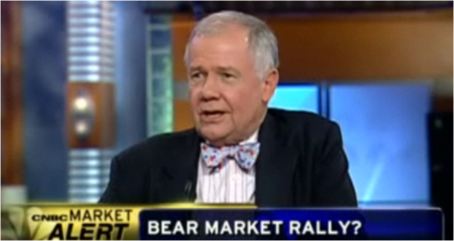
CNBC Interview with Jimmy Rogers
I love it! Jimmy Rogers, chairman of Rogers Holdings is really going out on limb this time. Well, not really. It’s more like he is on a fence, and ready to fall over to whichever side the wind blows. Let me explain this claim in more detail. With the Dow Jones Industrials Average currently trading at about 8,800, Rogers sees the market climbing higher by +240% to 30,000 or perhaps collapsing another -43% (after the worse bear market in decades) to 5,000.
“I’m afraid they’re printing so much money that stocks could go to 20,000 or 30,000,” Rogers said. “Of course it would be in worthless money, but it could happen and you could lose a lot of money being short,” he adds.
Why stop there – why not a more outrageous range of guesses between 100,000 and 1,000? If inflation is his worry, then maybe Mr. Rogers should be concerned about declining PE (Price/Earnings) multiples, which reached single digits in the late-1970s and early-1980s when we were experiencing double-digit inflation.
Thanks Jimmy, those meticulously defined predictions will make many fellow astrologists proud. These prophetic claims remind me of my prescient call this year that I would either gain 100 pounds or lose 100 pounds. So far my forecast has turned out to be spot on, however I won’t confess which direction my weight has swung.
Although Jimmy’s tone is notably pessimistic, he reminds us that this is the last time he has had NO short positions since after the “Crash of 1987.” If lightning strikes twice, maybe his actions demonstrate that now is not such a bad time to buy.
However, be wary because Rogers is not only frightened by inflation. He goes onto say that some country is going to suffer a currency crisis, but he does not know which one yet. “I expect there to be a currency crisis later this year or maybe next year,” he states. Let us hope that “Zimbabwean-esque” inflation does not take hold, otherwise we will be in line with Rogers at the grocery store buying millions of dollars in the vegetable aisle.
Jimmy Rogers is obviously a bright investor (not to mention the Wall Street bow-tie king) who has achieved great success over his career. Nonetheless, I believe he could go into a little more detail in explaining his outrageous, sensationalized claims. For some reason I don’t think this trend will change, but at a minimum, he will continue to provide food for thought and fantastic entertainment.
Chasing Profits – Can Fund Managers Beat the Game?

Achieving Long-Term Excess Returns is a Tough Race
How someone invests their money should fundamentally be based on their view of what’s the best way of playing the investment game. Before playing, the investor should answer the following key question: “Is the market efficient?” Efficient market followers believe active managers – professionals that periodically buy and sell with a profit motive – CANNOT consistently earn excess returns over longer periods of time, in part because market prices reflect all available information. If you fall into the efficiency camp, then you should dial 1-800-VANGUARD to simply buy some index funds. However, if you believe the market is inefficient, then invest in an exploitable strategy or hire an active investment manager you believe can outperform the market after fees and taxes.
For me personally, I fall somewhere in between both camps. I opportunistically invest my hedge fund in areas where I see superior return potential. However, in other areas of my investment practice (outside my main circle of expertise), I choose to side with the overwhelming body of evidence from academics that show passive/indexing slaughters about 75% of professionals.
Richard Roll, renowned economist and thought leader on the efficient market hypothesis, said this:
“I have personally tried to invest money, my client’s and my own, in every single anomaly and predictive result that academics have dreamed up. And I have yet to make a nickel on any of these supposed market inefficiencies. An inefficiency ought to be an exploitable opportunity. If there’s nothing investors can exploit in a systematic way, time in and time out, then it’s very hard to say that information is not being properly incorporated into stock prices. Real money investment strategies don’t produce the results that academic papers say they should.”
—(Wall Street Journal, 12/28/00)
The market gurus du jour blanket the media airwaves, but don’t hurt your back by hastily bowing. Having worked in the investment industry for a long time, you learn very quickly that many of the celebrated talking-heads on the TV today rotate quickly from the penthouse to the outhouse. Certainly, there are the well regarded professional money managers that survive the walk across the burning-coals and have performed great feats with their clients’ money over long periods of time. But even the legendary ones take their lumps and suffer droughts when their style or strategy falls out of favor.
The professional investing dynamics are no different than professional baseball. There are a relatively few hitters in the Major Leagues who can consistently achieve above a .300 batting average. In 2007, AssociatedContent.com did a study that showed there were only 12 active career .300 hitters in Major League Baseball. The same principle applies to investing – there is a narrow slice of managers that can consistently beat the market over longer periods of time.

There Are Only So Many .300 Hitters
Some statisticians point to the “law of large numbers” when describing long term investor success (a.k.a. “luck”) or ascribe the anomaly to statistical noise. Peter Lynch might have something to say about that. Peter Lynch managed the Fidelity Magellan Fund from 1977 – 1990, while he visited 200 companies per year and read about 700 company reports annually. Over that period Lynch averaged a 29% annual return for his investors vs. a 15% return for the S&P 500 index. Luck? How about Bill Miller from Legg Mason who outperformed the major industry benchmark for 15 consecutive years (1991-2005). Perhaps that too was good fortune? Or how about investor extraordinaire Warren Buffet who saw his stock price go from $33 per share in 1967 to $14,972 in 2007 – maybe that was just an accident too? An average schmuck off the street achieving Warren’s Buffett performance over a multi-decade period is equivalent to me batting .357 against Nolan Ryan and Randy Johnson…pure fantasy.
Academics also have difficulty with their efficiency arguments when it comes to explaining events like the “1987 Crash,” the technology bubble bursting in 2000, or the recent subprime derivative security meltdown. If all available information was already reflected in the market prices, then it would be unlikely the markets would experience such rapid and dramatic collapses.
What these bubbles show me is no matter how much academic research is conducted, the behavioral aspects of greed and fear will always create periods of inefficiency in the marketplace. These periods of inefficiency generate windows of profit opportunity that can be exploited by a subset of skillful managers. In the short-run, luck plays a great role; in the long-run sklill level determines ultimate performance. Benjamin Graham, summed it up best when he said, “In the short-term, the stock market is a voting machine; in the long-term a weighing machine.”
Wade W. Slome, CFA, CFP®
Plan. Invest. Prosper.
DISCLOSURE: Sidoxia Capital Management and client accounts do not have direct positions in LM or BRKA/B at the time the article was published.No information accessed through the Investing Caffeine (IC) website constitutes investment, financial, legal, tax or other advice nor is to be relied on in making an investment or other decision. Please read disclosure language on IC “Contact” page.
Building Your Financial Future – Mistakes Made in Investment Planning

Building Your Dream Future Requires a Plan
Building your retirement and financial future can be likened with the challenge of designing and building your dream home. The tools and strategies selected will determine the ultimate cost and outcome of the project.
I constantly get asked by investors, “Wade, is this the bottom – is now the right time to get in the markets?” First of all, if I precisely knew the answer, I would buy my own island and drink coconut-umbrella drinks all day. And secondarily, despite the desire for a simple, get-rich quick answer, the true solution often is more complex (surprise!). If building your financial future is like designing your dream home, then serious questions need to be explored before your wealth building journey begins:
1) Do I have enough money, and if not, how much money do I need to develop my financial future?
2) Can I build it myself, or do I need the help of professionals?
3) Do I have contingency plans in place, should my circumstances change?
4) What tools and supplies do I need to effectively bring my plans to life?
Most investors I run into have no investment plan in place, do not know the costs (fees) of the tools and strategies they are using, and if they are using an advisor (broker) they typically are in the dark with respect to the strategy implemented.
For the “Do-It-Yourselfers”, the largest problem I am witnessing right now is excessive conservatism. Certainly, for those who have already built their financial future, it does not make sense to take on unnecessary risk. However, for most, this is a losing strategy in a world laden with inflation and ever-growing entitlements like Medicare and Social Security. There’s clearly a difference between stuffing money under the mattress (short-term Treasuries, CDs, Money Market, etc.) and prudent conservatism. This is a credo I preach to my clients.
In many cases this conservative stance merely compounds a previous misstep. Many investors undertook excessive risk prior to the current financial crisis – for example piling 100% of investment portfolios into five emerging market commodity stocks.
What these examples prove is that the average investor is too emotional (buys too much near peaks, and capitulates near bottoms), while paying too much in fees. If you don’t believe me, then my conclusions are perfectly encapsulated in John Bogle’s (Vanguard) 1984-2002 study. The analysis shows the average investor dramatically underperforming both the professionally managed mutual fund (approximately by 7% annually) and the passive (“Do Nothing”) strategy by a whopping 10% per year.
Building your financial future, like building your dream home, requires objective and intensive planning. With the proper tools, strategies and advice, you can succeed in building your dream future, which may even include a coconut-umbrella drink.
Your Investment Car Needs Shocks

Smooth Out the Bumpy Ride
Investing can make for a bumpy ride. What can investors do to smooth out the rough financial journey? The simple answer: diversification. If you consider your investment portfolio as a car, then the process of diversification acts like shock absorbers. Those shocks make for a more comfortable ride while preventing potential disasters – like accidentally driving your investments off a cliff.
People generally understand the concept behind, “not putting all your eggs in one basket.” However, once introduced to financial theory terms such as correlation, covariance, and the efficient frontier, people’s eyes begin to glaze over…and rightfully so!
So what are some of the key points one should understand regarding diversification:
- Lunch CAN Be Free! There are very few free lunches in life, but with “diversification” you can indeed get something for nothing. For example, let’s assume you are approached with two investments, ski hats and sun visors, and each investment is expected to deliver a 5% annual return. Furthermore, let’s suppose that zero ski hats are sold in Spring and Summer (and zero sun visors in Fall and Winter). If you merely own one investment, that investment will be more risky (volatile) than a combo portfolio for half the year. Although any combination of two investments will create a 5% return, by diversifying (owning both investments), you can smooth out the ride. There’s your free lunch – the same return achieved for less risk (volatility)!
- Gravity Holds True For Investments Too! Nothing goes up forever, so do not concentrate your portfolio in sectors that have wildly outperformed other sectors/asset classes for long periods of time. Lessons learned over the last 10 years in the areas of technology and real estate highlight the dangers of over-exposure to any one sector in the economy.
- Vary Your Investment Diet! In the Oscar-nominated documentary Super Size Me, Morgan Spurlock decides to eat McDonald’s fast-food for breakfast, lunch, and dinner for thirty days. As a result, his cholesterol levels sky-rocket, he gains over 24 pounds, and his liver function deteriorates significantly. When it comes to your investment portfolio, you should balance it across a wide range of healthy options, including domestic and international stocks and bonds; large and small capitalization stocks; growth and value styles; cash and low-risk liquid investments; and alternative asset classes, such as real estate, commodities, and private investments.
The benefits of diversification will fluctuate under different economic climates. During our recent financial crisis, especially in late 2008, the correlation ratio (the degree that different asset classes move together) unfortunately was very high. However, those investors who were exposed to areas such as Treasury securities, gold, cash, and bonds generally fared better than those who did not. Subsequently, in the early part of 2009, the benefits of diversification shined through as outperformance in emerging markets, technology, consumer discretionary and growth stocks balanced the weakness suffered in banking, transportation, healthcare, bond and value segments.
Diversification helps on the rough roads of investing, so make sure to check those shocks!
Navigating the Fixed Income Waters

Fixed Income Rapids Can Be Treacherous
Given the downward plunge in equity markets that started at the beginning of 2008, investors have flocked to fixed income options in droves. But buyers should beware. Swimming in the fixed income markets is not like frolicking around in the kiddy pool, but rather more like swimming in treacherous, crocodile-infested waters. Not all bonds are created equally, so arming yourself with knowledge regarding bond investing risks can save lots of money (and limbs).
Bond prices move in the inverse direction of interest rates – so now that interest rates have fallen to five-decade lows, is now the best time to buy bonds? Certainly there are segments of the bond market that offer tremendous value, but when the Federal Funds Rate (the key benchmark inter-bank lending rate that the Federal Reserve sets) stands at effectively 0%, that means there is only one regrettable direction for rates to go.
Before diving head first into the bond market, investors should educate themselves about the following risks:
Interest Rate Risk: With record low interest rates, coupled with massive amounts of government stimulus injected both here and abroad, the risk of rising interest rates is becoming a larger reality. Large government deficits and expanding government debt issuance can lead to inflation pressures that are correlated to upward movements in interest rates.
Default Risk: Bonds typically pay bondholders interest payments (coupons) until maturity (expiration), however in challenging financial times, various issuing entities may be incapable of paying its investors, and therefore may default. As the recession matures, more and more companies are defaulting on their debt obligations.
Reinvestment Risk: Owning healthy yielding bonds in a declining interest rate environment is the equivalent of sailing with a tailwind – however all good things must eventually come to an end. At maturity, investors must also face the risk of potentially reallocating proceeds into lower yielding (lower coupon) alternatives. For those investors relying on higher fixed income payments to cover living expenses, reinvestment risk can pose a real threat to their financial future.
Callable Risk: Just like ice cream comes in different flavors, so do bonds. Certain bonds come equipped with an add-on “callable” feature that allows the issuer to retake possession of the bond for a predetermined price. In periods of declining interest rates, as we have experienced since the early 1980s, this advantageous option has been included repeatedly by many bond issuing entities. Prepayment risk for mortgage securities can also lead to suboptimal investment returns.
Liquidity Risks: This whole banking crisis that our global financial system is currently digesting has highlighted the importance of liquidity, and the painful clogging effects of illiquid fixed income securities. Forced sales of illiquid securities (due to lack of buyers) can lead to unanticipated and drastically low proceeds for sellers.
Overall, bonds offer tremendous diversification benefits to an investment portfolio and with the exploding baby boom generation entering retirement these fixed income vehicles are attractive. Just remember, before you dip that toe into the bond market waters, beware of the lurking risks hiding below the surface.




 Investing Caffeine
