Posts tagged ‘investing’
Getting off the Market Timing Treadmill

Most investors have been stuck on the financial treadmill of the 2000s and have nothing to show for it, other than battle scars from the 2008-2009 financial crisis. A lot of running, sweating, and jumping has produced effectively no results. Most media outlets continue to focus on the “lost decade” (see other Lost Decade story) in which investors have earned nothing in the equity markets. After a decade of excess in the 1990s should the majority of investors be surprised? Investing is no different than dieting and exercise – those topics are easy to understand but difficult to execute.
Where are the Billionaire Market Timers?
The financial industry oversimplifies investing and sells market timing as an effortless path to riches – even in tough times. In the search of the financial Holy Grail, the industry constantly crams new software bells and whistles and so-called “can’t lose” strategies down the throats of individual investors. Sadly, there is no miracle system, wonder algorithm, or get rich scheme that can sustainably last the test of time. Sure, a minority of speculators can get lucky and make money by following a risky strategy in the short-run, but as the global economic disaster caused by LTCM (Long Term Capital Management) taught us, even certain successful trading strategies or computer algorithms can stop working in a heartbeat and lead to a widespread bloodbath.
Are you still a believer in market timing? If so, then where are all the billionaire market timers? Famed growth manager, Peter Lynch astutely noted:
“I can’t recall ever once having seen the name of a market timer on Forbes‘ annual list of the richest people in the world. If it were truly possible to predict corrections, you’d think somebody would have made billions by doing it.”
Certainly, there are some hedge fund managers that have hit home runs with amazing market calls, but time will be the arbiter in determining whether they can stay on top.
Sage Speak on Market Timing
If you don’t believe me about market timing, then listen to what knowledgeable investors and thought leaders have to say on the subject. Larry Swedroe, a principal at Buckingham Asset Management, compiled a list including the following quotes:
- Warren Buffett (Investor extraordinaire): “We continue to make more money when snoring than when active.” He adds, “The only value of stock forecasters is to make fortune-tellers look good.”
- Jason Zweig (Columnist): “Whenever some analyst seems to know what he’s talking about, remember that pigs will fly before he’ll ever release a full list of his past forecasts, including the bloopers.” (See also Peter Schiff and Meredith Whitney stories)
- Bernard Baruch (Financier): “Only liars manage to always be out during bad times and in during good times.”
- Jonathan Clements (Columnist): “What to do when the market goes down? Read the opinions of the investment gurus who are quoted in the WSJ. And, as you read, laugh. We all know that the pundits can’t predict short-term market movements. Yet there they are, desperately trying to sound intelligent when they really haven’t got a clue.”
- David L. Babson (Investment Manager): “It must be apparent to intelligent investors that if anyone possessed the ability to do so [forecast the immediate trend of stock prices] consistently and accurately he would become a billionaire so quickly he would not find it necessary to sell his stock market guesses to the general public.”
- Peter Lynch (Retired Growth Manager): “Far more money has been lost by investors preparing for corrections, or trying to anticipate corrections, than has been lost in corrections themselves.”
Market Timing Road Rules
Rather than make guesses regarding the direction of the market, here are some investment rules to follow:
- Rule #1: Do not attempt to market time. Statistically it is a certainty that a minority of the millions of investors can time the market in the short-run – the problem is that very few, if any, can time the market for sustainable periods of time. Don’t try to be the hero, because often you will become the goat.
- Rule #2: Patiently make good investments, regardless of the economic conditions. It is best to assume the market will go nowhere and invest accordingly. Paying attention to a hot or cold economy leads to investors chasing their tails. Good investments should outperform in the long-run, regardless of the macroeconomic environment.
- Rule #3: Diversify. In the midst of the crisis, diversification didn’t cure simultaneous drops in most asset classes, however ownership of government Treasuries, cash, and certain commodities provided a cushion from the economic blows. Longer-term, the benefits of diversification become more apparent – it makes absolute sense to spread your risk around.
In some respects, there is always an aspect of timing to investing, but as referenced by some of the intelligent professionals previously, the driving force behind an investment decision should not be, “I think the market is going up,” or “I think the market is going down” – those thought processes are recipes for disaster. I strongly believe an investment process that includes patience, discipline, diversification, valuation sensitivity, and low-cost/ tax-efficient products and strategies will get you off the financial treadmill and move you closer to reaching your financial goals.
Read the Full Larry Swedroe Story
Wade W. Slome, CFA, CFP®
Plan. Invest. Prosper.
DISCLOSURE: Sidoxia Capital Management (SCM) and some of its clients own certain exchange traded funds, but at time of publishing had no direct positions in BRKA or any other security mentioned. No information accessed through the Investing Caffeine (IC) website constitutes investment, financial, legal, tax or other advice nor is to be relied on in making an investment or other decision. Please read disclosure language on IC “Contact” page.
Fees, Exploitation and Confusion Hammer Investors

The financial industry is out to hammer you. If you haven’t figured that out, then it’s time to wake up to the cruel realities of the industry. Let’s see what it takes to become the hammer rather than receiving the brunt of the pounding, like the nail.
Fees, Fees, Fees

I interface with investors of all stripes and overwhelmingly the vast majority of them have no idea what they are paying in fees. When I ask investors what fees, commissions, and transactions costs are being siphoned from their wallets, I get the proverbial deer looking into the headlight response. And who can blame them? Buried in the deluge of pages and hiding in the fine print is a list of load fees, management fees, 12b-1 fees, administrative fees, surrender charges, transaction costs, commissions, and more. One practically is required to obtain a law degree in order to translate this foreign language.
Wolf in Sheep’s Clothing

These wolves don’t look like wolves. These amicable individuals have infiltrated your country clubs, groups, volunteer organizations, and churches. The following response is what I usually get: “Johnny, my financial consultant, is such a nice man – we have known him for so long.” Yeah, well maybe the reason why Johnny is so nice and happy is because of the hefty fees and commissions you are paying him. Rather than paying for an expensive friend, maybe what you need is someone who can accelerate your time to retirement or improve your quality of life. If you prefer eating mac and cheese over filet mignon, or are looking to secure a position at Wal-Mart as a greeter in your 80s, then don’t pay any attention to the fees you may be getting gouged on.
I don’t want to demonize all practitioners and aspects of the financial industry, but like Las Vegas, there is a reason the industry makes so much money. The odds and business practices are stacked in their favor, so focus on protecting yourself.
Confusion

Investors face a very challenging environment these days, needing to decipher everything from Dubai debt defaults and PIIGS sovereign risk (Portugal-Ireland-Italy-Greece-Spain) to proposed new banking regulation and massive swings in the U.S. dollar. If our brightest economists and government officials can’t decipher these issues and “time the market,” then how in the heck are aggressive financial salesmen and casual investors supposed to digest all this ever-changing data? Making matters worse, the media continuously pours gasoline on fear-inducing uncertainties and shovels piles of greed-motivating fodder, which only serves to make matters more confusing for investors. Do yourself a favor and turn off the television. There are better ways of staying informed, without succumbing to sensationalized media stories, like reading Investing Caffeine!
Pushy financial salespeople complicate the situation by attempting to “wow” clients with fancy acronyms and industry jargon in hopes of impressing a prospect or client. In some situations, this superficial strategy may confuse an investor into thinking the consultant is knowledgeable, but in more instances than not, if the salesperson doesn’t know how to explain the investment concept in terms you understand, then there’s a good chance they are just blowing a lot of hot air.
Here’s what famous growth investor William O’Neil has to say about advice:
“Since the market tends to go in the opposite direction of what the majority of people think, I would say 95% of all these people you hear on TV shows are giving you their personal opinion. And personal opinions are almost always worthless … facts and markets are far more reliable.”
Amen.
Mistake of Trying to Time Market

My best advice to you is not to try and time the market. Even for the speculators with correct timing on one trade rarely get the move right the next time. As previously mentioned, even the smartest people on our planet have failed miserably, so I don’t recommend you trying it ether.
Here are a few examples of timing gone awry:
- Nobel Prize winners Robert Merton and Myron Scholes incorrectly predicted the direction of various economic variables in 1998, while investing client money at Long Term Capital Management. As a result of their poor timing, they single-handedly almost brought the global financial markets to their knees.
- Former Federal Reserve Chairman, Alan Greenspan, is famously quoted for his “irrational exuberance” speech in 1996 when the NASDAQ index was trading around 1,300. Needless to say, the index went on to climb above 5,000 in the coming years. Not such great timing Al.
- More recently, Ben Bernanke assumed the Federal Reserve Chairman role (arguably the most powerful financial position in our Universe) in February 2006. Unfortunately even he could not identify the credit and housing bubble that soon burst right under his nose.
Some of the best advice I have come across comes from Peter Lynch, former Fidelity manager of the Magellan Fund. From 1977-1990 his fund’s investment return averaged +29% PER YEAR. Here’s what he has to say about investment timing in the market:
“Worrying about the stock market 14 minutes per year is 12 minutes too many.”
“Anyone can do well in a good market, assume the market is going nowhere and invest accordingly.”
Rather than attempting to time the market, I would encourage you to focus on discovering a disciplined, systematic investment approach that can work in various market environments (see also, One Size Does Not Fit All).
Financial Carnage

The long-term result for investors playing the game, with rules stacked against them, is financial carnage.
If you don’t believe me, then just ask John Bogle, chairman of one of the fastest growing and most successful large financial firms in the industry. His 1984-2002 study shows how badly the average investor gets slammed, thanks to aggressive fees peddled by forceful financial salesmen and the urging into destructive emotional decisions. Specifically, the study shows the battered average fund investor earning a meager 2.7% per year while the overall stock market earned +12.9% annually over the period.

Source: Bogle Financial Center
It’s Your Investment Future
Given the economic times we are experiencing now, there is more confusion than ever in the marketplace. Insistent financial salespeople are using aggressive smoke and mirror tactics, which in many cases leads to unfortunate and damaging investment outcomes. Do your best to prepare and educate yourself, so you can become the hammer and not the nail.
It’s your investment future – invest it wisely.
Wade W. Slome, CFA, CFP®
Plan. Invest. Prosper.
DISCLOSURE: Sidoxia Capital Management (SCM) and some of its clients own certain exchange traded funds (including Vanguard ETFs and funds), but at time of publishing had no direct positions in securities mentioned in this article. No information accessed through the Investing Caffeine (IC) website constitutes investment, financial, legal, tax or other advice nor is to be relied on in making an investment or other decision. Please read disclosure language on IC “Contact” page.
Extrapolation: Dangers of Mixing Cyclical & Secular

One of the toughest jobs in making investment decisions is determining whether changes in profit growth rates are due to cyclical trends or secular trends. The growth of technology and the advent of the internet have not only accelerated the pace of information exchange, but these advancements have also led to the explosion of information (read more).
Drowning in too much information can make the most basic decisions confusing. One of the dreaded by-products of “information overload” is extrapolation. When faced with making a difficult or time consuming decision, many investors choose the path of least resistance, which is to fall back on our good friend…extrapolation.
Rather than taking the time of gathering the appropriate data, exploring both sides of an argument, and having objective information guide educated decisions, many investors open their drawers and grab their trusty ruler. The magic ruler is a wonderful straight-edged tool that can coherently connect any two data points. The beauty of the wooden instrument is the never-ending ability to bolt on a simple convenient story on why a short-term trend will persist forever (upwards or downwards).
We saw it firsthand as the world got sucked down the drain of the global financial crisis. Throughout 2008 bearish pundits like Nouriel Roubini, Peter Schiff, Meredith Whitney, and Jimmy Rogers came out of the woodwork (read more about Pessimism Porn) comparing the environment to the Great Depression and calling for economic collapse. Needless to say, equity markets rebounded significantly in 2009. The vicious rally was not strong enough, nor has the economic data turned adequately rosy for the bears to pack up their bags and hibernate. To be fair, the panicked moods have subsided for “Happy Abby” (Abby Joseph Cohen – Goldman Sachs strategist) to make a few short cameos on CNBC (read more), but we are far from the euphoric heights of the late ‘90s.
I think recent comments by John Authers, columnist at The Financial Times, captures the essence of the current sour mood despite the economic and equity market rebounds:
“Last year’s rebound was, most likely, a bear market bounce. The central hypothesis remains intact. On balance of probabilities, the rally since March has been a (very big) rally within a bear market, and the downward move is a (not so big) correction to that rally. There is no new reason to fear we will revisit the lows of 2009, but every reason to believe that stocks are still fundamentally mired in a bear market.”
Just as overly pessimistic bearishness can cloud judgment, so too can rose colored glasses. Chief economist at the National Association of Realtors, David Lereah, is an example of how biased bullishness can cloud reasoning too. Among the many comments that made Lereah a lightning rod, in July 2006 he noted the real estate “market is stabilizing” and followed up six months later by claiming, “It appears we have established a bottom.”
Extrapolation is a fun, easy tool, but at some point the simple laws of economics must kick into gear. Supply and demand generally do not rise and fall in a linear fashion in perpetuity. As the saying goes, “The herd is often led to the slaughterhouse.” Rather, I argue mean- reversion is a much more powerful tool than extrapolation for investors (read more).
The country faces many critical problems that cannot be ignored and politicians need to show leadership in addressing them. I encourage and remind people that we have survived through multiple wars, assassinations, currency crises, banking crises, SARS, mad cow, swine flu, widening deficits, recessions, and even political gridlock. So next time someone tells you the world is coming to the end, or a stock is going to the moon, do yourself a favor by putting away the ruler and aggregating the relevant data on both sides of an argument before jumping to hasty conclusions.
Wade W. Slome, CFA, CFP®
Plan. Invest. Prosper.
DISCLOSURE: Sidoxia Capital Management (SCM) and some of its clients own certain exchange traded funds, but at time of publishing had no direct positions in LM, or GS. No information accessed through the Investing Caffeine (IC) website constitutes investment, financial, legal, tax or other advice nor is to be relied on in making an investment or other decision. Please read disclosure language on IC “Contact” page.
Sports & Investing: Why Strong Earnings Can Hurt Stock Prices

There are many similarities between investing in stocks and handicapping in sports betting. For example, investors (bettors) have opposing views on whether a particular stock (team) will go up or down (win or lose), and determine if the valuation (point spread) is reflective of the proper equilibrium (supply & demand). And just like the stock market, virtually anybody off the street can place a sports bet – assuming one is of legal age and in a legal betting jurisdiction.
Right now investors are poring over data as part of the critical, quarterly earnings ritual. Thus far, roughly 20% of the companies in S&P 500 index have reported their results and 78% of those companies have beaten Wall Street expectations (CNBC). Unfortunately for the bulls, this trend has not been strong enough to push market prices higher in 2010.
So how and why can market prices go down on good news? There are many reasons that short-term price trends can diverge from short-run fundamentals. One major reason for the price-fundamental gap is the following factor: expectations. Just last week, the market had climbed over +70% in a ten month period, before issues surrounding the Massachusetts Senatorial election, President Obama’s banking reform proposals, and Federal Reserve Bank Chairman Ben Bernanke’s re-appointment surfaced. With such a large run-up in the equity markets come loftier expectations for both the economy and individual companies. So when corporate earnings unveiled from companies like Google (GOOG), J.P. Morgan (JPM), and Intel (INTC) outperform relative to forecasts, one explanation for an interim price correction is due to a significant group of investors not being surprised by the robust profit reports. In sports betting lingo, the sports team may have won the game this week, but they did not win by enough points (“cover the spread”).
Some other reasons stock prices move lower on good news:
- Market Direction: Regardless of the underlying trends, if the market is moving lower, in many instances the market dip can overwhelm any positive, stock- specific factors.
- Profit Taking: Many times investors holding a long position will have price targets or levels, if achieved, that will trigger selling whether positive elements are in place or not.
- Interest Rates: Certain valuation techniques (e.g. Discounted Cash Flow and Dividend Discount Model) integrate interest rates into the value calculation. Therefore, a climb in interest rates has the potential of lowering stock prices – even if the dynamics surrounding a particular security are excellent.
- Quality of Earnings: Sometimes producing winning results is not enough (see also Tricks of the Trade article). On occasion, items such as one-time gains, aggressive revenue recognition, and lower than average tax rates assist a company in getting over a profit hurdle. Investors value quality in addition to quantity.
- Outlook: Even if current period results may be strong, on some occasions a company’s outlook regarding future prospects may be worse than expected. A dark or worsening outlook can pressure security prices.
- Politics & Taxes: These factors may prove especially important to the market this year, since this is a mid-term election year. Political and tax policy changes today may have negative impacts on future profits, thereby impacting stock prices.
- Other Exogenous Items: Natural disasters and security attacks are examples of negative shocks that could damage price values, irrespective of fundamentals.
Certainly these previously mentioned issues do not cover the full gamut of explanations for temporary price-fundamental gaps. Moreover, many of these factors could be used in reverse to explain market price increases in the face of weaker than anticipated results.
For those individuals traveling to Las Vegas to place a wager on the NFL Super Bowl, betting on the hot team may not be enough. If expectations are not met and the hot team wins by less than the point spread, don’t be surprised to see a decline in the value of the bet.
Wade W. Slome, CFA, CFP®
Plan. Invest. Prosper.
DISCLOSURE: Sidoxia Capital Management (SCM) and some of its clients own certain exchange traded funds and GOOG, but at the time of publishing had no direct positions in JPM and INTC. No information accessed through the Investing Caffeine (IC) website constitutes investment, financial, legal, tax or other advice nor is to be relied on in making an investment or other decision. Please read disclosure language on IC “Contact” page.
The Invisible Giant

Bruce Berkowitz has not exactly been a household name (he apparently is not even Wikipedia-worthy). With his boyish looks, nasally voice, and slicked-back hair, one might mistake Berkowitz for a graduate student. However, his results are more than academic, which explains why this invisible giant was recently named the equity fund manager of the decade by Morningstar. It’s difficult to argue with long-term results, especially in the roller coaster market like we’ve experienced over the last ten years. The Fairholme Fund (FAIRX) fund earned a 13% annualized return over the ten-year period ending in 2009, beating the S&P 500 index by an impressive 14%.
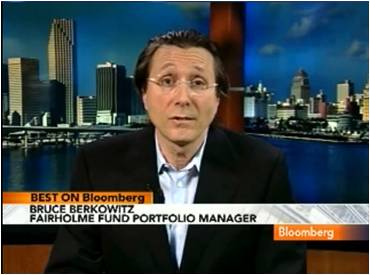 Click here to view Bloomberg invterview with Bruce Berkowitz
How He Did It
Berkowitz states the stellar performance was achieved by
“Ignoring the crowd and going towards stressed areas that many people are running from…We make our judgments based on the cash that securities generate.”
Fairholme is effectively a “go anywhere” fund that adheres tightly to the value-based philosophy. Berkowitz’s portfolio is centered on equity securities, but his team has also shown willingness to go up and down the capital structure, if they find value elsewhere.
The Fund and its History
Berkowitz started the fund in 1999 as an extension of his separate account business, which was created in his previous life at Smith Barney and Lehman Brothers. The Fairholme fund tends to concentrate around 15 to 25 securities on average, with some holdings accounting for more than 10% of the portfolio. An example of Fairholmes concentration is evidenced by its favorably timed trade in the energy sector, which resulted in a 35% weighting in the fund. Fortunately Berkowitz redeployed that winning position – before energy prices cratered in 2008 – into unloved areas like healthcare and defense stocks.
Berkowitz models his investment style after Warren Buffett, focused on good businesses with prolific cash flows. Like many value investors, Berkowitz fishes for contrarian based ideas residing in pockets of the market that are out of favor. He also likes to have a significant weighting in “special situations,” which are limited to about 25% of the portfolio. In order to take advantage opportunities, Berkowitz is not shy or bashful about carrying around a good chunk of cash in his pocket. He likes to keep about 15% on average to scoop up out of favor opportunities.
The Future of Fairholme
I commend Berkowitz for his admirable record, but I caution investors to not go hog wild over outperforming funds. He has crushed the market over an extremely challenging investment period, but investors need to remember that “mean reversion,” the tendency for a trend to move towards averages, applies to investing styles too. Concentrated, go-anywhere, large cap value, market timing funds that outperform for ten years at a time may underperform or outperform less dramatically over the next ten years. Just ask Bill Miller (see also Bill Miller Revenge of the Dunce article), concentrated value manager at Legg Mason, about mean reversion. Miller beat the market for 15 consecutive years before recently ending up in the bottom 10-year decile (1-star Morningstar rated) after some bad concentrated bets and poor investment timing. Another challenge for Fairholme is size (currently around $10.5 billion in assets under management). Having managed a multi-billion fund myself (see also my book), I can attest to the complexities Berkowitz faces in managing a much larger fund now.
Regardless, Berkowitz’s performance should not be ignored given his sound philosophy and achievement over an unprecedented period. Already, just a few weeks into 2010, Fairholme is ranked #1 in its fund category by Morningstar.
This is one invisible man you should not let disappear off your radar.
Wade W. Slome, CFA, CFP®
Plan. Invest. Prosper.
DISCLOSURE: Sidoxia Capital Management (SCM) and some of its clients own certain exchange traded funds, but at time of publishing had no direct positions in FAIRX, LM, BRKA/B or MORN. No information accessed through the Investing Caffeine (IC) website constitutes investment, financial, legal, tax or other advice nor is to be relied on in making an investment or other decision. Please read disclosure language on IC “Contact” page.
Lessons Learned from Financial Crisis Management 101

For many investors the financial crisis over the last 24 months was an expensive education. Rather than have to enroll and take the courses all over again, I am hopeful we can put that past education to good use. Here are some valuable lessons I learned from my two year degree in Financial Crisis Management 101.
Investors Don’t Get Paid For Emotions: In investing, emotional decisions generally lead to suboptimal  decisions. Over the financial crisis, despite the market rebound last year, many investors fell prey to fear. This queasiness (see Queasy Investors article) resulted in money being stuffed under the mattress – earning subpar yields – and asset allocations dramatically shifting towards bonds. Not surprisingly, the Barclays Aggregate Bond Index fell -1% in 2009 as the herd piled in. On the flip side, those willing to brave the equity markets were rewarded with a +23% gain in the S&P500 index. Certainly this bond-equity picture looked different in 2008, but unfortunately many mainstream portfolios lacked adequate bond exposure then. As famed Fidelity Magellan fund manager Peter Lynch points out, fretting about your portfolio can work against you: “Your ultimate success or failure will depend on your ability to ignore the worries of the world long enough to allow your investments to succeed.”
Martin Luther King Jr. put anxious emotions into perspective by expressing, “Normal fear protects us; abnormal fear paralyses us.” Prudent conservatism makes sense, but panicked alarm can lead you astray. Behavioral economists Daniel Kahneman and Amos Tversky punctuated this idea by showing the impact that “loss” has on peoples’ psyches. Through their research, Kahneman and Tversky demonstrated the pain of loss is more than twice as painful as the pleasure from gain. Euphoria, whether for homes or for other forms of credit-induced spending, is not a desirable emotion when investing either – just ask any house-flipping Florida or California resident looking for work. The moral of the story: plan for a rainy day and don’t succumb to the elation of the herd. Create a disciplined systematic approach that relies less on your gut. Emotional decisions, as we’ve seen over the last few years, generally do not fare well.
Quality Doesn’t Die in a Crisis: Good companies with solid growth prospects don’t disappear in a bear market. On  the contrary, they typically are in much better position to invest, step on the throats of their competitors, and steal market share. Many of the quality companies left for dead last year have risen from the ashes. Leveraged financials and debt laden companies were hit the hardest, and bounced nicely last year, but the market leaders are the companies that endure through bull and bear markets.
Buy and Hold is Not Dead: Catching fish  can be difficult if one constantly dips their line in and out of the water. Academic research falls pretty bluntly on the shoulders of “day traders,” and I’m still searching for a Warren Buffett equivalent to show up on Oprah or Charlie Rose espousing the virtues of speculation – oh wait, maybe Jim Cramer qualifies?
Long-term investors are a rare but dying breed – just look at the average fund manager’s holding period, which has dropped from about five years in the 1960s to less than one year today. The 1980s and 1990s weren’t too bad for buy and holders (about a +1,400% increase), but the strategy has subsequently gone in hibernation for a decade. Warren Buffett may be pushing a bit too far when he says, “Our favorite holding period is forever,” but directionally this posture may actually work well over the next ten years. Patience can pay off – even if you arrive late to the game. For example, if you bought Wal-Mart shares (WMT) after it rose 10-fold during its first 10 years, you still could have achieved a 60x return over the next 30 years. I, myself, believe there is a happy medium between high frequency trading (see HFT article) and “forever” investing. Regardless of your time horizon, I agree with late Sir John Templeton who said, “The only way to avoid mistakes is not to invest – which is the biggest mistake of all.”
Cyclical is Not Secular: Party crashers may be optimistic about the prospects of a gathering, but if they arrive too  late to the event, there may be no more food or wine left. The same principle applies to investment themes, as well-known value manager Bill Miller states, “Latecomers are usually persuaded that the cyclical has become the secular.” Over the last few years, the secular arguments of “real estate prices will never go down nationally,” and the belief that emerging markets like China would “decouple” from the U.S. market in 2008, simple were proved wrong. Time will tell if the gold-bugs will be right regarding their call for continued secular increases, or if the spike is a crescendo on a return to more normalized levels. On the whole, I much rather prefer to arrive at a big party prematurely, rather than showing up late sifting through the crumbs and scraping the bottom of the punch bowl.
Turn Off the TV: Fanning the flames of our daily emotions are media outlets. Thanks to globalization, the internet,  and the 24/7 news cycle, we are bombarded with some type of daily fear factor to worry about. Typically, an eloquent strategist or economist pontificates on the direction of the market. In many instances these talking heads don’t even manage client money or are not held accountable for their predictions (see Peter Schiff article). I like Barron’s Michael Santoli’s description of these story-telling market mavens, “A strategist’s first job is to have a plausible, defensible case to shop around client conference rooms globally. Being right is gravy.” Although intellectually stimulating, I advise you to limit your consumption and delivery of strategist commentary to cocktail parties and don’t let their advice sway your portfolio decisions. You’ll be much better served by listening to veteran investors who have successfully navigated choppy market cycles. Famed growth investor William O’Neil shrewdly chimes in on the subject too, “Since the market tends to go in the opposite direction of what the majority of people think, I would say 95% of all these people you hear on TV shows are giving you their personal opinion. And personal opinions are almost always worthless … facts and markets are far more reliable.”
Bad Loans are Made in Good Times: Markus Brunnermeier, a Princeton economist known for studying financial bubbles, declared this observation regarding loans. Hindsight is 20-20, but it’s no wonder that boat loads of no-doc, no down-payment, teaser rate subprime loans and overleveraged risky private equity loans were being made when unemployment was at 5% — not today’s 10% rate. Now with the loan spigots shut, the tables have been turned. Relatively few loans are now being made, but with a massively steep yield curve, surviving financial institutions are in a golden age for bringing on new wildly lucrative assets onto their balance sheets. Sure, the industry is still saddled with toxic legacy assets, but the negative impact should begin fading in coming quarters if the economy can continue building a firmer foundation.
Diversification Matters: Contrary to current thinking, which believes diversification didn’t help investors through  the crisis, owning certain asset classes like treasuries, certain commodities, and cash did help in 2008. Certainly, the correlations between many asset classes converged in the heat of the panic, but I’m convinced the benefits of diversification provide beneficial shock absorbers for most investment portfolios. Princeton professor and economist Burton Gordon Malkiel sums it up succinctly, “Diversity reduces adversity.”
The Herd is Often Led to the Slaughterhouse: The technology and housing bubble implosions serve as gentle  reminders of the slaughterhouse fate for those who follow the herd. Avoiding consensus thinking is virtually a requirement of long-term outperformance. As Sir John Templeton stated, “It’s impossible to produce superior performance unless you do something different from the majority.” John Paulson can also attest to this fact. If aggressively shorting the housing market and loading up on CDS insurance was the consensus, his firm would not have made $20 billion over 2007 and 2008.
These are obviously not all the lessons to be learned from the financial crisis, and by following a philosophy of continual learning, future mistakes should provide additional insights to help guard against losses and capitalize on potential opportunities. Having freshly graduated from Financial Crisis Management 101, I hope to immediately implement this education to land on the financial market’s Dean’s List.
Wade W. Slome, CFA, CFP®
Plan. Invest. Prosper.
DISCLOSURE: Sidoxia Capital Management (SCM) and some of its clients own certain exchange traded funds (including fixed income ETFs and FXI). Also at time of publishing SCM and some of its clients had a direct long position in WMT, but no position in BEN or BRKA/B. No information accessed through the Investing Caffeine (IC) website constitutes investment, financial, legal, tax or other advice nor is to be relied on in making an investment or other decision. Please read disclosure language on IC “Contact” page.
Bashful Path to Female Bankruptcy

The unrelenting expansion in bankruptcies does not discriminate on gender – you either have the money or you do not. Naomi Wolf, author of Give Me Liberty: A Handbook for American Revolutionaries, recently shed light on the underbelly of those suffering severe financial pain in this economic crisis…middle-class women.
How bad is it for middle class women?
“A new report shows that a million American middle-class women will find themselves in bankruptcy court this year. This is more women than will ‘graduate from college, receive a diagnosis of cancer, or file for divorce,’ according to the economist Elizabeth Warren.”
Wolf explores multiple factors in trying to explain this phenomenon. Surprisingly, higher education levels does not appear to prevent a higher percentage of bankruptcies in this large demographic.
If education levels are not a contributing factor, then what is? Here are some Wolf’s findings:
1) Awash in Debt: One explanation for the extra debt reliance is many of these positions occupied by this class of women are lower-paying, which requires women to tap credit lines more frequently. Also, many women have been targeted by luxury-goods manufacturers and credit-card companies. Repeated contacts by the marketers have led to more women succumbing to the consumerism messages shoveled to them.
2) Credit Card Legislation: Wolf makes the case that financial credit card legislation introduced in 2005 disproportionately negatively impacts divorced wives because credit card companies get priority in the repayment line over critical child support payments. In other words, child support payments go to the credit card company rather than to the child, thereby creating an undue financial burden on the female caregiver.
3) Skewed Emotional Beliefs about Money: The biggest issue regarding the emotional connection to finances is working-women “find it embarrassing to talk about money.” The article even acknowledges that many current generation women earn more than previous generations, but financial security has largely not improved because of the “money taboo.” I discover this taboo dynamic in my practice all the time. Part of the blame should be placed on the financial industry’s use of endless acronyms as smoke and mirrors to confuse and intimidate clients on the subject of money. I believe the better way to financial success is to empower clients through education and understanding, not deception and misinformation.
Wolf goes onto explain some of the confused financial thought processes held by this segment of women:
- Negotiating salary increases is difficult for these women because it makes them feel “unfeminine.”
- This class often fails to save because they falsely assume marriage will save them financially.
Unfortunately, the lack of financial literacy and dependence on the spouse leaves these women vulnerable to divorce and widowhood.
Working Class Women Better Prepared
Interestingly, Wolf’s findings point to working class women being much more financially literate and prepared in part because they have erased the notion of a knight in shining armor saving the day from their financial responsibilities. Bolstering her argument, Wolf references the success of the micro-finance programs being instituted to lower-class, working women in developing countries.
Wolf’s Solution
How do middle-class working women break this negative financial cycle? Wolf delivers the medicine directly by directing these women to break the “social role that casts middle-class women as polite, economically vague, underpaid, shopping-dazed dependents.” Opening their eyes to these issues will not erase all of the contributing factors, but women will be better equipped to deal with their financial problems.
From my perspective, there is no quick fix for immediate financial literacy. For those interested in learning more, I encourage you to read my article on personal finance, What to Do Now? Time to Get Your House in Order.
Regardless of your financial knowledge maturity, like any discipline, the more time you put in to it, the more benefits you will receive.
Read Complete Naomi Wolf Article Here
Wade W. Slome, CFA, CFP®
Plan. Invest. Prosper.
DISCLOSURE: Sidoxia Capital Management (SCM) and some of its clients own certain exchange traded funds, but at time of publishing had no direct positions in any company mentioned in this article. No information accessed through the Investing Caffeine (IC) website constitutes investment, financial, legal, tax or other advice nor is to be relied on in making an investment or other decision. Please read disclosure language on IC “Contact” page.
Running with the Bulls

Guest Contributing Writer: Bruce Wimberly
No matter where you turn some “expert” is espousing his or her view on the direction of the market. The reality is none of them know. My advice to anyone is avoid the fallacy of experts. Those that purport to know, donʼt. It is a mere exercise in futility to justify charging higher fees. Letʼs be honest if anyone knew the future direction of asset prices they would be beyond rich (Iʼm talking John Paulson – Trade of the Century rich!). Nice job John who would have thought you could make that much money betting against mortgages.
As investors our best bet is to accept that fact that market timing is a losing strategy. Timing the market is similar to a coin flip. Pure and simple, the cost of getting it wrong wipes out the occasional gain of getting it right. Remember, every time you listen to the perma-bears and try to time the market, there is big time investment professional on the other side of that trade who is by definition taking the opposite view.
Good investors expand their timeframes. They do not get sucked into the news of the day. Let the perma-bears worry about Dubai, currency devaluation, or whatever else is todayʼs fear. Keep in mind there is always something to worry about. For long term investors the greatest fear is not being in the market. For example, if inflation were to average 3% and you are sitting in cash earning nothing your money will be cut in half by 2033. Grandmaʼs mattress is not an option for most people.
Now back to the question of bulls versus bears and the direction of the markets. Who is right? The simplest way to think about this comes from Oracle of Omaha himself, Warren Buffett. Buffett thinks of the market as a reflection of total market cap relative to US GNP (gross national product). After all, in the long run the market should approximate some measure of overall corporate profitability or in this case overall economic growth. If you accept Buffettʼs argument then the market is neither overly expensive or cheap. As of yesterday the total market index is at $11,296.2 billion which is about 79% of the last reported GDP. (I know the perma-bulls will find some reason to bash the reported GDP number). Nevertheless, this simple formula provides a good long term context on which to gage the relative attractiveness of the overall market. To put todayʼs number in context (79%) at the peak of the market bubble in 1999, the ratio of total market cap/GDP was 150% or almost double todayʼs reading. Yes, the market has made a major move from depressed levels earlier in the year but that is irrelevant. Donʼt anchor on that number or you will never get off the sidelines.
My advice is simple, ignore the perma-bears and avoid market timing like the plague for it is a suckers bet (see also article on passive vs. active investing). If the market does pull back (and it will at some point) this is great news for the long term investor. Anytime you can buy a stock on sale – this is a good thing! So enjoy the Christmas holidays, donʼt believe the hyped up bears and as always:
Plan. Invest. Prosper.
DISCLOSURE: Sidoxia Capital Management (SCM) and some of its clients own certain exchange traded funds and equity securities in client and personal portfolios at the time of publishing, but had no direct position in BRKA/B. No information accessed through the Investing Caffeine (IC) website constitutes investment, financial, legal, tax or other advice nor is to be relied on in making an investment or other decision. Please read disclosure language on IC “Contact” page.
Secure Your GPS (Global Portfolio Specialist)

We’ve all been there, our head in our hands, lost in the middle of nowhere. One reason for blame can be overconfidence in the directions provided or our map reading abilities. Now we have GPS (Global Positioning System) devices – a tool I now could never live without. In the investment world, with the damage that has been done, intelligent advice is needed more than ever. Unfortunately, there is no GPS device to guide our investments, but many individuals would do their self a favor by finding the right experienced professional advisor to act as your GPS device (Global Portfolio Specialist).
Getting from point A to point B in the real world can be quite simple. In the investment world, the roadways are constantly shifting. Changes in interest rates, tax policies, unemployment, fiscal initiatives can represent obstacles, the equivalent of road construction barriers, potholes, erosion, mudslides, and earthquakes in our quest for financial freedom. Navigating these winding paths can require a GPS advice. Asking for help or directions can be embarrassing and castigating for some, especially for some proud males. Stubbornly appearing to have the answer can be more important for some, and can cloud the decision making process – even if assistance can lead to the most efficient path to prosperity.
Having a guide at your fingertips as you meet unknown forks in the road is a nice asset to have. Unfortunately finding the right guide is much easier said than done, many guides can have ulterior motives and hidden agendas that conflict with yours. So although, having a guide may be ideal, finding the right guide requires a lot of research (read how to find an advisor). The scope of qualifications between the capabilities of one advisor compared to another can be like comparing a plastic butter knife with a stainless steel swiss-army knife. The cheap butter knife may handle a few simple needs, but most investors would be better served by someone with a breadth of tools that can assist you with a diverse set of circumstances.

The old cliché states men hate to get directions while women seek a security blanket (a plan). GPS is not full proof, as occasionally the software is not updated or gets confused. But tech geeks like me have grown to love the assistance and benefit from the heightened efficiency and safety it provides. Not only am I more confident, but it also gets me to where I want to go in less time.
Having your guide is important when it comes to investments, but having someone with expertise in tax planning (should I consider Roth conversion in 2010?); estate planning (what impact will the expected changes in the estate tax rate have on my future?); and insurance planning (do I have adequate life, health, and business insurance?) can be critical. All these areas can have a profound impact on whether you achieve your personal and financial goals.
Along the road of life, there can be many bumps, twists and turns. If you would like the assistance of a professional advisor, consider doing your homework and finding the appropriate GPS. Here is a checklist:
1) Where are You Now? This means taking inventory of your assets and liabilities, getting a handle on your income and expenses, and having a firm understanding of your tax and family planning issues (will, trust, powers of attorneys, etc.)
2) Where are You Going? Next you need to know where you want to go? You may have a rough idea, but in order to create a coherent plan, goals need to be defined.
3) Create a Plan. Everyone’s map or blueprint will look different. Some will need highly detailed directions, while others due to different circumstances may have less complex needs or shorter distances to travel. Some may need guidance and directions to reach an adjacent state, while others may have more ambitious goals or planning needed to reach the peak of Mount Everest. Different destinations and circumstances will require different planning.
4) Monitor and Adjust Plan as Necessary. Road conditions, weather, breakdowns, flight cancellations, among many other unforeseen circumstances can change the path to your goal. That’s why it’s so important to review, not only the changes in external circumstances, such as the financial markets, but also any individual changes whether it’s health, family, personal, or goal related.
Some people prefer to do things the old-fashion way or are happy with subpar technology (i.e., compass). However, if you do not want to get lost, or want a clearer defined map, then it’s time to shop for that new Global Portfolio Specialist who can help guide you to your destination.
Wade W. Slome, CFA, CFP®
Plan. Invest. Prosper.
DISCLOSURE: Sidoxia Capital Management (SCM) or its clients owns certain exchange traded funds, but currently has no direct position in GRMN. No information accessed through the Investing Caffeine (IC) website constitutes investment, financial, legal, tax or other advice nor is to be relied on in making an investment or other decision. Please read disclosure language on IC “Contact” page.
Compounding: A Penny Saved is Billions Earned
What is “compounding” and why is it so great? It sounds like such a fancy financial term. One can think of compounding as a snowball rolling down a hill – the longer the snowball rolls (or the higher up the mountain you begin), the more compounding will expand the size of your snowball. Expanding your investment portfolio through compounding should be your major goal.
Albert Einstein, arguably one of the most intelligent people to walk this planet, was asked to describe mankind’s greatest discovery. His answer: “compound interest.” He went so far as to call it one of the “Eight Wonders of the World.” The benefits of compounding can be demonstrated via famous explorer, Christopher Columbus.
We all know the story, “In 1492, Christopher Columbus sailed the ocean blue.” To emphasize the benefits of compounding, let us suppose that Christopher Columbus made an investment in the historic year of 1492. If Chris had placed a single penny in a 6% interest-bearing account and instructed someone to remove the interest every year and put it in a piggybank, the total value collected in that piggybank would eventually accumulate to more than 30 cents. A pretty nice multiplier-effect on one penny, but not too much absolute cold hard cash to write home about…agreed?

"It's magic, I can turn pennies into billions."
However, if the young explorer had placed the same paltry investment of one cent into the same interest-bearing account, but LEFT the remaining earned interest to compound (thereby earning interest upon the previously earned interest) the results would be drastically different.
What would you guess the compounded account would be worth in 2009?
$10,000? $100,000? $1 million? $10 million? $100 million?
“NO” is the correct answer to all these guesses.
The correct answer: $121,096,709,346.21! Your eyes do not deceive you. That one penny invested in 1492 would have grown to $121 billion dollars today. If you don’t believe me, pull out your calculator and multiply $.01 * 1.06%, and repeat 517 times. Surely, we will not live 517 years to collect on an investment of such long duration. However, with proper planning everyone has the ability to invest quite a bit more than one cent to significantly build future wealth.
As an advisor, the problems related to compounding I see investors commit most are two-fold:
1) Investors are constantly shifting money in and out of their accounts (usually at suboptimal points) due to apprehension and greed, thereby nullifying the benefits of compounding.
2) Because of overpowering fear relating to current economic conditions, investors are parking their money in low yielding CDs (Certificates of Deposit), savings accounts, checking accounts, money market accounts, or other low returning investment vehicles. This strategy is equivalent to pushing the aforementioned snowball over the sidewalk, rather than down a long, steep hill.
In order to reap the rewards of compounding and dramatically expand your investment portfolio, a systematic, disciplined approach to investing needs to be followed. A system that more likely than not has a 20 year horizon rather than 20 days. Now go start saving those pennies!




 Investing Caffeine
