Posts tagged ‘inflation’
Seesawing Through Organized Chaos

Still fresh in the minds of investors are the open wounds created by the incredible volatility that peaked just a little over a year ago, when the price of insurance sky-rocketed as measured by the Volatility Index (VIX). Even though equity markets troughed in March of 2009, earlier the VIX reached a climax over 80 in November 2008. With financial institutions falling like flies and toxic assets clogging up the lending pipelines, virtually all asset classes moved downwards in unison during the frefall of 2008 and early 2009. The traditional teeter-totter phenomenon of some asset classes rising simultaneously while others were falling did not hold. With the recent turmoil in Greece coupled with the “Flash Crash” (read making $$$ trading article) and spooky headline du jour, the markets have temporarily reverted back to organized chaos. What I mean by that is even though the market recently dove about +8% in 8 days, we saw the teeter-totter benefits of diversification kick in over the last month.
Seesaw Success
While the S&P fell about -4.5% over the studied period below, the alternate highlighted asset classes managed to grind out positive returns.
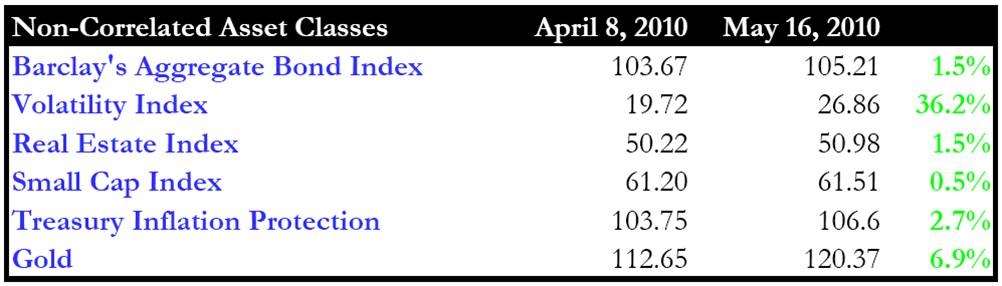
While traditional volatility has returned after a meteoric bounce in 2009, there should be more investment opportunities to invest around. With the VIX hovering in the mid-30s after a brief stay above 40 a few weeks ago, I would not be surprised to see a reversion to a more normalized fear gauge in the 20s – although my game plan is not dependent on this occurring.
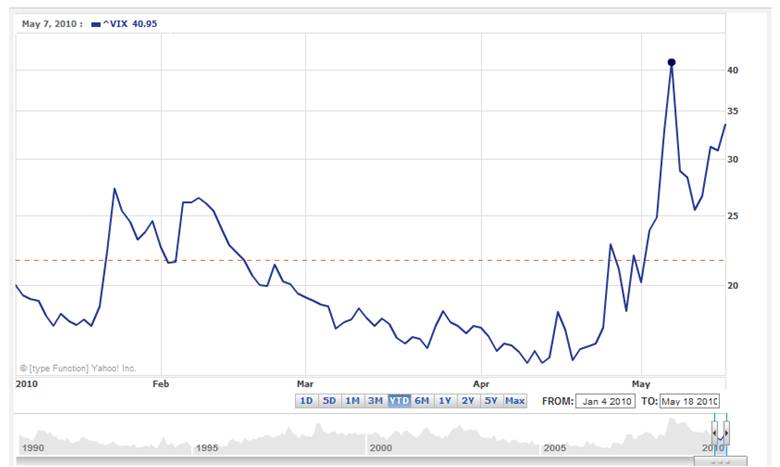
VIX Chart Source: Yahoo! Finance
Regardless of the direction of volatility, I’m encouraged that even during periods of mini-panics, there are hopeful signs that investors are able to seesaw through periods of organized chaos with the assistance of good old diversification.
Wade W. Slome, CFA, CFP®
Plan. Invest. Prosper.
*DISCLOSURE: Sidoxia Capital Management (SCM) and some of its clients own certain exchange traded funds (including AGG, BND, VNQ, IJR and TIP), but at the time of publishing SCM had no direct positions in VXX, GLD, or any security referenced in this article. No information accessed through the Investing Caffeine (IC) website constitutes investment, financial, legal, tax or other advice nor is to be relied on in making an investment or other decision. Please read disclosure language on IC “Contact” page.
One Size Does Not Fit All

When you go shopping for a pair of shoes or clothing what is the first thing you do? Do you put on a blindfold and feel for the right size? Probably not. Most people either get measured for their personal size or try on several different outfits or shoes. When it comes to investments, the average investor makes uninformed decisions and in many instances relies more on what other advisors recommend. Sometimes this advice is not in the best interest of the client. For example, some broker recommendations are designed to line their personal pockets with fees and/or commissions. In some cases the broker may try to unload unpopular product inventory that does not match the objectives and constraints of the client. Because of the structure of the industry, there can be some inherent conflicts of interest. As the famous adage goes, “You don’t ask a barber if you need a haircut.”
Tabulate Inventory
A more appropriate way of managing your investment portfolio is to first create a balance sheet (itemizing all your major assets and liabilities) individually or with the assistance of an advisor (see “What to Do” article) – I recommend a fee-only Registered Investment Advisor (RIA)* who has a fiduciary duty towards the client (i.e., legally obligated to work for the best interest of the client). Some of the other major factors to consider are your short-term and long-term income needs (liquidity important as well) and your risk tolerance.
Risk Appetites
The risk issue is especially thorny because the average investor appetite for risk changes over time. Typically there is also a significant difference between perceived risk and actual risk.
For many investors in the late 1990s, technology stocks seemed like a low risk investment and everyone from cab drivers to retired teachers wanted into the game at the exact worst (riskiest) time. Now, as we have just suffered through the so-called Great Recession, the risk pendulum has swung back in the opposite direction and many investors have piled into what historically has been perceived as low-risk investments (e.g., Treasuries, corporate bonds, CDs, and money market accounts). The problem with these apparently safe bets is that some of these securities have higher duration characteristics (higher price volatility due to interest rate changes) and other fixed income assets have higher long-term inflation risk.
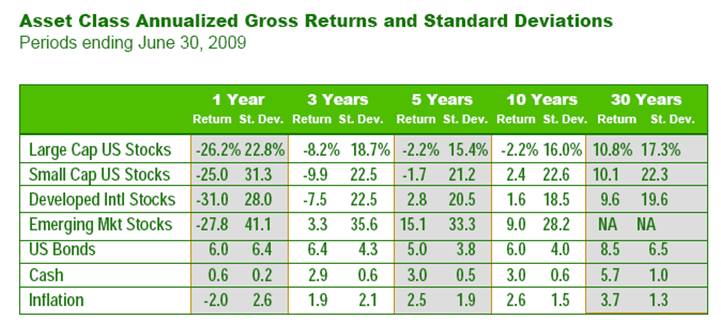
Source (6/30/09): Morningstar Encorr Analyzer (Ibbotson Associates) via State Street SPDR Presentation
A more objective way of looking at risk is by looking at the historical risk as measured by the standard deviation (volatility) of different asset classes over several time periods. Many investors forget risk measurements like standard deviation, duration, and beta are not static metrics and actually change over time.
Diversification Across Asset Classes Key
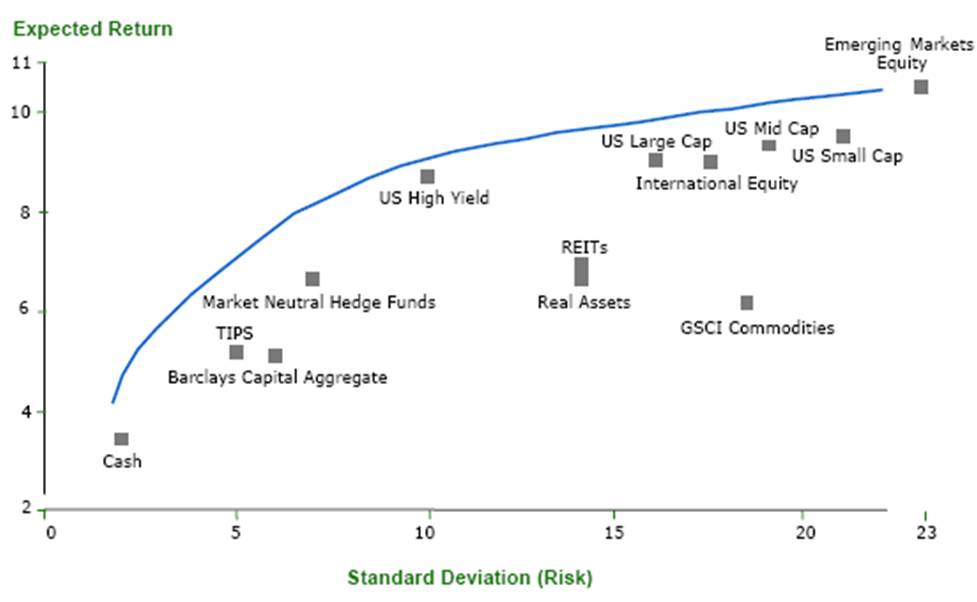
Source: State Street Global Advisors (June 30, 2009)
Correlation, which measures the price relationship between different asset classes, increased dramatically across asset classes in 2008, as the global recession intensified. However, over longer periods of time important diversification benefits can be achieved with a proper mixture of risky and risk-free assets, as measured by the Efficient Frontier (above). Conceptually, an investor’s main goal should be to find an optimal portfolio on the edge of the frontier that coincides with their risk tolerance.
Tailor Portfolio to Changing Circumstances
 In my practice, I continually run across clients or prospects that initially find themselves at the extreme ends of the risk spectrum. For example, I was confronted by an 80 year old retiree needing adequate income for living expenses, but improperly forced by their broker into 100% equities. On the flip side, I ran into a 40 year old who decided to allocate 100% of their retirement assets to fixed income securities because they are unsure of stocks. Both examples are inefficient in achieving their different investment objectives, yet there are even larger masses of the population suffering from similar issues.
Financial markets and client circumstances are constantly changing, so the objectives of the portfolio should be periodically revisited. One size does not fit all, so it’s important to construct the most efficient customized portfolio of assets that meets the objectives and constraints of the investor. Take it from me, I’m constantly re-tailoring my wardrobe (like my investments) to meet the needs of my ever-changing waistline.
Wade W. Slome, CFA, CFP®
Plan. Invest. Prosper.
*DISCLOSURE: For disclosure purposes, Sidoxia Capital Management, LLC is a Registered Investment Advisor (RIA) certified in the State of California. No information accessed through the Investing Caffeine (IC) website constitutes investment, financial, legal, tax or other advice nor is to be relied on in making an investment or other decision. Please read disclosure language on IC “Contact” page.
Drought in Higher Rates May Be Over

The drought in higher interest rates may be nearing an end? Ever since the global financial crisis accelerated into full force in the fall of 2008, there were a constant flow of coordinated interest rate cuts triggered around the world with the aim of stimulating global GDP (Gross Domestic Product) and improving credit flow through the clogged financial pipes. Central banks across the world cut key benchmark interest rate levels and the impact of these reductions has a direct influence on what consumers pay for their financial products and services. More recently, we have begun to see the reversal of previous cuts with rate hikes witnessed in several international markets. Last week we saw Norway become the first western European country to raise rates, following an earlier October rate lift by Australia and another by Israel in August. For some countries, the sentiment has switched from global collapse fears to a stabilization posture coupled with future inflation concerns. In the U.S., the data has been more mixed (read article here) and the Federal Reserve has been clear on its intention to keep short-term rates at abnormally low levels for an extended period of time. That stance would likely change with evidence of inflationary pressures or improved job market conditions.
What Does This Mean for Consumers?
Prior to the financial crisis, credit availability flourished at affordably low rates. Now, with signs of a potential global recovery matched with regulatory overhauls, consumers may be impacted in several financial areas:
1) Credit Card Rates: Beyond regulatory changes in Washington (read more), the interest rate charged on unpaid credit card balances may be on the rise. When the Federal Reserve inevitably raises the targeted Federal Funds Rate (the interest rate for loans made between banks) from the current target rate range of 0.00% and 0.25%, this action will likely have direct upward pressure on consumer credit card rates. The associated increase in key benchmark rates such as the Prime Rate (the rate charged to a bank’s most creditworthy customers) and LIBOR (London Interbank Offer Rate) would result in higher monthly interest payments for consumers.
2) Other Consumer Loans: Many of the same forces impacting credit card rates will also impact other consumer loans, like home mortgages and auto loans. Pull out your loan documents – if you have floating or variable rate loans then you may be exposed to future hikes in interest rates.
3) Business Loans / Lines of Credit: Business owners -not just consumers – can also be impacted by rising rates. When the cost of funding goes up (.i.e., interest rates), the banks look to pass on those higher costs to the customer so the account profitability can be maintained.
4) Dollar & Import Prices: To the extent subsequent United States rate hikes lag other countries around the world, our dollar runs the risk of depreciating more in value (currency investors, all else equal, prefer currencies earning higher interest rates). A weaker dollar translates into foreign goods and services costing more. If international central banks continue to raise rates faster than the U.S., then imported good inflation could become a larger reality.
5) Hit to Bond Prices: Higher interest rates can also result in a negative hit to your bond portfolio. Higher duration bonds, those typically with longer maturities and lower relative coupon payments, are the most vulnerable to a rise in interest rates. Consider shortening the duration of your portfolio and even contemplate floating rate bonds.
Interest rates are the cost for borrowed money and even with the recent increase in consumers’ savings rate, consumers generally are still saddled with a lot of debt. Do yourself a favor and review any of your credit card agreements, loan documents, and bond portfolio so you will be prepared for any future interest rate increases. Shopping around for better rates and/or consolidating high interest rate debt into cheaper alternatives are good strategies as we face the inevitable end in the drought of higher global interest rates.
Wade W. Slome, CFA, CFP®
Plan. Invest. Prosper.
DISCLOSURE: No information accessed through the Investing Caffeine (IC) website constitutes investment, financial, legal, tax or other advice nor is to be relied on in making an investment or other decision. Please read disclosure language on IC “Contact” page.
Clashing Views with Dr. Roubini

The say keep your friends close, and your enemies even closer. Nouriel Roubini, professor of economics and international business at the NYU Stern School of Business, is not an enemy, but I think his fluctuating views (see previous story) and Armageddon expectations are off base. Perma-bears like Roubini and Peter Schiff (view article) have gloated and danced in the media limelight due to their early but eventually right calls. Over the last seven months or so, their forecasts on the U.S. economy and markets have been off the mark. With that said, even those with competing views at times can find common ground. For Nouriel and I, we currently share similar beliefs on gold (see my article on gold).
Here’s what Professor Roubini has to say:
“ I don’t believe in gold. Gold can go up for only two reasons. [One is] inflation, and we are in a world where there are massive amounts of deflation because of a glut of capacity, and demand is weak, and there’s slack in the labor markets with unemployment peeking above 10 percent in all the advanced economies. So there’s no inflation, and there’s not going to be for the time being.The only other case in which gold can go higher with deflation is if you have Armageddon, if you have another depression. But we’ve avoided that tail risk as well. So all the gold bugs who say gold is going to go to $1,500, $2,000, they’re just speaking nonsense. Without inflation, or without a depression, there’s nowhere for gold to go. Yeah, it can go above $1,000, but it can’t move up 20-30 percent unless we end up in a world of inflation or another depression. I don’t see either of those being likely for the time being. Maybe three or four years from now, yes. But not anytime soon.”
My thoughts on oil are less bearish, but nonetheless more cautious given the massive price bounce to around $80 per barrel. Could I see prices coming down to $50 like Roubini feels is appropriate? Certainly. With the $100+ per barrel swing we saw last year, I cannot discount completely the possibility of that scenario. However, unlike gold, oil has a much stronger utility value, and based on the slow adoption of more expensive alternative energies, this commodity will be in strong demand for many years to come. The pace of global economic recovery, especially in countries like China, India, and Brazil provide an underlying demand for the petroleum product. In order to understand the underlying bid for this economic lubricant, all one has to do is look at the appetite of emerging economies like China when it comes to this black gold (see my article on China).
And where does Roubini think markets go from here?
“If the recovery of the economy is going to be anemic, sub-par, below-trend and U-shaped, there is going to be a correction. And therefore my view is to stay away from risky assets. Stay in liquid assets. I don’t know when the correction is going to occur, it could be a while longer, but eventually it will be a pretty ugly correction, across many different asset classes.”
Perhaps Roubini’s “double dip” fears will eventually come true – and he leaves himself plenty of room with vague loose language – however, I follow the philosophy of Peter Lynch: ‘‘If you spend more than 14 minutes a year worrying about the market, you’ve wasted 12 minutes.” Great companies don’t disappear in challenging markets – they become cheaper – and new innovative companies emerge to replace the old guard.
As much as I would like to be right all the time, that’s not the case. In order to learn from past mistakes and continually improve my process, it’s important to get the views of others…even from those with clashing perspectives.
Read IndexUniverse.com Interview with Nouriel Roubini Here
Wade W. Slome, CFA, CFP®
Plan. Invest. Prosper.
DISCLOSURE: Sidoxia Capital Management and client accounts do not have direct long or short positions in gold positions, however accounts do have long exposure to certain energy stocks and ETFs. No information accessed through the Investing Caffeine (IC) website constitutes investment, financial, legal, tax or other advice nor is to be relied on in making an investment or other decision. Please read disclosure language on IC “Contact” page.
Strong Advice from Super Swensen

Playing the financial markets is a challenging game, and over the last decade we’ve witnessed events we will never see again in our lifetimes. Through these muscle aches and pains, listening and paying attention to powerful, seasoned industry veterans, like David Swensen, becomes paramount. Mr. Swensen has proven his durability – he has managed the Yale endowment for 24 years and has overseen the growth of the university’s portfolio from $1 billion to $17 billion. For the decade ending in June 2008, the Yale portfolio averaged an incredible 16.3% annual return.
So what commanding advice does Mr. Swensen have to share? Here are a few nuggets regarding equities as discussed in his May interview published in The Guru Investor (TGI):
“With a long time horizon you should have an equity orientation, because over longer periods of time, equities are going to deliver better results,” he says. “If they don’t, then capitalism isn’t working. And we could well be at a point where investments in equities are going to produce returns going forward that are higher than what we’ve seen in the past five or ten years.”
I find it difficult to argue with him. Perhaps we still have a ways to go, but the equity markets had an explosion after the 1966-1982 hiatus. Perhaps the 2000-2009 period isn’t long enough to mark bottom, but at a minimum, the spring is coiling based on history.
When it comes to diversification, TGI summarized Swensen’s asset allocation as follows:
“He recommends that investors have 30% of their funds in U.S. stocks, 15% in Treasury bonds, 15% in Treasury Inflation-Protected Securities, 15% in Real Estate Investment Trusts, 15% in foreign developed market equities, and 10% in emerging market equities. As investors get older, they should keep this type of allotment for a portion of their portfolio but begin to decrease the size of that portion, putting part of their portfolios into less risky assets like cash or Treasuries.”
Many investors were taking excessive risk in 2008 (within their asset allocations), and they were not even aware. Let’s hope valuable lessons have been learned and investors adjust the risk levels of their portfolios as they age.
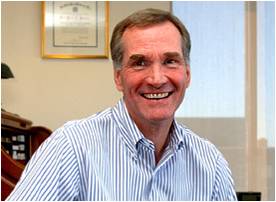
David Swensen (Michael Marsland/Yale University)
Mr. Swensen has some choice words for the mutual fund management industry as well:
“The problem is that the quality of the management in the mutual fund industry is not particularly high, and you pay an extraordinarily high price for that not-very-good management,” he says. Swensen cites one study performed by Rob Arnott that measured mutual fund performance over a two-decade period. The study found that you’d have had a 15% chance of beating market after fees and taxes by investing in mutual funds — and that includes only funds that were around for the entire period; many other weaker funds didn’t last, meaning the results have a survivorship bias.
Tough to disagree, and as I’ve written in the past, I believe there are only so many .300 hitters in baseball (a study in 2007 showed only 12 active career .300 hitters in the Major Leagues – highlighted in my previous Ron Baron article). Outside of baseball, there are consistent alpha generators in the market too. However, I’d make the case that identifying the alpha generators in the financial markets is much more difficult because of the extreme fund performance volatility. Even the best managers can string some bad years together.
Swensen doesn’t stop there. He expands on the reasons behind mutual fund manager underperformance:
Taxes and fees are the big culprits, Swensen says: “Why are the tax bills so high? Because turnover’s too high. The mutual fund managers are trading the portfolios as if taxes don’t matter, and taxes do matter. And they’re trading the portfolios as if transactions cost and market impact don’t matter, and they do matter. And as they trade the portfolios, basically what’s happening is Wall Street is siphoning off its slice of the pie … and that’s at the expense of the investor.”
One thing we learned from the real estate and financial bubble that burst over the last few years is that incentive structures were misaligned. Manager compensation, whether you are talking hedge funds or mutual funds, is based on too short a time horizon, and therefore incentive structures encourage abnormal risk-taking. In baseball terms, you have those that take excessive risk and swing for the mega-bucks fences (loose cannons) and the bunters (benchmark huggers) who seek the comfort of “lower” mega-bucks. Swensen is a much bigger believer in passive strategies (as am I), using passive investment vehicles like ETFs (Exchange Traded Funds).
Mr. Swensen continues his critical perspective by targeting investors too:
Individuals and institutions who buy mutual funds “take this mutual fund industry which produces a bunch of products that are not great to start with, and then they screw it up by chasing hot performance and selling after things turn cold.”
The 1984-2002 John Bogle data (Vanguard) included in my “Action Dan” article hammers that point home.
Where should investors go now?
Asked what the one recommendation he has right now for investors is, Swensen cited TIPS. “We’ve had this massive fiscal stimulus, massive monetary stimulus, and it’s hard to see how that doesn’t translate into pretty substantial inflation, or at least pretty substantial risk of inflation … down the road at some point,” he said.
Ditto, once again – I’m a believer in having some inflation protection in your portfolio. Of course there is no free lunch in the investment world, and so there are certainly some risk factors in Swensen’s alternative investment strategy (e.g. hedge funds, private equity, and real estate). Certainly, due to significant illiquidity and other factors, many of these areas got absolutely hammered in 2008.
The best investors prepare their portfolios for these strenuous times. Do yourself a favor and work on your muscle tone too – and listen to the strong advice of David Swensen.
Read the Full TGI Article Here
Wade W. Slome, CFA, CFP
Plan. Invest. Prosper.
DISCLOSURE: Sidoxia Capital Management and client accounts do have direct long positions in TIP at the time article was originally posted. No information accessed through the Investing Caffeine (IC) website constitutes investment, financial, legal, tax or other advice nor is to be relied on in making an investment or other decision. Please read disclosure language on IC “Contact” page.
Shiny Metal Shopping with Schiff, Rogers, and Faber

There I am, strolling through Costco (COST) with a pallet full of toilet paper, Diet Coke, and a garbage bag-sized bag of tortilla chips on my flat orange cart. As I roll into the cash register, I feel a cold panic grab me, only to realize I forgot my 25 pound gold brick in my car trunk as a method of payment for my necessities. Sound far-fetched? Probably not, if you are a part of the hyper-inflationary “Three Musketeers”: Peter Schiff, Jimmy Rogers, and Marc Faber.
Here is what some of the “world-is-ending” crowd is saying:
Peter Schiff (President of Euro Pacific Capital – Connecticut Senator Candidate): He sees the market potentially going much higher, but “it doesn’t matter how much money we have because we’re not going to be able to buy anything with it.”
Marc Faber (a.k.a.,“Dr Doom”, creator of the Gloom Boom & Doom Report): When asked by faux frog boiler and Fox News reporter Glenn Beck if he believes “it is 100% guaranteed that we are going to have hyper-inflation like Zimbabwe,” Faber’s short and to-the-point response was simply, “Yes, that’s correct.”
Jimmy Rogers (Chairman of Rogers Holdings): “I’m afraid they’re printing so much money that stocks could go to 20,000 or 30,000,” Rogers said. “Of course it would be in worthless money, but it could happen and you could lose a lot of money being short,” he adds. Mr. Rogers likes gold too: “I own gold, I’m not selling it.”
PRICING IN GOLD
One consistent theme heard from these three economic bears is that the Dow and other market indexes should be measured on a gold adjusted basis. Since Peter Schiff’s Dow 10,000 to 3,000 forecast never came to fruition (See Schiff’s other questionable predictions), he rationalizes it this way, “So if you price the 2002 Dow in gold, the Dow is at 3,000 now.” Marc Faber makes a similar argument by saying the Dow could double from today, but with gold tripling your worth will be down. That’s funny, because if I price the Dow based on 2002 lumber prices (rather than gold), the Dow would actually be up to about 20,000 (more than 2x its value today)! If prices should truly be measured in gold, then why doesn’t Goldman Sachs’ (GS) and others provide inflation adjusted price targets on their research reports? If gold is the true measure of value, then why can’t I pay off my American Express (AXP) bill by mailing in my gold necklace?
GOLD FEVER
With the effective quadrupling of gold prices in the last seven years (~$250/oz to ~$1,000/oz), gold bugs are more confidently pounding their chests and throwing out multi-thousand, frothy price targets. For example, Peter Schiff predicted $2,000 per ounce by 2009 (who knows, maybe he’ll be right and gold will be up another 100% in the ne next 90 days…cough, cough). Not only are you hearing the strategists and investors bang their drums more loudly, but gold advertisements are plastered all over the radio, television, and internet. Here are a few excerpts*:
- “Watch your gold investments be “on the money” every 9 out of 10 times.”
- “Gold prices could reach $2,300 an ounce or more before it’s over. Buyers of gold bullion at $900 an ounce could earn a return of +155%. That’s very good. But there’s an even BETTER WAY!”
- “Discover Our Little Known “Gold Price Predictor” That Has Been Spot On Every Single Time… Since 1901..!”
- “Turn EVERY $1 Of GOLD Into $10…Or MORE!”
Sources: streetauthority.com and soverignsociety.com
ALTERNATIVE SCENARIO
Another scenario to consider is a complete collapse in gold prices (and surge in the dollar) like we saw in the early 1980s We experienced about a -65% drop in gold prices (~$800/oz. to $300/oz.) from 1980-1982 and saw ZERO price appreciation for about a 25 year period. When did this abysmal period for gold begin? Right about the same time that Paul Volcker raised interest rates to fight inflation. Hmmm, I wonder what next direction of interest rates will be, especially with the Federal Funds rate currently at effectively 0%? Could we see a repeat of the early ‘80s? Seems like a possibility to me. Certainly if you fall into the Marshal Law, civil unrest, soup kitchen, and bread line camp, like the “Three Musketeers,” then burying tons of gold in your homemade bunker may indeed be an appropriate strategy.
Another head scratcher is all the talk revolving around an inflation driven market rebound. If inflation is truly the worry, then shouldn’t the “Three Musketeers” be massively short and be concerned about declining PE (Price/Earnings) multiples, like the single digit PE levels we saw in the late-1970s and early-1980s (when we were experiencing double-digit inflation)?
As I have chronicled, there can be some mixed interpretations regarding the direction of future gold prices. If you think a repeat of Volcker driven gold price collapse of the early ‘80s is possible, then establishing a heavy short position may be the ticket for you. If on the other hand, you are in the gold $4,000 camp, then it might be best to carry a few extra gold bars in the trunk for your next Costco trip.
DISCLOSURE: Sidoxia Capital Management and client accounts do not have direct long or short positions in COST, GS, AXP or gold positions. No information accessed through the Investing Caffeine (IC) website constitutes investment, financial, legal, tax or other advice nor is to be relied on in making an investment or other decision. Please read disclosure language on IC “Contact” page.
Gold Market Lunacy Kicking Into Gear

So wait a second, let me get this right. A company pays billions of dollars to buy insurance, and then decides to sell $3.5 billion in dilutive ownership rights (current stockholders losing more than 10% of their ownership) so that they can pay somebody else another $5.6 billion to take that same insurance they previously loved away. In my book, I call that lunacy. This madness is exactly what Barrick Gold (ABX) just decided to do. The world’s largest gold miner issued approximately 95 million common shares at $37 per share to remove gold price hedges (used to lock in gold prices at a certain level), so if gold prices spike Barrick will now be able to participate fully without the drag of the hedges.
Effectively, management has decided to turn the mining company into a Vegas casino, where shareholders can now freely speculate in the price of gold without the volatility reducing hedges in place. Does this outlandish behavior signal a top in gold prices (now hovering around $1,000 per ounce)? I’m not stupid enough to call the end of frothing, speculative behavior – just witness Alan Greenspan’s “irrational exuberance” speech in 1996 when the NASDAQ traded at 1,300 (then went on to peak above 5,000). But what I am bold enough to do is call a spade a spade and to point out how ridiculous this reverse hedging activity is.
Other signs of speculation beyond the 4x price increase over the last 8 years or so, is the fact that gold prices have risen in the face of incredibly weak gold jewelry demand, -22% year-over-year globally in Q2 according to the Gold Demand Trends. This leaves the remaining demand coming largely from speculators and global central banks. If you need more evidence for the gold speculation, just turn on your local AM radio station and listen for the endless number of get-rich-quick on gold advertisements – some stations need to fill the gaping hole once held by those advertisers hawking mortgages.
From a gold investors’ perspective, I would say I fall more into Warren Buffett camp of thinking. Unlike other commodities (some of which I believe will be driven upwards by my emerging market demand and other forces) , gold is something dug up from the dirt in South Africa, melted, transported to another hole, buried in the ground (central bank), and then storage costs are incurred to guard the shiny metal. Sure, jewelry and small commercial applications are drivers for real demand, but the majority of demand is derived from intangible desires. Other commodities, for example oil, copper, uranium, and natural gas offer a lot more utility.
So what’s next when it comes to the price of gold? Peter Schiff an uber-gold bull broker at Euro Pacific Capital believes Armageddon is coming for the U.S. economy and hyper-inflation will drive gold upwards to the $4,000 per ounce price range (See How Peter Schiff’s Other Forecasts Have Performed). Another possibility to consider is a complete collapse in gold prices (and surge in the dollar) like we saw in the early 1980s after Paul Volcker raised interest rates and gold prices did not appreciate for a 25 year period. Hmmm, I wonder what direction interest rates are going next with the Federal Funds rate currently at effectively 0%? Could we see a repeat of the early ‘80s? Seems like a possibility to me. Certainly if you fall into the civil unrest, soup kitchen, and bread line camp, like Schiff and other U.S. bears, then piling into the diluted Barrick Gold shares may not be a bad strategy.
Inflation
Given the massive stimulus, debt loads, money supply growth and legislative agendas currently in place, inflation is a major medium and long-term concern. My remedy is government guaranteed Treasury Inflated Protection Securities (TIPS) that not only compensates investors with interest payments (unlike gold), but will also see principal values increase in tandem with principal if inflation indeed rears its ugly head. For those conspiracy theorists that believe the Consumer Price Index (CPI) is rigged, there are alternative international flavors of TIPs that reset according to other inflation benchmarks. As a kicker, some of these particular securities offer a hedge against a sliding U.S. dollar, which may or may not continue.
So as I lie in my recliner with my popcorn and TIPs, I’ll watch Barrick and other speculators continue the gold buying frenzy, wondering when and how ugly the gold finale will be?
Wade W. Slome, CFA, CFP®
Plan. Invest. Prosper.
DISCLOSURE: Sidoxia Capital Management and client accounts do not have direct long or short positions in ABX or gold related securities or BRKA/B at the time the article was published. Sidoxia Capital Management and its clients do have long exposure to TIP shares. No information accessed through the Investing Caffeine (IC) website constitutes investment, financial, legal, tax or other advice nor is to be relied on in making an investment or other decision. Please read disclosure language on IC “Contact” page.
V-Shaped Recovery or Road to Japan Lost Decades?
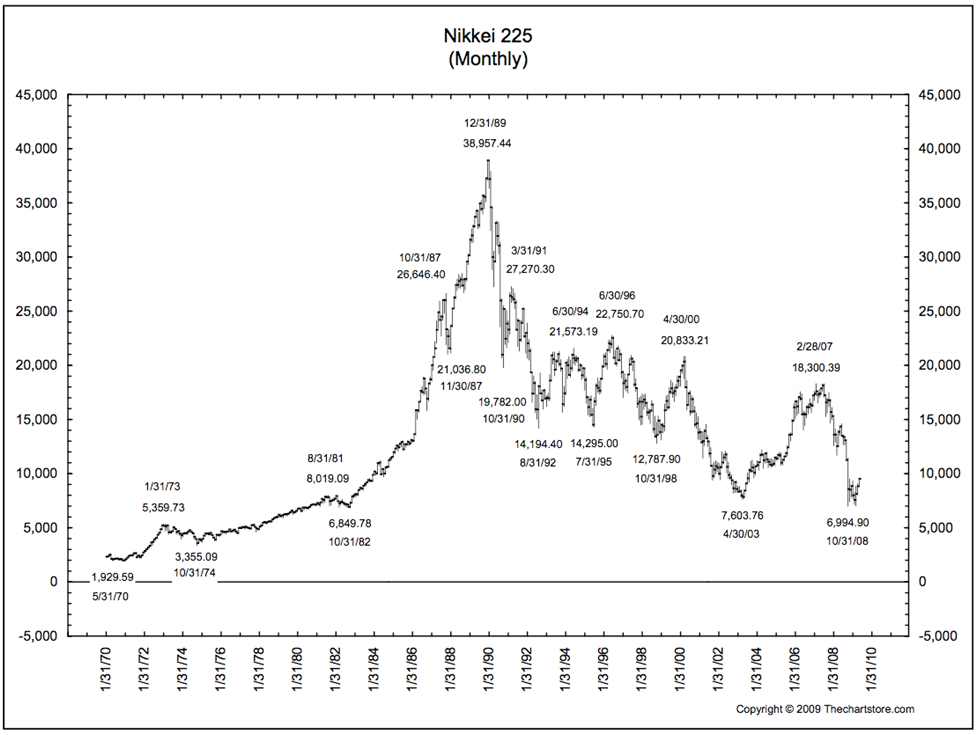
The Lost Decades from the 1989 Peak
On the 6th day of March this year, the S&P 500 reached a devilish low of 666. Now the market has rebounded more than 50% over the last five months. So is this a new bull market throttled into gear, or is it just a dead-cat bounce on route to a lost two decades, like we saw in Japan?
Smart people like Nobel Prize winner and economist Paul Krugman make the argument that like Japan, the bigger risk for the U.S. is deflation (NY Times Op-Ed), not inflation.
Now I’m no Nobel Prize winner, but I will make a bold argument of why Professor Krugman is out to lunch and why we will not go in a Japanese death-like, deflationary spiral.
Let’s review why our situation is dissimilar from our South Pacific friends.
Major Differences:
- Japanese Demographics: The Japanese population keeps getting older (see UN chart), which will continue to pressure GDP growth. According to the National Institute of Population and Social Security Research, by 2055 the Japanese population will fall 30% to 90 million (equivalent to 1955 level). Over the same time frame, the number of elderly under age 65 is expected to halve. To minimize the effects of the contraction of the working population, it will be necessary both to increase labor productivity, loosen immigration laws, and to promote the employment of woman and people over 65. Japan’s population is expected to expected contraction in Japan’s labor force of almost 1% a year in 2009-13.

Source: The Financial Times/UN (Declining Workforce Per 65 Year Old)
- Bank of Japan Was Slow to React: Japan recognized the bubble occurring and as a result hiked its key lending discount rate from 1989 through May 1991. The move had the desired effect by curbing the danger of inflation and ultimately popped the Nikkei-225 bubble. Stock prices soon plummeted by 50% in 1990, and the economy and land prices began to deteriorate a year later. Belatedly, Japan’s central bank began a series of interest rate-cuts, lowering its discount rate by 500-basis points to 1% by 1995. But the Japanese economy never recovered, despite $1-trillion in fiscal stimulus programs.
- The Higher You Fly, the Farther You Fall: The relative size of the Japanese bubble was gargantuan in scale compared to what we experienced here in the United States. The Nikkei 225 Index traded at an eye popping Price-Earnings ratio of about 60x before the collapse. The Nikkei increased over 450% in the eight years leading up to the peak in 1989, from the low of about 6,850 in October 1982 to its peak of 38,957 in December 1989. Compare those extreme bubble-icious numbers with the S&P 500 index, which rose approximately a more meager 20% from the end of 1999 to the end of 2007 (U.S. peak) and was trading at more reasonable 18x’s P-E ratio.
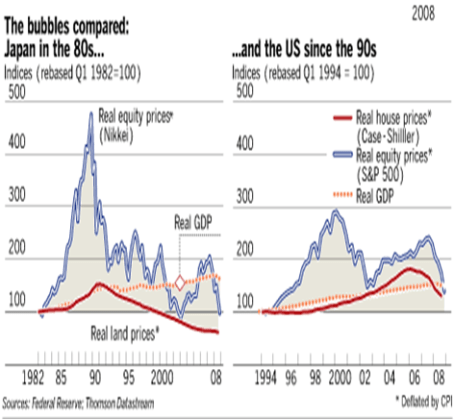
Source: Dow Jones
- Debt Levels not Sustainable: Japan is the most heavily indebted nation in the OECD. Japan is moving towards that 200% Debt/GDP level rapidly and the last time Japanese debt went to 200% of GDP (during WWII), hyper-inflation ensued and forced many fixed income elderly into poverty. Although our debt levels have yet to reach the extremes seen by Japan, we need to recognize the inflationary pressure building. Japan’s debt bubble cannot indefinitely sustain these debt increases, leaving little option but to eventually inflate their way out of the problem.
- Banking System Prolongs Japanese Deflation: Despite the eight different stimulus plans implemented in the 1990s, Japan lacked the fortitude to implement the appropriate corrective measures in their banking system by writing off bad debts. An article from July 2003 Barron’s article put it best:


After the collapse of the property bubble, many families and businesses had debts that far exceeded their devalued assets. When a version of this happened in America in the savings-and-loan crisis, the resulting mess was cleaned up quickly. The government seized assets, sold them off, bankrupted ailing banks and businesses, sent a few crooks to jail and everything started fresh, so that deserving new businesses could get loans. The process is like a tooth extraction — painful but mercifully short. In Japan this process has barely begun. Dynamic new businesses cannot get loans, because banks use available credit to lend to bankrupt businesses, so they can pretend they are paying their debts and avoid the pain of write-offs. This is self-deception. The rotten tooth is still there. And the Japanese people know it.
The Future – Rise of the Rest: Fareed Zakaria, Newsweek editor wrote about the “Rise of the Rest” in an incredible article (See Sidoxia Website) describing the rising tide of globalization that is pulling up the rest of the world. The United States population represents only 5% of the global total, and as the technology revolution raises the standard of living for the other 95%, this trend will only accelerate the demand of scarce resources, which will create a constant inflationary headwind.
For those countries in decline, like Japan, demand destruction raises the risk of deflation, but historically the innovative foundation of capitalism has continually allowed the U.S. to grow its economic pie. Economic legislation by our Congress will help or hinder our efforts in dealing with these inflationary pressures. One way is to incentivize investment in innovation and productive technologies. Another is to expand our targeted immigration policies towards attracting college educated foreigners, thereby relieving aging demographics pressures (as seen in Japan). These are only a few examples, but regardless of political leanings, our country has survived through wars, assassinations, terrorist attacks, banking crises, currency crises, and yes recessions, to only end up in a stronger global position.
This crisis has been extremely painful, but so have the many others we have survived. I believe time will heal the wounds and we will eventually conquer this crisis. I’m confident that historians will look at the coming years in favorable light, not the lost decades of pain as experienced in Japan.
Wade W. Slome, CFA, CFP®
Plan. Invest. Prosper.
Treasury Bubble Hasn’t Burst….Yet

10-Year Treasury Chart (5-14-09)
Clusterstlock’s Joe Weisenthal’s takes a historical look on 10-year Treasury yields going back to 1962. As you can see, the yield is still below 1962 levels, despite the massive inflationary steps the Federal Reserve and Treasury have taken over the last 18 months (6-26-09 yield was 3.51%). These trends can also be put into perspective by reading Vincent Fernando’s post at http://www.researchreloaded.com. Take a peek.
Ways to take advantage of this trend include purchases of TBT (UltraShort 20+ Year Treasury ProShares) or short TLT (iShares Barclays 20+ Year Treasury Bond)*.

Reverse View of Historical 10-Year Treasury Yield
*Disclosure: Sidoxia Capital Management clients and/or Slome Sidoxia Fund may have a short position in TLT.
U.S. the Next Zimbabwe? Faber Thinks So…

Imagine paying $2 for a tube of toothpaste today and then $4,600,000 for that same tube one year from now – well that’s what happened in Zimbabwe. Zimbabwe is the first country in the 21st century to hyperinflate. In February 2007, Zimbabwe’s inflation rate topped 50% per month and according to Bloomberg, the latest official figures on Zimbabwe’s inflation rate registered 231 million percent in July 2008.
“I am 100 percent sure that the U.S. will go into hyperinflation,” Marc Faber, a.k.a. “Dr Doom”, creator of the Gloom Boom & Doom Report said. “The problem with government debt growing so much is that when the time will come and the Fed should increase interest rates, they will be very reluctant to do so and so inflation will start to accelerate.”
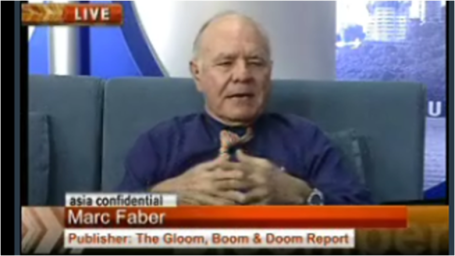
Dr. Gloom - Marc Faber
Click Here For Video (Bloomberg)
Faber goes on to say the U.S. economy will enter “hyperinflation” approaching the levels in Zimbabwe because the Federal Reserve will be reluctant to raise interest rates, investor Faber said. Prices may increase at rates “close to” Zimbabwe’s gains, Faber said in an interview in Hong Kong. Zimbabwe’s inflation rate reached 231 million percent in July, the last annual rate published by the statistics office.
I’m not sure if the United States should be included in the same camp as Zimbabwe? Haven’t check recently, but do they have a comparable financial system producing the likes of Microsoft, Genentech, Starbucks, and Pfizer? I think not. Our economic situation is no box of chocolates, as our deficits expand and national debt balloons, but our problems are well documented. More appropriately, I would say we are the tallest midget (or “little people” to be politically correct) and some growth hormone is on the way.




 Investing Caffeine
