Posts tagged ‘Europe’
Economic Tug-of-War as Recovery Matures

Excerpt from No-Cost June 2011 Sidoxia Monthly Newsletter (Subscribe on right-side of page)
With the Rapture behind us, we can now focus less on the end of the world and more on the economic tug of war. As we approach the midpoint of 2011, equity markets were down -1.4% last month (S&P 500 index) and are virtually flat since February – trading within a narrow band of approximately +/- 5% over that period. Investors are filtering through data as we speak, reconciling record corporate profits and margins with decelerating economic and employment trends.
Here are some of the issues investors are digesting:
 Profits Continue Chugging Along: There are many crosscurrents swirling around the economy, but corporations are sitting on fat profits and growing cash piles owing success to several factors:
- International Expansion: A weaker dollar has made domestic goods and services more affordable to foreigners, resulting in stronger sales abroad. The expansion of middle classes in developing countries is leading to the broader purchasing power necessary to drive increasing American exports.
- Rising Productivity: Cheap labor, new equipment, and expanded technology adoption have resulted in annualized productivity increases of +2.9% and +1.6% in the 4th quarter and 1st quarter, respectively. Eventually, corporations will be forced to hire full-time employees in bulk, as bursting temporary worker staffs and stretched employee bases will hit output limitations.
- Deleveraging Helps Spending: As we enter the third year of the economic recovery, consumers, corporations, and financial institutions have become more responsible in curtailing their debt loads, which has led to more sustainable, albeit more moderate, spending levels. For instance, ever since mid-2008, when recessionary fundamentals worsened, consumer debt in the U.S. has fallen by more than $1 trillion.
 Fed Running on Empty: The QE2 (Quantitative Easing Part II) government security purchase program, designed to stimulate the economy by driving interest rates lower, is concluding at the end of this month. If the economy continues to stagnate, there’s a possibility that the tank may need to be re-filled with some QE3? Maintaining the 30-year fixed rate mortgage currently around 4.25%, and the 10-year Treasury note yielding around 3.05% will be a challenge after the program expires. Time will tell…
 Slogging Through Mud: Although corporate profits are expanding smartly, economic momentum, as measured by real Gross Domestic Product (GDP) growth, is struggling like a vehicle spinning its wheels in mud. Annualized first quarter GDP growth registered in at a meager +1.8% as the economy weans itself off of fiscal stimulus and adjusts to more normalized spending levels. An elevated 9% unemployment rate and continued weak housing market is also putting a lid on consumer spending. Offsetting the negative impacts of the stimulative spending declines have been the increasing tax receipts achieved as a consequence of seven consecutive quarters of GDP growth.
 Mixed Bag – Euro Confusion: Germany reported eye-popping first quarter GDP growth of +5.2%, the steepest year-over-year rise since reunification in 1990, yet lingering fiscal concerns surrounding the likes of Greece, Portugal, and Italy have intensified. Fitch, for example, recently cut its rating on Greece’s long-term sovereign debt three notches, from BB+ to B+ plus, and placed the country on “rating watch negative” status. These fears have pushed up two-year Greek bond yields to over 26%. Regarding the other countries mentioned, Standard & Poor’s, another credit rating agency, cut Italy’s A+ rating, while the European Union and International Monetary Fund agreed on a $116 billion bailout program for Portugal.
Wade W. Slome, CFA, CFP®
Plan. Invest. Prosper.
DISCLOSURE: Sidoxia Capital Management (SCM) and some of its clients own certain exchange traded funds, but at the time of publishing SCM had no direct position in any security referenced in this article. No information accessed through the Investing Caffeine (IC) website constitutes investment, financial, legal, tax or other advice nor is to be relied on in making an investment or other decision. Please read disclosure language on IC “Contact” page.
Soros & Reflexivity: The Tail Wagging the Dog

Billionaire investor George Soros, who is also Chairman of Soros Fund Management and author of The Crash of 2008¸ is well known for his theory on reflexivity, which broadly covers political, social, financial, and economic systems. Soros built upon this concept (see also Soros Super Bubble), which was influenced by philosopher Karl Popper. With all the fear and greed rippling through global geographies as diverse as Iceland, California, Dubai, and Greece, now is an ideal time to visit Soros’s famous reflexivity theory, which may allow us to put the recent chaos in context. With the recent swoon in the market, despite domestic indicators trending positively, a fair question to ask is whether the dog is wagging the tail or the tail wagging the dog?
The Definition of Reflexivity
Simply stated, reflexivity can be explained as the circular relationship that exists between cause and effect. Modern financial theory teaches you these lessons: 1) Financial markets are efficient; 2) Information flows freely; 3) Investors make rational decisions; and 4) Markets eventually migrate towards equilibrium. Reflexivity challenges these premises with the claims that people make irrational and biased decisions with incomplete information, while the markets trend toward disequilibrium, evidenced by repeated boom and bust cycles.
Let’s use the housing market as an example of reflexivity. By looking at the housing bubble in the U.S., we can shed some light on the theory of reflexivity. Americans initial buying love affair with homes pushed prices of houses up, which led to higher valuations of loans on the books of banks, which allowed the banks to lend more money to buyers, which meant more home buying and pushed prices up even higher. To make matters worse, even the government joined the game by adding incentives for people who could not afford homes. As you can see, the actions and decisions of an observer can have a direct impact on other observers and the system itself, thereby creating a spiraling upward (or downward) effect.
Now What?
Now, the reflexivity tail that is wagging the dog is Europe…specifically Greece. The bear case goes as follows: the Greek financial crisis will brew into a stinky contagion, eventually spreading to Spain and Italy, thus hammering shut a U.S. export market. The double dip recession in the U.S. will not only exacerbate the pricking of the Chinese real estate bubble, but also topple all other global economies into ruin.
Certainly, the excessive sovereign debt levels across the globe have grown like cancer. Fortunately, we have identified the problem and politicians are being forced by voters to address the fiscal problems. More importantly, capital flows are an unbiased arbiter of economic policies. Over time – not in the short-run necessarily – capital will move to where it is treated best. Meaning those countries that harness responsible debt loads, institute pro-business growth policies, remove unsustainable and insolvent entitlements, and incentivize education and innovation will be the countries that earn the honor of holding their fair share of vital capital. If the politicians don’t make the correct decisions, the hemorrhaging of capital to foreigners and the painfully high unemployment levels will force Washington into making the tough but right decisions (usually in the middle of a crisis).
Reflexivity, as it pertains to financial markets, has been a concept the 79 year old George Soros has passionately espoused since his 1987 book, The Alchemy of Finance. Perhaps a better understanding of reflexivity will help us better take advantage of the tail wagging disequilibriums experienced in the current financial markets. Time will tell how long this disequilibrium will last.
Wade W. Slome, CFA, CFP®
Plan. Invest. Prosper.
*DISCLOSURE: Sidoxia Capital Management (SCM) and some of its clients own certain exchange traded funds, but at the time of publishing SCM had no direct positions in any other security referenced in this article. No information accessed through the Investing Caffeine (IC) website constitutes investment, financial, legal, tax or other advice nor is to be relied on in making an investment or other decision. Please read disclosure language on IC “Contact” page.
Teen Prom of Listings Driven by Globalization

The international and emerging markets are like maturing teenagers attending a prom. If the U.S. represents the incumbent Seniors, then the international regions, like Europe and China, are the underclassmen now overwhelming the dance party. In 2009 for example, China has accounted for approximately 40% of all IPOs (Initial Public Offerings), according to The Financial Times.
This trend, however, is not a new phenomenon. Grant Thorton, an accounting consultancy firm, found the declining trend in American stock listings occurring for more than a decade. Specifically, Grant Thorton discovered the following:
“…the number of US exchange-listed companies is down by more than 22 per cent since 1991 and down by 53 per cent when allowing for real, inflation-adjusted gross domestic product growth.”
Why is the U.S. losing listing market share? David Weild, a former Nasdaq Vice Chairman, believes the advent of online brokerage firms in the mid-1990s shoulders a lot of the blame. The new order handling rules established in 1997 made the profitability of supporting small-cap stocks less profitable for the traditional brokerage firms.
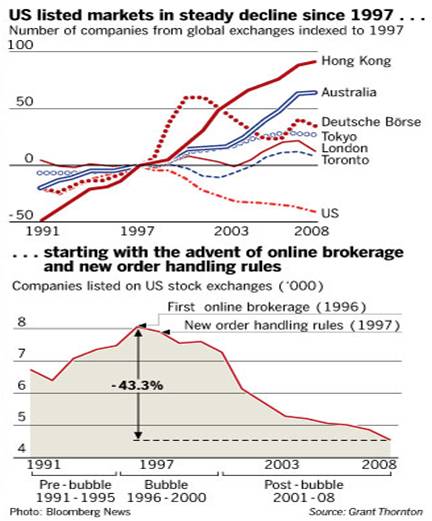
Source: Charts from The Financial Times show steady U.S. listings decline.
The reasons for the rule changes were designed to drive lower costs and improved transparency. These goals have largely been achieved, but due to globalization and the heightened liquidity in international and emerging markets, alternative exchanges have been gaining share.
Although profitability in supporting small-cap stocks has dropped, the evolution of high frequency trading (HFT) has stirred up the pot of controversy (read HFT article here). Exchanges, in an attempt to offset lost listings profits, are building new streams of revenues targetting these rapid pace computer traders.
As globalization spreads, thanks in part to the spread of technology advances, foreigners are joining what Thomas Friedman calls a new “flat” world, and the underclassmen are coming to the party with their dancing shoes.
Read The Financial Times Article Here
Wade W. Slome, CFA, CFP®
Plan. Invest. Prosper.
DISCLOSURE: No information accessed through the Investing Caffeine (IC) website constitutes investment, financial, legal, tax or other advice nor is to be relied on in making an investment or other decision. Please read disclosure language on IC “Contact” page.




 Investing Caffeine
