Posts tagged ‘equities’
The Curious Case of Gen Y and Benjamin Button

If a current Gen Y-er aged backwards like Benjamin Button, he would feel right at home when it comes to investing, because acute conservatism and risk aversion have struck older and younger generations alike. The Curious Case of Benjamin Button is a story that follows the critical peaks and valleys of a boy born in his eighties, who immediately begins to reverse the aging process. Investors of all ages have suffered their peaks and valleys over the last decade, and these experiences have impacted investing attitudes and perceptions heavily during the prime earning years. For retirees, it’s virtually impossible for extreme events like the Great Depression, World War II, Vietnam, Kennedy’s assassination, and Nixon’s impeachment to NOT have had an influence on individuals’ investing behavior.
Investing Consequences on Younger Investors
If a younger Mr. Button were still alive today, there is no doubt the disheartening events experienced in his 80s would only become reinforced by the bleak occurrences in 2008-2009. His reverse aging would not only have allowed him to witness the collapse of Lehman Brothers, but also behold the demise and bailout of other gargantuan financial institutions. Today, if Benjamin wasn’t busy watching the MTV Video Music Awards, he would most likely be diligently managing his bullet-proof portfolio of cash, CDs (Certificates of Deposit), Treasury bills, and maybe some tax-free municipals if he was feeling a little spunky.
The cautious stance of youthful savers was confirmed in a recent study conducted by Merrill Lynch Global Wealth Management. The report demonstrates how the recent financial crisis has had a severe dampening impact on the risk appetites of 18-34 year old “Millennials.” So dramatic an effect was the recession, the nervous conservatism experienced by the 30-somethings was only rivaled by fear from 65 year olds. In fact, the 56% of young investors, who were more cautious today than a year ago, was the highest percentage registered by any age group.
Here’s what Christopher Geczy adjunct associate professor of finance at University of Pennsylvania’s Wharton School had to say about younger Millennials:
“We’re coming off a series of financial crises that hit this young generation at points in their lives where external events shape strong opinions…Many of them have witnessed a decline in the wealth of their families and seen their parents delay retirement or even return to the workforce.”
Beyond witnessing the challenges faced by their parents, the Millennials are encountering their own obstacles – such as joblessness. For those workers under age 35, the unemployment rate in August stood at more than 13% – significantly higher than the 9.6% national rate.
Note to Youths: Stocks for the Long Haul
In the typical life cycle of investing, investors flaunt a higher risk tolerance in their younger years and exhibit more risk aversion as they approach or enter retirement. Historically, this makes perfect sense because workers earlier in their careers have plenty of time to ride out the fluctuations associated with owning equities. Jeremy Siegel, professor at the Wharton University Professor, says stocks significantly outperform bonds by 6% per year over longer timeframes (see Siegel Digs in Heels).
For Gen Y-ers the larger risk is being too conservative, not too aggressive. Barry Nalebuff, a strategy professor at Yale’s School of Management agrees:
“The biggest risk for this generation is that they’ll live too long. With medical breakthroughs, the reality is that many of them will live beyond 100…The only way they have enough assets to last them is to invest in stocks. If they don’t, a lot of people will have to keep working way past when they want to because they won’t have enough money saved up.”
Even for those downbeat on the domestic equity markets – rightfully so with no price gains achieved over the last decade – younger investors should not lose sight of the tremendous equity opportunities available internationally (see the Blowing the Perfect Investment Game).
For many people, reverse aging may be fun for a while, but for Benjamin Button, living through the Great Depression and multiple wars as an adult would likely dampen the mood and increase risk aversion dramatically. Millennials have persevered through difficult times too. Generation Y has survived two recessionary bubbles caused by excessive technology spending and consumer credit binging, both over a short timeframe. Becoming too conservative for these investors will feel comfortable in the short-run if uncertainty continues to prevail. But investing now with adequate, diversified equity exposure is the prudent course of action. Even a wrinkly Benjamin Button could agree, wisely investing in some equities during your earlier career sure beats working as a Wal-Mart (WMT) greeter into your 80s.
Read the full Money-CNN and Newsweek articles on the subject
Wade W. Slome, CFA, CFP®
Plan. Invest. Prosper.
DISCLOSURE: Sidoxia Capital Management (SCM) and some of its clients own certain exchange traded funds and WMT, but at the time of publishing SCM had no direct position in BAC/Merrill, Lehman, or any other security referenced in this article. No information accessed through the Investing Caffeine (IC) website constitutes investment, financial, legal, tax or other advice nor is to be relied on in making an investment or other decision. Please read disclosure language on IC “Contact” page.
Metrics Mix-Up: Stocks and Real Estate Valuation

When it comes to making money, investors choose from a broad menu of investment categories, ranging all the way from baseball cards and wines to collectible cars and art. Two of the larger and more popular investment categories are stocks and real estate. Unfortunately for those poor souls (such as me) analyzing these two classes of assets, the stock and real estate investor bigwigs have not come together to create an integrated metric system. Much the same way the United States has chosen to go it alone on a proprietary customary unit measurement system with Burma and Liberia – choosing inches and feet over centimeters and meters. On the subject of stock and real estate valuation, investors and industry professionals have been stubbornly defiant in designing unique and cryptic terminology, despite sharing the exact same financial principles.
Who Cares About Real Estate?
Well, apparently everyone. Southern California doesn’t have a monopoly on real estate, but through my practice in Orange County, I find it difficult to not trip over real estate investors on a daily basis. I work in effectively what was “ground zero” of the subprime debacle and the commercial real estate pains continue to ripple through “the OC.”
Ramping up the real estate learning curve reminds me of my high school Spanish class – I understood enough Spanish to work my way through a Taco Bell menu but little else. In order to actually learn Spanish I had to completely immerse myself in the language, even if it meant continually speaking to my classmates in Spanish through my alias (Paco).
Real Estate Foundational Terms
Despite being a relative new resident in the Orange County area, engrossing myself in real estate hasn’t been much of a challenge. Over a brief period, my interactions and conversations taught me my financial degrees and credentials were just as applicable in the realty world as they were in the stock market world. While evaluating real estate valuation techniques, I discovered two new key terms:
1) NOI (Net Operating Income): Unlike stock analysis, which uses “Net Income” as a core driver in determining an asset’s value, real estate relies on NOI. Net operating income is generally derived by calculating income before depreciation and interest expense. In finance, there are many versions of income. I’m sure there are more explanations, but two reasons behind the selection of NOI in real estate valuation over other metrics is due to the following: a) NOI may be used as a proxy for cash flow, which can be integral in many valuation techniques; and b) NOI is “capital structure neutral” if comparing multiple properties. Therefore, NOI allows an investor to compare varying properties on an apples-to-apples basis regardless of whether a property is massively leveraged or debt-free.
2) Cap Rate (Capitalization Rate): This ratio is computed by taking the NOI and dividing it by a property’s initial cost (or value). In stock market language, you can think of a “cap rate” as an inverted P/E (Price – Earnings) ratio – an inverted P/E ratio has also been called the “earnings yield.” Complicating terminology matters is the interchangeable use of income and earnings in the investment world. In the case of the P/E ratio, the denominator generally used is “Net Income.”
A shortcoming to the cap rate ratio, in my view, is the failure to deduct taxes. Although comparability across properties may get muddied, if determining profit availability to investors is the main goal, then I think an adjusted NOI (subtracting taxes) would be a more useful proxy for valuation purposes. Tax benefits associated with REITS (Real Estate Investment Trusts) complicates the metric usage issue further.
The simplistic beauty of marrying NOI and a cap rate is that a crude valuation estimate can be constructed by merely blending these two metrics together. For example, a commercial real estate property generating $500,000 in NOI that applies a 5% cap rate to the property can arrive at a valuation estimate of $10,000,000 ($500,000/.05).
Similarities between Stocks & Real Estate
At the end of the day, the theoretical value of ANY asset can be calculated by taking the projected after-tax cash flows and discounting that stream back into today’s dollars – whether we are talking about a stock, bond, derivative, real estate property, or other asset. Both stock and real estate analysis use readily available income numbers and price ratios to estimate cash flows and valuations. Regrettably, since real estate and equity investors generally play in different leagues, the rules and language are different.
The lingo used for analyzing separate asset classes may be unique, but the math and fundamental examination are the same. The formula for learning real estate is similar to that of Spanish – you need to dive in and immerse yourself into the new language. If you don’t believe me, just ask Paco.
Wade W. Slome, CFA, CFP®
Plan. Invest. Prosper.
DISCLOSURE: Sidoxia Capital Management (SCM) and some of its clients own certain exchange traded funds, but at the time of publishing had no direct positions in YUM or any other security mentioned. No information accessed through the Investing Caffeine (IC) website constitutes investment, financial, legal, tax or other advice nor is to be relied on in making an investment or other decision. Please read disclosure language on IC “Contact” page.
Equities Up, But Investors Queasy

The market may have recovered partially from its illness over the last two years, but investors are still queasy when it comes to equities. The market is up by more than +60% since the March 2009 lows despite the unemployment rate continuing to tick higher, reaching 10.2% in October. Even though equity markets have rebounded, recovering investors have flocked to the drug store with their prescriptions for bonds. Mark Dodson, CFA, from Hays Advisory published a telling chart that highlights the extreme aversion savers have shown towards stocks.
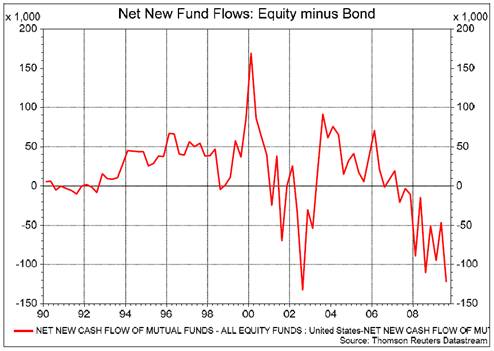
Source: Hays Advisory LLC (Thomson Reuters Datastream)
Dodson adds:
“Net new fund mutual fund flows favor bonds over stocks dramatically, so much so that flows are on the cusp of breaking into record territory, with the previous record occurring back in the doldrums of the 2002 bear market. Given nothing but the chart (above), we would never in a million years guess that the stock market has rallied 50-60% off the March lows. It looks more like what you would see right in the throes of a nasty stock market decline.”
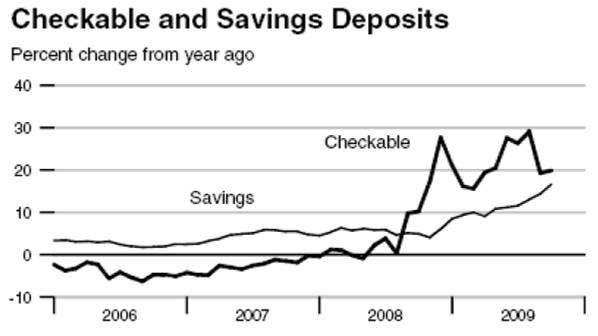
Checking and savings data from the Federal Reserve Bank of Saint Louis further corroborates the mood of the general public as the nausea of the last two years has yet to wear off. The mountains of cash on the sidelines have the potential of fueling further gains under the right conditions (see also Dry Powder Piled High story).
As Dodson notes in the Hays Advisory note, not everything is doom and gloom when it comes to stocks. For one, insider purchases according to the Emergent Financial Gambill Ratio is the highest since the recent bear market came to a halt. This trend is important, because as Peter Lynch emphasizes, “There are many reasons insiders sell shares but only one reason they buy, they feel the price is going up.”
What’s more, the yield curve is the steepest it has been in the last 25 years. This opposing signal should provide comfort to those blue investors that cried through inverted yield curves (T-Bill yields higher than 10-Year Notes) that preceded the recessions of 2000 and 2008.
Equity investors are still feeling ill, but time will tell if a dose of bond selling and a prescription for “cash-into-stocks” will make the queasy patient feel better?
Wade W. Slome, CFA, CFP®
Plan. Invest. Prosper.
DISCLOSURE: No information accessed through the Investing Caffeine (IC) website constitutes investment, financial, legal, tax or other advice nor is to be relied on in making an investment or other decision. Please read disclosure language on IC “Contact” page.




 Investing Caffeine
