Posts tagged ‘data center’
Big Debt and Massive AI Bet Not Yet a Threat

Government debt levels have reached stratospheric heights, and hundreds of billions in corporate borrowing are piling up to finance a gargantuan AI data center infrastructure buildout.
How have stock and bond investors responded to this unprecedented debt binge?
With a collective shrug.
For the month, the major stock indexes continued their march higher:
· S&P 500: +2.6%
· NASDAQ: +3.9%
· Dow Jones Industrial Average: +1.3%
Meanwhile, the bond market largely shrugged off hawkish rhetoric surrounding potential interest rate hikes from Federal Reserve Chairman Kevin Warsh following his speech at the closely watched Jackson Hole annual symposium.
More specifically, fixed-income performance held steady:
· U.S. Aggregate Bond (AGG): +0.0%
· 10-Year Treasury Note Yield: +0.3%(4.76%) Although interest rates have risen significantly from their post-pandemic lows, yields remain near historically manageable levels (see chart below) – especially when framed against the backdrop of robust corporate profit growth and broader economic resilience.
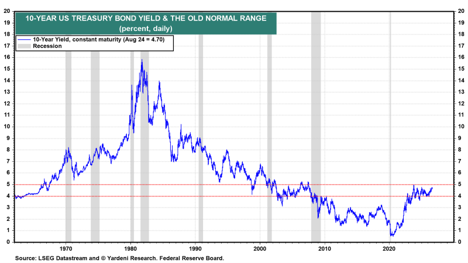
Source: Ed Yardeni
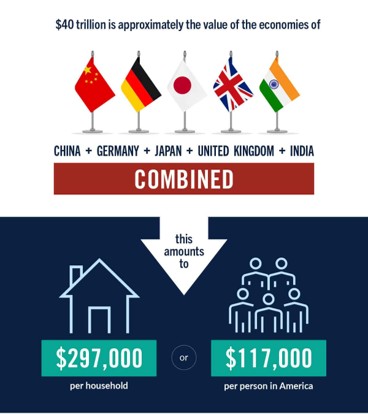
$40 Trillion Mountain of Debt As highlighted by the Peter G. Peterson Foundation, gross U.S. federal debt has officially breached the $40 trillion mark. To put that figure into perspective, here are a few insightful graphics (below).
Source: Peter G. Peterson Foundation
$40 trillion roughly equals the combined gross domestic product (GDP) of China, Germany, Japan, the UK, and India. It also translates to approximately $297,000 per U.S. household or $117,000 per person.
Source: Peter G. Peterson Foundation
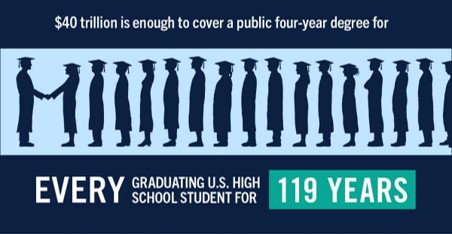
Expressed another way, $40 trillion could cover four-year college tuition for every graduating high school senior in America for the next 119 years.
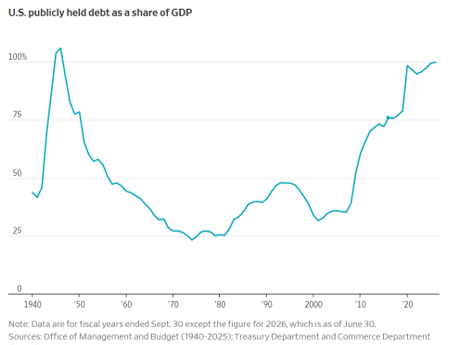
$40 Trillion in a Historical Perspective
Source: The Wall Street Journal
Measuring raw dollar debt over long spans of time can be misleading due to compound inflation. A far more accurate economic yardstick is calculating debt as a percentage of GDP (Gross Domestic Product). As shown above, national debt-to-GDP levels haven’t reached these heights in a generation – not since the massive fiscal spending surge needed to finance World War II.
Hand-wringing over national debt is hardly new. Over four decades ago, the front page of The New York Times (Sept 15, 1985) declared: “A $2 Trillion National Debt: Not Just Another Milestone.” The warnings then sounded identical to the alarms sounding today: “The $2 trillion figure reflects serious problems for government taxation and spending, as well as new strains on the economy.”
Just as in prior historical cycles, elevated debt ratios can eventually be brought back into balance. However, the longer policymakers kick the fiscal can down the road, the more difficult it will be to reverse the damaging trend. Mathematically, the remedy remains unchanged: the federal government must curb expenditures (Social Security, Medicare, and defense spending) and/or raise revenues (increase taxes).
How Can Stocks Prices Be at Record Highs?
Against a headline backdrop dominated by exploding federal debt, ongoing geopolitical conflict in the Middle East, Fed rate uncertainty, and AI data center backlash, how do equity markets keep hitting record highs?
It boils down to two fundamental drivers:
1) Surging Corporate Profitability
A solid underlying economy, anchored by healthy employment metrics (4.1% unemployment in July) is receiving a direct shot of adrenaline from the colossal capital investment flowing into artificial intelligence (see The Multi-Trillion AI Tsunami). Beyond reducing software coding overhead and customer support overhead via automated software agents, AI implementations are accelerating go-to-market timelines and driving faster top-line growth. The end result is an expanding waterfall of corporate profits, reflected in robust forward consensus estimates for +36% S&P 500 earnings growth (see chart below).
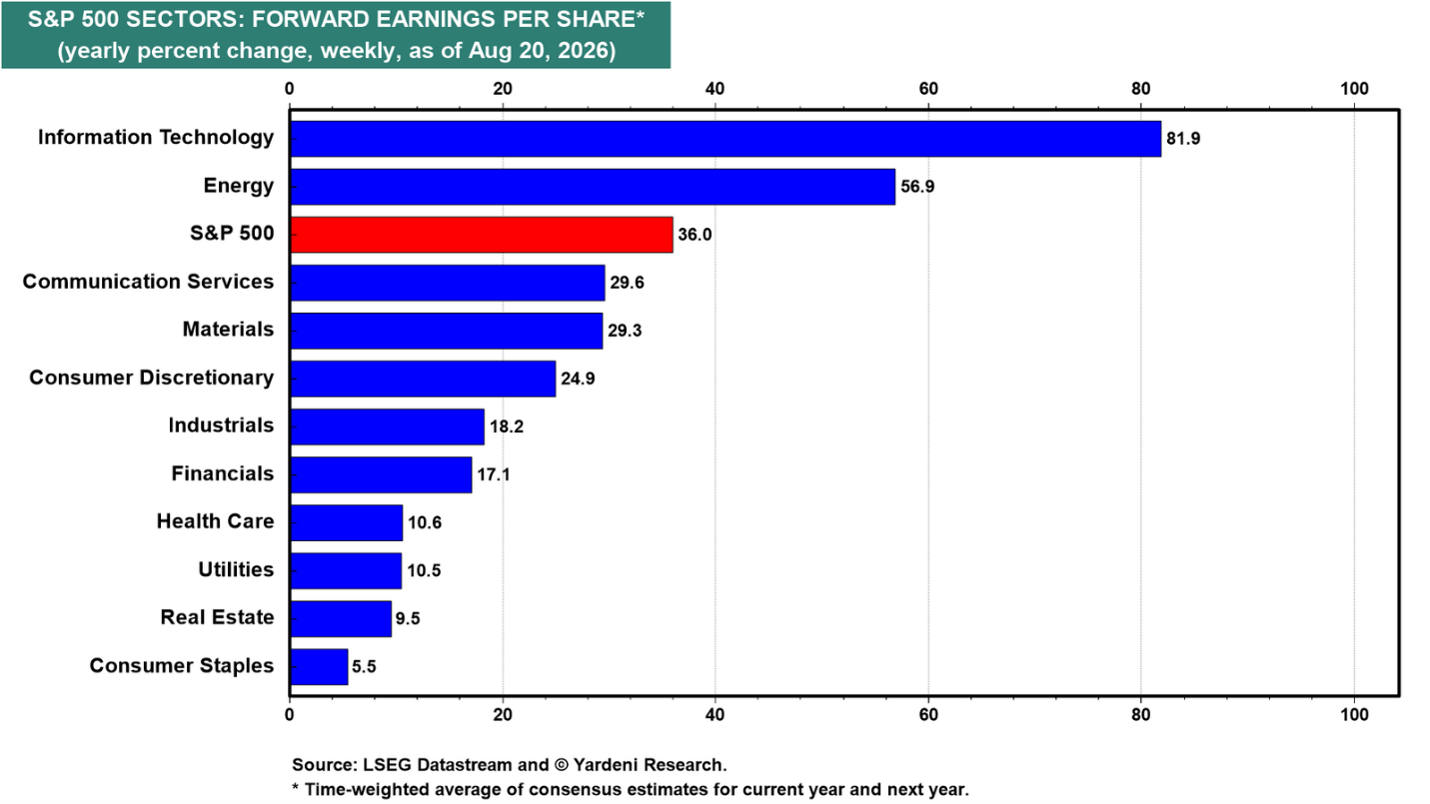
Source: Ed Yardeni
2) Mammoth AI Capex Converting to Revenues:
We remain in the early stages of the AI buildout, yet hyper-scalers and chipmakers are generating extraordinary top- and bottom-line expansion.
Consider NVIDIA Corp. (NVDA), sitting at the epicenter of the hardware buildout with a market valuation topping $5 trillion. The company recently posted nearly $100 billion in quarterly revenue while clearing over $50 billion in quarterly profit. Meanwhile, AI juggernaut Anthropic (founded just five years ago vs. NVIDIA 33 years ago), reported a $6.5 billion annual revenue run-rate in July, with internal projections pointing toward $190 billion to $200 billion by 2028. Reports indicate Anthropic is targeting a valuation as high as $2 trillion ahead of an anticipated public listing.
Airbnb: A Real-World AI Case Study
For skeptics questioning whether end-user enterprises are seeing concrete returns on their AI investments, look no further than the cloud computing divisions of major tech providers. Alphabet (GOOG), Amazon (AMZN), and Microsoft (MSFT) are collectively spending an estimated $615 billion in capital expenditures this year, which is backed by an impressive $1.4 trillion in combined remaining performance obligations (RPO) commitments from enterprise customers. The cloud divisions of the hyperscalers have achieved these whopping results with very minimal headcount growth (see AI Genie Out of the Bottle).
For the AI doubters, I would also direct you to the recent Q2 Shareholder report of Airbnb Inc. (ABNB), a Sidoxia Capital Management and personal investment. In the company’s Q2 Shareholder Letter, Co-Founder and CEO Brian Chesky detailed how fundamental integration of AI is translating into operational productivity.
“We’ve rebuilt Airbnb from the ground up to be an AI-native company, and it’s showing up in our results… On key initiatives, we’ve reduced the time from concept to delivery by as much as 60%. And compared to the same period last year, we’ve increased the number of features and improvements we’ve shipped this year by nearly 80%… The acceleration from AI allowed us to make hundreds of improvements across Airbnb for hosts and guests.”
These platform enhancements include:
- Hotel Stays: Seamless integration of thousands of new boutiques and independent hotels to the platform.
- Grocery Delivery: Partnered with grocer-delivery leader, Instacart (another Sidoxia investment).
- Car Rentals: Integrated rental car bookings with major fleets (including Hertz, Avis, Budget, and Enterprise).
- Airport Pickups: Feature added to increase convenience for travelers.
- Luggage Storage: Logistic benefit provided to customers arriving before check-in times (CEO called this a “sleeper hit”).

Source: Airbnb
It’s not difficult to imagine a day, in the not-too-distant future, when a query to Airbnb asking to organize my trip to Italy can result in the app automatically coordinating my entire customized itinerary in seconds.
Beyond improving the customer experience, AI is simultaneously reshaping Airbnb’s unit economics. Their AI customer support assistant now operates in 50 countries, resolving nearly 45% of incoming support inquiries autonomously without human agent intervention and has been rated the best AI support assistant in travel. This automation has driven a -16% reduction in its cost-per-booking translating into huge savings for the company.
Skeptics should take note of the next leg of AI expansion. The next major phase will be driven by all the companies/industries racing to learn and implement AI, so businesses can experience similar benefits accomplished by Airbnb.
The Net-Net
There is never a shortage of macroeconomic worries, including $40 trillion in national debt, central bank shifts, or geopolitical friction. Yet over multi-year horizons, stock prices track earnings and innovation. Right now, accelerating corporate productivity and the massive early-stage deployment of AI infrastructure remain the primary engines pushing equity markets to new all-time record highs.
Wade W. Slome, CFA, CFP®
Plan. Invest. Prosper.
This article is an excerpt from a previously released Sidoxia Capital Management complimentary newsletter (September 1, 2026). Subscribe Here to view all monthly articles.
Sidoxia Capital Management (SCM) and some of its clients hold positions in NVDA, GOOGL, AMZN, MSFT, ABNB and certain exchange traded funds (ETFs), but at the time of publishing had no direct position in any other security referenced in this article.
DISCLOSURE: No information accessed through the Investing Caffeine (IC) website constitutes investment, financial, legal, tax or other advice nor is to be relied on in making an investment or other decision. Each investor’s situation is unique so please work with a professional financial adviser, tax accountant or legal representative, as applicable, to develop an individualized plan or address any questions you may have. Investing involves risk including the possibility of loss of one’s investment.
AI Genie Out of the Bottle – Despite Attempts to Throttle

While geopolitics, interest rates, inflation, and economic growth constantly influence financial markets, the primary driver of stock prices over recent years remains the rapid global adoption of artificial intelligence. Ever since OpenAI’s ChatGPT sparked the AI revolution in November 2022, the technology landscape has been permanently altered. Although local pushback against the massive AI infrastructure rollout is intensifying, the AI genie is out of the bottle – and it cannot be put back in.
Data Center Angst, Chinese Competition, and Bubble Spending Concerns
Last month proved to be a choppy period for equity investors. In addition to escalating geopolitical tensions in the Middle East, markets were rattled by surging Chinese AI capabilities and semiconductor competition. The China tech rivalry is highlighted by the release of Moonshot’s Kimi K3 model and the IPO (Initial Public Offering) of chipmaker CXMT, the largest company trading on mainland China, valued near $500 billion.
The technology sector took the largest brunt of the selling pressure. The NASDAQ index fell -3.2% and the Magnificent 7-heavy QQQ index tumbled -6.6%. The S&P 500 index and Dow Jones Industrial Average had more modest moves, down -0.1% and up +0.3%, respectively for the month.
The AI Data Center Backlash
While consumers and businesses enjoy the instant productivity gains of AI software, a groundswell of community opposition is rising against the physical footprint required to power these tools. Critics frequently cite concerns over potential job losses, rising electricity bills, regional water consumption, rogue agent cyber-attacks, negative effects on residential property values, and other environmental damages.
A recent Gallup survey revealed that 71% of Americans oppose data center construction in their local communities. Currently, 15 states have enacted or proposed moratoriums/bans on new data center construction (see States Banning Data Centers).
While “NIMBY” (Not In My Back Yard) opposition may delay or defer localized builds, the overarching economic and strategic advantages of AI mean development will press forward. To win over reluctant municipalities, hyperscalers (including, Amazon, Google, Microsoft, and Meta) are offering tailored community benefit agreements, local grid investments, and environmental commitments (see Hyperscalers Put Community Investment First).
As Doug Sims, Managing Director at Green Finance & Economic Development, notes, hyperscalers are funding “investments in weatherization, home repairs, heat pumps, distributed solar and storage, and demand-management technologies.” These initiatives lower peak energy demand and reduce household costs while helping secure local permits. Communities that embrace this infrastructure stand to reap substantial long-term rewards in high-paying jobs and expand their local tax base.
Does AI Work? Is it Worth Trillions in Investment?
A central debate across Wall Street is whether the estimated $6 trillion in projected spending on AI chips, data centers, and power grid upgrades over the next five years will generate sufficient economic returns (see my previous article, The Multi-Trillion AI Tsunami).
From my vantage point, the answer is a resounding yes. One need look no further than the massive $760 billion in combined capital expenditure projected for 2026 alone across Meta, Microsoft, Amazon, and Alphabet – an 84% increase over the $413 billion spent in 2025 (see chart below).
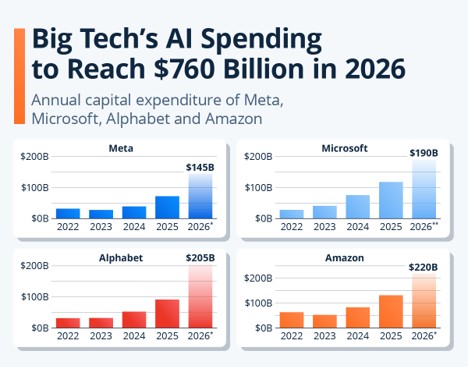
Source: Statista
Where’s the Beef?
Given these staggering capital outlays, investors are understandably asking when and where the payoff will materialize.
I may be dating myself but an iconic commercial introduced when I was a kid captures this sentiment. For any hamburger enthusiasts, you may remember the 1984 Wendy’s “Where’s the Beef?” commercial, in which three elderly customers examine a massive, fluffy bun only to find a tiny patty buried inside. Wall Street is currently looking at hyperscaler capital expenditures and asking the same question: “Where is the meat on this multi-billion-dollar AI burger?”
While free cash flow profiles are temporarily compressed by infrastructure buildouts, there is already plenty of high-protein evidence demonstrating that these investments are paying off:
· Accelerating Top-Line Cloud Revenues
· Record Commercial Backlogs/Remaining Performance Obligations (RPO)
· Substantial Productivity Gains
Let’s review the latest growth figures from the four major hyperscalers:
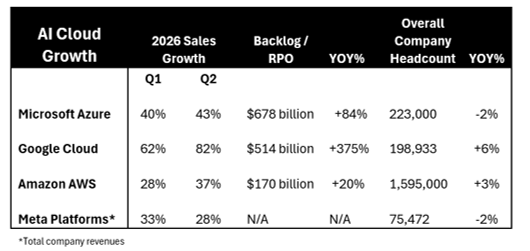
The $760 billion in spending by the “Big 4” hyperscalers is astounding but the backlogs (orders received but not fulfilled) for just the top three (Microsoft, Google, and Amazon) are even more gigantic at approximately $1.4 trillion (see Backlog/RPO column total in table above). If AI technology lacked real-world utility or failed to generate economic returns, enterprise customers would not be locking in massive orders in multi-year forward commitments. Despite achieving surging revenue growth, hyperscaler headcount growth remains remarkably subdued (see far-right column in table above). This is proof positive that internal AI deployment is unlocking operating leverage and efficiency.
Looking Ahead
We remain in the early innings of the enterprise AI adoption curve. Even if political maneuvering or regulatory friction slows the pace of data center construction in certain jurisdictions, it will simply extend the runway of this infrastructure super-cycle rather than trigger a boom-and-bust collapse. The AI genie has granted far more wishes than it has denied – and despite attempts to throttle its momentum, the AI transformation continues to march forward.
Wade W. Slome, CFA, CFP®
Plan. Invest. Prosper.
This article is an excerpt from a previously released Sidoxia Capital Management complimentary newsletter (August 3, 2026). Subscribe Here to view all monthly articles.
Sidoxia Capital Management (SCM) and some of its clients hold positions in AMZN, GOOGL, META, MSFT, and certain exchange traded funds (ETFs), but at the time of publishing had no direct position in 688825.SS (CXMT), WEN, or any other security referenced in this article.
DISCLOSURE: No information accessed through the Investing Caffeine (IC) website constitutes investment, financial, legal, tax or other advice nor is to be relied on in making an investment or other decision. Each investor’s situation is unique so please work with a professional financial adviser, tax accountant or legal representative, as applicable, to develop an individualized plan or address any questions you may have. Investing involves risk including the possibility of loss of one’s investment.
A.I. Field of Dreams

In the 1989 Academy Award–nominated film Field of Dreams, the lead character Ray Kinsella (played by Kevin Costner) hears a mysterious voice whisper, “If you build it, he will come.” Acting on blind faith, Ray builds a baseball diamond in the middle of his Iowa cornfield, risking financial ruin. Against all logic, the field draws a flood of visitors.
Today, a similar “field of dreams” is being built—not with corn, but with data centers. Instead of baseball players, it is artificial intelligence (AI) models, applications, and users who are coming.
The Market’s AI Momentum
The AI boom has already reshaped markets with all three benchmarks hitting record highs. Last month, the S&P 500 climbed +1.9%, while the NASDAQ rose +1.6% and Dow Jones Industrial Average surged +3.2%. Year to date, the indexes are up +10%, +11%, and +7%, respectively.
Behind this surge lies an unprecedented wave of AI infrastructure investment. Hyperscalers—Amazon.com (AMZN), Microsoft Corp. (MSFT), Google-Alphabet (GOOGL), Meta Platforms (META), and others—are pouring hundreds of billions into AI, much of it flowing directly to NVIDIA Corp. (NVDA), the undisputed leader in GPUs (Graphic Processing Units) powering the world’s AI engines. How large is the spending? NVIDIA CEO Jensen Huang estimates $3 trillion to $4 trillion will be spent this decade to fuel the AI revolution.

Source: Visual Capitalist
The Scale of AI’s Buildout
To put this into perspective:
- Amazon is projected to spend over $100 billion in 2025 alone, more than its cumulative capital expenditures from 2000–2020 combined.
Meta is constructing its $10 billion+ Hyperion data center in Louisiana—a sprawling 4 million sq. ft. complex across 2,250 acres, powered by a $4 billion natural gas plant. The footprint is so gargantuan it could cover much of Manhattan (see graphic below).

- xAI’s Colossus, a 750,000 sq. ft. data center in Memphis, Tennessee was completed in just 122 days—equivalent to building 418 homes in half the time it normally takes to construct one house (see slide below).

Source: BOND (Global Technology Investment Firm)
This breakneck pace of spending underscores the urgency and competitive pressure driving the global AI arms race.
The Origin of the AI Floodgates Opening

The spark was lit on November 30, 2022, when OpenAI released its LLM (large language model) called ChatGPT. Within two months, it amassed 100 million users.
Today, ChatGPT’s metrics have blasted much higher (see slide below):
- 800 million weekly active users
- 20 million paid subscribers
- $3.7 billion in revenue (as of April 2025)
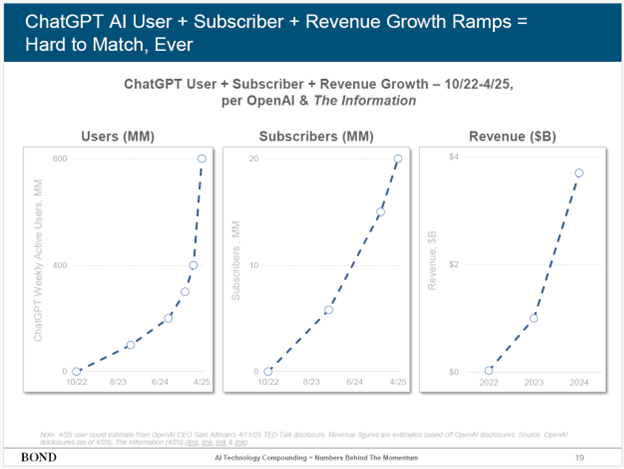
Source: BOND (Global Technology Investment Firm)
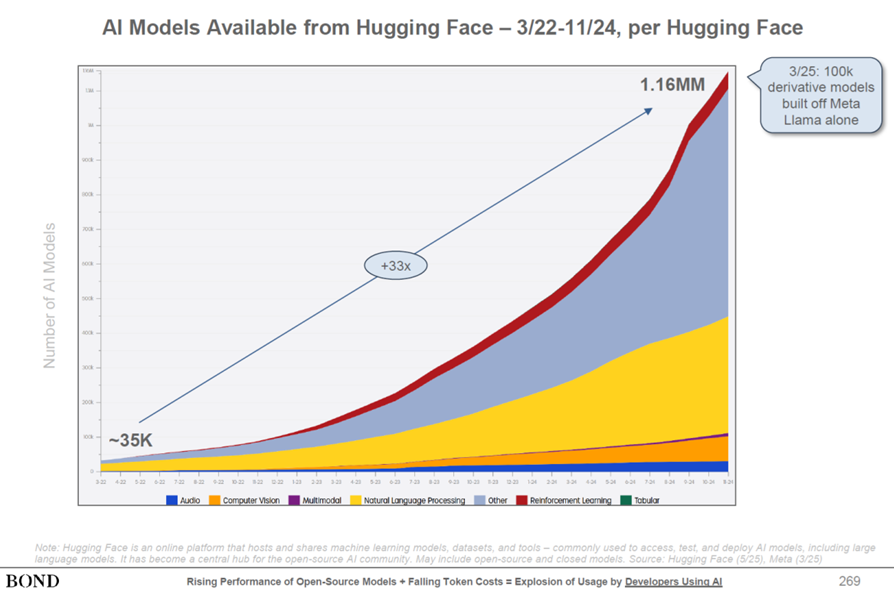
But OpenAI is far from alone. Google (Gemini), xAI (Grok), Anthropic (Claude), Meta (LLaMA), Amazon (Titan), Perplexity, and DeepSeek are all competing with their own LLMs. In total, over 1 million machine learning models now exist (see slide below) — each requiring costly compute power and pricey data centers.
Source: BOND (Global Technology Investment Firm)
Bubble or Productivity Breakthrough?
With trillions flowing into AI, a natural question arises: Is this a bubble?
Even OpenAI CEO Sam Altman admits we’re in an AI bubble :
“When bubbles happen, smart people get overexcited about a kernel of truth…Someone is going to lose a phenomenal amount of money… and a lot of people are going to make a phenomenal amount of money.”
Both realities can be true:
- Yes, hyperscalers are spending like “drunken sailors.”
- Yes, AI demand and productivity benefits are real and growing exponentially.
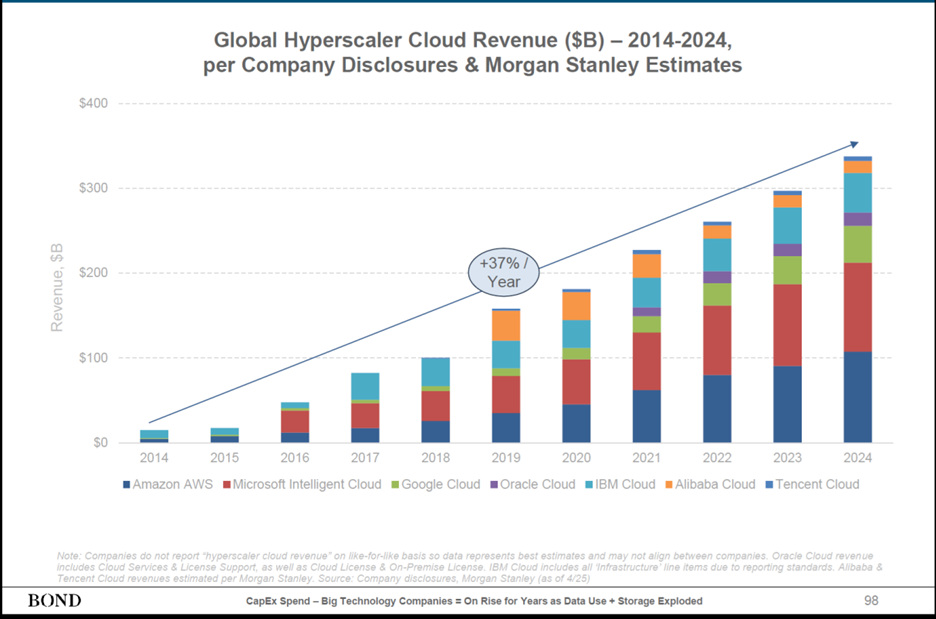
Consider the trajectory of global cloud revenues: from nearly $0 a decade ago to $300 billion today—a +37% CAGR (see chart below).
Source: BOND (Global Technology Investment Firm)
And the primary reason for cloud growth can be attributed to AI productivity benefits. A recent SAP survey found that workers using AI save nearly one hour per day on average. That’s transformative for companies: higher productivity without needing proportional hiring.
AI Use Cases Expanding Aggressively
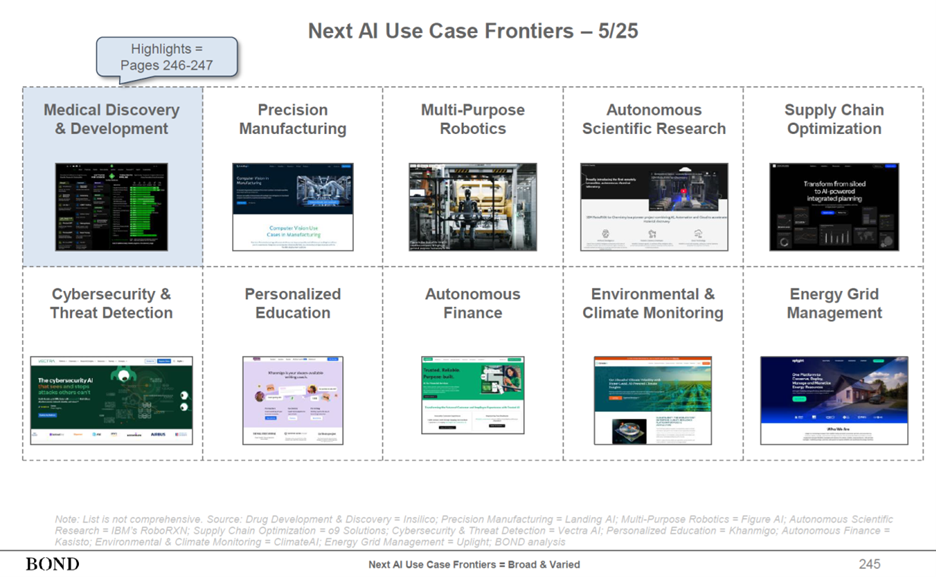
AI’s applications now span nearly every sector (see slide below):
- Technology – software engineering, code generation
- Customer Service & Marketing – customer support and call centers
- Transportation – autonomous vehicles and logistics
- Healthcare – drug discovery and development
- Supply Chains – precision manufacturing and optimization
- Automation – multi-purpose robotics
- Cybersecurity – threat detection and prevention
- Education – personalized lessons and curriculums
- Energy – grid optimization and demand forecasting
Source: BOND (Global Technology Investment Firm)
The New Field of Dreams
Throughout history, every great leap—printing press, steam engine, electricity, internet—has required massive upfront investment before the payoff arrived. AI is following the same path. Today, we are in the midst of building a new AI Field of Dreams. However, now, the data centers are the new baseball fields. And as with Ray Kinsella’s diamond, the masses are indeed coming.
Wade W. Slome, CFA, CFP®
Plan. Invest. Prosper.
This article is an excerpt from a previously released Sidoxia Capital Management complimentary newsletter (August 1, 2025). Subscribe Here to view all monthly articles.
DISCLOSURE: Sidoxia Capital Management (SCM) and some of its clients hold positions in GOOGL, META, AMZN, MSFT, NVDA, and certain exchange traded funds (ETFs), but at the time of publishing had no direct position in SAP or any other security referenced in this article. No information accessed through the Investing Caffeine (IC) website constitutes investment, financial, legal, tax or other advice nor is to be relied on in making an investment or other decision. Please read disclosure language on IC Contact page.