Posts tagged ‘bill gross’
Bears Hibernate During Melt-Up

Source: Photobucket
Here we are 719 days from the market bottom of March 2009, and the S&P 500 has more than doubled from its index low value of 666 to 1343 today. Noticeably absent during the meteoric rise have been the hibernating bears, like economist Nouriel Roubini (aka “Dr. Doom”) or Peter Schiff (see Emperor Schiff Has No Clothes), who blanketed the airwaves in 2008-2009 when financial markets were spiraling downwards out of control. The mere fact that I am writing about this subject may be reason enough to expect a 5-10% correction, but with a +100% upward move in stock prices I am willing to put superstition aside and admire the egg on the face of the perma-bears.
Shape of Recovery
After it became clear that the world was not coming to an end, in late 2009 and throughout 2010, the discussion switched from the likelihood of a “Great Depression” to a debate over the shape of the alphabet letter economic recovery. Was the upturn going to be an L-shaped, V-shaped, square root-shaped, or what Roubini expected – a U-shaped (or bathtub-shaped) recovery? You be the judge — does six consecutive quarters of GDP expansion with unemployment declining look like a bathtub recovery to you?
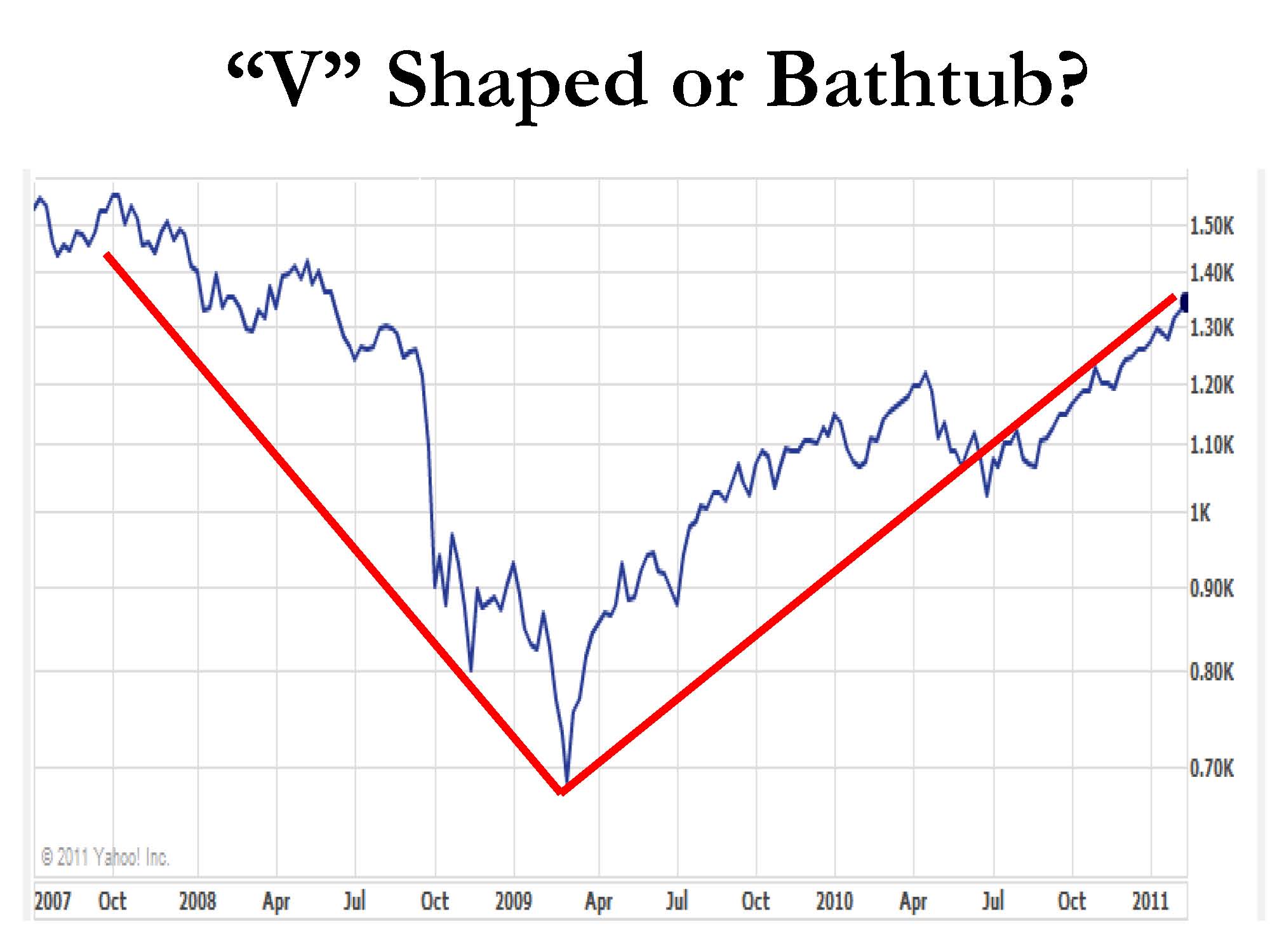
Chart Source: Yahoo Finance
This picture above looks more like a “V” to me, and the recently reported Institute for Supply Management’s (ISM) manufacturing index figure of 60.8 in January (the highest reading in seven years) lends credence to a stronger resurgence in the economy. Apparently the PIMCO bear brothers, Mohamed El-Erian and Bill Gross, are upwardly adjusting their view of a “New Normal” environment as well. Just recently, the firm raised its 2011 GDP forecast by 40-50% to a growth rate of 3-3.5% in 2011.
The Bears’ Logic
Bears continually explain away the market melt-up as a phenomenon caused by excessive and artificial liquidity creation (i.e., QE2 money printing, and 0% interest rate policy) Bernanke has provided the economy. Similar logic could be used to describe the excessive and artificial debt creation generated by individuals, corporations, and governments during the 2008-2009 meltdown. Now that leveraged positions are beginning to unwind (banks recapitalizing, consumers increasing savings rate, state and government austerity and tax measures, etc.), the bears still offer little credit to these improving trends.
Are we likely to experience another +100% upward move in stock prices in the broader indexes over the next two years? Unlikely. Our structural government debt and deficits, coupled with elevated unemployment and fiercer foreign competition are all factors creating economic headwinds. Moreover, inflation is starting to heat up and a Federal Funds rate policy cannot stay at 0% forever.
The Shapes of Rebounds
To put the two-year equity market recovery in historical perspective, the Financial Times published a 75-year study which showed the current market resurgence (solid red line) only trailing the post-Great Depression rebound of 1935-1938.
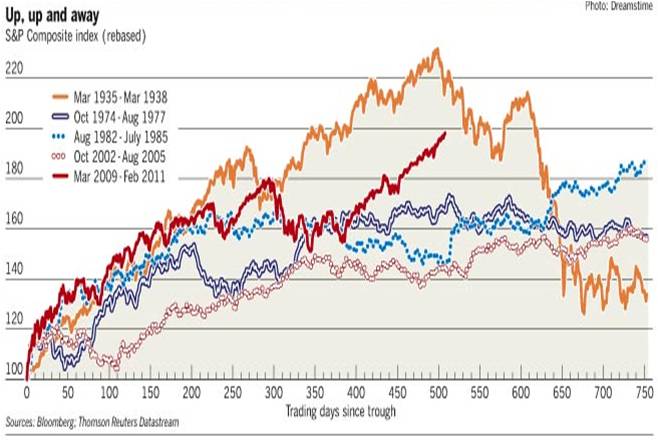
Source: Financial Times
Although we are absolutely not out of the economic woods and contrarian sentiment indicators (i.e., Volatility Index and Put-Call ratio) are screaming for a pullback, the foundation of a sustainable global recovery has firmed despite the persisting chaos occurring in the Middle East. Fourth quarter 2010 corporate profits (and revenues) once again exceeded expectations, valuations remain attractive, and floods of itchy retail cash still remain on the sidelines just waiting to jump in and chase the upward march in equity prices. Although the trajectory of stock prices over the next two years is unlikely to look like the last two years, there is still room for optimism (as I outlined last year in Genesis of Cheap Stocks). The low-hanging equity fruit has been picked over the last few years, and I’m certain that bears like Roubini, Schiff, El-Erian, Gross, et.al. will eventually come out of hibernation. For those investors not fully invested, I believe it would be wise to wait for the inevitable growls of the bears to resurface, so you can take further advantage of attractive market opportunities.
Click Here for More on the PIMCO Downhill Marathon Machine
Wade W. Slome, CFA, CFP®
Plan. Invest. Prosper.
DISCLOSURE: Sidoxia Capital Management (SCM) and some of its clients own certain exchange traded funds, but at the time of publishing SCM had no direct position in any other security referenced in this article. No information accessed through the Investing Caffeine (IC) website constitutes investment, financial, legal, tax or other advice nor is to be relied on in making an investment or other decision. Please read disclosure language on IC “Contact” page.
Strategist Predictions and MacGyver Credo
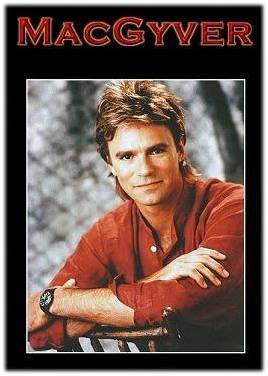
MacGyver: Resourceful dude with sweet mullet (Source: Photobucket).
“Only a fool is sure of anything, a wise man keeps on guessing.” – MacGyver
We have gotten to the part of the year when strategists gather for the annual dart throwing ritual of 2011 price targets. S&P projections get chucked around with the hopes of sticking – like cooked spaghetti to the wall. MacGyver appreciates the fine art of guessing, and so do Wall Street strategists.
How the Game’s Played
You don’t have to be a brain surgeon to figure out how the Wall Street astrology game works. When in doubt, just say the market will be up +10% next year. Hmmm, why +10%?
1) Well, first of all, these strategists work for employers who are in the business of hawking financial products and services to the masses, so if you want to generate revenues, you better attempt to line up some believers with some rosy scenarios.
2) History is on the strategists’ side. Equity markets move up about 70% of the time, so why not make an optimistic bet. Data from Crestmont Research and Roger Ibbotson support the average return over the last 100 years or so has averaged approximately +10% (with a lot of peaks and valleys). Obviously, that hasn’t been the case over the last decade. The PIMCO bond brothers of Bill Gross and Mohamed El-Erian blame the “New Normal” environment despite recently raising their 2011 GDP forecasts to a “Less Sluggish New Normal.” More likely, the decade of the 2000s is more like the “Old Normal” of boom-busts like we experienced in the 1930s and 1970s.
3) The other cardinal rule to be followed religiously: Forecasts made by any Wall Street type need to be made in tight packs like a herd. There is comfort in numbers, and why in the world would someone risk embarrassment or career risk. Fat paychecks abound for these strategists and hugging consensus views is OK, as long as a logical story can be patched together in explaining it.
With all this discussion about +10% average stock market returns, guess what type of returns this year’s Barron’s strategist survey is forecasting? You guessed it…+10% – what a shocker! Let’s hope this guess is more accurate than Barron’s +10% strategist return forecast for 2008 (S&P 500 was actually down -38.5% in 2008). Strategists don’t always get it wrong – the sanguine +12% outlook for 2010 is basically spot on with a few days left in the year. The sanguine 2002 outlook of +13%, however, was about -35% too sanguine (S&P plummeted about -23% that year).
Although most strategists feign absolute knowledge and precision, history shows these projections rarely prove accurate. Like predicting weather, guessers may get the long-term climate forecast fairly close, but the short-term estimates are generally pure speculation. In my book, 12 months is very short-term. Famed investor and author Charles Ellis captures the challenge of market forecasts:
“Predicting the stock market roughly is not hard, but predicting it accurately is truly impossible.”
I ascribe to the Peter Lynch view that speculating about the direction of the market is futile:
“If you spend more than 13 minutes analyzing economic and market forecasts, you’ve wasted 10 minutes.”
Kass Gets Hall Pass
Even though I may relish in flogging strategists, I provide certain professionals a hall pass under the following conditions:
- The educated guesser is putting real, hard-earned money behind their assertions.
- The guesses do not hug a tightly-knit herd.
- Guesses are made transparent and guessers make themselves accountable for bold statements.
- Those making guesses freely admit to the fallibility of making non-consensus suppositions.
One man whom embodies these principles is famed hedge fund manager Doug Kass, whom I have written about on several occasions (read more). Not only are Kass’s 2011 predictions provocative, they are also entertaining. His self proclaimed 40% batting average in 2010 may be a little higher than reality, but I will let you be the judge of his 2010 calls on the dollar, gold, Fed actions, Iran, Goldman Sachs, utilities, Warren Buffett, mutual funds, short-selling, New York Yankees, and more (read full 2010 Kass list).
The herd of strategists may continue having trouble making accurate market forecasts in the future, but perhaps resourcefully adding some duct tape and a Swiss Army knife to their repertoire like MacGyver will help improve accuracy. If not, rest assured, the strategists will sleep well making their +10% forecasts while continuing to collect big fat paychecks.
Wade W. Slome, CFA, CFP®
Plan. Invest. Prosper.
DISCLOSURE: Sidoxia Capital Management (SCM) and some of its clients own certain exchange traded funds, but at the time of publishing SCM had no direct position in any security referenced in this article. No information accessed through the Investing Caffeine (IC) website constitutes investment, financial, legal, tax or other advice nor is to be relied on in making an investment or other decision. Please read disclosure language on IC “Contact” page.
PIMCO – The Downhill Marathon Machine

How would you like to run a marathon? How about a marathon that is prearranged all downhill? How about a downhill marathon with the wind at your back? How about a downhill marathon with the wind at your back in a wheelchair? Effectively, that is what a 30-year bull market has meant for PIMCO (Pacific Investment Management Co.) and the “New Normal” brothers (Co-Chairman Bill Gross and Mohamed El-Erian) who are commanding the bond behemoth (read also New Normal is Old Normal). Bill Gross can appreciate a thing or two about running marathons since he once ran six marathons in six consecutive days.
This perseverance also assisted Gross in co-founding PIMCO in 1971 with $12 million in assets under management. Since then, the company has managed to add five more zeroes to that figure (today assets exceed $1.2 trillion). In the first 10 years of the company’s existence, as interest rates were climbing, PIMCO managed to layer on a relatively thin amount of assets (approximately $1 billion). But with the tailwind of declining rates throughout the 1980s, PIMCO’s growth began to accelerate, thereby facilitating the addition of more than $25 billion in assets during the decade.
The PIMCO Machine
For the time-being, PIMCO can do no wrong. As the endless list of media commentators and journalists bow to kiss the feet of the immortal bond kings, the blinded reporters seem to forget the old time-tested Wall Street maxim:
“Never confuse genius with a bull market.”
The gargantuan multi-decade move in interest rates, the fuel used to drive bond prices to the moon, might have something to do with the company’s success too? PIMCO is not exactly selling ice to the Eskimos – many investors are scooping up PIMCO’s bond products as they wait in their bunkers for Armageddon to arrive. Thanks to former Federal Reserve Chairman Paul Volcker (appointed in 1979), the runaway inflation of the early 1980s was tamed by hikes he made in the key benchmark Federal Funds Rate (the targeted rate that banks lend to each other). From a peak of around 20% in 1980-1981 the Fed Funds rate has plummeted to effectively 0% today with the most recent assistance coming from current Fed Chairman Ben Bernanke.
Although these west-coast beach loving bond gurus are not the sole beneficiary in this “bond bubble” (see Bubblicious Bonds story), PIMCO has separated itself from the competition with its shrewd world-class marketing capabilities. A day can hardly go by without seeing one of the bond brothers on CNBC or Bloomberg, spouting on about interest rates, inflation, and global bond markets. As PIMCO has been stepping on fruit in the process of collecting the low-hanging fruit, the firm has not been shy about talking its own book. Subtlety is not a strength of El-Erian – here’s what he had to pimp to the USA Today a few months ago as bond prices were continuing to inflate: “Simply put, investors should own less equities, more bonds, more global investments, more cash and more dry ammunition.”
If selling a tide of fear resulted in a continual funnel of new customers into your net, wouldn’t you do the same thing? Fearing people into bonds is something El-Erian is good at: “In the New Normal you are more worried about the return of your capital, not return on your capital.” Beyond alarm, accuracy is a trivial matter, as long as you can scare people into your doomsday way of thinking. The fact Bill Gross’s infamous Dow 5,000 call never came close to fruition is not a concern – even if the forecast overlapped with the worst crisis in seven decades.
Mohamed Speak
Mohamed El-Erian is a fresher face to the PIMCO scene and will be tougher to pin down on his forecasts. He arrived at the company in early 2008 after shuffling over from Harvard’s endowment fund. El-Erian has a gift for cryptically speaking in an enigmatic language that could only make former Federal Reserve Chairman Alan Greenspan proud. Like many economists, El-Erian laces his commentary with many caveats, hedges, and generalities – concrete predictions are not a strength of his. Here are a few of my favorite El-Erian obscurities:
- “ongoing paradigm shift”
- “endogenous liquidity”
- “tail hedging”
- “deglobalization”
- “post-realignment”
- “socialization losses”
Excuse me while I grab my shovel – stuff is starting to pile up here.
Don’t get me wrong…plenty of my client portfolios hold bonds, with some senior retiree portfolios carrying upwards of 80% in fixed income securities. This positioning is more a function of necessity rather than preference, and requires much more creative hand-holding in managing interest-rate risk (duration), yield, and credit risk. At the margin, unloved equities, including high dividend paying Blue Chip stocks, provide a much better risk-adjusted return for those investors that have the risk tolerance and time-horizon threshold to absorb higher volatility.
PIMCO has traveled along a long prosperous road over the last 30 years with the benefit of a historic decline in interest rates. While PIMCO may have coasted downhill in a wheelchair for the last few decades, this behemoth may be forced to crawl uphill on its hands and knees for the next few decades, as interest rates inevitably rise. Now that is a “New Normal” scenario Bill Gross and Mohamed El-Erian have not forecasted.
Wade W. Slome, CFA, CFP®
Plan. Invest. Prosper.
DISCLOSURE: Sidoxia Capital Management (SCM) and some of its clients own certain exchange traded funds, but at the time of publishing SCM had no direct position in PIMCO/Allianz, or any other security referenced in this article. No information accessed through the Investing Caffeine (IC) website constitutes investment, financial, legal, tax or other advice nor is to be relied on in making an investment or other decision. Please read disclosure language on IC “Contact” page.
Changing of the Guard

Over previous decades, there has been a continual battle between the merits of active versus passive management. Passive management being what I like to call the “do nothing” strategy, in which a basket of securities is purchased, and the underlying positions remain largely static. For all intents and purposes, the passive management strategy is controlled by a computer. Rather than solely using a computer, active management pays professionals six or seven figures to fly around to conferences, interview executive management teams, and apply their secret sauce tactics. Unlike passive managers, active managers do their best to determine which winning securities to buy and which losing ones to sell in their mutual funds and hedge funds.
Caught in the middle of this multi-decade war between passive and active management are Vanguard Group (founded in Valley Forge, Pennsylvania in 1975 by John Bogle) and Fidelity Investments (founded in 1946 in Boston, Massachusetts by Edward C. Johnson II). Currently John Bogle and Vanguard’s passive philosophy is winning the war. A changing of the guard, similar to the daily ceremony witnessed in front of Buckingham Palace is happening today in the mutual fund industry. Specifically, Vanguard, the company spearheading passive investing, has passed Fidelity Investments as the largest mutual fund company according to assets under management. Before 2010, Fidelity topped the list of largest firms every year since 1988, when it passed the then previous leader, Merrill Lynch & Co (BAC).
As of July 2010, Vanguard stands at the top of the mutual fund hill, managing $1.31 trillion versus Fidelity’s $1.24 trillion. Vanguard is sufficiently diversified if one considers its largest fund, the Vanguard Total stock Market Index Fund (VITSX), sits at around $127 billion in assets. The picture looks worse for Fidelity, if you also account for the $113 billion in additional ETF assets (Exchange Traded Funds) Vanguard manages – Fidelity is relatively absent in the ETF segment (State Street). Once famous active funds, such as Fidelity Magellan (now managed by Harry Lange – FMAGX) have underperformed the market over the last ten years causing peak assets of $110 billion in 2000 to decline to around $22 billion today. The $68 billion Fidelity Contrafund (FCNTX), managed by Will Danhoff, has not grown sufficiently to offset Magellan’s (and other funds) declines.
The Proof is in the Pudding
Some in the industry defend the merits of active management, and through some clever cherry-picking and data mining come to the conclusion that passive investing is overrated. If you believe that money goes where it is treated best, then the proof in the pudding suggests active management is the discipline actually suffering the beating (see Darts, Monkeys & Pros). The differences among the active-passive war of ideals have become even more apparent during the heart of the financial crisis. Since the beginning of 2008 through August 2010, Morningstar shows $301 billion in assets hemorrhaging from actively managed U.S. equity funds, while passive equity-index funds have soaked up $113 billion of inflows.
On a firm-specific basis, InvestmentNews substantiated Vanguard’s gains with the following figures:
In the 10 years ended Dec. 31, Vanguard’s stock and bond funds attracted $440 billion, compared with $101 billion for Fidelity, Morningstar estimates. This year through August, Vanguard pulled in $49 billion while Fidelity had withdrawals of $2.8 billion, according to the research firm.
Vanguard is gaining share on the bond side of the house too:
Vanguard also benefited from the popularity of bond funds. From Jan. 1, 2008, through Aug. 31, 2010, the company’s fixed- income portfolios pulled in $134 billion while Fidelity’s attracted $33 billion (InvestmentNews).
Vanguard is not the only one taking share away from Fidelity. Fido is also getting pinched by my neighbor PIMCO (Pacific Investment Management Company), the $1.1 trillion assets under management fixed income powerhouse based in Newport Beach, California. Bond guru Bill Gross leads the $248 billion Pimco Total Return Fund (PTTAX), which has helped the firm bring in $54 billion in assets thus far in 2010.
Passive Investing Winning but Game Not Over
Even with the market share gains of Vanguard and passive investing, active management assets still dwarf the assets controlled by “do-nothing” products. According to the Vanguard Group and the Investment Company Institute, about 25% of institutional assets and about 12% of individual investors’ assets are currently indexed (2009). The analysis gets a little more muddied once you add ETFs to the mix.
Passive investing may be winning the game of share gains, but is it winning the performance game? The academic research has been very one-sided in favor of passive investing ever since Burton Malkiel came out with his book, A Random Walk Down Wall Street. More recently, a study came out in June 2010 by Standard & Poor’s Indices Versus Active Funds (SPIVA) division showing more than 75% of active fixed income managers underperforming their index on a five-year basis. From an equity standpoint, SPIVA confirmed that more than 60% domestic equity funds and more than 84% international equity funds underperformed their benchmark on a five-year basis. InvestmentNews provides some challenging data to active-management superiority, however it is unclear whether survivorship bias, asset-weighting, style drift, and other factors result in apples being compared to oranges. SPIVA notes the complexity over the last three years has increased due to 20% of domestic equity funds, 13% of international equity funds, and 12% of fixed income funds liquidating or merging.
Regardless of the data, investors are voting with their dollars and happily accepting the superior performance, while at the same time paying less in fees. The positive aspects associated with passive investment products, such as index funds and ETFs, are not only offering superior performance like a Ferrari, but that enhanced quality also comes at the low price equivalent of a Hyundai. On a dollar-adjusted basis, stock-index funds charge an average of 29 cents per $100, compared with 95 cents for active funds (almost a 70% discount), according to research firm Lipper. For example, Vanguard’s passive VITSX fund charges clients as little as 6 cents for every $100 invested (Morningstar).
There has indeed been a changing of the market share guard and Fidelity may also be losing the debate over active versus passive management, but you do not need to shed a tear for them. Fidelity is not going to the poorhouse and will not be filing for Chapter 11 anytime soon. Last year Fidelity reported $11.5 billion in revenue and $2.5 billion in operating income. Those Fidelity profits should be more than enough to cover the demoted guard’s job retraining program and retirement plan benefits.
Read the Complete InvestmentNews Article
Wade W. Slome, CFA, CFP®
Plan. Invest. Prosper.
DISCLOSURE: Sidoxia Capital Management (SCM) and some of its clients own certain exchange traded funds, but at the time of publishing SCM had no direct position in VITSX, PTTAX, BAC, FCNTX, FMAGX, or any other security referenced in this article. No information accessed through the Investing Caffeine (IC) website constitutes investment, financial, legal, tax or other advice nor is to be relied on in making an investment or other decision. Please read disclosure language on IC “Contact” page.
Siegel Digs in Heels on Stocks

Jeremy Siegel, Wharton University Professor and author of Stocks for the Long Run, is defending his long-term thesis that stocks will outperform bonds over the long-run. Mr. Siegel in his latest Financial Times article vigorously defends his optimistic equity belief despite recent questions regarding the validity and accuracy of his long-term data (see my earlier article).
He acknowledges the -3.15% return of U.S. stock performance over the last decade (the fourth worst period since 1871), so what gives him confidence in stocks now? Let’s take a peek on why Siegel is digging in his heels:
Since 1871, the three worst ten-year returns for stocks have ended in the years 1974, 1920, and 1978. These were followed, respectively, by real, after-inflation stock returns of more than 8 per cent, 13 per cent, and 9 per cent over next ten years. In fact for the 13 ten-year periods of negative returns stocks have suffered since 1871, the next ten years gave investors real returns that averaged over 10 per cent per year. This return has far exceeded the average 6.66 per cent real return in all ten years periods, and is twice the return offered by long-term government bonds.
Siegel’s bullish stock stance has also been attacked by Robert Arnott, Chairman of Research Affiliates, when he noted a certain bond strategy bested stocks over the last 40 years. Here’s what Mr. Siegel has to say about stock versus bond performance:
Even with the recent bear market factored in, stocks have always done better than Treasury bonds over every 30-year period since 1871. And over 20-year periods, stocks bested Treasuries in all but about 5 per cent of the cases… In fact, with the recent stock market recovery and bond market decline, stock returns now handily outpace bond returns over the past 30 and 40 years.
If you’re 50, 60, or older, then Siegel’s time horizons may not fit into your plans. Nonetheless, in any game one chooses to play (including the game of money), I, like many, prefer to have the odds stacked in my favor.
In addressing the skeptics, such as Bill Gross who believes the U.S. is entering a “New Normal” phase of sluggish growth, Mr. Siegel notes this commentary even if true does not account for the faster pace of international growth – Siegel goes on to explain that the S&P 500 corporations garner almost 50% of revenues from these faster growing areas outside the U.S.
On the subject of valuation, Mr. Siegel highlights the market is trading at roughly 14x’s 2010 estimates, well below the 18-20x multiples usually associated with low-interest rate periods like these.
In periods of extreme volatility (upwards or downwards), the prevailing beliefs fight reversion to the mean arguments because trend followers believe “this time is different.” Just think of the cab drivers who were buying tech stocks in the late 1990s, or of the neighbor buying rental real estate in 2006. Bill Gross with his “New Normal” doesn’t buy the reversion argument either. Time will tell if we have entered a new challenging era like Mr. Gross sees? Regardless, Professor Siegel will be digging in his heels as he invests in stocks for the long run.
Read the Whole Financial Times Article Written by Professor Siegel
Wade W. Slome, CFA, CFP®
Plan. Invest. Prosper.
“Bill, Say It Ain’t So…”
Bond guru and Newport Beach neighbor, Bill Gross, is out with his entertaining monthly PIMCO piece (Click Here). Try to keep a box of tissues close by in case you cry during the read. His views support my stance on short duration bonds and TIPs (Treasury Inflation Protected Securities), but big Bill would NEVER stand to root for equities – especially after his call for Dow 5000 a while back.
In this CNBC piece, he points out the obvious troubles we face from all the debt we’re choking on. As a country, we need the “Heimlich Maneuver!”

"Save to Your Grave"




 Investing Caffeine
