Rogers Sees an Explosion in Stock Prices…Or Complete Collapse
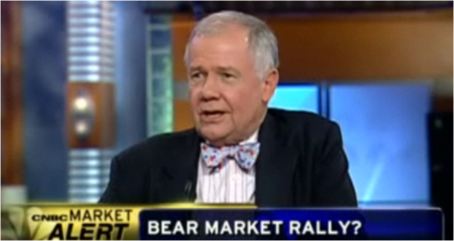
CNBC Interview with Jimmy Rogers
I love it! Jimmy Rogers, chairman of Rogers Holdings is really going out on limb this time. Well, not really. It’s more like he is on a fence, and ready to fall over to whichever side the wind blows. Let me explain this claim in more detail. With the Dow Jones Industrials Average currently trading at about 8,800, Rogers sees the market climbing higher by +240% to 30,000 or perhaps collapsing another -43% (after the worse bear market in decades) to 5,000.
“I’m afraid they’re printing so much money that stocks could go to 20,000 or 30,000,” Rogers said. “Of course it would be in worthless money, but it could happen and you could lose a lot of money being short,” he adds.
Why stop there – why not a more outrageous range of guesses between 100,000 and 1,000? If inflation is his worry, then maybe Mr. Rogers should be concerned about declining PE (Price/Earnings) multiples, which reached single digits in the late-1970s and early-1980s when we were experiencing double-digit inflation.
Thanks Jimmy, those meticulously defined predictions will make many fellow astrologists proud. These prophetic claims remind me of my prescient call this year that I would either gain 100 pounds or lose 100 pounds. So far my forecast has turned out to be spot on, however I won’t confess which direction my weight has swung.
Although Jimmy’s tone is notably pessimistic, he reminds us that this is the last time he has had NO short positions since after the “Crash of 1987.” If lightning strikes twice, maybe his actions demonstrate that now is not such a bad time to buy.
However, be wary because Rogers is not only frightened by inflation. He goes onto say that some country is going to suffer a currency crisis, but he does not know which one yet. “I expect there to be a currency crisis later this year or maybe next year,” he states. Let us hope that “Zimbabwean-esque” inflation does not take hold, otherwise we will be in line with Rogers at the grocery store buying millions of dollars in the vegetable aisle.
Jimmy Rogers is obviously a bright investor (not to mention the Wall Street bow-tie king) who has achieved great success over his career. Nonetheless, I believe he could go into a little more detail in explaining his outrageous, sensationalized claims. For some reason I don’t think this trend will change, but at a minimum, he will continue to provide food for thought and fantastic entertainment.
Chasing Profits – Can Fund Managers Beat the Game?

Achieving Long-Term Excess Returns is a Tough Race
How someone invests their money should fundamentally be based on their view of what’s the best way of playing the investment game. Before playing, the investor should answer the following key question: “Is the market efficient?” Efficient market followers believe active managers – professionals that periodically buy and sell with a profit motive – CANNOT consistently earn excess returns over longer periods of time, in part because market prices reflect all available information. If you fall into the efficiency camp, then you should dial 1-800-VANGUARD to simply buy some index funds. However, if you believe the market is inefficient, then invest in an exploitable strategy or hire an active investment manager you believe can outperform the market after fees and taxes.
For me personally, I fall somewhere in between both camps. I opportunistically invest my hedge fund in areas where I see superior return potential. However, in other areas of my investment practice (outside my main circle of expertise), I choose to side with the overwhelming body of evidence from academics that show passive/indexing slaughters about 75% of professionals.
Richard Roll, renowned economist and thought leader on the efficient market hypothesis, said this:
“I have personally tried to invest money, my client’s and my own, in every single anomaly and predictive result that academics have dreamed up. And I have yet to make a nickel on any of these supposed market inefficiencies. An inefficiency ought to be an exploitable opportunity. If there’s nothing investors can exploit in a systematic way, time in and time out, then it’s very hard to say that information is not being properly incorporated into stock prices. Real money investment strategies don’t produce the results that academic papers say they should.”
—(Wall Street Journal, 12/28/00)
The market gurus du jour blanket the media airwaves, but don’t hurt your back by hastily bowing. Having worked in the investment industry for a long time, you learn very quickly that many of the celebrated talking-heads on the TV today rotate quickly from the penthouse to the outhouse. Certainly, there are the well regarded professional money managers that survive the walk across the burning-coals and have performed great feats with their clients’ money over long periods of time. But even the legendary ones take their lumps and suffer droughts when their style or strategy falls out of favor.
The professional investing dynamics are no different than professional baseball. There are a relatively few hitters in the Major Leagues who can consistently achieve above a .300 batting average. In 2007, AssociatedContent.com did a study that showed there were only 12 active career .300 hitters in Major League Baseball. The same principle applies to investing – there is a narrow slice of managers that can consistently beat the market over longer periods of time.

There Are Only So Many .300 Hitters
Some statisticians point to the “law of large numbers” when describing long term investor success (a.k.a. “luck”) or ascribe the anomaly to statistical noise. Peter Lynch might have something to say about that. Peter Lynch managed the Fidelity Magellan Fund from 1977 – 1990, while he visited 200 companies per year and read about 700 company reports annually. Over that period Lynch averaged a 29% annual return for his investors vs. a 15% return for the S&P 500 index. Luck? How about Bill Miller from Legg Mason who outperformed the major industry benchmark for 15 consecutive years (1991-2005). Perhaps that too was good fortune? Or how about investor extraordinaire Warren Buffet who saw his stock price go from $33 per share in 1967 to $14,972 in 2007 – maybe that was just an accident too? An average schmuck off the street achieving Warren’s Buffett performance over a multi-decade period is equivalent to me batting .357 against Nolan Ryan and Randy Johnson…pure fantasy.
Academics also have difficulty with their efficiency arguments when it comes to explaining events like the “1987 Crash,” the technology bubble bursting in 2000, or the recent subprime derivative security meltdown. If all available information was already reflected in the market prices, then it would be unlikely the markets would experience such rapid and dramatic collapses.
What these bubbles show me is no matter how much academic research is conducted, the behavioral aspects of greed and fear will always create periods of inefficiency in the marketplace. These periods of inefficiency generate windows of profit opportunity that can be exploited by a subset of skillful managers. In the short-run, luck plays a great role; in the long-run sklill level determines ultimate performance. Benjamin Graham, summed it up best when he said, “In the short-term, the stock market is a voting machine; in the long-term a weighing machine.”
Wade W. Slome, CFA, CFP®
Plan. Invest. Prosper.
DISCLOSURE: Sidoxia Capital Management and client accounts do not have direct positions in LM or BRKA/B at the time the article was published.No information accessed through the Investing Caffeine (IC) website constitutes investment, financial, legal, tax or other advice nor is to be relied on in making an investment or other decision. Please read disclosure language on IC “Contact” page.
“Bill, Say It Ain’t So…”
Bond guru and Newport Beach neighbor, Bill Gross, is out with his entertaining monthly PIMCO piece (Click Here). Try to keep a box of tissues close by in case you cry during the read. His views support my stance on short duration bonds and TIPs (Treasury Inflation Protected Securities), but big Bill would NEVER stand to root for equities – especially after his call for Dow 5000 a while back.
In this CNBC piece, he points out the obvious troubles we face from all the debt we’re choking on. As a country, we need the “Heimlich Maneuver!”

"Save to Your Grave"
Building Your Financial Future – Mistakes Made in Investment Planning

Building Your Dream Future Requires a Plan
Building your retirement and financial future can be likened with the challenge of designing and building your dream home. The tools and strategies selected will determine the ultimate cost and outcome of the project.
I constantly get asked by investors, “Wade, is this the bottom – is now the right time to get in the markets?” First of all, if I precisely knew the answer, I would buy my own island and drink coconut-umbrella drinks all day. And secondarily, despite the desire for a simple, get-rich quick answer, the true solution often is more complex (surprise!). If building your financial future is like designing your dream home, then serious questions need to be explored before your wealth building journey begins:
1) Do I have enough money, and if not, how much money do I need to develop my financial future?
2) Can I build it myself, or do I need the help of professionals?
3) Do I have contingency plans in place, should my circumstances change?
4) What tools and supplies do I need to effectively bring my plans to life?
Most investors I run into have no investment plan in place, do not know the costs (fees) of the tools and strategies they are using, and if they are using an advisor (broker) they typically are in the dark with respect to the strategy implemented.
For the “Do-It-Yourselfers”, the largest problem I am witnessing right now is excessive conservatism. Certainly, for those who have already built their financial future, it does not make sense to take on unnecessary risk. However, for most, this is a losing strategy in a world laden with inflation and ever-growing entitlements like Medicare and Social Security. There’s clearly a difference between stuffing money under the mattress (short-term Treasuries, CDs, Money Market, etc.) and prudent conservatism. This is a credo I preach to my clients.
In many cases this conservative stance merely compounds a previous misstep. Many investors undertook excessive risk prior to the current financial crisis – for example piling 100% of investment portfolios into five emerging market commodity stocks.
What these examples prove is that the average investor is too emotional (buys too much near peaks, and capitulates near bottoms), while paying too much in fees. If you don’t believe me, then my conclusions are perfectly encapsulated in John Bogle’s (Vanguard) 1984-2002 study. The analysis shows the average investor dramatically underperforming both the professionally managed mutual fund (approximately by 7% annually) and the passive (“Do Nothing”) strategy by a whopping 10% per year.
Building your financial future, like building your dream home, requires objective and intensive planning. With the proper tools, strategies and advice, you can succeed in building your dream future, which may even include a coconut-umbrella drink.
Steepening Yield Curve – Disaster or Recovery?

Various Treasury Maturities in 2006 Highlighting Inversion
Wait a second, aren’t we suffering from the worst financial crisis in some seven decades; our GDP (Gross Domestic Product) is imploding; real estate prices are cratering; and we are hemorrhaging jobs faster than we can say “bail-out”? We hear it every day – our economy is going to hell in a hand basket.
If Armageddon is indeed upon us, then why in the heck is the yield-curve steepening more than a Jonny Moseley downhill ski run? Bears typically point to one or all of the following reasons for the rise in long-term rates:
- Printing Press: The ever-busy, government “Printing Press” is working overtime and jacking up inflation expectations.
- Debt Glut: Our exploding debt burden and widening budget and trade deficits are rendering our dollar worthless.
- Foreign “Nervous Nellies”: Foreign Treasury debt buyers (the funders of our excessive spending) are now demanding higher yields for their lending services, particularly the Chinese.
- Yada, Yada, Yada: Other frantic explanations coming from nervous critics hiding in their bunkers.
All these explanations certainly hold water; however, weren’t these reasons still in place 3, 6, or even 9 months ago? If so, perhaps there are some other causes explaining steepening yield curve.
One plausible explanation for expanding long-term rates stems from the idea that the bond market actually does integrate future expectations and is anticipating a recovery. Let us not forget the “inverted yield curve” we experienced in 2006 (see Chart ABOVE) that accurately predicted the looming recession in late 2007. Historically, when short-term rates have exceeded long-term rates, this dynamic has been a useful tool for determining the future direction of the economy. Now we are arguably observing the reverse take place – the foundations for recovery are forming.

Treasury Yield Curve (June 2009)
Alternatively, perhaps the trend we are currently examining is merely a reversal of the panic rotation out of equities last fall. If Japanese style deflation is less of a concern, it makes sense that we would see a rebound in rates. The appetite for risk was non-existent last year, and now there have been some rays of sunlight that have glimmered through the dark economic clouds. Therefore, the selling of government guaranteed securities, which pushed prices down and yields upward, is a logical development. This trend doesn’t mean the equity markets are off to the races, but merely reflects investors’ willingness to rotate a toe (or two) back into stocks.
Investing Caffeine Launches

Investing Caffeine Launches
It has already been more than a year since the humble beginnings of Sidoxia Capital Management, LLC in April 2008 (here in lovely Newport Beach, California). Since then, I have written a successful book, How I Managed $20,000,000,000.00 by Age 32, appeared on ABC News, spoken on numerous radio shows, and traveled around to more than a dozen speaking engagements. Now, I am opening the next exciting chapter in my life journey – the launch of my new blog, Investing Caffeine.
Investing Caffeine will wake up your investment brain by tackling the complex issues of investing and financial planning, with the goal of educating and entertaining your mind. You can be the ultimate judge by posting your comments onto Investing Caffeine’s website. Financial topics can be boring, so make Investing Caffeine a part of your routine by injecting a jolt of financial knowledge. See you at my café!
Religious Pursuit of Stock Knowledge (Top 5 Books)

Feed Your Brain
In this stress-filled society dominated with endless amounts of information, and where the masses chase instant gratification, it is difficult to find the time, energy, and focus to curl up to a good book. But in life, knowledge acquisition requires more than a quick keyboard dance on Google.com, or a fleeting skim of a Wikipedia passage. Mastering a subject requires in-depth, nuanced analysis, and books are ideal vehicles used to achieve this aim.
When it comes to the topic of equity investing, it feels as though there are an infinite number of books scattered on the investment menu. Investing in many ways is like religion – there are so many different styles to choose from, even if many of them strive for the same or similar goals. Therefore, I believe if investors are fine-tuning or shopping for an investment philosophy, it makes sense to explore a cross-section of investment styles/religions.
In my view, successful equity investing integrates a balanced mix of “art” and “science.” Too much emphasis on either aspect can be detrimental to investors’ financial health. Although understanding the science takes time, training and patience, generally a committed student can learn the nuts and bolts of investing by mastering the key financial equations, ratios, and concepts. However, becoming a fluent investment artist requires the adept understanding and prediction of human behavior – no easy task.
Having logged thousands of hours and decades of years, my blood shot eyes and finance-soaked brain came up with a balanced mix of “art” and “science” in what I call my, “Top 5 Stock Book Starter Kit”:
A Random Walk Down Wall Street by Burton Malkiel
A great foundational investment book that tackles the major internal and external factors impacting our complex financial markets.
Beating the Street by Peter Lynch
A “Hall-of-Famer” growth investor, Lynch successfully managed the Fidelity Magellan Fund from 1977 to 1990 and averaged a +29% annual return. This book provides countless pearls of wisdom for both the seasoned pro and the bushy-tailed novice.
The Intelligent Investor by Benjamin Graham
When Warren Buffet pronounces this, “By far the best book on investing ever written,” people should pay attention. Graham is considered by many to be the father of “value” investing.
Reminiscences of a Stock Operator by Edwin Lefevre
This book profiles the life and times of early 20th century trader Jesse Livermore, commonly believed to be the greatest trader of all-time. Livermore provides a view into the “fast money” approach that contrasts the traditional “growth” and “value” investment styles.
Common Stocks and Uncommon Profits by Phil Fisher
A Wall Street legend that explains the key factors of superior stock returns.
There you go…upon completion, you will have officially become a stock guru!
Your Investment Car Needs Shocks

Smooth Out the Bumpy Ride
Investing can make for a bumpy ride. What can investors do to smooth out the rough financial journey? The simple answer: diversification. If you consider your investment portfolio as a car, then the process of diversification acts like shock absorbers. Those shocks make for a more comfortable ride while preventing potential disasters – like accidentally driving your investments off a cliff.
People generally understand the concept behind, “not putting all your eggs in one basket.” However, once introduced to financial theory terms such as correlation, covariance, and the efficient frontier, people’s eyes begin to glaze over…and rightfully so!
So what are some of the key points one should understand regarding diversification:
- Lunch CAN Be Free! There are very few free lunches in life, but with “diversification” you can indeed get something for nothing. For example, let’s assume you are approached with two investments, ski hats and sun visors, and each investment is expected to deliver a 5% annual return. Furthermore, let’s suppose that zero ski hats are sold in Spring and Summer (and zero sun visors in Fall and Winter). If you merely own one investment, that investment will be more risky (volatile) than a combo portfolio for half the year. Although any combination of two investments will create a 5% return, by diversifying (owning both investments), you can smooth out the ride. There’s your free lunch – the same return achieved for less risk (volatility)!
- Gravity Holds True For Investments Too! Nothing goes up forever, so do not concentrate your portfolio in sectors that have wildly outperformed other sectors/asset classes for long periods of time. Lessons learned over the last 10 years in the areas of technology and real estate highlight the dangers of over-exposure to any one sector in the economy.
- Vary Your Investment Diet! In the Oscar-nominated documentary Super Size Me, Morgan Spurlock decides to eat McDonald’s fast-food for breakfast, lunch, and dinner for thirty days. As a result, his cholesterol levels sky-rocket, he gains over 24 pounds, and his liver function deteriorates significantly. When it comes to your investment portfolio, you should balance it across a wide range of healthy options, including domestic and international stocks and bonds; large and small capitalization stocks; growth and value styles; cash and low-risk liquid investments; and alternative asset classes, such as real estate, commodities, and private investments.
The benefits of diversification will fluctuate under different economic climates. During our recent financial crisis, especially in late 2008, the correlation ratio (the degree that different asset classes move together) unfortunately was very high. However, those investors who were exposed to areas such as Treasury securities, gold, cash, and bonds generally fared better than those who did not. Subsequently, in the early part of 2009, the benefits of diversification shined through as outperformance in emerging markets, technology, consumer discretionary and growth stocks balanced the weakness suffered in banking, transportation, healthcare, bond and value segments.
Diversification helps on the rough roads of investing, so make sure to check those shocks!
Who Will Pass the Stress Test?
 The Government, including the Federal Reserve and U.S. Treasury department, is conducting a review of the 19 largest banks that pose “systemic” risk to the overall financial system. Although there will be no “Pass” or “Fail” grade given to the institutions, the government will clarify whether capital-raising will be necessary to weather a worsening economic storm. Scenarios under the stress test will contemplate the impact on the banks’ balance sheets and request capital increases for the weaker banks. The pessimistic case for the banks considers the following hypothetical setting:
Gross domestic product (GDP) declining by -3.3 percent in 2009 and growing by +0.5 percent in 2010.
Unemployment rate reaching 10.3 percent
Home prices to fall by another 29 percent, by 2010.
Right now the government is negotiating with the bank management teams regarding how much, if any, capital-raising will be necessary over the next six months. If the banks are unsuccessful raising capital on their own, then the government will standby to inject government money in to the banks. Rather than using tax-payer dollars, I’m in the camp that the banks’ bondholders should share the pain by converting their debt into equity – thereby relieving the burden on our debt-strapped government and taxpayers. Larry Summers, the Director of the White House’s National Economic Council, has hinted the administration is exploring this route. Regardless, the government needs to strengthen the equity positions of the banks if Bill Ackman at Pershing Square Capital Management is correct in estimating the financial system needing to repay $300 billion in debt coming due in 2009; $280 billion in 2010; and $250 billion in 2011.
In some respects this “Stress Test” is a “Lose-Lose” proposition because if certain banks are forced to raise large sums of capital, then the public will lose confidence in the banks. Conversely, if all the banks come out of the test with a clean bill of health, then the public will lose all confidence in the credibility of the tests themselves. Results will arrive soon enough – let’s hope the stress-test provides relief, not a migraine!
Green Shoots or Spring Fever
Experts are debating whether the recent bounce experienced in the equity markets is a function of a fundamental turnaround in the economy, or is this more a function of wearing rose-colored glasses after extreme price declines. Irrespective of your view, the S&P 500 Index rose +9.4% in April; the Dow Jones Industrials +7.3%; and the NASDAQ Composite Index +12.4%. After wholesale panic began last September green shoots now appear to be budding through the ashes:
 Healthier Than Anticipated Corporate Earnings: Company earnings reports are beating expectations. A +17% bounce in the KBW Bank Sector Index during April is one validating piece of evidence. “The earnings season in general has been better than expected, with 68% of the S&P 500 reporting upside surprises, and we’re three-quarters of the way done,” said Art Hogan, chief market strategist, Jefferies & Co.
Improving Consumer Spending: Despite significant job losses and weak economic activity, consumer spending, which accounts for about 2/3 of Gross Domestic Product (GDP), was up +1.5% in the first quarter of 2009.
Stabilization in Home Prices: Although housing prices continue to decline, existing home unit sales have stabilized over the last four to five months at around 4.5 million homes.
Merger Marriages On the Rise: Merger activity is perking up now that a market bottoming process appears to have commenced. Oracle/Sun Microsystems in technology; Merck/Schering Plough in healthcare; and Pulte Homes/Centex in homebuilding are just a few examples of recent merger marriages.
Capital-Raising on the Rise: Capital markets are functioning much better with bond spreads tightening and the cost of issuance declining for corporations. Beyond the hundreds of billions raised through new bond deals, we are seeing troubled areas like the REITS (Real Estate Investment Trusts) raising vital equity capital as well. Prologis (PLD), Chimera (CIM), Kimco (KIM), Vornado (VNO), AMB (AMB), and Simon Property Group (SPG) have raised over $4 billion in the last few months.




 Investing Caffeine
