PPIP Becomes Miniaturized “Mini Me”

Mini-Me and Dr. Evil from famed Austin Powers movies
In two of Mike Myer’s Austin Powers movies, Verne Troyer plays Dr. Evil’s miniature clone, Mini-Me. At a “breathtaking” one-eighth the size of the fully-sized villain, Mini-Me didn’t quite pack the same evil punch as his surrogate daddy, Dr. Evil. The same can be said of the government’s PPIP (Public Private Investment Program), which was originally designed to unclog the financial system by removing toxic and illiquid investments from owners desiring liquidity.
Unfortunately, the PPIP size has been reduced to ppip dimensions. The Fundamental Analyst (FA) blogger (www.fundamentalanalyst.com) points out that the program’s scope has likely shrunk to $100 billion from the original goal of $1 trilllion – a proportion even smaller than Mini-Me’s relative size to Dr. Evil. Treasury Secretary Timothy Geithner’s explanation for the decline in program size is due to the improving financial market conditions and the capital raising activities of the banks. Perhaps partially true, but “not so fast” says FA – he blames the suspension of mark-to-market accounting as the driver for positive overstated banking earnings, which allowed the banks to hoodwink investors and raise capital under false pretenses.
Read the Fundamental Analyst’s Article on PPIP Here
FA goes onto highlight what little skin the participants (including, AllianceBernstein, BlackRock, Invesco, Oaktree Capital Management, TCW Group, and Wellington Management) have in the game relative to the other 93% of capital fronted by the taxpayers. I agree – the surplus taxpayer exposure is evil. Time will tell how effective the Mini-Me ppip program will be…

Original PPIP plan drawn up by the Financial Times
Leveraged ETFs…Too Much Adrenaline?

Do we really need extra levered ETF risk?
Isn’t the market volatile enough without leverage? I believe the vast majority of individuals have plenty of adrenaline in their daily investment lives without the necessity of exotic inverse ETFs (Exchange Traded Funds) or other leveraged investment vehicles. FINRA (Financial Industry Regulatory Authority), the largest regulating body overseeing U.S. securities firms feels much the same way. Many of these ETFs seek to earn a daily return double or triple a designated index – the inverse instruments strive to mirror the return in the opposite direction.
Read WSJ Article (FINRA Urges Caution on Leveraged Funds)
No doubt, many exchange traded funds have some key advantages over actively managed mutual funds such as lower costs, tax efficiency, and improved liquidity; however most investors have no business in trading these crazy leveraged gimmicks. For example, I wouldn’t recommend average investors speculating in the Direxion 3X Inverse Financial Bull (FAS) ETF, which was down more than 95% in its first four months of existence. Do yourself a favor and heed the advice of stuntmen that advise, “Please, do not try this at home.”
FINRA conveyed this sentiment in a recent notice:
“While such products may be useful in some sophisticated trading strategies, they are highly complex financial instruments that are typically designed to achieve their stated objectives on a daily basis. Due to effects of compounding, their performance over longer periods of time can differ significantly from their stated daily objective.”
The Wall Street Journal article goes on to show a return example of how three different funds performed (vanilla index fund, double long fund, double inverse fund) under alternating positive and negative +/-10% day scenarios. After 60 days of alternating up +10% and down -10% on an initial investment of $100, the index fund ended at a value of $40.47 while the double inverse funds finished worth a meager $2.54 each. The example proves that the correlation between the leveraged ETF and the underlying target index can vary dramatically when invested for longer periods than a day.
These levered products make for excellent brokerage and trading software commercials, but rather than getting sucked in to talking baby traders and fast moving graphics, the average day trader or casual investor would be better served by bungee jumping or sky diving to get their adrenaline fix.
Wade W. Slome, CFA, CFP®
Plan. Invest. Prosper.
DISCLOSURE: Sidoxia Capital Management (SCM) and some of its clients own certain exchange traded funds, but at the time of publishing SCM had no direct position in FAS, or any other security referenced in this article. No information accessed through the Investing Caffeine (IC) website constitutes investment, financial, legal, tax or other advice nor is to be relied on in making an investment or other decision. Please read disclosure language on IC “Contact” page.
UFC 100 Lesnar-Mir: Pro Fighting or Cockfighting?

Brock Lesnar vs. Frank Mir
“Mayhem” may be the best word to describe UFC 100 – the mixed martial arts (MMA) event held in Las Vegas on July 11th was attended by 11,000 wound up fans. Regardless of the controversy related to the brutality of the sport – John McCain at one point called it “human cockfighting” – people are opening their wallets up in droves to watch these roided beasts bludgeon each other for $44.95 on Pay-Per-View.

In the Heavyweight class Brock “The Next Big Thing” Lesnar, a 6’3” – 265 pound monster destroyed his lesser foe Frank Mir in two rounds. For his winning demolition, Lesnar is estimated to rake in more than $2 million for his two round mauling. Despite Mir’s earlier victory over Lesnar, he earned a shockingly low $45,000 for the main event. With over $5 million collected from the gates in Las Vegas, an estimated 1.5 million Pay-Per-View watchers, and key advertisers like Bud Light and Harley Davidson, UFC executives had a little loose change to pay the stable of barbarian fighters.
After walloping Mir and flipping two prominently displayed birds (i.e., middle fingers) to the Las Vegas fans, Lesnar also KO’d UFC sponsor Bud Light by saying he was thirsty for a Coors. Lesnar held a grudge because he was not compensated for his victory by Bud Light. As the old saying goes, “There is no such thing as bad publicity.” Well, we’ll have to wait and see what impact Lesnar’s shenanigans will have on future UFC sponsorships.
Debate still lingers on whether MMA will go mainstream, and based on the force of this juggernaut, I would have to say the Magic 8-ball says the “Possibilities are strong.” Not only has 60 Minutes done a story on UFC here in the states, but the popularity of the sport is spreading rapidly globally. Evidence includes the beaming of the live fights to 75 countries and the large 20-member Japanese media group that travelled to Nevada to follow UFC star Yoshihiro Akiyama.
Whether you agree with the raw violence of the sport or not, there is no denying the momentum of this express train. UFC has come a long way in a relatively short period of time. UFC President Dana White and business partners purchased UFC in 2001 for $2 million – CNBC estimates the value of the company at $1 billion today. The IPO markets have been pretty stingy of late, but with a few more successful events like UFC 100, don’t be surprised to see Dana White offering shares via a road show through your local financial center. If Lesnar gets a cut of the shares, he might even celebrate the IPO with a swig of Bud Light.
Are Two Stimulus Packages Really Enough?

Plenty of talk of a 2nd stimulus adrenaline shot.
Am I the only one getting nauseated with all this debate regarding another potential stimulus package? Laura Tyson (Obama advisor), James Galbraith (collegiate professor), Paul Krugman (economist), and Warren Buffett, among other pundits, have recently suggested that the current multi-hundred billion plan doesn’t pack enough punch. I think I’m going to jump in front of all these experts and start screaming for a 3rd stimulus package. Why stop at two when we can just print some more money.
Isn’t the gargantuan $11 trillion in debt and massive projected $1.8 trillion budget deficit large enough? Call me crazy, but if we currently have only spent 10% of the current $787 billion package, then shouldn’t we focus on spending the other $700 billion first before we plan a 2nd stimulus and choke our children and grandchildren with $100s of billions in additional debt. Judging by the slow implementation of stimulus disbursements and spending, I guess we still need to buy all the shovels at The Home Depot before all the “shovel-ready” projects commence.
Click Here for Bloomberg Interview with James Galbraith
Here’s another thought – perhaps we can cut wasteful inefficient spending that has grown out of control and invest those dollars into innovative research and education. Investing into the brainpower of our country will create jobs now and even higher paying ones in the future. Of course cutting spending (and jobs) doesn’t get you more votes and lobbyists are quick to remind our elected officials of this fact. We live in a society that desires instant gratification, but before lurching into a panicked state let’s collectively take a deep breath and realize this economic mess took us a while to get into and therefore will take a while to get out.
Rather than spending more in additional stimulus, possibly the current spending programs can be more efficiently prioritized. Not all spending is created equally, and therefore temporarily stuffing our houses with more cars, TVs, and clothing probably is not going to sustainably grow our economy in a country dealing with harsh realities. For example, globalization, energy dependence, and escalating healthcare costs are just a few issues that our nation needs to address.
If none of these ideas seem to gain traction, then you can join me at the trough in a push for a 3rd economic stimulus.
Wade W. Slome, CFA, CFP® www.Sidoxia.com
DISCLOSURE: Sidoxia Capital Management and client accounts do not have direct positions in BRKA/B or HD at the time the article was published. No information accessed through the Investing Caffeine (IC) website constitutes investment, financial, legal, tax or other advice nor is to be relied on in making an investment or other decision. Please read disclosure language on IC “Contact” page.
Cash Strapped Bond Issuers Should Follow Willie Sutton
![940614_83408820[1]](https://investingcaffeine.com/wp-content/uploads/2009/07/940614_834088201.jpg "940614_83408820[1]")
When infamous bank robber Willie Sutton was asked why he robs banks, he coyly responded, “Because that’s where the money is.” Willie Sutton was one of the more prominent bank robbers in American history. During his long career he had robbed close to 100 banks from the late 1920s to 1952. He was known as “Slick Willie” or “The Actor.” As a master of disguise the FBI files show that Sutton masqueraded himself as a mailman, policeman, telegraph messenger, maintenance man and a host of other personas. The Credit Default Swap market has also been disguised in mystery and opaqueness.
With many cash strapped bond issuers looking for ways to negotiate more favorable credit terms during these tough economic times, one strategy has been to approach holders of the CDS instruments. However, CDS holders have no reason to negotiate with corporate bond issuers (for pennies on the dollar) when they stand to collect a full dollar from their bank (due to terms in the CDS contracts). Cash starved corporations rather should listen to Willie Sutton and go straight to the money source – the banks that issued the CDS to the investors. As bankruptcies increase, and bank failures rise, the trio of bond holders, bond issuers, and CDS issuers (banks) will become closer friends (and/or enemies).
Research Reloaded delved more into this issue by discussing the tactics used by media companies, Gannett and McClatchy (Read Article Here). Lots of wrinkles need to be ironed out in the CDS market, measured in the tens of trillions in notional value, but part of the solution involves the bond issuer and investor going straight to the money source (the bank issuer of the CDS). Willie would be proud.
Wade W. Slome, CFA, CFP® www.Sidoxia.com
Treasury Bubble Hasn’t Burst….Yet

10-Year Treasury Chart (5-14-09)
Clusterstlock’s Joe Weisenthal’s takes a historical look on 10-year Treasury yields going back to 1962. As you can see, the yield is still below 1962 levels, despite the massive inflationary steps the Federal Reserve and Treasury have taken over the last 18 months (6-26-09 yield was 3.51%). These trends can also be put into perspective by reading Vincent Fernando’s post at http://www.researchreloaded.com. Take a peek.
Ways to take advantage of this trend include purchases of TBT (UltraShort 20+ Year Treasury ProShares) or short TLT (iShares Barclays 20+ Year Treasury Bond)*.

Reverse View of Historical 10-Year Treasury Yield
*Disclosure: Sidoxia Capital Management clients and/or Slome Sidoxia Fund may have a short position in TLT.
You and Your 401K are Not Alone

You have choices when it comes to managing your 401k.
A large majority of individual investors watched their 401k retirement accounts crater throughout 2008 and the beginning of 2009. For some, prudently managing these accounts, while attempting to decipher historic, unimaginable events, proved to be a difficult challenge. Fortunately for investors there are alternatives beyond managing a narrow 401k menu of options by yourself.
One option to consider is the establishment of a Self Directed 401k account, sometimes called a Self Directed Brokerage Account (SDBA). This is an option offered by a minority of plan sponsors (employers) to their employees, so make sure to ask your human resources department if you are interested in exploring this selection. By opening a separate Self Directed 401k account at a third party brokerage firm the investor should have access to a broader set of investment options relative to traditional 401k offerings. The retirement plan documents may however limit investment choices to certain investment products, in part due to litigation concerns created by potentially poor plan participant decisions. Increased trading and administrative charges are other potential costs to mull over.
Opening up one of these self directed accounts also avails a 401k investor to work with an outside advisor who can assist with managing the external brokerage account. Of course, nothing in life comes for free, so the individual will be paying the advisor for these services rather than managing the account solo.
Instead of creating a whole new external Self Directed account, 401k investors can also hire companies for personal 401k management advice in their existing accounts. One such firm, Financial Engines, made famous by its academic all-star founder Bill Sharpe, provides advice to investing participants for a fee, based on the dollar value of the account.
Financial Engines claims to work with more than 750 large employers (including 112 of the FORTUNE 500 and 8 of the FORTUNE 20) and 8 of the largest retirement plan providers serving the retirement market. The problem with services like these (including Guided Choice, also a brainchild of a finance guru – Harry Markowitz) is that no matter how great the advice may be, the investor is stuck with the limited investment options provided by the employer on the 401k company menu.
Other players in the financial industry are swirling around to advise participants on a piece of this $3 trillion 401k U.S. retirement asset market (ICI 2007 estimate), including some brokerage and mutual fund companies, and even independent financial planners. Also, don’t forget if you ever leave an employer, you have the ability to roll over your 401k account into a personal IRA (Individual Retirement Account) – an account you fully control with a buffet of options.
Regardless of the money you may have lost or the amount of confusion you feel, realize that you are not alone (if you choose not to be). Make sure to contact the appropriate human resource professional in charge of retirement benefits, and discover your 401k options.
TARP: Squeezing Blood from Banking Stones

Collecting Bank Dividends Will Become Tougher
There was a sense of relief in the financial markets when it was announced that 10 banks repaid Troubled Asset Relief Program (TARP) funds in the amount of $68 billion back to the federal government. The ten banks included JPMorgan Chase, Goldman Sachs, Morgan Stanley and American Express. Timothy Geithner, the Treasury Secretary, said the repayments were encouraging, but warned that the crisis in the banking industry was not over yet (Economist).
Unfortunately, the falling tide has left some banks stranded, unable to repay TARP loans or the dividends on the preferred shares issued to the government.
The Wall Street Journal reported the following:
At least three small, cash-strapped banks have stopped paying the U.S. government dividends that they owe because they got $315.4 million in capital infusions under the Troubled Asset Relief Program. Pacific Capital Bancorp, a Santa Barbara, Calif., lender that got $180.6 million from the Treasury Department in November, has since posted net losses of $49.7 million. Pacific Capital said … that it suspended dividend payments on its common and preferred stock as part of a wider effort to save about $8 million per quarter. A bank spokeswoman confirmed that the U.S.’s preferred shares are included in the dividend freeze.
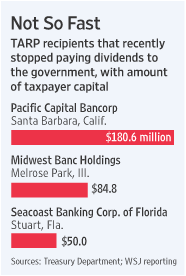 With around 40 bank failures already in 2009, these TARP dividend suspensions may be more the trend rather than the exception. Maybe next time the Treasury will ask for a deposit or driver’s license to guarantee dividend payments before they fork over more TARP money?
Wade W. Slome, CFA, CFP®
Plan. Invest. Prosper.
DISCLOSURE: Sidoxia Capital Management (SCM) and some of its clients own certain exchange traded funds, but at the time of publishing SCM had no direct position in JPMorgan Chase (JPM), Goldman Sachs (GS), Morgan Stanley (MS), American Express (AXP), or any other security referenced in this article. No information accessed through the Investing Caffeine (IC) website constitutes investment, financial, legal, tax or other advice nor is to be relied on in making an investment or other decision. Please read disclosure language on IC “Contact” page.
Banking Pigs Back at the Trough

Sooey! With some of the TARP (Troubled Asset Relief Program) government loans paid back, it appears that the malnourished pigs of the banking sector are hungry again and back at the trough for loftier pay packages. A recent Wall Street Journal article pointed out Goldman Sachs is on track to pay its employees $20 billion in 2009, almost double the compensation of 2008, and forking out even a higher average ($700,000 per employee) than 2007.
Beyond gluttonous appetites, these banking execs are attempting to make pigs fly as well. Like a magician using the art of illusion to move an object from one shell to the next, or divert attention with smoke and mirrors, these large Wall Street banks are shuffling around their compensation plans. A recent Bloomberg article noted that Citigroup Inc. is moving to raise base salaries by as much as 50% to help counterbalance reductions in annual bonuses. Citigroup is particularly in hot water because the U.S. bank received $45 billion in government fund assistance. According to the Wall Street Journal, similar trends are bubbling up at Zurich-based UBS, where executives raised banker base pay by 50%. Bank of America also said in March 2009 it may boost salaries as a percentage of total compensation. The banks are hoping that reducing bonuses tied to risky behavior, while raising salaries, will appease the regulators.
The governments “pay czar,” Kenneth Feinberg, may have something to say about these inflating compensation trends. The WSJ points out:
Feinberg will have the authority to regulate compensation for 175 executives at seven companies, including Citigroup, that received “exceptional” government help.

As a rule of thumb, securities firms generally pay out approximately 50% of revenue in employee compensation. Bonuses have traditionally made up about two-thirds of bankers’ total compensation. Compensation consultant Alan Johnson in New York says salaries typically range from $80,000 to $300,000, with bonuses often adding millions of dollars. The article goes onto highlight the five biggest Wall Street firms awarded their employees a record $39 billion of bonuses in 2007. Sparking some of this heated debate stems from the eye-popping bonuses paid out to Merrill employees before the Bank of America merger. Merrill Lynch emptied $14.8 billion out of its wallet for pay and benefits last year before it was acquired by Bank of America – the New York Attorney General Andrew Cuomo is investigating $3.6 billion of the bonuses (tied mostly to payments made in December 2008).
To protect themselves, firms like Morgan Stanley and UBS have also added “clawback” provisions that allow portions of a worker’s bonus to be recouped under certain scenarios if the firms are harmed by an employee in the future. Perhaps this will create a disincentive for harmful behavior, but likely not enough to pacify the regulators
The pigs have regained their appetites and are eagerly awaiting for some more fixings at the trough. Time will tell if 2009 can produce squeals of swinish satisfaction or will regulators take the bankers to an unfortunate visit to the butchers?
Slome Takes Pre-4th of July Pitstop

Slome on the Airwaves with Dare to Dream
President and Founder of Sidoxia Capital Management, Wade Slome CFA, CFP®, recently sat down for an interview with Dare to Dream radio host Deborah Dachinger. Slome spoke about his book, How I Managed $20,000,000,000.00 by Age 32, along with life experiences that shaped his career and financial trends occurring in the marketplace.