Avoiding Automobile and Portfolio Crashes

Personal opinions of oneself don’t always mirror reality. Self perceptions relating to both driving and investing can be inflated. For example, the National Highway Traffic Safety Administration (NHTSA) reports that 95% of crashes are caused by human error, but 75% of drivers say they are better drivers than most.
Contributing factors to crashes include: 1) Distractions; 2) Alcohol; 3) Unsafe behavior (i.e., speeding); 4) Time of day (fatality rate is 3x higher at night); 5) Lack of safety belt; 6) Weather; and 7) Time of week (weekends are worst crash days).
A spokesman for the Insurance Institute for Highway Safety is quick to point out that driving behind the wheel is the riskiest activity most people engage in on a daily basis – more than 40,000 driving related fatalities occur each year. Careful common sense helps while driving, but driving sober at 4 a.m. (very few drivers on the road) on a weekday with your seatbelt on won’t hurt either.
Avoiding a Portfolio Crash
Another dangerous activity frequently undertaken by Americans is investing, despite people’s inflated beliefs of their money management capabilities. Investing, however, does not have to be harmful if proper precautions are taken.
Here is some of the hazardous behaviors that should be avoided by those maneuvering an investment portfolio:
1) Trading Too Much: Excessive trading leads to undue commissions, transaction costs, bid-ask spread, impact costs. Many of these costs are opaque or invisible and won’t necessarily be evident right away. But like a leaky boat, direct and indirect trading costs have the potential of sinking your portfolio.
2) Worrying about the Economy Too Much: The country experiences about two recessions a decade, nonetheless our economy continues to grow. If macroeconomics still worry you, then look abroad for even healthier growth – considerable international exposure should aid the long-term success of your portfolio and assist you in sleeping better at night.
3) Emotionally Reacting – Not Objectively Planning: News is bad, so sell. News is good, so buy. This type of conduct is a recipe for portfolio disaster. Better to do as Warren Buffett says, “Be fearful when others are greedy, and be greedy when others are fearful.” The long-term fundamental prospects for any investment are much more important than the daily headlines that get the emotional juices flowing.
4) Hostage to Short-term Time Horizon: Rather than worry about the next 10 days, you should be focused on the next 10 years. The further out you can set your time horizon, the better off you will be. Patience is a virtue.
5) Incongruent Portfolio with Risk: Many retirees got caught flat-footed in the midst of the global financial crisis of 2008-09 with investment portfolios heavy in equities and real estate. Diversified portfolios including fixed-income, commodities, international exposure, cash, and alternative investments should be optimized to meet your specific objectives, constraints, risk tolerance, and time horizon.
6) Timing the Market: Attempting to time the market can be hazardous to your investment health (see Market Timing article). If you really want to make money, then avoid the masses – the grass is greener and the eating better away from the herd.
Driving and investing can both be dangerous activities that command responsible behavior. Do yourself a favor and protect yourself and your portfolio from crashing by taking the appropriate precautions and avoiding the common hazardous mistakes.
Read Full Forbes Article on Driving Dangers
Wade W. Slome, CFA, CFP®
Plan. Invest. Prosper.
*DISCLOSURE: Sidoxia Capital Management (SCM) and some of its clients own certain exchange traded funds, but at the time of publishing SCM had no direct positions in any security referenced in this article. No information accessed through the Investing Caffeine (IC) website constitutes investment, financial, legal, tax or other advice nor is to be relied on in making an investment or other decision. Please read disclosure language on IC “Contact” page.
EBITDA: Sniffing Out the Truth

Financial analysts are constantly seeking the Holy Grail when it comes to financial metrics, and to some financial number crunchers EBITDA (Earnings Before Interest Taxes Depreciation and Amortization – pronounced “eebit-dah”) fits the bill. On the flip side, Warren Buffett’s right hand man Charlie Munger advises investors to replace EBITDA with the words “bullsh*t earnings” every time you encounter this earnings metric. We’ll explore the good, bad, and ugly attributes of this somewhat controversial financial metric.
The Genesis of EBITDA
The origin of the EBITDA measure can be traced back many years, and rose in popularity during the technology boom of the 1990s. “New Economy” companies were producing very little income, so investment bankers became creative in how they defined profits. Under the guise of comparability, a company with debt (Company X) that was paying interest expense could not be compared on an operational profit basis with a closely related company that operated with NO debt (Company Z). In other words, two identical companies could be selling the same number of widgets at the same prices and have the same cost structure and operating income, but the company with debt on their balance sheet would have a different (lower) net income. The investment banker and company X’s answer to this apparent conundrum was to simply compare the operating earnings or EBIT (Earnings Before Interest and Taxes) of each company (X and Z), rather than the disparate net incomes.
The Advantages of EBITDA
Although there is no silver bullet metric in financial statement analysis, nevertheless there are numerous benefits to using EBITDA. Here are a few:
- Operational Comparability: As implied above, EBITDA allows comparability across a wide swath of companies. Accounting standards provide leniency in the application of financial statements, therefore using EBITDA allows apples-to-apples comparisons and relieves accounting discrepancies on items such as depreciation, tax rates, and financing choice.
- Cash Flow Proxy: Since the income statement traditionally is the financial statement of choice, EBITDA can be easily derived from this statement and provides a simple proxy for cash generation in the absence of other data.
- Debt Coverage Ratios: In many lender contracts certain debt provisions require specific levels of income cushion above the required interest expense payments. Evaluating EBITDA coverage ratios across companies assists analysts in determining which businesses are more likely to default on their debt obligations.
The Disadvantages of EBITDA
While EBITDA offers some benefits in comparing a broader set of companies across industries, the metric also carries some drawbacks.
- Overstates Income: To Charlie Munger’s point about the B.S. factor, EBITDA distorts reality. From an equity holder’s standpoint, in most instances, investors are most concerned about the level of income and cash flow available AFTER all expenses, including interest expense, depreciation expense, and income tax expense.
- Neglects Working Capital Requirements: EBITDA may actually be a decent proxy for cash flows for many companies, however this profit measure does not account for the working capital needs of a business. For example, companies reporting high EBITDA figures may actually have dramatically lower cash flows once working capital requirements (i.e., inventories, receivables, payables) are tabulated.
- Poor for Valuation: Investment bankers push for more generous EBITDA valuation multiples because it serves the bankers’ and clients’ best interests. However, the fact of the matter is that companies with debt or aggressive depreciation schedules do deserve lower valuations compared to debt-free counterparts (assuming all else equal).
Wading through the treacherous waters of accounting metrics can be a dangerous game. Despite some of EBITDA’s comparability benefits, and as much as bankers and analysts would like to use this very forgiving income metric, beware of EBITDA’s shortcomings. Although most analysts are looking for the one-size-fits-all number, the reality of the situation is a variety of methods need to be used to gain a more accurate financial picture of a company. If EBITDA is the only calculation driving your analysis, I urge you to follow Charlie Munger’s advice and plug your nose.
Wade W. Slome, CFA, CFP®
Plan. Invest. Prosper.
*DISCLOSURE: Sidoxia Capital Management (SCM) and some of its clients own certain exchange traded funds, but at the time of publishing had no direct positions in any security referenced in this article. No information accessed through the Investing Caffeine (IC) website constitutes investment, financial, legal, tax or other advice nor is to be relied on in making an investment or other decision. Please read disclosure language on IC “Contact” page.
Measuring the Market with Valuation Dipstick

Investor opinions about the stock market’s value are all over the map.
Doomsayers think the market is valued at crazy levels, and believe that “buy-and-hold” investing is dead. Bears remind investors that stocks have led to nothing good except for a lost decade of performance (read article on Lost Decade). Many speculators on the other hand believe they have the ability to “time the markets” to take advantage of volatility in any market (see also Market Timing article). In trader land, overconfidence is never in short-supply. Certainly, if you are a trader at Goldman Sachs (GS) or UBS and you are trading with privileged client data, then taking advantage of volatility can be an extremely lucrative endeavor. However most day-traders, and average investors, are not honored with the same information. Rather, the public gets overwhelmed by online brokerage firms and their plethora of software bells and whistles – inadequate protection when investing among a den of wolves. Equipping speculators with day trading tools is a little like giving a 7-year old a squirt gun and shipping them off to Afghanistan to fight the Taliban – the odds are not in the kid’s favor.
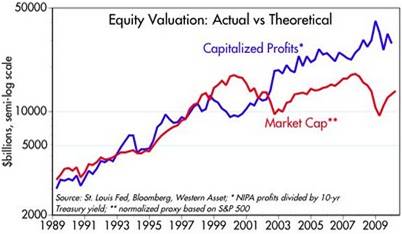
With so much uncertainty out in the marketplace, how do we know if the overall market is cheap or expensive? According to Scott Grannis, former Chief Economist at Western Asset Management and author of the Calafia Beach Pundit blog, the dipstick components necessary to measure the value of the market are corporate profits relative to the level of Gross Domestic Product (GDP) and the value (market cap) of the S&P 500 index. Grannis is a believer in the tenet that stock prices follow earnings, and as you can see from his charts below, earnings have grown much faster than stock prices over the last 10 years:
20 Year Chart
50 Year Chart
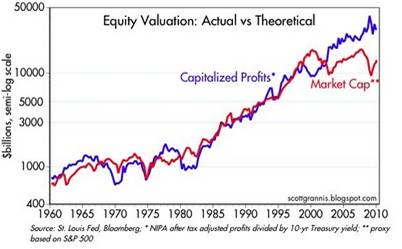
As you can see there is an extremely tight correlation on the 50-year chart until the last decade. What does the recent diverging trend mean? Here’s what Grannis has to say:
“Note that profits doubled from 1998 to 2009, yet the S&P 500 index today is still lower than it was at the end of 1998…equities continue to be extremely undervalued. Another way of looking at this is that the market is discounting current profits using an 8% 10-yr Treasury yield, or a 50% drop in corporate profits from here. Simply put, according to this model the market is priced to some very awful assumptions.”
How will this valuation gap be alleviated? Grannis correctly identifies two scenarios to achieve this end: 1) Rising treasury yields; and 2) Rising equity prices. His base case would be a move on the 10-year yield to 5.5%, and a move upwards in the S&P 500 index +50%.
Judging by Grannis’s dipstick measurement, there’s plenty of oil in the system to prevent the market engine from overheating just quite yet.
Read the Complete Scott Grannis Article
Wade W. Slome, CFA, CFP®
Plan. Invest. Prosper.
*DISCLOSURE: Sidoxia Capital Management (SCM) and some of its clients own certain exchange traded funds, but at the time of publishing SCM had no direct positions in GS, UBS, or any security referenced in this article. No information accessed through the Investing Caffeine (IC) website constitutes investment, financial, legal, tax or other advice nor is to be relied on in making an investment or other decision. Please read disclosure language on IC “Contact” page.
Sidoxia Introduces “Fusion”

With the quote machines taking a temporary breather, what better time than now to talk about a new product creation from Sidoxia Capital Management – Fusion. For those readers following Investing Caffeine for some time, you likely have an informed understanding of Sidoxia Capital Management’s investment philosophy (www.Sidoxia.com). Well, now Sidoxia has formalized its investment product through the introduction of Fusion, a hybrid product integrating low-cost, tax-efficient investment vehicles and strategies, including individual stocks, individual bonds, equity ETFs (Exchange Traded Funds), and fixed income ETFs. Rather than being boxed into a simplistic life cycle fund, Fusion offers a customized investment vehicle that can meet investors’ wide ranging objectives and constraints. A key differentiating component of Fusion is its inclusion of some of the same stocks and securities employed in the Slome Sidoxia Fund (a hedge fund also managed by Sidoxia Capital Management for accredited investors). The aim of Fusion is to maximize the risk-adjusted returns in the context of a broadly diversified balanced portfolio (including international exposure).
Client Product Process
For those qualified investors, a one-on-one interview is conducted with each separate account investor to determine the objectives and constraints associated with the account. Subsequently, a customized Investment Policy Statement (IPS) is created for each client, effectively creating a blueprint for how the account will be managed. Depending on the risk-tolerance, time horizon, and objectives of the client, an equity allocation will be customized to meet the client’s needs. The balance of the portfolio will be invested in fixed-income, cash/liquid assets, and hybrid securities – including convertible bonds and alternative investments on a more limited basis. Individual security selection is derived from implementing fundamental and quantitative screening tools, leveraging the investment experience of the investment manager (Wade Slome), and the ranking of securities on a risk-adjusted valuation basis. Lower ranked securities are generally used as funding sources for purchases of higher ranked investment candidates.
Buy Discipline
A systematic, disciplined process is performed before the inclusion of any security is finalized into a portfolio. With respect to the selected equity securities, particular emphasis is placed on valuation metrics, including cash flows, earnings growth, dividend yields, price-earnings ratios, and other important fundamental statistics. In regards to equity related exchange traded funds (ETFs), some of the previously mentioned factors will be considered in addition to a top-down view of a funds underlying long-term growth potential. The buy discipline, established for the fixed income allocation of the portfolio, carefully considers dynamics such as yield, duration, maturity, income, inflation-protection, currency risk, and other factors. Compared to other competing domestic-centric products, Fusion has the ability and willingness to invest globally to explore attractive risk-reward investment opportunities abroad.
Portfolio Construction
Within the parameters of the various Fusion product versions (aggressive, conservative, and moderate), each portfolio is constructed with flexibility in meeting the unique objectives and constraints of each account – including any liquidity or income requirements indicated by the client. Every portfolio is constructed from the same menu of underlying investment options, thereby assuring relative consistency across accounts. Allocations across investment selections will vary based upon the Fusion product version selected.
Trading Strategies
Under normal economic circumstances, Fusion invests with a long-term time horizon of three to five years for its equity positions. As a result, factors such as transaction costs, impact costs, opportunity costs, bid-ask spreads, tax consequences, are considered before conducting trades. Regarding fixed income portfolios, the previously mentioned factors along with the underlying yield, duration, and fundamental factors will determine the holding period. Trading frequency may fluctuate, depending on financial market and client-specific circumstances, but generally speaking heightened volatility will lead to additional opportunistic portfolio activity.
Sell Discipline
The Fusion sell discipline is fairly straight forward. If a security reaches a designated price target, provides an inferior risk-adjusted return profile relative to other opportunities, or if the original investment rationale negatively changes, then the investment becomes a sell candidate. If Fusion discovers opportunities with superior investment characteristics, the sell candidates, in addition to cash, will be utilized to fund new purchases.
Product Fee Structure
The annual fee charged for portfolio management services is rendered on a percentage of assets under management basis. As a fee-only investment advisor, inherent incentives are built-in to preserve and grow client account values – a principle not practiced by many commissioned based brokers/advisors. Contact a Sidoxia Capital Management representative by phone (949-258-4322) or e-mail (info@Sidoxia.com) to learn more about Fusion’s fee structure and account minimum threshold.
Wade W. Slome, CFA, CFP®
Plan. Invest. Prosper.
*DISCLOSURE: Sidoxia Capital Management (SCM) and some of its clients own certain exchange traded funds, but at the time of publishing SCM had no direct positions in any security referenced in this article. No information accessed through the Investing Caffeine (IC) website constitutes investment, financial, legal, tax or other advice nor is to be relied on in making an investment or other decision. Please read disclosure language on IC “Contact” page.
Shanking Your Way to Success: Tiger Woods & Roger McNamee

Spring has sprung and that means golf is back in full swing with the Masters golf tournament kicking off next week in Augusta, Georgia. Next week also marks the return of Tiger Woods in his first competition since news of Tiger’s sex scandal and car crash originally broke. As an avid golf fan (and occasional frustrated player), I must admit I do find a devilish sense of guilty pleasure every time I see a pro golfer shank a ball into the thick of the woods or plop one in the middle of the drink. I mean, how many hundreds of balls have I donated to golf courses across this great nation? Let’s face it, no matter how small, people derive some satisfaction from seeing others commit similar mistakes…misery loves company. Even the world’s elite, including Tiger Woods, slip up periodically.
For quite possibly the worst, nightmarish, meltdown classic of all-time, you may recall Frenchman John van de Velde’s 18th hole collapse at the 1999 British Open in Carnoustie, Scotland.
Investment Pros Shank Too
Investment legend Peter Lynch (see Investment Caffeine profile on Lynch), who trounced the market with a +29% annual return average from 1977-1990, correctly identified the extreme competitiveness of the stock-picking world when he stated, “If you’re terrific in this business you’re right six times out of ten.” Even with his indelible record, Lynch had many disastrous stocks, including American International Airways, which went from $11 per share down to $0.07 per share. Famous early 20th Century trader Jesse Livermore puts investment blundering into context by adding, “If a man didn’t make mistakes he’d own the world in a month.”
Mistakes, plain and simply, are a price of playing the investment game. Or as the father of growth investing Phil Fisher noted (see Investment Caffeine profile on Fisher), “Making mistakes is an inherent cost of investing just like bad loans are for the finest lending institutions.”
McNamee’s Marvelous Misfortune
Since the investment greats operate under the spotlight, many of their poor decisions cannot be swept under the rug. Take Roger McNamee, successful technology investor and co-founder of Elevation Partners (venture capital) and Silver Lake Partners (private equity). His personal purchase of 2.3 million shares ($37 million) in smartphone and handheld computer manufacturer Palm Inc. (PALM) has declined by more than a whopping -75% since his personal purchase just six months ago at $16.25 share price (see also The Reformed Broker). McNamee is doing his best to recoup some of his mojo with his hippy-esque band Moonalice – keep an eye out for tour dates and locations.
Lessons Learned
More important than making repeated mistakes is what you do with those mistakes. “Insanity is doing the same thing over and over again, and expecting different results,” observed Albert Einstein. Learning from your mistakes is the most important lesson in hopes of mitigating the same mistakes in the future. Phil Fisher adds, “I have always believed that the chief difference between a fool and a wise man is that the wise man learns from his mistakes, while the fool never does.” As part of my investment process, I always review my errors. By explicitly shaming myself and documenting my bad trades, I expect to further reduce the number of poor investment decisions I make in the future.
With the Masters just around the corner, I must admit I eagerly wait to see how Tiger Woods will perform under extreme pressure at one of the grandest golf events of the year. I will definitely be rooting for Tiger, although you may see a smirk on my face if he shanks one into the trees.
Wade W. Slome, CFA, CFP®
Plan. Invest. Prosper.
*DISCLOSURE: Sidoxia Capital Management (SCM) and some of its clients own certain exchange traded funds, but at the time of publishing had no direct positions in PALM or any security referenced in this article. No information accessed through the Investing Caffeine (IC) website constitutes investment, financial, legal, tax or other advice nor is to be relied on in making an investment or other decision. Please read disclosure language on IC “Contact” page.
Simmons Wants to Kiss Life Insurance Worries Away

The Makeup Master
Gene Simmons, lead singer of rock group Kiss, was born as Chaim Witz in Israel 60 years ago. After 40 years of rocking & rolling, the band is still alive and well and touring this spring in the U.K. I am no stranger to Gene Simmons – as a matter of fact, Kiss was the first concert I attended as a kid at the San Francisco Cow Palace in the 1970s. Despite his early professional career success, all the limelight and money was not enough for Gene Simmons, so he put his entrepreneurial skills to the test and aggressively added a broad Kiss merchandising line (over 3,000 licensed/merchandise items), including everything from Kiss baby clothing and Kiss wine to Kiss dart boards and Kiss caskets. Yep, soup to nuts, from the cradle to the grave, and you can even purchase the merchandise with your Kiss Visa credit card!
All Aboard the Premium Financing Train
Now, Mr. Simmons has expanded his business interests to a broader set of financial services. Specifically, Simmons has co-founded a company (Cool Springs Life) that sells premium finance life insurance targeted at high net worth individuals. Simmons and CEO Samuel Watson stopped off at Bloomberg to spread the premium finance gospel:
Premium financing arrangements set up for life insurance are primarily designed for wealthy individuals with large, multi-million dollar estates. This explains a little about whom are the prime targets for life insurance premium financing, but why would wealthy individuals potentially want this financing tool?
Premium Financing Benefits:
- Pay for Estate Taxes: The primary advantage of life insurance for the wealthy is to provide liquidity to beneficiaries (in the form of a death benefit) at the death of the “insured” to fund future estate taxes. Estate tax legislation is still up in the air, but in my view will likely increase to a hefty 45% to 55% rate over the next year. The tax-free liquidity (see a knowledgeable CPA to confirm tax status) provided to the surviving beneficiary by the insurance policy can be especially important if the deceased person’s assets are tied up in illiquid assets like real estate. The government is impatient in regards to tax collections, so gaining immediate access to the death benefit proceeds is a more attractive alternative than forced sales of illiquid assets (potentially at fire-sale prices).
- Other People’s Money: Some people prefer to purchase things with other people’s money. The cost of the financing can be another benefit to the strategy. The interest rate owed on a premium financing deal may be lower than the return a client can earn on alternative investments. If the investment strategy proves successful, the borrower will earn a positive spread on the loan (borrow low, invest high).
- Lower Estate Value: By gifting life insurance assets to a trust (e.g., an Irrevocable Life Insurance Trust – ILIT), there are ways for a wealthy donor to lower his estate value by employing gifting strategies and other estate planning structures. These estate planning tactics often preserve asset values for designated beneficiaries, rather than forking over unnecessarily high taxes to the IRS (Internal Revenue Service). In some cases a knowledgeable attorney can structure premium payments in such a fashion that exemption allowances alleviate any potential gift tax consequence.
Normally nothing in life comes risk-free and the same principle applies to life insurance premium financing.
Premium Financing Risks:
- Interest Rate Risk: Many of these contracts are constructed based on a floating interest rate structure like LIBOR (London Interbank Offered Rate) , therefore if interest rates rise, the borrowers could expose themselves to higher interest payments.
- Credit Risk of Lender: Heaven forbid we go through another financial crisis of the same scale as 2008-2009, but insurance players such as AIG were large players in the premium financing market during this period and caused significant disruption to all relevant participants in the premium financing food chain. Failure of a lender could compromise the integrity of the life insurance and estate planning strategy.
- Risk of Deteriorating Borrower Assets: Depending on the circumstances and facts surrounding the premium financing structure, the lender may require different forms of borrower collateral (i.e., stocks, bonds, real estate, letter of credit, etc.) on top of the cash value/surrender value of the life insurance policy. If the borrower’s collateral value decreases below a certain threshold, the borrower may be forced to supply additional collateral.
For those people who want to rock and roll all night and party every day, perhaps life insurance premium financing is not for you. However, if you got a lot of dough and want to preserve the value of your estate, maybe you should give Gene Simmons a call. With a signed contract, he might even include a Kiss casket for your future funeral plans.
Wade W. Slome, CFA, CFP®
Plan. Invest. Prosper.
DISCLOSURE: Sidoxia Capital Management (SCM) and some of its clients own certain exchange traded funds and a derivative security of an AIG insurance subsidiary, but at time of publishing had no direct positions in AIG. No information accessed through the Investing Caffeine (IC) website constitutes investment, financial, legal, tax or other advice nor is to be relied on in making an investment or other decision. Please read disclosure language on IC “Contact” page.
Markowitz’s Five Dimensions of Risk

Eighty-two year old Harry Markowitz, 1990 Nobel Prize winner, is best known for his creation of Modern Portfolio Theory (MPT) in the 1950s. MPT elegantly combines mathematical variables such that investors can theoretically maximize returns while minimizing risk with the aid of diversification. Markowitz’s Efficient Frontier research eventually led to the future breakthrough of the Capital Asset Pricing Model (CAPM).
The Different Faces of Risk
Before we dive further into Markowitz’s dimensions of risk, let’s explore the definitions of the word “risk.” Just like the word “love” is interpreted differently by different people, so too does risk. To some, risk is defined as the probability of loss. To mathematicians, risk often means the historical volatility in returns as measured by standard deviation or Beta. For many individual investors, risk is frequently mischaracterized by emotions – risk is believed to be high after market collapse and low after extended market rallies (see also Wobbling Risk Tolerances article).
The Five Dimensions of Risk
With the procedural definitions of risk behind us, we can take a deeper look at risk from the eyes of Markowitz. Beyond the complex mathematical equations, Markowitz also understands risk from the practical investor’s standpoint. In a recent Financial Advisor magazine article Markowitz reviews the five dimensions of risk exposure:
1) Time Horizon
2) Liquidity Needs
3) Net Income
4) Net Worth
5) Investing Knowledge/Attitudes on Risk
Rather than pay attention to these practical dimensions of individual risk tolerance, countless investors adjust their risk exposure (equity allocation) by speculating on the direction of the stock market, which usually means buying high and selling low at inopportune times. Although it can be entertaining to guess the direction of the market, we all know market timing is a loser’s game in the long-run (see also Market Timing Treadmill article). Markowitz’s first four risk exposures are fairly straightforward, measurable factors, however the fifth exposure (“knowledge and attitude”) is much more difficult to measure. Determining risk attitude can be an arduous process if risk tolerance constantly wavers through the winds of market volatility.
The Double Whammy
Rather than becoming a nervous Nelly, constantly chomping on your finger nails, your investment focus should be on action, and the things you can control. The number one goal is simple….SAVE. How does one save? All one needs to do is spend less than they take in. Like dieting, saving is easy to understand, but difficult to execute. You can either make more money, spend less, or better yet… do both.
The Baby Boomers are not completely out of the woods, but the next generations (X, Y, Z, etc.) is even worse off because they face the “Double Whammy.” Not only are life expectancies continually increasing but the Social Security safety net is becoming bankrupt. Consider the average life expectancy was roughly 30 years old in 1900 and in developed countries today we stand at about 78 years. Some actuarial tables are peaking out at 120 years now (see also Brutal Reality to Aging Demographics). So when considering Markowitz’s risk exposure #1 (time horizon), it behooves you to calibrate your risk tolerance to match a realistic life expectancy (with some built-in cushion if modern medicine does a better job).
Taming the Wild Beast
Every investor’s risk profile is multi-dimensional and constantly evolving due to changes in Markowitz’s five risk exposures (time horizon, liquidity needs, net income, net worth, and knowledge/attitude). Risk can be a wild animal difficult to tame, but if you can create a disciplined, systematic investment plan, you too can reach your financial goals without getting bitten by the numerous retirement hazards.
Read the complete Financial Advisor article on Harry Markowitz
Wade W. Slome, CFA, CFP®
Plan. Invest. Prosper.
*DISCLOSURE: Sidoxia Capital Management (SCM) and some of its clients own certain exchange traded funds, but at the time of publishing had no direct positions in any security mentioned in this article. No information accessed through the Investing Caffeine (IC) website constitutes investment, financial, legal, tax or other advice nor is to be relied on in making an investment or other decision. Please read disclosure language on IC “Contact” page.
Mozilo and Healthcare Tan Tax to the Rescue?

Ideological trains came crashing together as the battle for comprehensive healthcare reform resulted in the whole enchilada approach of the Democrats winning over the baby-step approach advocated by the Republicans. Thank goodness there is a savior to remedy the hefty $940 billion costs of the national healthcare plan…Angelo Mozilo. Not only will this mortgage tycoon (former CEO of Countrywide – the largest U.S. mortgage lender at one time) have his fat-cat wallet to fund multiple new healthcare taxes on the wealthy, but the government will also be collecting a new 10% tanning tax on all Mr. Mozilo’s bronzing sessions. Perhaps the CBO (Congressional Budget Office) healthcare reform cost saving estimates ($138 billion in the first decade) may come in even better than anticipated?
20,000,000 Tanning Sessions to Health
The public shouldn’t shed a tear for the real estate pain Mr. Mozilo endured – he still managed to stash a nice pile of dough before the mortgage walls came tumbling down on him. Given Mr. Mozilo’s timely sale of about $300 million in Countrywide stock before the share price cratered, coupled with the $23.8 million retirement fund and roughly $21 million in deferred compensation (Minyanville.com), Mr. Mozilo should have enough money to cover about 20,000,000 tanning sessions by my calculation. That sounds like a rather large number, but I expect Mr. Mozilo will shrewdly negotiate a bulk discount for the sessions, even if the government disapproves of the asssociated lost tax revenues.
However, one major potential hurdle for Mozilo may be finding the adequate time for tanning. If the SEC (Securities and Exchange Commission) is successful in prosecuting him on the alleged securities fraud and insider trading charges, then he may need to petition for a tanning bed in the prison gym.
Unintended Beach-going Consequences
Although we all condemn the harmful side effects of skin cancer from sunbathing, let’s not completely dismiss some of the advantages, including the benefits of Vitamin D production. Other cited ailments benefitting from sunlight exposure include, eczema, arthritis, psoriasis, acne, season affective disorder, and depression. One of the worse afflictions suffered by beach-goers (male and female alike) is the tragic “pastiness” condition. One of the severe unintended consequences of President Obama’s tanning tax may indeed be the extreme ridicule unleashed on light skinned beach bums that are unable to afford the tanning tax (see photo below).

Toss the Drumstick
On a more serious note, I get the fact that the government wants to raise a substantial amount of money to cover an extensive healthcare bill like this one – either through taxes and/or cost cuts. However, I think there are other areas in the healthcare food chain that need to climb higher in the national debate. Although, I’m OK with the tanning tax, I strongly believe there is more fertile ground in attacking obesity (see article on the Economics and Consequences of Obesity) and other costlier areas of treatment. The amount of money spent on managing obesity, and associated ailments, trounces the expenditures directed towards cancer by more than $50 billion by some estimates. Dated data shows we are spending more than $100 billion dollars on obesity-related healthcare costs. One study estimates obesity costs in the United States will reach $344 billion by 2018.
Bolstering the severity of the condition, the CDC (Center of Disease Control) noted the following:
“More than one third of U.S. adults—more than 72 million people—and 16% of U.S. children are obese. Since 1980, obesity rates for adults have doubled and rates for children have tripled. Obesity rates among all groups in society—irrespective of age, sex, race, ethnicity, socioeconomic status, education level, or geographic region—have increased markedly.”
I realize the importance of a copper tone tan can have on the lives of millions of Americans, and I also recognize the tanning tax is just a small blip in the growing 2,200 healthcare bill signed into law. Nonetheless, the spotlight of the healthcare debate needs to focus on the highest cost silos (i.e., obesity). Otherwise, I’m not completely sure whether all of Angelo’s taxed tanning sessions will be enough to cover our country’s immense healthcare costs?
Related Article: Bill Maher Chearleads No Profit Healthcare
Wade W. Slome, CFA, CFP®
Plan. Invest. Prosper.
*DISCLOSURE: Sidoxia Capital Management (SCM) and some of its clients own certain exchange traded funds, but at the time of publishing had no direct positions in BAC or any security mentioned in this article. No information accessed through the Investing Caffeine (IC) website constitutes investment, financial, legal, tax or other advice nor is to be relied on in making an investment or other decision. Please read disclosure language on IC “Contact” page.
Jumping on the Globalization Train

What happens when you mix a group of Saudi Arabians, Germans, Chinese, French, and South Koreans with billions of dollars? This is not the lead-in question to a politically incorrect joke, but rather a teaser related to a multi-billion infrastructure project currently under a bidding process in Saudi Arabia.
The proposed $7 billion, 450 kilometer high speed Saudi Arabian railway connecting Islam’s two holiest cities (Mecca and Medina) is expected to ease congestion of the 2.5 million Muslims making the annual journey to Mecca as part of the Hajj pilgrimage.
Amidst the fallout from the recent global financial crisis, the benefits of capitalism, globalization, and free trade have come under attack. There obviously were some horrible decisions made and the collapse of financial institutions around the world underscored the necessity to shore up our regulatory system. Nonetheless, this microcosm of a project is proof positive that globalization is alive and well (see also Friedman Flat World article). How else can you explain China Railway Construction Corp./Beijing Railway Administration (China), Siemens (Germany), Hyundai/Samsung (South Korea), Alstom (France), and Saudi Binladin Group (Saudi Arabia) coming together on a multi-billion project bidding process?
Oil Rich Countries Think Strategically
Saudi Arabia is not the only oil-rich country that has used the dramatic increase in oil revenues to fund investments in the future. Beyond Saudi Arabia, other oil rich areas like Qatar, Russia, and the UAE (United Arab Emirates) federation are examples of regions wanting to join the 21st Century global party rather than sitting around idly. The billions of black gold being pumped from the oil reservoirs is getting poured into infrastructure, such as technology, roads, bridges, hospitals, and yes…railways. These countries realize the importance of diversifying their economies away from the dependence on any one sector. Leadership from these regions understand the damaging economic impact of boom-bust energy price cycles, therefore they are doing their best by diversifying into other economic areas – including infrastructure. How serious is Saudi Arabia when it comes to investments? Well, the United States stimulus program was a drop in the bucket (single digit percentage of GDP) relative to Saudi Arabia, which according to BusinessWeek had the largest stimulus package among the Group of 20 (69% of GDP).
The Case for Free Trade
As protectionists and trade union organizers scratch and scream in response to expansion of globalization, competing countries around the world have their economic foot on the pedal when it comes to extending trade borders.
Tariffs, quotas and various other taxes only serve to drag down the competitiveness of our country’s most treasured industries.
These economic trade concepts are not new. Adam Smith, considered by some as the “father of economics” wrote about the “invisible hand” in his famous book Wealth of Nations (1776) and economist David Ricardo explained “comparative advantage” in his book On the Principles of Political Economy and Taxation (1817). Without getting into the nitty-gritty, suffice it to say the advantages to free trade have been well documented over the centuries.
As the standards of living climbs for hundreds of millions of people in developing countries, these populations are becoming fertile ground for the sale of U.S. technology, pharmaceuticals, appliances, automobiles, and other goods and services.
Rather than pouring sand into the gears of innovation, incentives need to be established to motivate product excellence. Otherwise, capital and jobs will migrate to other countries. Intel CEO (INTC) Paul Otellini, who was recently quoted in a New York Times article, is urging Congress to improve business, tax, and education incentives. Thanks to China’s tax policy and availability of a skilled labor pool, Intel is able to save $1 billion on a $4.5 billion plant being constructed this year – not exactly chump change.
Certainly, rules need to be created that promote fairness and credible enforcement of penalties, otherwise the benefits of trade become diluted.
Overall, the recent financial crisis caused economists, politicians, and various pundits to question the validity and benefits of capitalism, globalization, and free trade. In the vast spanning web of global commerce, the recent high speed Saudi railway may only represent a very tiny thread in the whole world’s infrastructure spend. Nonetheless, this multi-billion project integrating international heavyweights from all over world proves that despite the shortcomings of globalization, capitalism, and free trade, the benefits remain substantial and there is still time to jump back on the train.
Read The Financial Times article on the Saudi Arabia railway project.
Wade W. Slome, CFA, CFP®
Plan. Invest. Prosper.
*DISCLOSURE: Sidoxia Capital Management (SCM) and some of its clients own certain exchange traded funds, but at the time of publishing had no direct positions in Intel (INTC), China Railway Construction Corp., Beijing Railway Administration, Siemens, Hyundai/Samsung, Alstom, and Saudi Binladin Group or any security mentioned in this article. No information accessed through the Investing Caffeine (IC) website constitutes investment, financial, legal, tax or other advice nor is to be relied on in making an investment or other decision. Please read disclosure language on IC “Contact” page.
Bankruptcy: Where are You on the Capital Structure Totem Pole?
 The media likes to focus in on the microscopic universe of 30 stocks we like to call the Dow Jones Industrial Average, or the “market.” The reality is the Dow is like a drop in the ocean if you consider the global opportunity set across the capital structure. What is the capital structure? Well, you can think of the capital structure like a totem pole. The actual universe of investment opportunities spans everything from Blue Chip dividend paying stocks to illiquid international convertible preferred securities. The selection of the security type will determine where you sit on the capital structure (totem pole), and the location is especially important when the topic shifts to the dreaded word…B-A-N-K-R-U-P-T-C-Y.
Opening the Chapter Book on Bankruptcy
From a security or safety standpoint, the preferred investor location is at the top of the totem pole (capital structure). Why? Because once an entity declares Chapter 7 and begins asset liquidation, the bondholders/creditors at the top of the structure get paid first – whereas the equity holders at the bottom of the pole get paid last (if there are any asset proceeds remaining to be distributed). Here is a general ranking, from top to bottom, of the major security categories along the capital structure (more specialized hybrid security versions can fit in between the listed items):
1) Secured Bonds
2) Unsecured Bonds
3) Convertible Bonds
4) Preferred Stocks
5) Common Stock/Equity
Bankruptcy is a legal process that provides relief to many individuals who can no longer pay all of their debts. A potential outcome in the bankruptcy process is “debtor discharge,” which wipes away some or all of an individual’s debt. Here is a brief synopsis of the bankruptcy flavors:
Chapter 11: Designed primarily for businesses, Chapter 11 bankruptcy law allows financially distressed businesses to remain in business as debt payments are reorganized under the supervision of the courts. Technically, individuals can also choose to file for Chapter 11 bankruptcy, however practically speaking, individuals generally choose other paths. High profile examples of Chapter 11 bankruptcies include Lehman Brothers, Enron Corp., WorldCom Inc., General Motors Co., and Chrysler Group.
Chapter 7 & 13: These segments of the bankruptcy code are principally constructed for individuals. A means test reviewing an individual’s financial situation will determine which plan is most feasible. Here are brief descriptions:
- Chapter 7 is often referred to as the liquidating bankruptcy. This bankruptcy strategy is often used by individuals to save assets like a home and/or car. Although non-exempt assets will be liquidated by the owner to pay off creditors, many of a debtors assets are categorized as exempt – meaning the owner will not be forced to sell assets and creditors are held at bay.
- Chapter 13 allows individuals to retain assets by following a court sanctioned payment plan. Typically debt payments are made by the individual over years, and as long as payments remain current, the owner can retain assets.
More to Gain, More to Lose at the Bottom
Being at the bottom of the capital structure totem pole (owning stocks) involves relatively more price volatility. If you combine the wild swings with the fact that about 50% of households own stock in some shape or form (Edward N. Wolff at New York University – 2009), then you create a recipe of intrigue. Theoretically, stocks have unlimited profit potential (not the case for most bonds). The media loves to report on the daily fortunes won and lost on the global stock exchanges, in addition to following the bigwig billionaires.
More Boredom, Less to Lose at the Top
Being at the top of the capital structure totem pole (owning bonds) comes with more security (less volatility), but also more boredom (less profit potential). That’s not to say healthy returns cannot be achieved in the bond market. We saw firsthand, during the financial crisis, how bankruptcy fears rocked certain areas of the bond market (e.g., high yield bonds), creating extraordinary investment opportunities. With liquidity returning to the market, and signs of economic stability coming back, investors will need to climb much higher up the tree to grab the hanging fruit.
Although there is plenty of room for optimism given certain macroeconomic and corporate indicators, the global economy is certainly not out of the woods. Business bankruptcies remain elevated, just as investors are piling into the perceived safe arms of corporate bonds. Interest rates, along with industry and company-specific factors will obviously impact the price performance of corporate bonds. If the economy hits choppy waters again, it behooves investors in higher yielding bonds to get a better understanding of where they sit on the capital structure totem pole. If not, those bond investors will slide down the capital structure, left commiserating about losses with their neighboring risk-loving stockholders.
Wade W. Slome, CFA, CFP®
Plan. Invest. Prosper.
*DISCLOSURE: Sidoxia Capital Management (SCM) and some of its clients own certain exchange traded funds, but at the time of publishing had no direct positions in Lehman Brothers, Enron Corp., WorldCom Inc., General Motors Co., and Chrysler Group or any security mentioned in this article. No information accessed through the Investing Caffeine (IC) website constitutes investment, financial, legal, tax or other advice nor is to be relied on in making an investment or other decision. Please read disclosure language on IC “Contact” page.




 Investing Caffeine

