Posts filed under ‘Uncategorized’
Construction Complete on New & Improved Sidoxia.com Website

After five years in business, Sidoxia decided it was time to give its website a digital facelift. As part of the home page remodel, a number of new features and fresh content have been added to streamline the site.

Overall, we are proud of our newly constructed website because we strongly believe it accurately reflects our values (i.e., Philosophy & Investment Approach) and clarifies the differentiated servicesSidoxia brings to the marketplace.
Here are a few additional highlights:
 Videos Page: Through a collection of four videos, President & Founder Wade Slome provides an overview of the firm, and also speaks to Sidoxia’s investing process and philosophy.
 Books Page: Besides investing money and providing financial planning services for clients, Mr. Slome shares financial experiences and views through two different books available for purchase on Amazon.com.
 Blog (Investing Caffeine): Keeping in-tune with the ebbs and flows of the financial markets is critical in order to provide our clients with leading-edge service. Since 2009, Investing Caffeine has provided thousands of monthly viewers with insightful and educational financial material.
Take a look around the site and let us know what you think!
Sidoxia.com
Plan. Invest. Prosper.
DISCLOSURE: Sidoxia Capital Management (SCM) and some of its clients hold positions in certain exchange traded funds (ETFs), but at the time of publishing SCM had no direct position in any other security referenced in this article. No information accessed through the Investing Caffeine (IC) website constitutes investment, financial, legal, tax or other advice nor is to be relied on in making an investment or other decision. Please read disclosure language on IC Contact page.
The Challenge of Defining Growth vs. Value

“A challenge only becomes an obstacle when you bow to it.”
― Ray Davis (Famous General in the Marines)
In the investing world, one major challenge is defining the differences between “growth” vs. “value”. Warren Buffett said it best when he described growth and value as two separate sides of the same coin. In general, low or declining growth will be valued less than a comparable company with faster growth. Often, most companies go through a life cycle just like a human would (see Equity Life Cycle). In other words, companies frequently start small, grow larger, mature, and then die. Of course, some companies never grow, or because of lack of funding or outsized losses, end up suffering an early death. It’s tough to generalize with companies, because some businesses are more cat-like than human. For example, Apple Inc. (AAPL) may not have had nine lives, but the stock has been left for dead several times during its lifespan, before managing to resurrect itself from value status to growth darling (with a little assistance from Steve Jobs). Whether Tim Cook can lead Apple back to the Promised Land of growth remains to be seen, but many investors still see value.
Fluctuating price and earnings trends over a company’s life cycle frequently create confusion surrounding the proper categorization of a stock as growth or value. The other frustrating aspect to this debate is the absence of a universally accepted definition of growth and value. A few specialty companies have chosen to address this challenge. Russell Investments in Seattle, Washington is a leader in the benchmark/index creation field. Russell tackles the definitional issue by creating quantitatively based definitions, tediously explained in a thrilling 44-page paper titled, “Construction and Methodology.” Here is an exhilarating excerpt:
“Russell Investments uses a ‘non-linear probability’ method to assign stocks to the growth and value style valuation indexes. Russell uses three variables in the determination of growth and value. On the value side, book-to-price is used, while on the growth side, the I/B/E/S long-term growth variable was replaced by two variables- I/B/E/S forecast medium-term growth (2 yr) and sales per share historical growth (5 yr).”
As I bite my tongue in sarcasm, I like to point out that these methodologies constantly change – Russell most recently changed their methodology in 2011. What’s more, there are numerous other indexing companies that define growth and value quite differently (e.g., Standard & Poor’s, Lipper, MSCI, etc.).
Like religious beliefs that are viewed quite differently and are prone to passionate arguments, so too can be the debates over growth vs. value categorization. I’ve been brainwashed by numerous great investors (see Investor Hall Fame), and underpinning my philosophy is the belief that price follows earnings (see It’s the Earnings Stupid). As a result, I am constantly on the lookout for attractively priced stocks that have strong growth prospects. If Russell or S&P looked under the hood of my client portfolios, I’m certain they would find a healthy mix of growth and value stocks, as they define it. If they looked in Warren Buffett’s portfolio, arguably similar conclusions could be made. Most observers call Buffett a value investor, but over Buffett’s career, he has owned some of the greatest growth stocks of all-time (e.g., Coca Cola (KO), American Express Co (AXP), and Procter & Gamble (PG)).
At the end of the day, expectations embedded in the value of share prices determine future appreciation or depreciation, depending on how actual results register relative to those expectations. If stock prices are too high (as measured by the P/E, Price/Free-Cash-Flow, or other valuation metrics), slowing growth can lead to sharp and painful price declines. On the flip side, cheap or reasonably priced stocks can experience significant price appreciation if earnings and cash flows sustainably improve or accelerate.
In my view, the greatest stock pickers think about investing like sports handicapping (see What Happens in Vegas, Stays in Las Vegas). The key isn’t buying fast growth (high P/E) or slow growth (low P/E) companies, but rather discovering which stocks are mispriced. Finding heavily shorted stocks that are poised for growth, or discovering unloved stocks with underappreciated potential are both ways to make money.
While defining growth vs. value is certainly difficult, the more important challenge is calibrating a company’s future growth expectations and determining the fair price to pay for a stock based on those prospects. Investing entails many difficulties, but categorizing investors or stocks as growth or value is a less important challenge than honing forecasting and valuation skills. Investing is challenging enough without worrying about superfluous growth vs. value definitions.
Wade W. Slome, CFA, CFP®
Plan. Invest. Prosper.
DISCLOSURE: Sidoxia Capital Management (SCM) and some of its clients hold positions in certain exchange traded funds (ETFs), and AAPL, but at the time of publishing SCM had no direct position in KO, AXP, PG, MHP, or any other security referenced in this article. No information accessed through the Investing Caffeine (IC) website constitutes investment, financial, legal, tax or other advice nor is to be relied on in making an investment or other decision. Please read disclosure language on IC Contact page.
March Madness Brings Productivity Sadness

You feel that scratchy throat coming on? Taking a long lunch to discuss business? Has there been a death in the family? Don’t feel bad about calling in sick or being unproductive during March Madness, the multi-week annual NCAA college basketball tournament, because you are not alone. According to Challenger, Gray and Christmas, 3.0 million people plan to watch up to three hours of basketball games during work hours, costing companies and the economy at least $134 million in lost wages during the first two days of the tournament. What’s more, March Madness tends to attract other unproductive habits in the form of illegal gambling to the tune of $2.5 billion each year (source: FBI).
While I don’t have the time to spend hours filling out a 64-team bracket, I can’t do all the finger-pointing – I too participate in my fair share of unproductive lollygagging. I’ve been known to throw away hours of my time scrolling through my Twitter news feed (twitter.com/WadeSlome) or paging through my Flipboard timelines. Heck, if you really want to talk about unproductive, the President of the United States even filled out a bracket (click here) – so far, so good, but his Wisconsin pick didn’t help his cause.
If you need more proof of our country’s collective lack of productivity, then consider the following:
- Fantasy Fun: In 2008, there were 35 million people (mostly men) participating in fantasy football at a cost of $6.5 billion over a 17-week NFL season (source: Challenger, Gray and Christmas).
- The Juice: The 1995 O.J. Simpson verdict cost the country $480 million in lost output and the New York Stock Exchange trading volume plummeted by 41% during the half hour surrounding the reading of the verdict (source: Alan Dershowitz’s America on Trial).
- Shop until You Drop: “Cyber Monday” is one of the largest online shopping days of the year, which occurs shortly after Thanksgiving’s “Black Friday”. Workers wasted $488 million of their time in 2007, and that number has undoubtedly increased significantly since then (source: Challenger, Gray and Christmas).
- Summer Sport: In 2012, Captivate Network found out that workers watching the Summer Olympics at the office resulted in a productivity loss of $650 million.
- Hangover Hammer: Super Bowl Sunday is one of the largest alcohol consumption evenings of the year. The U.S. Center for Disease Control estimates that hangovers cost our nation about $160.5 billion annually.
- Social Media Profit Black Hole: Are you addicted to Facebook (FB), Twitter, LinkedIn (LNKD) or other social media network of choice? A report by LearnStuff shows that Americans spend as much time collectively on social media in one day as they do watching online movies in a year. The cost? A whopping 4.4% of GDP or $650 billion.
Investor Madness
One of the biggest black hole productivity drains for investors is the endless deluge of foreboding news items – each story potentially becoming the next domino to collapse the global economy. The most productive use of time is an offensive strategy focused on identifying the best investment opportunities that meet lasting financial objectives. Reading prospectuses, annual reports, and quarterly financial results may not be as sexy as scanning the latest Twitter-worthy headline, but detailed research and questioning goes a long way towards producing superior long-term returns.
On the other hand, news-driven fears that cause investment paralysis can cause irreparable damage. A counter greed-driven performance chasing strategy will lead to tears as well. It’s OK to read the newspaper in order to be informed about long term trends and economic shifts, but as Mark Twain says, “If you don’t read the newspaper, you are uninformed. If you do read the newspaper, you are misinformed.”
While March Madness may not be the most productive time of the year, when your sore throat clears or you get back from that late lunch, it behooves you to become more productive with your investment strategies. Picking the wrong investment players on your portfolio team may turn March Madness into investor sadness.
Wade W. Slome, CFA, CFP®
Plan. Invest. Prosper.
DISCLOSURE: Sidoxia Capital Management (SCM) and some of its clients hold positions in certain exchange traded funds (ETFs), but at the time of publishing SCM had no direct position in FB, LNKD, Twitter, or any other security referenced in this article. No information accessed through the Investing Caffeine (IC) website constitutes investment, financial, legal, tax or other advice nor is to be relied on in making an investment or other decision. Please read disclosure language on IC Contact page.
“Se-Frustration” Medicine Tough to Swallow

Article is an excerpt from previously released Sidoxia Capital Management’s complementary March 1, 2013 newsletter. Subscribe on right side of page.
Over the last few years, the Washington D.C. fear du jour has migrated from debt ceiling to elections and now from fiscal cliff to sequestration. A better term for the $85 billion triggering of automatic spending cuts (sequestration) may be “se-frustration” due to Congress’s annoying inability to agree on a responsible approach to reducing our country’s burdensome debt and deficits. The forced cuts getting crammed down our government’s throat taste like bitter medicine, especially when the economy is limping its way back to a slow recovery (revised 4th quarter GDP growth of a meager +0.1%). Although the $1.2 trillion in cuts over 10 years may gag growth to an intensified slowdown, the good news is that the cuts will assist with the long-term health of the economy – even though most reasonable people agree there are more appropriate medicinal regimens to be offered.
The Se-Frustration / Sequestration Breakdown
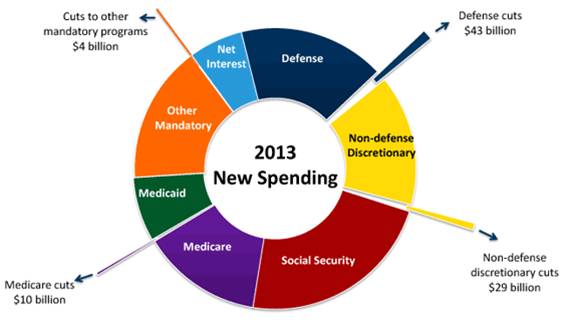
Source: Peter G. Peterson Foundation
As you can see from the pie chart above, the $85 billion in spending cuts (small slivers) associated with the sequester represent a relatively small fraction of our country’s total $3.6 trillion federal budget. More specifically, the expenditure reductions equate to a meager 2.4% of 2013’s total spending tab.How is the $85 billion in painful spending medicine being administered? If Congress continues with this flawed solution, more than half of the cuts (~$43 billion) will come from defense spending (see also Impoverished Global Babysitter). For the balance of the cutbacks, discretionary spending is bearing the largest brunt of the austerity moves (~$29 billion). The main discretionary programs hit include scientific and medical research, national parks, education, food inspections, federal employee pay, law enforcement, grants to state and local governments, and the Head Start pre-school program. Notable exceptions to the reductions include military personnel, and Social Security beneficiaries. To a lesser extent, Medicare dollars will decline by about $10 billion, and a final miscellaneous mandatory program category will drop by approximately $4 billion.
Before you fall to your knees in tears of despair, let’s put this se-frustration into better perspective. While $85 billion sounds like a lot of dough, the fact of the matter is our government is still running a $1 trillion deficit (i.e. spending > tax receipts). Even if we chose to have 10 sequestrations today, our country would still be running a deficit (see chart below):

Source: Calafia Beach Pundit (Scott Grannis)
While the $85 billion in se-frustration pills taste bitter now, this far from ideal medicine will improve our fiscal health nonetheless. The elephant in the room remains our graying Baby Boomer population and associated explosion of Medicare costs, but a little bad medicine is still better than none.
Checkbooks Open as Merger Mania Materialize

Corporations have been flush with trillions in cash over the last five years, but due to the uncertainty surrounding our economic recovery, CEOs (Chief Executive Officers) chose to keep their short arms out of their deep pockets. As we entered 2013 that mindset has begun to change. The inherent drive for companies to grow sales, earnings, and cash flows has finally surpassed the fears of contraction, uncertainty, and recession. How do we know the mindset has changed? One need look no further than the roughly $300 billion in deals announced in the first 60 days of 2013. Here is a partial sample of the higher profile transactions:
-Warren Buffett’s Berkshire Hathaway (BRKB) and private-equity partner 3G Capital agreed to buy ketchup maker H.J. Heinz Company (HNZ) for around $23 billion.
–Dell Inc. (DELL) has offered a private buyout out of the company for $24.4 billion, thanks to a private equity partner and a $2 billion stake from PC partner Microsoft Corp. (MSFT).
–Office Depot Inc. (ODP) offered to buy OfficeMax Inc. (OMX) for $1.3 billion in stock.
–Comcast Corp. (CMCSA) is buying the 49% share of NBCUniversal it doesn’t already own for $16.7 billion from General Electric Co. (GE).
–American Airlines parent AMR Corp. AMR and US Airways Group Inc. (LCC) approved their $11 billion merger.
–Anheuser-Busch InBev (BUD) is in multi-billion dollar discussions to buy Mexican beer brands from Constellation Brands (STZ).
–Oracle Corp. (ORCL) agreed to buy Acme Packet Inc. (APKT) for $2.1 billion.
–Hormel Foods Co. (HRL) closes $700 million Skippy peanut butter acquisition from Unilever PLC (UL).
–AT&T (T) has agreed to acquire 700 MHz B band spectrum from Verizon Communications (VZ) for $1.9 billion.
–Avis Budget Group (CAR) announced acquisition of Zipcar (ZIP) for $500 million.
–Shell-Royal Dutch (RDSA) agreed to buy LNG Assets from Repsol for $6.7 billion, including the assumption of debt.
As you can see, the multi-hundred billion M&A boom of 2013 (mergers and acquisitions) has been on a tear. The fear surrounding executive board rooms has subsided, so the hunger for growth should be strong enough to keep the checkbook out and available for future company purchases.
Cornucopia Corner

Here is a short list from an abundant set of stories over the last month
- Pope Retires: Pope Benedict XVI is resigning his Popemobile and red shoes to focus on reading and prayer. After eight years as an elected pope, the 85-year-old pontiff will be the first pope to resign since Pope Gregory XII, who stepped down in 1415.
- Italian Election Like Messy Meatballs: Inconclusive election results have created a hung parliament with no signals of an imminent resolution. What’s more, former Prime Minister Silvio Berlusconi is currently being investigated over bribery charges, and an Italian blogger/comedian has splintered election results further. One thing is clear, after two years of recession, voters are unhappy and want to reverse the government’s austerity actions.
- When Bernanke Talks, People Listen (Sort Of…): Federal Reserve Chairman Ben Bernanke updated Congress with his semi-annual testimony followed by answers provided to the House Financial Services Committee. I’m not sure what some Fed followers are smoking, but those worried about potential Fed policy changes have not been listening carefully to the Fed chief’s consistent message of accommodative actions. Bernanke explicitly stated monetary stimulus will remain in place until unemployment reaches 6.5% and inflation exceeds 2.5% (neither target has yet been achieved).
- Hedge Fund Managers Duke It Out Over Diet Shakes: Carl Icahn, Chairman of Icahn Enterprises, and junior Bill Ackman, CEO of Pershing Square Capital Management have recently fiercely debated the merits of Herbalife Ltd (HLF). Ackman is short some 20 million shares and Icahn recently reported a 13% stake in Herbalife shares. (see also Herbalife Strife)
- Russian Meteor: About 1,000 people were hurt when a meteor blasted over Russia (See Video).
- North Korea Flexing Nuke Muscles: North Korea conducted its 3rd nuclear test and warned of more to come.
Wade W. Slome, CFA, CFP®
Plan. Invest. Prosper.
DISCLOSURE: Sidoxia Capital Management (SCM) and some of its clients hold positions in certain exchange traded funds (ETFs) and CMCSA, but at the time of publishing SCM had no direct position in BRKB, HNZ, HRL, UL, T, VZ, CAR, ZIP, AMR, LCC, ORCL, APKT, DELL, MSFT, RDSA, Repsol, ODP, OMX, HLF, BUD, STZ, GE, or any other security referenced in this article. No information accessed through the Investing Caffeine (IC) website constitutes investment, financial, legal, tax or other advice nor is to be relied on in making an investment or other decision. Please read disclosure language on IC Contact page.
Top 10 (or so) Things I’m Thankful For

With the holidays now upon us, this period provides me the opportunity to briefly escape the daily investment rat race, and reflect on the numerous aspects of my life for which I am grateful. There is so much to be thankful for, but it’s easy to lose sight of what’s important, especially when time is flying by in the blink of an eye. As the old saying goes, “Life is like a roll of toilet paper. The closer you get to the end, the faster it goes.” The proliferation of gray hair, coupled with my sprouting kids, is a constant reminder that life is not slowing down for me, but actually speeding up.
As I lay here like a slug on the couch, which is slowly absorbing me, I take no shame in unbuttoning my top pant button to relieve the belly-busting pressure of excessive turkey and mash potato consumption. The cranberry sauce on my chin and pumpkin pie crust on my shirt does not distract me from the football game or prevent me from reflecting upon my life’s gifts.
In that vein, here is a list of my top 10 things for which I am grateful:
10. Sugar: Without sweets, being relegated to a life of bread, water, and broccoli would be a boring challenge. Thankfully, once I became a grown adult earning a paycheck, I also earned the right to eat Cap’n Crunch (with Crunch Berries) for breakfast; peanut butter-Nutella & banana sandwich for lunch; apple fritter & milk for dinner; and some Double Stuf Oreos for dessert (yes, only one ‘f’ in Stuf!).
9. College Sports: Watching professional sports is fun, but when A-Rod earns $275 million for the NY Yankees and rides the pine during the playoffs, the business aspects take a little allure away from the sport. Although college athletes may sneak a few bucks under the table, they are nonetheless a lot less corrupted, and the electric atmosphere of a live college event cannot be replicated. The opportunities are fewer due to adult responsibilities, but nothing beats a crisp fall afternoon on the couch with a bowl of hot chili, a frosty beverage, and a remote control, while flipping through a series of college football games.
8. Gadgets: Seems like yesterday when I was introduced to my first computer, a 1983 Compaq Portable computer that weighed 28 pounds; had a 9 inch green screen; integrated two 320k drives; and retailed originally for about $3,500….ouch! Today, my iPhone 5 is more than 99% lighter, stores 100,000 times more information, and costs a fraction of the price. If you add my iPad, Kindle, Roku video streaming box, my DVR set-top box, my GPS, and other electronic gadgets, it’s hard to imagine how I could have lived a life without these luxuries five years ago.
7. Cards: I analyze numbers, probabilities, and emotions in my day job every day, it’s no wonder that I somehow need to do the same thing in my leisure time. No-Limit Texas Hold ‘Em is the name of the game, and I was introduced to it by world champion “poker brat” Phil Helmuth when he personally taught a group of us at an investment conference in 2003. I haven’t entered the $10,000 World Series of Poker in Las Vegas yet, but it’s on my bucket list.
6. Challenges: I’m a washed up basketball hack after an insignificant high school career and about 12 years of old-man basketball leagues, but my competitive juices keep flowing today. In hopes of not turning to a fully gelatinous blob, I have periodically pushed myself to some competitive athletic challenges, including a hike to the peak of Mt. Whitney; a couple half marathons; a sprint triathlon; a Colorado bike trip; and a few seasons of indoor co-ed soccer. Next up, I’m training for a “century” bike ride – a 100 mile race in early 2013 near Santa Barbara. I guess I better work off some of that stuffing, mash potatoes, and gravy.
5. Good Books: I pretty much read for a living on average 8-12 hours per day, but I suppose I’m a glutton for punishment. Given all my other interests and responsibilities, it’s tough to find the free time to curl up to a good book, but if I can squeeze in a book every quarter, I give myself a pat on the back. Nothing beats true, real-life experiences, but I’ve learned a tremendous amount through all the books I’ve read (for leisure and schooling). Regrettably diversity has gotten the short end of the stick, since about half the books I read are investment related, including a few that I’ve reviewed here on my blog like The Big Short, Too Big to Fail, The Greatest Trade Ever, and Winning the Loser’s Game (to name a few). Currently, I’m reading a fascinating New York Times Bestseller on world religions, called Religious Literacy, which leads me to my next Top 10 item…
4. Spirituality: While I am probably a lot more apathetic and ignorant in the area of religion as compared to the average person, nevertheless I have learned to appreciate the importance and benefits of religion and spirituality through my life experiences. From Judaism to Islam, and Buddhism to Christianity, there is no denying the moral lessons and spiritual balance these religions provide billions of people around the globe. I have a long way to go on my spiritual journey, but I’m slowly learning and progressing. On days where the Dow plummets a few hundred points or when the share price of a top holding tanks, I’m quickly reminded of the importance of spiritual balance.
3. Travel: While many people have hardly ventured from their hometown during their lifetime, I have been blessed with the fortune of seeing many places around the world. Not only have I lived on the East Coast, West Coast, and in the Midwest, but I have also traveled to five different continents. Appreciating different cultures and viewpoints is what truly makes life more interesting for me.
2. Friends: The digital age has not only brought friends closer together through social networks like Facebook (FB) and LinkedIn (LNKD), but has also pushed us further apart because vicariously spying on someone online is much easier than calling someone or grabbing coffee with them. Thankfully, I have a core set of friends that I can share my life’s ups and downs.
1a. Investing: Enough said. I’ve been investing for close to 20 years, and this blog is evidence of the blood, sweat, and tears I’ve dedicated to this endeavor. Various investments will go in and out of favor, and economic cycles will go up and down, but one trend that I know will persist is that I will be investing for the rest of my life.
1b. Health: It goes without saying, but if I don’t have my own good health, then very little on my top 10 list is possible. I’ve outlived two close family members of mine, so needless to say, I am very thankful to be breathing and living.
1c. Family: Having all these great experiences, including al the highs and lows, means absolutely nothing, if you have nobody to share them with. My family means the world to me, and days like Thanksgiving remind me of how lucky I really am.
Although this list was originally scheduled for 10 items, it looks like it has unintentionally expanded to a few more. But how can you blame me? I’ve had some tough times like everyone, but it is virtually impossible to not be thankful for the life I get to live now. Not only do I get to do what I love, but I also get paid to do it.
Last but not least, a special thanks needs to also go out to you, my devoted blog reader. I know you’re devoted, because you have made it to the end of this lengthy article. Without you, I wouldn’t have the motivation to continually scribble down my random thoughts.
Happy Thanksgiving and happy holidays!
Wade W. Slome, CFA, CFP®
Plan. Invest. Prosper.
DISCLOSURE: Sidoxia Capital Management (SCM) and some of its clients hold long positions in certain exchange traded funds (ETFs), AMZN, and AAPL, and a short position in NFLX. At the time of publishing SCM had no direct positions in LNKD, FB, HPQ or any security referenced in this article. No information accessed through the Investing Caffeine (IC) website constitutes investment, financial, legal, tax or other advice nor is to be relied on in making an investment or other decision. Please read disclosure language on IC Contact page.
Sun Breaking through Stormy Financial Clouds?

The ominous economic storm clouds have been looming for quite some time now. And with the lingering European financial crisis, U.S. Presidential elections, and a pending “fiscal cliff” coming to a head in the next few months, investors have their umbrellas firmly in hand. While average investors have been running for shelter, the stock market has been shining. In addition to the +2% gain in August, stocks have advanced about +12% in 2012 and about +20% from a year ago, as measured by the S&P 500 index. The move in the Nasdaq Composite index has been even brighter, surging +18% higher this year and about +25% from a year ago (quite a bit different from Bill Gross’s “Cult of Equity” 4% return expectations).
Here is a look of 1-year returns provided by Mark Perry at Carpe Diem a week and a half ago:

A big driver for these positive returns are record corporate profits:

Despite the positive returns and record profits, investors remain terrified. How scared are people about potential economic thunder and lightning? According to Scott Grannis at Calafia Beach Pundit, savings deposits have increased by a staggering $2.4 trillion over the past four years, which is effectively losing 2-3% in annual value to inflation. I don’t know when negative sentiment will turn positive, but when it does, there is a lot of pent up demand for consumption and investment.

Death to Uncertainty
The markets hate uncertainty. This cliché is often referenced, but the truth is…there is always uncertainty. More aptly stated, the markets hate additional uncertainty. So whether you are a Republican or Democrat, the mere fact the elections will be over in November may be enough to lower uncertainty and lift some of the gloomy financial clouds. Republicans hope for fiscal sanity to return with a win by the Romney ticket, but the market may favor an Obama victory because it likes the devil it knows rather than the one it doesn’t. The race is very close now, and as always, the Independents will determine which party ultimately wins.
When discussion shifts to the impending “fiscal cliff” (automatic tax hikes and spending cuts), voter patience wears thinner – inaction is no longer a sustainable political strategy. If you don’t believe me, then just reference the record-low Congressional approval rating. Incumbents looking for re-election will have to set forth credible solutions to these serious fiscal problems, or suffer the consequences. Voters are serious now, and a “do-nothing” strategy will only lead to an early retirement, not a cushy paycheck in Washington D.C.
The corporate world is watching closely too. Tight-fisted executives sitting on trillions of dollars in cash are looking for some direction. No matter who wins, by knowing the direction of future policy changes, executive optimism is likely to spur incremental growth.
Be Prepared & Pack Your Sunglasses
Admittedly, recent economic data hasn’t been overly rosy, and there are no immediate signs of a bright and shiny economic day. Although not surprising, given the constant media attention, European economic activity has fallen into recession. In our backyard, U.S. GDP growth decelerated in second quarter to 1.5% from 2.0% from the previous quarter, and job growth has stalled. In Asia, economic figures out of China continue to generate lackluster trends. As strategist Ed Yardeni points out, “August manufacturing activity fell to a nine-month low with the new export orders index the lowest in three years.”
On the surface, the uninspiring economic data would suggest to investors to pack their bags and move into a bunker. However, what shrewd investors realize is that trading with economic trends is not an optimal strategy. Following such logic would have led investors to pile in buying at the peak of 2007 and panic sell at the bottom in early 2009. Much of the recent economic news is nothing to write home about, and the information has already been factored into current prices and expectations. The real trick is determining the state of affairs 12-18 months from now, which is not an easy task. So while current data is fragile at best, governments and central banks across the globe have been aggressively cutting rates, implementing fiscal stimulus, and positioning for further monetary policy support. What’s more, consumers and corporations have deleveraged (cut debt) significantly, and governments are currently going through this painful process.
Sell in May and Regret Away
As the weakening data started to roll out at the beginning of spring, so-called market pundits were quick to point out the seasonal trade to “Sell in May and go away.” Well, if you followed that strategy, you may have slept better, but you not only would have incurred significant transaction costs and taxes, but also given up some capital gains and dividends. September and October have traditionally been volatile months, so the financial market gods may still have something to say.
Weather forecasting and financial forecasting are difficult professions. Even though the economic weather has been cloudy recently, if you are relying too heavily on your umbrella and galoshes, the next few months should help determine whether it’s time to bust out your sunglasses and sunscreen rather than a heavy raincoat.
Wade W. Slome, CFA, CFP®
Plan. Invest. Prosper.
DISCLOSURE: Sidoxia Capital Management (SCM) and some of its clients hold positions in certain exchange traded funds (ETFs), but at the time of publishing SCM had no direct position in Barclays or any other security referenced in this article. No information accessed through the Investing Caffeine (IC) website constitutes investment, financial, legal, tax or other advice nor is to be relied on in making an investment or other decision. Please read disclosure language on IC Contact page.
The Art of the Conference Call

My heart is beating, my palms are sweaty, and I feel like I’m about to hurl. No, I don’t have the flu and I am not about to go sky diving, but rather my top holding is about to report its quarterly financial results. Fifteen minutes after the market close, the headline numbers are due. Company XYZ has just reported EPS results of $.96, a penny above Wall Street expectations. The outcome of the pending 60 minute conference call could have major ramifications, not only to my pocketbook, but also to millions of investors, including mine.
After printing out the fresh press release, hot-off-the-press, the challenge now becomes determining what to do with this mountain of newly available data at my fingertips?
Here are some important factors to consider as you scan through reams of press release data and prep for the next 60 minutes of joy:
Get the Basics: Most importantly, once your figure out what reported revenue and EPS results are relative to consensus, investors must determine whether the numbers are GAAP (Generally Accepted Accounting Principles) or Non-GAAP. Surprisingly to some, Non-GAAP results are preferred because these numbers are generally closer to “cash reality”.
What’s Guidance? The majority of companies reporting their quarterly results will provide investors an outlook of their financial expectations for the following quarter – and sometimes for the full year. This commentary is often more important to the immediate stock price compared to the just-reported actual results.
Bust Out the Red Bull: Now that we have the basics and the conference call is beginning, it’s time to break out the 6-pack of Red Bull. If company XYZ is like any of the other 98% of companies, investors will have the pleasure of listening to 30 minutes of monotonous press release reading. This is a smoke and mirrors approach for management to avoid the upcoming firing line of tough questions.
Numerical Basics: Now is the time to put your multi-tasking skills to the test. First, as management reads the press release in a monotone voice (usually verbatim or to a script), you can gather some of the important financial basics. Cash is king, so the first place I migrate to find the cash generating power of a company (or lack thereof) is the Cash Flow Statement. The crucial aspect is determining how much discretionary cash is available to the company after accounting for maintenance capital expenditures – this cash power can be used for dividends, share buybacks, and acquisitions. Next on the priority totem pole is the income statement, where we can check out the trends in sales growth, profit margins, and company specific metrics, such as same store sails in the retail industry or BOE in the energy industry (Barrels of Oil Equivalent). Strong profitability is great, but if the sales, margins, cash flows, and/or company metrics are moving in the wrong direction, then look out below – the stock may be on the verge of cratering. For reference, just take a peek at Zynga [ZNGA], Netflix [NFLX], Facebook [FB], and Research in Motion [RIMM] for proof.
Digesting Q&A: The questions and answers portion of the conference call is the meat and potatoes of the earnings release meal. This is the portion of the call in which management’s feet are held up to the fire with some critical questions. There are plenty of relevant and reasonable questions, but there is always at least one analyst who asks a 10-part question with endless follow-ups, going into the most obscure facets of the company, which will have no bearing on the stock price. On manzy occasions, the analysts ask the questions are more concerned about listening to the tones of their voice than they are interested in finding critical answers to strategic and operational corporate issues. Nonetheless, in most cases, this segment can be the most valuable part of the conference call.
Hodge Podge & Intangibles: After following the previous steps, the scattered puzzle will begin to take shape. But there are still are some pieces to put in place, in order to create a clearer picture. For example, market share is an important feature – triangulating share gains and losses via revenue trends and industry data can help determine who is winning and losing in the marketplace. The institution of price increases or cuts is another data point that can provide insights into the level of cut-throat competition. And let´s not forget aquisitions, these corporate marriages can either be a sign of dominant strength or a sign of weak desperation.
Putting the previously discussed elegant tools to use will help you become a better stock artist, but to truly master the art of the conference call one has to repeatedly practice these steps and add your personal list of analytical intangibles. Then, you will have a profitable piece of art.
Wade W. Slome, CFA, CFP®
Plan. Invest. Prosper.
DISCLOSURE: Sidoxia Capital Management (SCM) and some of its clients own certain exchange traded funds and NFLX, but at the time of publishing SCM had no direct position in any other security referenced in this article. No information accessed through the Investing Caffeine (IC) website constitutes investment, financial, legal, tax or other advice nor is to be relied on in making an investment or other decision. Please read disclosure language on IC “Contact” page.
Bin Laden Killing Overshadows Royal Rally

Excerpt from No-Cost May Sidoxia Monthly Newsletter (Subscribe on right-side of page)
Before the announcement of the killing of the most wanted terrorist in the world, Osama bin Laden, the royal wedding of Prince William Arthur Philip Louis and Catherine Middleton (Duke and Duchess of Cambridge) grabbed the hearts, headlines, and minds of people around the world. As we exited the month, a less conspicuous royal rally in the U.S. stock market has continued into May, with the S&P 500 index climbing +2.8% last month as the economic recovery gained firmer footing from the recession of 2008 and early 2009. As always, there is no shortage of issues to worry about as traders and speculators (investors not included) have an itchy sell-trigger finger, anxiously fretting over the possibility of losing gains accumulated over the last two years.
Here are some of the attention-grabbing issues that occurred last month:
 Powerful Profits: According to Thomson Reuters, first quarter profit growth as measured by S&P 500 companies is estimated at a very handsome +18% thus far. At this point, approximately 84% of companies are exceeding or meeting expectations by a margin of 7%, which is above the long-term average of a 2% surprise factor.
 Debt Anchor Front & Center: Budget battles remain over record deficits and debt levels anchoring our economy, but clashes over the extension of our debt ceiling will occur first in the coming weeks. Skepticism and concern were so high on this issue of our fiscal situation that the Standard & Poor’s rating agency reduced its outlook on the sovereign debt rating of U.S. Treasury securities to “negative,” meaning there is a one-in-three chance our country’s debt rating could be reduced in the next two years. Democrats and Republicans have put forth various plans on the negotiating table that would cut the national debt by $4 – $6 trillion over the next 10-12 years, but a chasm still remains between both sides with regard to how these cuts will be best achieved.
 Inflation Heating Up: The global economic recovery, fueled by loose global central bank monetary policies, has resulted in fanning of the inflation flames. Crude oil prices have jumped to $113 per barrel and gasoline has spiked to over $4 per gallon. Commodity prices have jumped up across the board, as measured by the CRB (Commodity Research Bureau) BLS Index, which measures the price movements of a basket of 22 different commodities. The CRB Index has risen over +28% from a year ago. Although the topic of inflation is dominating the airwaves, this problem is not only a domestic phenomenon. Inflation in emerging markets, like China and Brazil, has also expanded into a dangerous range of 6-7%, and many of these governments are doing their best to slow-down or reverse loose monetary policies from a few years ago.
 Expansion Continues but Slows: Economic expansion continued in the first quarter, but slowed to a snail’s pace. The initial GDP (Gross Domestic Product) reading for Q1 slowed down to +1.8% growth. Brakes on government stimulus and spending subtracted from growth, and high fuel costs are pinching consumer spending.
 Ben Holds the Course: One person who is not overly eager to reverse loose monetary policies is Federal Reserve Chairman, Ben Bernanke. The Chairman vowed to keep interest rates low for an “extended period,” and he committed the Federal Reserve to complete his $600 billion QE2 (Quantitative Easing) bond buying program through the end of June. If that wasn’t enough news, Bernanke held a historic, first-ever news conference. He fielded a broad range of questions and felt the first quarter GDP slowdown and inflation uptick would be transitory.

Skyrocketing Silver Prices: Silver surged ahead +28% in April, the largest monthly gain since April 1987, and reached a 30-year high in price before closing at around $49 per ounce at the end of the month. Speculators and investors have been piling into silver as evidenced by activity in the SLV (iShares Silver Trust) exchange traded fund, which on occasion has seen its daily April volume exceed that of the SPY (iShares SPDR S&P 500) exchange traded fund.
 Obama-Trump Birth Certificate Faceoff: Real estate magnate and TV personality Donald Trump broached the birther issue again, questioning whether President Barack Obama was indeed born in the United States. President Obama produced his full Hawaiian birth certificate in hopes of putting the question behind him. If somehow Trump can be selected as the Republican presidential candidate for 2012, he will certainly try to get President Obama “fired!”
 Charlie Sheen…Losing! The Charlie Sheen soap opera continues. Ever since Sheen has gotten kicked off the show Two and a Half Men, speculation has percolated as to whether someone would replace Sheen to act next to co-star John Cryer. Names traveling through the gossip circles include everyone from Woody Harrelson to Jeremy Piven to Rob Lowe. Time will tell whether the audience will laugh or cry, but regardless, Sheen will be laughing to the bank if he wins his $100 million lawsuit against Warner Brothers (TWX).
Wade W. Slome, CFA, CFP®
Plan. Invest. Prosper.
DISCLOSURE: Sidoxia Capital Management (SCM) and some of its clients own certain commodity and S&P 500 exchange traded funds, but at the time of publishing SCM had no direct position in SLV, SPY, TWX, or any other security referenced in this article. No information accessed through the Investing Caffeine (IC) website constitutes investment, financial, legal, tax or other advice nor is to be relied on in making an investment or other decision. Please read disclosure language on IC “Contact” page.
Top 10 of 2010

Last year is over, but you can relive some of the memories by enjoying a few of the more popular Investing Caffeine articles of 2010. If you have already read all of these, you can always take a vacation and return 365 days from now and read the best of 2011 then. Happy (not so) New Year!
John Mauldin: The Man Who Cries Wolf
Professional Double–Dip Guesses are “Probably” Wrong
Technical Analysis – Astrology or Lob Wedge?
Marathon Investing: Genesis of Cheap Stocks
PIMCO – The Downhill Marathon Machine
Getting off the Market Timing Treadmill
TMI: The Age of Information Overload
Lessons Learned from Financial Crisis Management 101
Wade W. Slome, CFA, CFP®
Plan. Invest. Prosper.
DISCLOSURE: Sidoxia Capital Management (SCM) and some of its clients own certain exchange traded funds, but at the time of publishing SCM had no direct position in any other security referenced in this article. No information accessed through the Investing Caffeine (IC) website constitutes investment, financial, legal, tax or other advice nor is to be relied on in making an investment or other decision. Please read disclosure language on IC “Contact” page.
Females in Finance – Coming Out of Hibernation
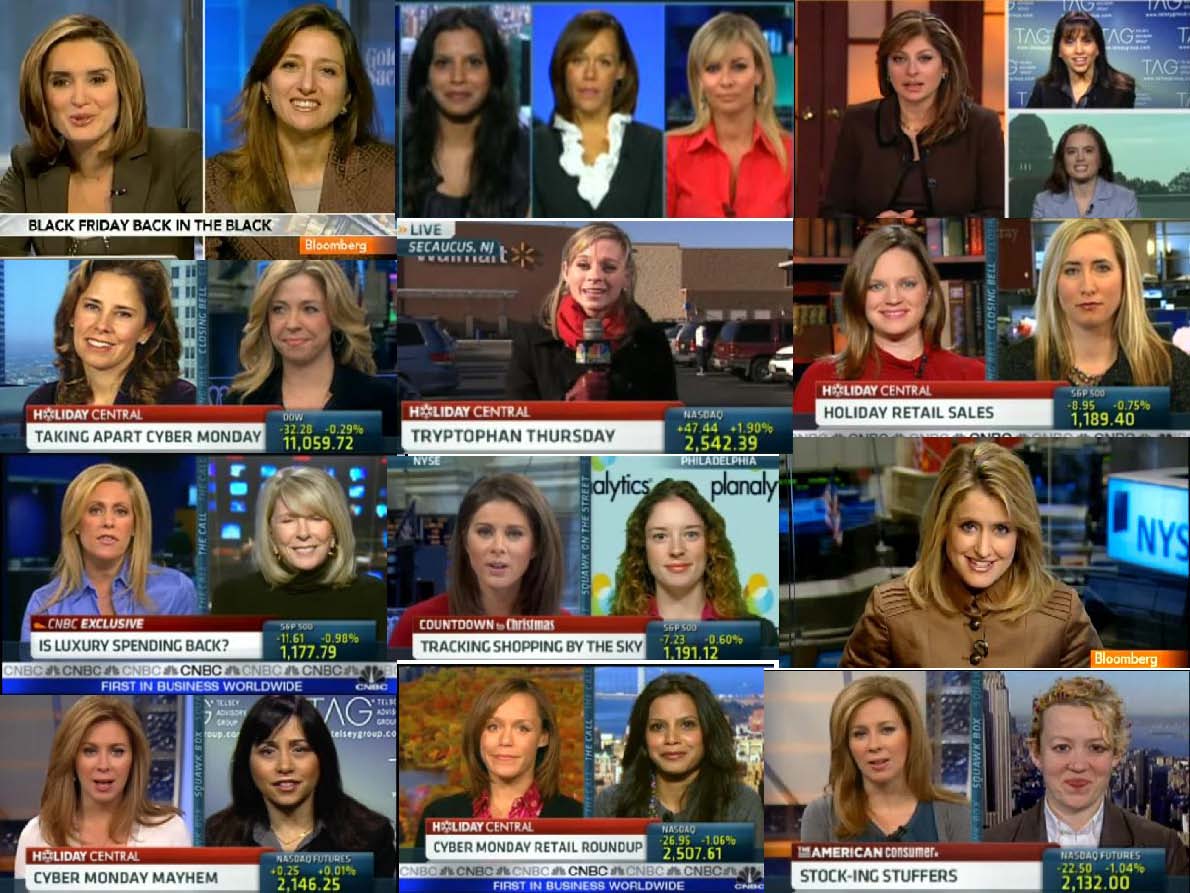
I’m not sure if you are like me, but the annual media ritual of myopically breaking down the sale of every shoe, belt, cell phone, television, and pair of underwear during the November/December holiday season can become very grating. What makes it a little easier for me to swallow is the stable of attractive female retail analysts who are finally unleashed from their long hibernation slumbers to review their mall traffic and parking satellite findings. I’m a happily married man, but I still cannot complain about seeing these multi-threat beauties dissect sales trends and fashion fads. However, in this day and age, I’m not so sure that females feel the same way about their under-representation in the finance field?
If there are 155.8 million females in the United States and 151.8 million males (Census Bureau: October 2009), then how come only 6% of hedge fund managers (BusinessWeek), 8% of venture capitalists, and 15% of investment bankers are female (Harvard Magazine)? Is the finance field just an ol’ boys network of chauvinist pig-headed males who only hire their own? Or do the severe time-demands of the field force females to opt-out of the industry due to family priorities?
Although I’m sure family choices and quality of life are factors that play into the decision of entering the demanding finance industry, from my experience I would argue women are notoriously underrepresented even at younger ages (well before family considerations would weigh into career decisions). Maybe cultural factors such as upbringing and education are other factors that make math-related jobs more appealing to men?
If underrepresentation in the finance field is not caused by female choice, then perhaps the male dominated industry is merely a function of more men opting into the field (i.e., men are better suited for the industry). More specifically, perhaps male brains are just wired differently? Some make the argument that all the testosterone permeating through male bodies leads them to positions involving more risk. If you look at other risk related fields like gambling, women too are dramatic minorities, making up about 1/3 of total compulsive gamblers.
Women Better than Men?
The funny part about the underrepresentation of females in finance is that one study actually shows female hedge fund managers outperforming their male counterparts. Here’s what a BusinessWeek article had to say about female hedge fund managers:
A new study by Hedge Fund Research found that, from January 2000 through May 31, 2009, hedge funds run by women delivered nearly double the investment performance of those managed by men. Female managers produced average annual returns of 9%, versus 5.82% for men and, in 2008, when financial markets were cratering, funds run by women were down 9.6%, compared with a 19% decline for men.
The article goes onto to theorize that women may not be afraid of risk, but actually are better able to manage risk. A UC Davis study found that male managers traded 45% more than female managers, thereby reducing returns by -2.65% (about 1% more than females).
Regardless of the theories or studies used to explain gender risk appetite, the relative underrepresentation of females in finance is a fact. I’ll let everyone else weigh in why that is the case, but in the meantime I will enjoy watching the female analysts explain the minute by minute account of UGG and iPad sales through the holiday shopping season.
Wade W. Slome, CFA, CFP®
Plan. Invest. Prosper.
Related Articles:
BusinessWeek article on female fund managers
Bashful Path to Female Bankruptcies
DISCLOSURE: Sidoxia Capital Management (SCM) and some of its clients own certain exchange traded funds and AAPL, but at the time of publishing SCM had no direct position in DECK or any other security referenced in this article. No information accessed through the Investing Caffeine (IC) website constitutes investment, financial, legal, tax or other advice nor is to be relied on in making an investment or other decision. Please read disclosure language on IC “Contact” page.




 Investing Caffeine
