Posts filed under ‘Trading’
Getting off the Market Timing Treadmill

Most investors have been stuck on the financial treadmill of the 2000s and have nothing to show for it, other than battle scars from the 2008-2009 financial crisis. A lot of running, sweating, and jumping has produced effectively no results. Most media outlets continue to focus on the “lost decade” (see other Lost Decade story) in which investors have earned nothing in the equity markets. After a decade of excess in the 1990s should the majority of investors be surprised? Investing is no different than dieting and exercise – those topics are easy to understand but difficult to execute.
Where are the Billionaire Market Timers?
The financial industry oversimplifies investing and sells market timing as an effortless path to riches – even in tough times. In the search of the financial Holy Grail, the industry constantly crams new software bells and whistles and so-called “can’t lose” strategies down the throats of individual investors. Sadly, there is no miracle system, wonder algorithm, or get rich scheme that can sustainably last the test of time. Sure, a minority of speculators can get lucky and make money by following a risky strategy in the short-run, but as the global economic disaster caused by LTCM (Long Term Capital Management) taught us, even certain successful trading strategies or computer algorithms can stop working in a heartbeat and lead to a widespread bloodbath.
Are you still a believer in market timing? If so, then where are all the billionaire market timers? Famed growth manager, Peter Lynch astutely noted:
“I can’t recall ever once having seen the name of a market timer on Forbes‘ annual list of the richest people in the world. If it were truly possible to predict corrections, you’d think somebody would have made billions by doing it.”
Certainly, there are some hedge fund managers that have hit home runs with amazing market calls, but time will be the arbiter in determining whether they can stay on top.
Sage Speak on Market Timing
If you don’t believe me about market timing, then listen to what knowledgeable investors and thought leaders have to say on the subject. Larry Swedroe, a principal at Buckingham Asset Management, compiled a list including the following quotes:
- Warren Buffett (Investor extraordinaire): “We continue to make more money when snoring than when active.” He adds, “The only value of stock forecasters is to make fortune-tellers look good.”
- Jason Zweig (Columnist): “Whenever some analyst seems to know what he’s talking about, remember that pigs will fly before he’ll ever release a full list of his past forecasts, including the bloopers.” (See also Peter Schiff and Meredith Whitney stories)
- Bernard Baruch (Financier): “Only liars manage to always be out during bad times and in during good times.”
- Jonathan Clements (Columnist): “What to do when the market goes down? Read the opinions of the investment gurus who are quoted in the WSJ. And, as you read, laugh. We all know that the pundits can’t predict short-term market movements. Yet there they are, desperately trying to sound intelligent when they really haven’t got a clue.”
- David L. Babson (Investment Manager): “It must be apparent to intelligent investors that if anyone possessed the ability to do so [forecast the immediate trend of stock prices] consistently and accurately he would become a billionaire so quickly he would not find it necessary to sell his stock market guesses to the general public.”
- Peter Lynch (Retired Growth Manager): “Far more money has been lost by investors preparing for corrections, or trying to anticipate corrections, than has been lost in corrections themselves.”
Market Timing Road Rules
Rather than make guesses regarding the direction of the market, here are some investment rules to follow:
- Rule #1: Do not attempt to market time. Statistically it is a certainty that a minority of the millions of investors can time the market in the short-run – the problem is that very few, if any, can time the market for sustainable periods of time. Don’t try to be the hero, because often you will become the goat.
- Rule #2: Patiently make good investments, regardless of the economic conditions. It is best to assume the market will go nowhere and invest accordingly. Paying attention to a hot or cold economy leads to investors chasing their tails. Good investments should outperform in the long-run, regardless of the macroeconomic environment.
- Rule #3: Diversify. In the midst of the crisis, diversification didn’t cure simultaneous drops in most asset classes, however ownership of government Treasuries, cash, and certain commodities provided a cushion from the economic blows. Longer-term, the benefits of diversification become more apparent – it makes absolute sense to spread your risk around.
In some respects, there is always an aspect of timing to investing, but as referenced by some of the intelligent professionals previously, the driving force behind an investment decision should not be, “I think the market is going up,” or “I think the market is going down” – those thought processes are recipes for disaster. I strongly believe an investment process that includes patience, discipline, diversification, valuation sensitivity, and low-cost/ tax-efficient products and strategies will get you off the financial treadmill and move you closer to reaching your financial goals.
Read the Full Larry Swedroe Story
Wade W. Slome, CFA, CFP®
Plan. Invest. Prosper.
DISCLOSURE: Sidoxia Capital Management (SCM) and some of its clients own certain exchange traded funds, but at time of publishing had no direct positions in BRKA or any other security mentioned. No information accessed through the Investing Caffeine (IC) website constitutes investment, financial, legal, tax or other advice nor is to be relied on in making an investment or other decision. Please read disclosure language on IC “Contact” page.
Sports & Investing: Why Strong Earnings Can Hurt Stock Prices

There are many similarities between investing in stocks and handicapping in sports betting. For example, investors (bettors) have opposing views on whether a particular stock (team) will go up or down (win or lose), and determine if the valuation (point spread) is reflective of the proper equilibrium (supply & demand). And just like the stock market, virtually anybody off the street can place a sports bet – assuming one is of legal age and in a legal betting jurisdiction.
Right now investors are poring over data as part of the critical, quarterly earnings ritual. Thus far, roughly 20% of the companies in S&P 500 index have reported their results and 78% of those companies have beaten Wall Street expectations (CNBC). Unfortunately for the bulls, this trend has not been strong enough to push market prices higher in 2010.
So how and why can market prices go down on good news? There are many reasons that short-term price trends can diverge from short-run fundamentals. One major reason for the price-fundamental gap is the following factor: expectations. Just last week, the market had climbed over +70% in a ten month period, before issues surrounding the Massachusetts Senatorial election, President Obama’s banking reform proposals, and Federal Reserve Bank Chairman Ben Bernanke’s re-appointment surfaced. With such a large run-up in the equity markets come loftier expectations for both the economy and individual companies. So when corporate earnings unveiled from companies like Google (GOOG), J.P. Morgan (JPM), and Intel (INTC) outperform relative to forecasts, one explanation for an interim price correction is due to a significant group of investors not being surprised by the robust profit reports. In sports betting lingo, the sports team may have won the game this week, but they did not win by enough points (“cover the spread”).
Some other reasons stock prices move lower on good news:
- Market Direction: Regardless of the underlying trends, if the market is moving lower, in many instances the market dip can overwhelm any positive, stock- specific factors.
- Profit Taking: Many times investors holding a long position will have price targets or levels, if achieved, that will trigger selling whether positive elements are in place or not.
- Interest Rates: Certain valuation techniques (e.g. Discounted Cash Flow and Dividend Discount Model) integrate interest rates into the value calculation. Therefore, a climb in interest rates has the potential of lowering stock prices – even if the dynamics surrounding a particular security are excellent.
- Quality of Earnings: Sometimes producing winning results is not enough (see also Tricks of the Trade article). On occasion, items such as one-time gains, aggressive revenue recognition, and lower than average tax rates assist a company in getting over a profit hurdle. Investors value quality in addition to quantity.
- Outlook: Even if current period results may be strong, on some occasions a company’s outlook regarding future prospects may be worse than expected. A dark or worsening outlook can pressure security prices.
- Politics & Taxes: These factors may prove especially important to the market this year, since this is a mid-term election year. Political and tax policy changes today may have negative impacts on future profits, thereby impacting stock prices.
- Other Exogenous Items: Natural disasters and security attacks are examples of negative shocks that could damage price values, irrespective of fundamentals.
Certainly these previously mentioned issues do not cover the full gamut of explanations for temporary price-fundamental gaps. Moreover, many of these factors could be used in reverse to explain market price increases in the face of weaker than anticipated results.
For those individuals traveling to Las Vegas to place a wager on the NFL Super Bowl, betting on the hot team may not be enough. If expectations are not met and the hot team wins by less than the point spread, don’t be surprised to see a decline in the value of the bet.
Wade W. Slome, CFA, CFP®
Plan. Invest. Prosper.
DISCLOSURE: Sidoxia Capital Management (SCM) and some of its clients own certain exchange traded funds and GOOG, but at the time of publishing had no direct positions in JPM and INTC. No information accessed through the Investing Caffeine (IC) website constitutes investment, financial, legal, tax or other advice nor is to be relied on in making an investment or other decision. Please read disclosure language on IC “Contact” page.
Technical Analysis – Astrology or Lob Wedge?

Investing comes in many shapes and sizes. And like religion (see Investing Religion article), most investment strategies are built on the essential belief that following certain rules and conventions will eventually lead to profit enlightenment. When it comes to technical analysis (TA), a discipline used with the principal aim of predicting future prices from past patterns, some consider it a necessity for making money in the market. Others, regard the practice of TA as a pseudoscience, much like astrology.
I feel there is a proper place for TA on selective basis, which I will describe later, but for the most part I agree with some of the legendary investors who have chimed in on the subject:
Warren Buffett: “I realized technical analysis didn’t work when I turned the charts upside down and didn’t get a different answer.”
Peter Lynch: “Charts are great for predicting the past.”
Technical Analysis Linguistics
Fundamental analysis, the antithesis of technical analysis, strives to predict future price direction by analyzing facts and data surrounding a company, industry, and/or economy. It too comes with its own syntax and versions, for example: value, growth, top-down, bottom-up, quantitative, etc.
I do not claim to be a TA expert, however in my many years of investing I have come across a smorgasbord of terms and flavors surrounding the discipline. Describing and explaining the density of material surrounding TA would encompass too large of a scope for this article, but here are some prevalent terms one should come to grips with if you want to become a technical analysis guru:
Technical analysis Approaches
- Elliot Wave
- Relative strength / Momentum (see Momentum Investing article)
- MACD (Moving Average Convergence / Divergence)
- Fibonacci retracement
- Dow Theory
- Stochastics
- Bollinger bands
Price Patterns
- Head and shoulders
- Double bottom
- Cup and handle
- Channels
- Breakouts
- Pivot points
- Candlesticks
- Resistance/Support
- Dead cat bounce (my personal favorite)
Each of these patterns are supposes to provide insight into the future direction of price. At best, I would say the academic research surrounding the subject is “inconclusive,” and at worst I’d say it’s considered a complete “sham.”
The Lob Wedge

As I’ve stated earlier, I fall in the skeptical camp when it comes to TA, since fundamental analysis is the main engine I use for generating and tracking my investment ideas. For illustrative purposes, you may consider fundamental analysis as my group of drivers and irons. I do, however, utilize selective facets of TA much like I use a lob wedge in golf for a limited number of specific situations (e.g., shots over high trees, downhill lies, and fast greens). When it comes to trading, I do believe there is some value in tracking the relationship of extreme trading volume (high or low), especially when it is coupled with extreme price movement (high or low). The economic laws of supply and demand hold true for stock trades just as they do for guns and butter, and sharp moves in these components can provide insights into the psychological mindset of investors with respect to a security (or broader market). Beyond trading volume, there are a few other indicators that I utilize as part of my trading strategies, but these tactics play a relatively minor role, since most of my core positions are held on a multi-year time horizon.
Overall, there is a stream of wasteful noise, volatility, and misinformation that permeates the financial markets on a daily basis. A major problem with technical analysis is the many false triggered signals, which in many cases lead to excessive trading, transaction costs, and ultimately subpar investment returns. Although I remain a skeptic on the subject of technical analysis and I may not read my horoscope today, I will continue to keep a lob wedge in my golf bag with the hopes of finding new, creative ways of using it to my advantage.
Wade W. Slome, CFA, CFP®
Plan. Invest. Prosper.
DISCLOSURE: Sidoxia Capital Management (SCM) and some of its clients own exchange traded funds and various securities, but at time of publishing had no direct position in BRKA/B or any company mentioned in this article. No information accessed through the Investing Caffeine (IC) website constitutes investment, financial, legal, tax or other advice nor is to be relied on in making an investment or other decision. Please read disclosure language on IC “Contact” page.
China Executes Wall Street Solution

China is taking an innovative approach to white collar crime…execution. Yang Yanming, a rogue securities trader, completed his death sentence this week for embezzling $9.52 million (a daily rounding error for Goldman Sachs, I might add). Not exactly a cheery topic for the holiday season, but nonetheless, apparently an effective technique for cracking down on illegal behavior. Last I heard, there has been no mention of a $65 billion Chinese version of the Madoff Ponzi scheme? I wonder what kind of risks the financial division of AIG would have undertaken, if involuntary death sentences were considered as viable options in the back of their minds? China in fact carries out more annual executions (via lethal injection and gun) than any other country in the world.
Part of the recent financial crisis can be attributed to the culture of Wall Street and the investment industry, which centers on exploiting “OPM,” an acronym I use to describe “other people’s money.” Often, industry professionals (I use the term loosely) assume undue amounts of risk in hopes of securing additional income, no matter the potential impact on the client. The thought process generally follows: “Why should I risk my own capital to make a mega-bonus, when I can swing for the fences using someone else’s?” And if OPM cannot be secured from individuals, perhaps the capital can be borrowed from the banks – at least before the bailouts occurred.
OPM does come with some caveats, however. Say for example the OPM comes from the government. When TARP (Troubled Asset Relief Program) funds got crammed down the throats of the banking industry, the auspice of reduced bonuses didn’t sit very well with many of the fat-cat Wall Street executives. Financial institutions prefer their OPM with few strings and little to no accountability. Goldman Sachs (GS), JP Morgan (JPM), and Morgan Stanley (MS) weren’t big fans of the government’s pay scale, so these banks paid back the TARP funds at mid-year. Citigroup (C) is still negotiating with the U.S. Treasury and regulators to remove the scarlet phrase of “exceptional assistance” from their chests.
This subject of accountability brings up additional doses of blame to distribute. Not only are the gun-slinging bankers and advisers the ones to blame, but in many cases the clients themselves shoulder some of the responsibility. Either the clients’ start drinking the speculative “Kool-Aid” of their advisor or they neglect to ask a few basic questions for accountability. Just as Ronald Reagan stressed in his conversations with the Soviets, it is also imperative for clients to “trust but verify” the relationship with their advisor (read how to get your financial house in order).
One thing we learned from the crisis of 2008-2009 is that trust is a scarce resource. Investors can “luck” into a trustworthy relationship, but more often than not, just like anything else, it takes time and effort to build a worthy partnership.
The suppliers of OPM have gotten smarter and more skeptical after the crisis, however the managers of OPM haven’t discarded risk from their toolboxes. In addition to the general rebound in domestic equities, we have seen emerging markets, commodities, high-yield bonds, and foreign currencies (to name a few areas), also vault higher.
Regulatory reform for the financial industry is a hot topic for discussion, although virtually nothing substantive has been implemented yet. Incentives, accountability, and adequate capital requirements need to be put in place, so excessive risk-taking (like we saw at the AIG division handling Credit Default Swaps) doesn’t compromise the safety of our financial system. Also, traders need to be incentivized for making responsible decisions and punished adequately for participating in illegal activities. I know the President has a lot on his plate right now, but perhaps the Obama administration could set up a brief meeting with the capital punishment committee in Beijing. I’m confident the Chinese could assist us in “executing” a financial regulatory system solution.
Read Full Reuters Article on Rogue Chinese Trader
Wade W. Slome, CFA, CFP®
Plan. Invest. Prosper.
DISCLOSURE: Sidoxia Capital Management (SCM) and some of its clients own certain exchange traded funds (VFH) and BAC, but at time of publishing had no direct positions in GS, AIG, JPM, MS and C. No information accessed through the Investing Caffeine (IC) website constitutes investment, financial, legal, tax or other advice nor is to be relied on in making an investment or other decision. Please read disclosure language on IC “Contact” page.
Making Safer Asbestos: Einhorn on CDS

David Einhorn, founding hedge fund manager of Greenlight Capital, exploited Credit Default Swaps (CDS) derivative contracts to their fullest in the midst of the financial crisis and now he says any effort to keep them in existence is like making “safer asbestos.” Hypocritical?
As toxic debt devices that profit from credit default triggers, CDSs have created “large correlated and asymmetrical risks,” which have “scared authorities into spending hundreds of billions of taxpayer money to prevent speculators who made bad bets from having to pay,” according to Einhorn.
The abolishment of the CDS market would have no impact on me (I have never traded a CDS in my life), but in principle Einhorn has no leg to stand on. Just because these unregulated insurance contracts were not properly disclosed or collateralized by American International Group, Inc. (AIG) does not mean a transparent, properly collateralized, central clearing exchange could not be created to efficiently meet the needs of counterparties.
Derivatives Description
Conceptually, a CDS is no different than a derivatives option contract. Take for example a put contract. Like a CDS, a put contract can be purchased as insurance (hedging against price declines on a current holding) or it can be purchased for speculative purposes (profit from future potential price declines if there is no underlying ownership position). All derivatives are structured for hedging or speculation, whether you are talking about options, futures, swaps, or other exotic forms of derivatives (i.e., swaptions). CDSs are no different.
Einhorn is not the first person to disingenuously speak about derivatives. The “do as I say, not as I do” principle holds true for Warren Buffett too. Buffett blasted derivatives as “weapons of mass destruction,” yet he has made billions of dollars (read about Buffett on derivatives) in premiums from writing (selling) multi-year options on various indexes.
Derivatives History
Derivative trading goes as far back as Roman and Greek history when similar contracts were used for crop insurance and shipping purposes. After the Great Depression, the Investment Act of 1934 legitimized options under the watchful eye of the Securities and Exchange Commission (SEC). Subsequently, the Chicago Board Options Exchange (CBOE) began trading listed options in 1973. Since then, the investment banks and other financial players have created derivative products making up many different flavors.
The Solution
How does Einhorn feel about central clearing exchanges?
“The reform proposal to create a CDS clearing house does nothing more than maintain private profits and socialised risk by moving the counterparty risk from the private sector to a newly created too big to fail entity.”
Oh really? If the utility of hedging contracts has been documented for hundreds of years, then why wouldn’t we create a standardized, transparent, adequately capitalized central clearing house for these tools? Whether Einhorn is asking for the eradication of all derivatives, I cannot be sure. If his extermination comments apply equally to all derivatives, then I guess we’ll just have to shutter entities like the CBOE, which handled 1.19 billion options contracts last year alone. If eliminating speculation was the focal point of Einhorn’s argument, then perhaps regulators could simply raise the reserve requirements for those merely gambling on price declines or default triggers.
In the end, if what Einhorn recommended came to fruition, he would only be throwing the baby out with the bathwater. CDSs, and other derivatives, serve a healthy and useful purpose towards the aim of creating more efficient financial markets. I agree that the AIG flavor of CDSs were like lethal asbestos, so let’s see if we can now replace it with some safer insulation protection.
Read Financial Times Editorial on David Einhorn
Wade W. Slome, CFA, CFP®
Plan. Invest. Prosper.
DISCLOSURE: Sidoxia Capital Management (SCM) or its clients owns certain exchange traded funds, but currently has no direct position in AIG, or BRKA/BRKB. No information accessed through the Investing Caffeine (IC) website constitutes investment, financial, legal, tax or other advice nor is to be relied on in making an investment or other decision. Please read disclosure language on IC “Contact” page.
Teen Prom of Listings Driven by Globalization

The international and emerging markets are like maturing teenagers attending a prom. If the U.S. represents the incumbent Seniors, then the international regions, like Europe and China, are the underclassmen now overwhelming the dance party. In 2009 for example, China has accounted for approximately 40% of all IPOs (Initial Public Offerings), according to The Financial Times.
This trend, however, is not a new phenomenon. Grant Thorton, an accounting consultancy firm, found the declining trend in American stock listings occurring for more than a decade. Specifically, Grant Thorton discovered the following:
“…the number of US exchange-listed companies is down by more than 22 per cent since 1991 and down by 53 per cent when allowing for real, inflation-adjusted gross domestic product growth.”
Why is the U.S. losing listing market share? David Weild, a former Nasdaq Vice Chairman, believes the advent of online brokerage firms in the mid-1990s shoulders a lot of the blame. The new order handling rules established in 1997 made the profitability of supporting small-cap stocks less profitable for the traditional brokerage firms.
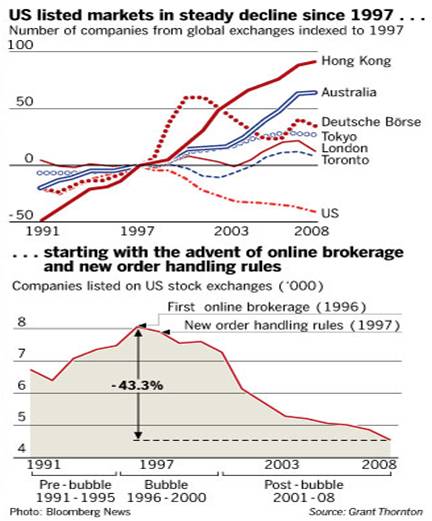
Source: Charts from The Financial Times show steady U.S. listings decline.
The reasons for the rule changes were designed to drive lower costs and improved transparency. These goals have largely been achieved, but due to globalization and the heightened liquidity in international and emerging markets, alternative exchanges have been gaining share.
Although profitability in supporting small-cap stocks has dropped, the evolution of high frequency trading (HFT) has stirred up the pot of controversy (read HFT article here). Exchanges, in an attempt to offset lost listings profits, are building new streams of revenues targetting these rapid pace computer traders.
As globalization spreads, thanks in part to the spread of technology advances, foreigners are joining what Thomas Friedman calls a new “flat” world, and the underclassmen are coming to the party with their dancing shoes.
Read The Financial Times Article Here
Wade W. Slome, CFA, CFP®
Plan. Invest. Prosper.
DISCLOSURE: No information accessed through the Investing Caffeine (IC) website constitutes investment, financial, legal, tax or other advice nor is to be relied on in making an investment or other decision. Please read disclosure language on IC “Contact” page.
The Halloween Indicator Buried at Cemetery in 2009

Boo!
Statisticians, economists, speculators, and superstitious investors have been known to get spooked by scary patterns. Tomorrow marks the end of the menacing six month period of supposed underperformance that starts in May and ends on Halloween. The so-called “Halloween Indicator” has popularized the expression of “sell in May and walk away.” The indicator obviously has not followed the alleged tendency in 2009, as there has been more “treat” than “trick” for investors over the last six months. The S&P has rallied about +22% (excluding dividends) with only one day left in the trading period. Numerous academics have studied the phenomenon and not surprisingly there is some debate regarding the validity of various studies (see past study) – differing opinions have risen to the surface, depending on the number of years compiled in the data.
Here is what Mark Hulbert at MarketWatch had to say on the subject:
“Over the Dow’s history up until the last 12 months, there were no fewer than 17 occasions (15% of the years) in which both the winter months turned in a net loss for the stock market and the summer months produced a gain. There furthermore were 45 years (41% of the time) in which the stock market during the summer period did better than it did over the winter months that immediately preceded it. So the stock market’s performance over the last 12 months is hardly exceptional. It would take a lot more than the recent seasonal missteps to convince a statistician that this long-term pattern has stopped working for good. “
Other calendar effects besides the Halloween Indicator include, the January Effect, Monday Effect, and Presidential Cycle. Even though some pundits point to evidence supporting calendar effects, in many cases the data is proved to be statistically insignificant.
With Halloween just around the corner, here’s Sidoxia Capital Management wishing you a larger bag of treats rather than tricks in your quest in following calendar effects.
Wall Street Halloween Costume Ideas:
Short of ideas for Halloween costumes this year? No need to fear. Here are a few bloodcurdling Wall Street costume ideas with the help of Joshua Brown at The Reformed Broker and our friends at Forbes:

Top Ten Scariest Wall Street Halloween Costumes
Halloween Index:
For those that would rather get there treats from the stock market rather than a candy bowl, perhaps you may find a sweet idea from Stockerblog’s Halloween Stock Index.
Have a happy and safe Halloween!
Wade W. Slome, CFA, CFP®
Plan. Invest. Prosper.
DISCLOSURE: Sidoxia Capital Management and client accounts do not have direct positions in any of the Halloween Stock Index companies with the exception of long positions in WMT for some Sidoxia accounts. No information accessed through the Investing Caffeine (IC) website constitutes investment, financial, legal, tax or other advice nor is to be relied on in making an investment or other decision. Please read disclosure language on IC “Contact” page
Insider Trading: Raj Rajaratnam vs. Pete Rose

A recent Wall Street Journal article written by Donald J. Boudreaux, a professor of Economics at George Mason University, makes the case that insider trading is actually healthy for the operations of the financial markets. The arrest of Galleon Group founder and hedge fund manager, Raj Rajaratnam, is a tragedy according to the article’s author. Specifically he says, “Insiders buying and selling stocks based on their knowledge play a critical role in keeping asset prices honest—in keeping prices from lying to the public about corporate realities.”
Oh really? Then I suppose Professor Boudreaux would be fine with all-time leading hitter and former Cincinnati Reds Manager betting on his own baseball team to win or lose.
Another disputed aspect of insider trading by Boudreaux is the inability to monitor the crime. “Insider trading is impossible to police and…parsing the difference between legal and illegal insider trading is futile—and a disservice to all investors.” Maybe heroin and cocaine should be legalized too, since we can’t completely police these crimes either? Seems to me the insider trading laws are pretty clear what insiders can and cannot do with material information. The digital world we live in today only empowers investigators more than ever to discover clear electronic footprint trails connecting trading and banking accounts. Certainly, there will be creative crooks like Bernie Madoff that can slyly succeed for a period of time, but those that grasp too far will eventually get caught.
Professor Boudreaux goes on to describe the scenario of an unscrupulous CEO at a hypothetical company (Acme Inc.) driving a company into bankruptcy. He argues employees, creditors, and investors would be better served by a CEO enriching himself with insider trading in the name of price efficiency. Capital productivity would be enhanced for creditors/investors thanks to information efficiency and employees could manage their job hunting effectively.
Sounds great Don, but in a legal insider trading world, don’t you think inefficient, unscrupulous behavior for siphoning information from executives might lead to distracting and wasteful corporate actions? If I’m an employee at ACME Inc. and I can make more money trading ACME stock, rather than being a productive employee making widgets, then it doesn’t take a genius to figure out where my 40 hour work week concentration will reside. Moreover, how is a sabotaging CEO, who is raking in millions by shorting his company’s stock ,supposed to be a good thing for stakeholders? I strongly disagree. Stakeholders will be jeopardized more by an unfocused, greed-absorbed workforce than by the current enforcement structure, which strives for an even playing field of information.
After forcefully arguing trading on insider information should not be prohibited, the professor hedges his stance by saying there are exceptions: “There are, of course, situations in which it is in the interest of both a company and the public for that company to delay the release of information.” For example, he describes a merger situation where early information leakage could “jeopardize the prospect of achieving greater efficiencies.” If according to Boudreaux, policing of insider information is impossible, then determining what he calls “proprietary” versus “non-proprietary” information is only going to stir up a worse hornet’s nest.
In the end, if price efficiency (see story on market efficiency) and cheaper cost of capital is Professor Boudreaux’s central aim, then perhaps disclosing inside information, rather than selfishly profiting from trading on inside information, is a more suitable approach. For Pete Rose, I recommend sticking to legalized sports betting in Las Vegas as a superior strategy.
Read Full Professor Boudreaux WSJ Article
Wade W. Slome, CFA, CFP®
Plan. Invest. Prosper.
DISCLOSURE: No information accessed through the Investing Caffeine (IC) website constitutes investment, financial, legal, tax or other advice nor is to be relied on in making an investment or other decision. Please read disclosure language on IC “Contact” page.
Walking on Egg Shells

The recent stock market rally has investors walking on egg shells. “Nervous Nelly” investors panicked on the way down last year, and now they are fearful and skeptical about the sustainability of the fierce six-month rally. The S&P 500 is up about 60% from the latest bear market lows, but I think the recent New Jersey Business News (NJBN) article captures the investor sentiment perfectly, “I’m scared, I’m scared, I’m scared,” investor Dania Leon said. “Why are we up, especially with unemployment as high as it is? I don’t feel great because I worry that we could have a 500- or 600-point drop in a day and I won’t be quick enough to pull out of it in time.”
Will investors ever be comfortable? Well yes, of course, exactly at the right time to sell. Calm and complacency will most likely settle in once the economic headlines are on a clear path to recovery. At that point, the market, like a game of chess, will likely have already anticipated the recovery.
Until then, the whipsaw syndrome seems to have taken effect on investors. The NJBN article goes onto expand on investors’ emotional scars:
“They’ve been traumatized twice,” said Michal Strahilevitz, a business professor at Golden Gate University who studies the psychology of individual investors. “First they lost a lot and got out. And now they’ve watched it climb up. It’s a lot of regret, and for people who are investing for their family, it’s a lot of guilt.”
Trillions of low yielding cash continues to sit on the sidelines, waiting for the inevitable 10% “pullback.” Strategist Laszlo Birinyi sees little evidence for an imminent correction, “Give me the evidence…in 1982 we went 424 days before we had a correction. In 2000, we went seven years before we had a 10% correction. In 2002, we went three or four years.” (For more on Mr. Birinyi, see http://is.gd/3xS5u)
At the end of the day, as great growth investor Peter Lynch said, it’s the direction of corporate earnings that will ultimately drive the market higher or lower. “People may bet on hourly wiggles of the market but it’s the earnings that waggle the wiggle long term.” Right now based on the strength of the rally, the market is telling us that third quarter corporate earnings should come in better than analyst expectations. Perhaps we get a yawner response (sell on the news reaction), or if improvement outright stalls, perhaps we will get the mother of all expected corrections?
All these mind games make for an extremely tiresome investing mental tug-of-war. I choose not to get caught up in this game of market timing, but rather I choose to let the investment opportunity-set drive my investment decisions. I have taken some chips off the table during this rebound but I am still finding plenty of other fertile opportunities to redeploy capital. As others nervously walk on egg shells, I opt to clean up the mess and look for a clearer investment path.
Read the Full NJBN Article Here
Wade W. Slome, CFA, CFP®
Plan. Invest. Prosper.
Action Dan (Poker King) and Professional Investing

"Action Dan" wins millions in poker by skillfully mixing art with science
As I write in my book (How I Managed $20,000,000,000.00 by Age 32), successful investing requires skillful use of both art and science. What I find so fascinating is that the same principles apply to poker playing. Like investing, poker is also a game of skill that rewards a player who adequately understands the mathematical probabilities (science) while still able to appropriately read the behavior of his or her opponents (art). Take for example professional poker player and 1995 WSOP champ Dan Harrington. In 2003 he finished 3rd at the World Series of Poker Main Event (the Super Bowl of poker) out of a pool of 839 players. In 2004, the following year, despite the pool more than tripling to 2,576 participants, Mr. Harrington managed to finish 4th and take home a cool $1.5 million in prize money. Did luck account for this success? I think not. Odds, if left to chance, would be 1 in 25,000 for repeating this feat, according to the Economist.
In the short-run, random volatility and luck can make the average investor look like Warren Buffett, but because of the efficiency of the market, that same average investor will look like a schmuck over the long-run. Legg Mason Funds Management put out an incredible chart that I believe so elegantly captures the incoherent and meaningless, short-term noise that the media attempts to interpret daily. What appears like outperformance in the short-run may merely be the lucky performance of a reckless speculator.

Source: Legg Mason Funds Management
Dan Harrington, and so many other talented professionals know this fact all too well when an inexperienced “donkey” over-bets a clearly inferior hand, only to nail an inside-straight card on the “river” (last card of the round) out of pure luck – thereby knocking out a superior professional player. Over the long-run these out-of-control players end up losing all their money and professionals relish the opportunity of playing against them.
Talk to professionals and ask them what the biggest mistake new players make? The predominate answer: novices simply play too many hands. In the world of investing, the same can be said for excessive trading. Commissions, transactions costs, taxes and most importantly, ill-timed, emotionally driven trades lead the average investor to significantly underperform. I’ve referenced it before, and I’ll reference it again, John Bogle’s 1984-2002 study shows the significant drag the aforementioned costs have on professionals’ performance, and especially the average fund investor that underperformed the passive (a.k.a., “Do Nothing” strategy) S&P 500 return by more than a whopping 10% annually!
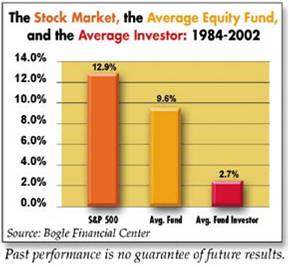
I consider myself an above average player, and I’ve won a few small tournaments, but match me up against a professional like “Action Dan” Harrington and I’ll get destroyed in the long-run. Investing, like professional poker, can lead to excess returns with the proper integration of patience and a disciplined systematic approach. I strongly believe that all great long-term investors successfully implement a strategy that marries the art and science aspects of investing. Don’t hold your breath if you expect to see me on ESPN, it may be a while before you see me at the Final Table with Dan Harrington at the World Series of Poker.
Wade W. Slome, CFA, CFP®
Plan. Invest. Prosper.
DISCLOSURE: Sidoxia Capital Management (SCM) and some of its clients own certain exchange traded funds, and at the time of publishing had no direct positions in LM, DIS, or BRKA/B. No information accessed through the Investing Caffeine (IC) website constitutes investment, financial, legal, tax or other advice nor is to be relied on in making an investment or other decision. Please read disclosure language on IC “Contact” page.




 Investing Caffeine
