Posts filed under ‘Themes – Trends’
Passive vs. Active Investing: Darts, Monkeys & Pros

Bob Turner is founder of Turner Investments and a manager of several funds at the investment company. In a recent article he reintroduces the all-important, longstanding debate of active management (“hands-on”) versus passive management (“hands off”) approaches to investing.
Mr. Turner makes some good arguments for the active management camp, however some feel differently – take for example Burton Malkiel. The Princeton professor theorizes in his book A Random Walk Down Wall Street that “a blindfolded monkey throwing darts at a newspaper’s stock page could select a portfolio that would do just as well as one carefully selected by experts.” In fact, The Wall Street Journal manages an Investment Dartboard contest that stacks up amateur investors’ picks against the pros’ and random stock picks selected by randomly thrown darts. In many instances, the dartboard picks outperform the professionals.
Given the controversy, who’s right…the darts, monkeys, or pros? Distinguishing between the different categorizations can be difficult, but we will take a stab nevertheless.
Arguments for Active Management
Turner contends, active management outperforms in periods of high volatility and he believes the industry will be entering such a phase:
“Active managers historically have tended to perform best in a market in which the performance of individual stocks varies widely.”
He also acknowledges that not all active managers outperform and admits there are periods where passive management will do better:
“The reason why most active investors fail to outperform is because they in fact constitute most of the market. Even in the best of times, not all active managers can hope to outperform…The business of picking stocks is to some degree a zero-sum game; the results achieved by the best managers will be offset at least somewhat by the subpar performance of other managers.”
Buttressing his argument for active management, Turner references data from Advisor Perspectives showing an inconclusive percentage (40.5%-67.8%) of the actively managed funds trailing the passively managed indexes from 2000 to 2008.
The Case for Passive Management
Turner cites one specific study to support his active management cause. However, my experience gleaned from the vast amounts of academic and industry data point to approximately 75% of active managers underperforming their passively managed indexes, over longer periods of time. Notably, a recent study conducted by Standard & Poor’s SPIVA division (S&P Indices Versus Active Funds) discovered the following conclusions over the five year market cycle from 2004 to 2008:
- S&P 500 outperformed 71.9% of actively managed large cap funds;
- S&P MidCap 400 outperformed 79.1% of mid cap funds;
- S&P SmallCap 600 outperformed 85.5% of small cap funds.
Read more about the dirty secrets shrinking your portfolio.
According to the Vanguard Group and the Investment Company Institute, about 25% of institutional assets and about 12% of individual investors’ assets are currently indexed (passive strategies). If you doubt the popularity of passive investment strategies, then look no further than the growth of Exchange Traded Funds (ETFs – see chart), index funds, or Vanguard Groups more than $1 trillion dollars in assets under management.
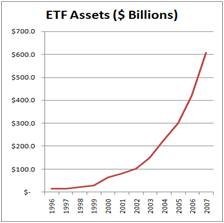
Although I am a firm believer in passive investing, one of its shortcomings is mean reversion. This is the idea that upward or downward moving trends tend to revert back to an average or normal level over time. Active investing can take advantage of mean reversion, conversely passive investing cannot. Indexes can get very top-heavy in weightings of outperforming sectors or industries, meaning theoretically you could be buying larger and larger shares of an index in overpriced glamour stocks on the verge of collapse. We experienced these lopsided index weightings through the technology bubbles in the late 1990s and financials in 2008. Some strategies may be better than other over the long run, but every strategy, even passive investing, has its own unique set of deficiencies and risks.
Professional Sports and Investing
As I discuss in my book, there are similarities that can be drawn between professional sports and investing with respect to active vs. passive management. Like the scarce number of .300 hitters in baseball, I believe there are a select few investment managers who can consistently outperform the market. In 2007, AssociatedContent.com did a study that showed there were only 22 active career .300 hitters in Major League Baseball. I recognize in the investing world there can be a larger role for “luck,” which is difficult, if not impossible, to measure (luck won’t help me much in hitting a 100 mile per hour fastball thrown by Nolan Ryan). Nonetheless, in the professional sports arena, there are some Hall of Famers (prospects) that have proved they could (can) consistently outperform their peers for extended durations of time.
Experience is another distinction I would highlight in comparing sports and investing. Unlike sports, in the investment world I believe there is a positive correlation between age and ability. The more experience an investor gains, generally the better long-term return achieved. Like many professions, the more experience you gain, the more valuable you become. Unfortunately, in many sports, ability deteriorates and muscles atrophy over time.
Size Matters
Experience alone will not make you a better investor. Some investors are born with an innate gift or intellect that propels them ahead of the pack. However, most great investors eventually get cursed by their own success thanks to accumulating assets. Warren Buffet knows the consequences of managing large amounts of dollars, “gravity always wins.” Having managed a $20 billion fund, I fully appreciate the challenges of investing larger sums of money. Managing a smaller fund is similar to navigating a speed boat – not too difficult to maneuver and fairly easy to dodge obstacles. Managing heftier pools of money can be like captaining a supertanker, but unfortunately the same rapid u-turn expectations of the speedboat remain. Managing large amounts of capital can be crippling, and that’s why captaining a supertanker requires the proper foresight and experience.
Room for All
As I’ve stated before, I believe the market is efficient in the long run, but can be terribly inefficient in the short-run, especially when the behavioral aspects of emotion (fear and greed) take over. The “wait for me, I want to play too” greed from the late 1990s technology craze and the credit-based economic collapse of 2008-2009 are further examples of inefficient situations that can be exploited by active managers. However, due to multiple fees, transaction costs, taxes, not to mention the short-term performance/compensation pressures to perform, I believe the odds are stacked against the active managers. For those experienced managers that have played the game for a long period and have a track record of success, I feel active management can play a role.
At Sidoxia Capital Management, I choose to create investment portfolios that blend a mixture of passive and active investment strategies. Although my hedge fund has outperformed the S&P 500 in 2009, that fact does not necessarily mean it’s the appropriate sole approach for all clients. As Warren Buffet states, investors should stick to their “circle of competence” so they can confidently invest in what they know. That’s why I generally stick to the areas of my expertise when I’m actively investing in stocks, and fill in the remainder of client portfolios with transparent, low-cost, tax-efficient equity and fixed income products (i.e., Exchange Traded Funds).
Even though the actively managed Turner Funds appear to have a mixed-bag of performance numbers relative to passively managed strategies, I appreciate Bob Turner’s article for addressing this important issue. I’m sure the debate will never fully be resolved. In the meantime, my client portfolios will aim to mix the best of both worlds within active and passive management strategies in the eternal quest of outwitting the darts, monkeys, and other pros.
Read the full Bob Turner article on Morningstar.com
Wade W. Slome, CFA, CFP®
Plan. Invest. Prosper.
DISCLOSURE: Sidoxia Capital Management (SCM) and some of its clients own certain exchange traded funds but had no direct position in stocks mentioned in this article. No information accessed through the Investing Caffeine (IC) website constitutes investment, financial, legal, tax or other advice nor is to be relied on in making an investment or other decision. Please read disclosure language on IC “Contact” page.
The Economics and Consequences of Obesity

‘Tis the season to consume a lot of calories, and my tighter fitting, post turkey-day trousers can attest to that fact. Healthcare reform is front and center in the national debate, as well, and the rising epidemic of obesity should play a significant role in the discussion. Why is this issue so important? According to female financial guru, Suze Orman, we are already spending $57 billion more on obesity than cancer. Obesity-related health care costs totaled about $117 billion in 2000, according to the CDC (Center of Disease Control). One study on obesity estimates the problem will cost the United States $344 billion in health costs by 2018.
Although it may be an uncomfortable issue to talk about, this matter has had a direct personal impact on my family, making the problem all the more tangible to me. Regardless of the function of genetics or what lifestyle choices are made, the negative consequences are indisputable.
Take a look at the table of negative outcomes provided by the CDC:
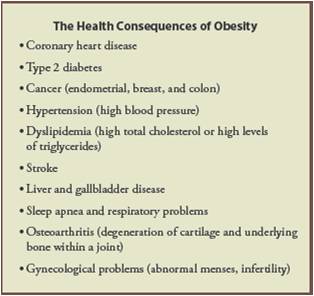
These consequences obviously take a large toll on the individuals, but they also have a massive impact on our healthcare system. And the CDC has the data to backup the severity of this intensifying problem:
“More than one third of U.S. adults—more than 72 million people—and 16% of U.S. children are obese. Since 1980, obesity rates for adults have doubled and rates for children have tripled. Obesity rates among all groups in society—irrespective of age, sex, race, ethnicity, socioeconomic status, education level, or geographic region—have increased markedly.”
Before solutions can be created, the root problems need to be addressed. One of the factors contributing to increased incidence of obesity is our unhealthy dietary habits (myself included). A chart from the New York Times highlights the economic impact of our food choices has been impacted by inflation trends. Over the last 30 years, unhealthy foods (beer, butter, and soda) have become much cheaper than healthy foods (fresh fruits and vegetables), on a relative basis (see chart below). Making a trip to fast food chains has not only become more convenient, but the practice has also become more affordable.

Source: Bureau of Labor Statistics (NY Times)
With our work lives stretched even further and stress levels rising, the picture below highlights the relationship between obesity (as measured by the Body Mass Index) and minutes spent per day eating. Our unhealthy, indoor, sedentary lifestyles take away from our healthy eating habits as well. The U.S. is the country with the highest percentage of individuals who are obese and the country that spends the third fewest minutes per day eating (eating more fast food). Seems like a fairly tight correlation.
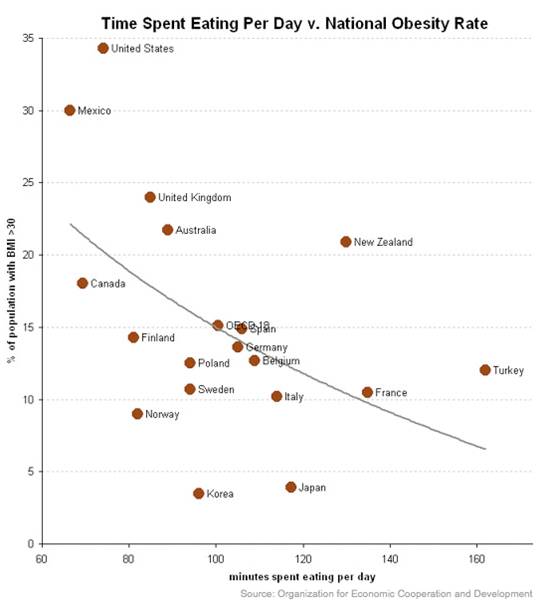
Data Source: OECD (Organization for Economic Cooperation and Development)
Solutions?
Education / Government: Educational support through cooperation with the government is necessary to spread the word regarding the consequences of obesity. Incentives also need to be integrated into our healthcare system so individuals can responsibly attack obesity head-on.
Behavioral Modification: Healthier diet and exercise lifestyles need to be evangelized. Implementation of economic incentives can possibly improve behavior by lowering insurance premiums in exchange for better health compliance.
Medications: Research needs to continue so innovative medications can help prevent and control obesity. Arena Pharmaceuticals (ARNA), VIVUS (VVUS), and Orexigen Therapeutics (OREX) are in the late stages in an attempt of getting their obesity drugs approved by the FDA. There is tremendous profit potential if the proper mix of efficacy and safety can be proven, however the detection of side-effects can potentially derail adoption and approval.
Surgery: Advancements have been introduced through medical technologies as well. Allergan’s (AGN) Lap-Band device is an example of an FDA approved device that effectively wraps around the stomach like a rubber-band to control excessive eating urges.
Obviously this is not an easy problem to deal with, as evidenced by the skyrocketing numbers. Many face inherent genetic hurdles in conquering diabetes, while others may have other health issues that contribute to overweight problems.
With the holidays upon us, I still plan on responsibly splurging on occasion, but I’m praying I will have the discipline to mix in some veggies and a run around the block with my eggnog and turkey leg. In the meantime, perhaps I’ll help support the economy by running to the mall and burning some holiday calories by doing some shopping!
Wade W. Slome, CFA, CFP®
Plan. Invest. Prosper.
DISCLOSURE: Sidoxia Capital Management (SCM) and some of its clients own certain exchange traded funds and AGN, but at time of publishing had no direct positions in ARNA, VVUS, or OREX. No information accessed through the Investing Caffeine (IC) website constitutes investment, financial, legal, tax or other advice nor is to be relied on in making an investment or other decision. Please read disclosure language on IC “Contact” page.
Turkey Stuffing, Wall Street Style

There will be no shortage of turkey stuffing this year, thanks to a story from Joshua Brown’s The Reformed Broker site (Wall Street Turkeys…Full of Stuffing).
In the spirit of Thanksgiving, which turkeys did journalist Terry Keenan roast?
Timothy Geithner: A fledgling economy and aggressive fiscal measures have painted a big target on Geithner’s back. I don’t fall into the “let’s lynch Geithner” camp, but Keenan feels “It’s a fair bet President Obama’s least-popular appointed official won’t be around to roast next Thanksgiving. “
John Thain: The former Merrill Lynch CEO and Bank of America executive who spent $1.2 million redecorating his Manhattan office made the list too. The man referred to as “I-Robot” may be difficult to cook, but regardless the article claims he is seeking to find employment running a different public company in the mean time.
Larry Summers: As the Director of President Obama’s National Economic Council, Mr. Summers has done a respectable job of flying below the radar, but not low enough to escape his past as Harvard University’s President (and the associate poor performing endowment).
Jeffrey Immelt: GE is no weakling, weighing in around $170 billion in market cap, but Keenan highlights the fledgling performance of NBC over the last two decades as reason to stuff this turkey.
Vikrim Pandit: The CEO of Citigroup survived a tumultuous period in 2009. Keenan however underscores how:
“His image suffered a big blow at the hands of Andrew Ross Sorkin, who paints an unflattering portrait of Pandit in his best-selling book, Too Big to Fail. If Pandit can’t play the “source game” to his advantage, it’s hard to see how he’s up to the much tougher task of reviving Citi’s fortunes.”
Now that we’re done with the turkey, could you please pass the stuffing.
Wade W. Slome, CFA, CFP®
Plan. Invest. Prosper.
DISCLOSURE: Sidoxia Capital Management (SCM) and its clients own certain exchange traded funds (including VFH), but currently have no direct positions in BAC, GE, or C. No information accessed through the Investing Caffeine (IC) website constitutes investment, financial, legal, tax or other advice nor is to be relied on in making an investment or other decision. Please read disclosure language on IC “Contact” page.
Darkest Before Dawn – Gaming Industry Waiting for Sunrise

It is always darkest before dawn, and right now the days are dark in the video game industry.
The industry is facing multiple challenges ranging from the migration of players from console games to digital online games; the growth of the iPhone and mobile devices as a free and discounted gaming platform; sky-rocketing development and marketing costs; and not to mention a consumer recession in which coughing up $50-$60 bucks a pop for a next generation platform game can be quite painful (read more on economy).
Recent console price cuts are a welcomed positive, but industry leading Electronic Arts CEO (Ticker: ERTS), John Riccitiello’s sober assessment of the industry was summarized as followed:
“While the recent hardware price reductions are driving higher console sales, the improvement is not enough to get the industry back to flat software sales for the calendar year. We now expect packaged goods software to be down mid-to-high single digits in North America and Europe combined. This is well below our initial expectations for the year.”
Not all is lost, however. I am amazed out how gaming has expanded since I was a kid. I may be dating myself, but I vividly recall the endless summer days of playing Adventure and Pac-Man on my Atari 2600 and heading over to the arcade to play Defender with my buddies. Since the 1970s, the industry has matured dramatically.
If you don’t believe me, check out the trailer from the new industry megahit Call of Duty: Modern Warfare 2. Industry analysts are calling for an amazing $500 million in sales…in the first week! By way of comparison, this year’s top-grossing film in the U.S., “Transformers: Revenge of the Fallen,” generated over $200 million in sales over the first five days of its release.
If you have more time to burn, you can take a walk down memory lane to look at the history of video games from 1972 to 2007.
Electronic Arts (ERTS) a Long-Term Winner
As the complexity of the video game industry rises, the barriers to entry become even tougher, and weaker competitors fall to the way side. Industry leaders like Electronic Arts (EA), with approximately $4 billion in revenues and $2 billion in cash and securities on their balance sheet (with virtually no debt), stand to be powerful survivors once the industry finds its way through the valley. Not a large percentage of companies have about a third of its market capitalization in cash. Financial strength alone does not mean much if a company were in continual decline, but I strongly believe the industry will eventually rebound and EA will be pulled up with the tide. In their most recent quarter, the company highlighted their growing market share in North America and Europe couple with their #1 software publisher positioning on the PlayStation3 (PS3) and Microsoft Xbox 360 platforms.
Given all the swirling shifts in the industry, EA is not sitting on its hands either. In conjunction with the company’s earnings release, EA simultaneously announced their acquisition of Playfish, the largest social networking game provider on the internet, attracting over 60 million players per month and securing the #2 game provider position on Facebook. On the cost front, the company is implementing a targeted headcount reduction by approximately 1,500 employees, which will reduce costs by at least $100 million. This austerity plan will make EA more competitive and allow the company to invest more in growth initiatives and better handle the curveballs thrown at them. EA has become more focused too. As part of the cuts, the company will reduce the number of game titles from the mid-60 count last year to the high-30s next year. Quality, not quantity is the new emphasis and more resources will be diverted to EA’s online digital efforts.
The traditional video game packaged-game industry is very hit-driven, much like the movie industry. One way EA deals with this challenge is by creating franchises that keep consumers wanting more, whether it’s sequels to the Sims, Harry Potter, or other titles. Better yet, EA has created a razor blade replacement model with their sports franchises. For example, in Electronic Art’s Madden NFL franchise football game, players need to update their athlete rosters to account for the annual post-season blockbuster trades and fresh rookie signees. EA’s Sports division has a built-in mechanism to drive recurring demand for new content.
With the stock over $60 less than 24 months ago, a large percentage of the industry and company warts have already been discovered and discounted into the current stock price (~$18). As with all my stock picks, I leave dry powder as ammunition for any future purchases at lower prices. The critical two week selling season has historically accounted for up to 1/3 of a company’s total annual sales – that’s what I call a back-end loaded revenue stream! Or put another way, the software industry traditionally generates almost half of its annual sales during the holiday season. The tightly concentrated timeline for sales may bring heightened volatility to the stock’s trading pattern in the coming weeks.
For those with an extended time horizon, one need only look at EA’s cash pile, market positioning, normalized earnings, and long-term industry prospects in order to take a closer examination at Electronic Arts. Times are dark in the video game industry, but dawn will be here soon enough and Electronic Arts is positioned to benefit when the time comes.
Read EA’s Fiscal Q2 Earnings Call Transcript from Seeking Alpha
Wade W. Slome, CFA, CFP®
Plan. Invest. Prosper.
DISCLOSURE: Sidoxia Capital Management (SCM) and its clients have a long position in ERTS and AAPL at the time this article was originally posted. SCM and its clients own certain exchange traded funds, but currently have no direct position in ATVI, SNE, MSFT, or Facebook. No information accessed through the Investing Caffeine (IC) website constitutes investment, financial, legal, tax or other advice nor is to be relied on in making an investment or other decision. Please read disclosure language on IC “Contact” page.
Clashing Views with Dr. Roubini

The say keep your friends close, and your enemies even closer. Nouriel Roubini, professor of economics and international business at the NYU Stern School of Business, is not an enemy, but I think his fluctuating views (see previous story) and Armageddon expectations are off base. Perma-bears like Roubini and Peter Schiff (view article) have gloated and danced in the media limelight due to their early but eventually right calls. Over the last seven months or so, their forecasts on the U.S. economy and markets have been off the mark. With that said, even those with competing views at times can find common ground. For Nouriel and I, we currently share similar beliefs on gold (see my article on gold).
Here’s what Professor Roubini has to say:
“ I don’t believe in gold. Gold can go up for only two reasons. [One is] inflation, and we are in a world where there are massive amounts of deflation because of a glut of capacity, and demand is weak, and there’s slack in the labor markets with unemployment peeking above 10 percent in all the advanced economies. So there’s no inflation, and there’s not going to be for the time being.The only other case in which gold can go higher with deflation is if you have Armageddon, if you have another depression. But we’ve avoided that tail risk as well. So all the gold bugs who say gold is going to go to $1,500, $2,000, they’re just speaking nonsense. Without inflation, or without a depression, there’s nowhere for gold to go. Yeah, it can go above $1,000, but it can’t move up 20-30 percent unless we end up in a world of inflation or another depression. I don’t see either of those being likely for the time being. Maybe three or four years from now, yes. But not anytime soon.”
My thoughts on oil are less bearish, but nonetheless more cautious given the massive price bounce to around $80 per barrel. Could I see prices coming down to $50 like Roubini feels is appropriate? Certainly. With the $100+ per barrel swing we saw last year, I cannot discount completely the possibility of that scenario. However, unlike gold, oil has a much stronger utility value, and based on the slow adoption of more expensive alternative energies, this commodity will be in strong demand for many years to come. The pace of global economic recovery, especially in countries like China, India, and Brazil provide an underlying demand for the petroleum product. In order to understand the underlying bid for this economic lubricant, all one has to do is look at the appetite of emerging economies like China when it comes to this black gold (see my article on China).
And where does Roubini think markets go from here?
“If the recovery of the economy is going to be anemic, sub-par, below-trend and U-shaped, there is going to be a correction. And therefore my view is to stay away from risky assets. Stay in liquid assets. I don’t know when the correction is going to occur, it could be a while longer, but eventually it will be a pretty ugly correction, across many different asset classes.”
Perhaps Roubini’s “double dip” fears will eventually come true – and he leaves himself plenty of room with vague loose language – however, I follow the philosophy of Peter Lynch: ‘‘If you spend more than 14 minutes a year worrying about the market, you’ve wasted 12 minutes.” Great companies don’t disappear in challenging markets – they become cheaper – and new innovative companies emerge to replace the old guard.
As much as I would like to be right all the time, that’s not the case. In order to learn from past mistakes and continually improve my process, it’s important to get the views of others…even from those with clashing perspectives.
Read IndexUniverse.com Interview with Nouriel Roubini Here
Wade W. Slome, CFA, CFP®
Plan. Invest. Prosper.
DISCLOSURE: Sidoxia Capital Management and client accounts do not have direct long or short positions in gold positions, however accounts do have long exposure to certain energy stocks and ETFs. No information accessed through the Investing Caffeine (IC) website constitutes investment, financial, legal, tax or other advice nor is to be relied on in making an investment or other decision. Please read disclosure language on IC “Contact” page.
From Pooches to Profits

Oh, I’m sure you’ve seen them – those nauseating people that willingly accept facial tongue baths from their pets and dress them up in ridiculous costumes. Hey, wait a second… I guess I’m one of those annoying people too. My wife and I were just debating which Halloween attire we should get for our dog…Cound Dogula or Barkenstein? But we are not the only fanatics humanizing our pets, as Petsmart (PETM) recently outlined in their recent analyst day. Sixty-two percent of U.S. households own a pet and if you just add up all the cats and dogs, the total reaches 171 million pets.
This is no small business – according to PETM, the industry exceeded $43 billion in 2008, spanning a whole variety of products and services, including food, veterinary care, supplies, and grooming/boarding services. PETM is collecting its growing share of the market at 14%, and I expect this share to increase over time.
What’s fueling the growth of the sector? For one, demographics is a contributor. As many Baby Boomers have become “empty-nesters” (kids move on) over time, they tend to fill that void with a pet. In addition, many working marriages have pushed having kids to the back-burner and choose to substitute a furry baby as a surrogate.
These trends have translated into vibrant growth for PETM over the years. The company has over 1,150 stores and 738 Banfield veterinary partnership locations, not to mention a significant rise in hotels. No, these are not the Four Seasons, but rather pet hotels that you can board Fido in when you take that family vacation to Hawaii or where guilt-ridden families can drop your friend off for doggy Day camp. These 156 pet hotels, which are included as part of PETM’s “Services,” continue to gain traction as they plan to open 20 new locations per year. Currently, services represents 11% of PETM’s sales (up from 8.8% in 2006), growing faster than overall sales with a significantly higher profit margins than the corporate average.
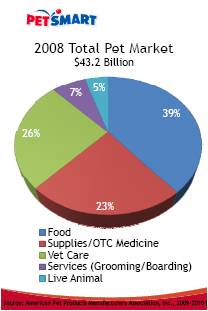
Source: Petsmart 2009 Analyst Day
Not everything is peachy keen as the company acknowledges the negative impact of unemployment, lower discretionary consumer spending and higher savings rate. As a result, PETM’s high margin “Hardgoods” category has gotten clobbered lately – even with more stable sales in non-discretionary categories like “Food.” Despite the economic developments, the company is not sitting on its hands. Not only are they focusing on driving sales through store pet adoptions (approaching four million on a cumulative basis), but the company is also reaping the rewards of its Pet Perks customer database to optimize sales performance. Petsmart has even taken a page out of Costco’s (COST) book with its focus on private label brands.
Beyond sales growth initiatives, the company has also been tightening their spending belt. For example, PETM is reducing capital expenditures from 6.4% of sales ($294 million) in 2007 to an estimated 2.2% ($120 million) this year. In addition, PETM is working on process improvements, space optimization, labor scheduling, and other cost-cutting initiatives.
The fruits of these labors are creating results. Just last week at their analyst meeting, PETM raised their 2009 earnings per share forecast to a range of $1.43 – $1.51 (from previous estimate of $1.37 – $1.45). Based on 2010 Wall Street estimate of $1.54, PETM’s stock currently trades at a reasonable 16.5x P/E multiple. On a free cash flow basis, the multiple on the estimated $226 million this year is even more attractive (see my article on cash flow investing).
Halloween is just around the corner, so maybe beyond picking up a doggie cardigan for the crisp fall weather, maybe you should consider some PETM shares too.
Wade W. Slome, CFA, CFP®
Plan. Invest. Prosper.
DISCLOSURE: Sidoxia Capital Management and its client accounts have no direct position in COST shares at the time this article was originally posted. Slome Sidoxia Fund does have a long position in PETM shares at the time this article was originally posted. No information accessed through the Investing Caffeine (IC) website constitutes investment, financial, legal, tax or other advice nor is to be relied on in making an investment or other decision. Please read disclosure language on IC “Contact” page.
Dry Powder Piled High

Money goes where it is treated best. Sometimes idle cash contributes to the inflation of speculative bubbles, while sometimes that same capital gets buried in a bunker out of fear. The mood-swing pendulum is constantly changing; however with the Federal Funds Rate at record lows, some of the bunker money is becoming impatient. With the S&P 500 up +60% since the March lows, investors are getting antsy to put some of the massive mounds of dry powder back to work – preferably in an investment vehicle returning more than 1%.
How much dry powder is sloshing around? A boatload. Bloomberg recently referenced data from ICI detailing money market accounts flush with a whopping $3.5 trillion. This elevated historical number comes despite a $439.5 million drop from the record highs experienced in January of this year.
From a broader perspective, if you include cash, money-market, and bank deposits, the nation’s cash hoard reached $9.55 trillion in September. What can $10 trillion dollars buy? According to Bloomberg, you could own the whole S&P 500 index, which registers in at a market capitalization price tag of about $9.39 trillion. The article further puts this measure in context:
“Since 1999, so-called money at zero maturity has on average accounted for 62 percent of the stock index’s worth. … Before the collapse of New York-based Lehman Brothers Holdings Inc. last year, the amount of cash never exceeded the value of U.S. equities.”
Cash levels remain high, but the 60% bounce from the March lows is slowly siphoning some money away. According to ICI data, $15.8 billion has been added to domestic-equity funds since March. Trigger shy fund managers, fearful of the macro-economic headlines, have been slow to put all their cash to work, as well. Jeffrey Saut, chief investment strategist at Raymond James & Associates adds “Many of the fund managers I talk to that have missed this rally or underplayed this rally are sitting with way too much cash.”
With so much cash on the sidelines, what do valuations look like since the March rebound?
“The index [S&P 500] trades for 2.18 times book value, or assets minus liabilities, 33 percent below its 15-year average, data compiled by Bloomberg show. The S&P 500 was never valued below 2 times net assets until the collapse of Lehman, data starting in 1994 show. The index fetches 1.15 times sales, 22 percent less than its average since 1993.”
On a trailing P/E basis (19x’s) the market is not cheap, but the Q4 earnings comparisons with last year are ridiculously easy and companies should be able to trip over expectations. The proof in the pudding comes in 2010 when growth in earnings is projected to come in at +34% (Source: Standard & Poor’s), which translates into a much more attractive multiple of 14 x’s earnings. Revenue growth is the missing ingredient that everyone is looking for – merely chopping an expense path to +34% earnings growth will be a challenging endeavor for corporate America.
Growth outside the U.S. has been the most dynamic and asset flows have followed. With some emerging markets up over +100% this year, the sustainability will ultimately depend on the shape of the global earnings recovery. At the end of the day, with piles of dry powder on the sidelines earning next to nothing, eventually that capital will operate as productive fuel to drive prices higher in the areas it is treated best.
Read the Complete Bloomberg Article Here.
Wade W. Slome, CFA, CFP®
Plan. Invest. Prosper.
“Pessimism Porn” Takes a Hit – Emotions of Investing

“Every dark cloud has a silver lining, but lightning kills hundreds of people each year who are trying to find it.”
–Tongue-in-cheek quote from motivational poster.
There’s nothing like a little destructive global financial crisis to boost viewership ratings. CNBC benefitted last fall from all the gloom and doom permeating the media outlets, but unfortunately for the cable business channel, a more constructive market environment over the last six months doesn’t sell as well as what New York Magazine called, “pessimism porn.” Tyler Durden at Zero Hedge recently provided statistics showing the impact of more optimistic financial markets. CNBC experienced total viewer year-over-year declines of -37% as measured in mid-September – worse than Mr. Durden’s late July statistics that illustrated a -28% decline.
Small wonder that we now see discussions developing between Comcast Corp. (CMCSA) and General Electric (GE) over a potential partnership with the NBC-Universal assets. Other potential parties may enter the fray, but GE’s shopping of the traditional media unit is evidence ofthe station’s pessimism over a secularly declining business.
Businesses are not the only ones influenced by pessimism – so are individuals. Behavioral economists Daniel Kahneman and Amos Tversky have provided support to the impact pessimism has on peoples’ psyches. Emotional fears of loss can have a crippling effect in the decision making process. Through their research, Kahneman and Tversky showed the pain of loss is more than twice as painful as the pleasure from gain. How do they prove this? Through various hypothetical gambling scenarios, they highlight how irrational decisions are made. For example, more people choose the scenario of an initial $600 nest egg that grows by $200, rather than starting with $1,000 and losing $200 (despite ending up at the same exact point under either scenario).
Of course investors have short memories from a historical perspective. Whether it’s the 17th century tulip mania (people paying tens of thousands for tulips – inflation adjusted), the technology bubble of the late 1990s, or the more recent real estate/credit craze, eventually a new bubble forms.
If you are one of those people that get sucked into “pessimism porn” or big bubbles, then I suggest you grab the remote control, turn off CNBC, and then switch over to The History Channel. You may just learn from the repeated emotional mistakes made by those of our past.
Wade W. Slome, CFA, CFP®
Plan. Invest. Prosper.
DISCLOSURE: Sidoxia Capital Management (SCM) and some of its clients own certain exchange traded funds, but at the time of publishing SCM had no direct position in CMCSA, GE, or any other security referenced in this article. No information accessed through the Investing Caffeine (IC) website constitutes investment, financial, legal, tax or other advice nor is to be relied on in making an investment or other decision. Please read disclosure language on IC “Contact” page.
Nation’s CEOs Suffering Severely: Pay Down -0.08%

Hold on, let me pull out my violin to play some sympathetic consoling music for our nation’s Chief Executive Officers (CEOs). According to a Corporate Library survey of 2,700 publicly traded companies, CEO compensation declined -0.8% in 2008. I guess that 4th Ferrari and 3rd yacht will have to be put on hold. With some creative perseverance and a little elbow grease, I’m sure the class of underprivileged CEOs can still salvage a healthy package of stock options and restricted stock (to pad the paltry multi-million dollar salaries).
This is what Payscale.com had to say in a report from 2008:
“In 1970, CEO salary and bonus packages were typically about $700,000 – 25 times the average production worker salary; by 2000, CEO salaries had jumped to almost $2.2 million on average, 90 times the average salary of a worker, according to a 2004 study on CEO pay by Kevin J. Murphy and Jan Zabojnik. Toss in stock options and other benefits, and the salary of a CEO is nearly 500 times the average worker salary, the study says.”
Of course, Congress and the public are looking for scapegoats to blame for the global financial crisis. There is no better group to blame than highly compensated CEOs. As a result, we are seeing more “say on pay” proposals brought to shareholder votes, thereby removing power from the hands of self-appointed compensation committees and chummy board members. Currently, a Shareholder Bill of Rights Act is making its rounds through Congress that would establish an annual shareholder vote to approve executive compensation of executive management along with have a separate vote on “golden parachute” payments in the context of a company merger or acquisition.
The U.S. is not the only country to implement these types of shareholder rights. As David Ellis at CNN Money wrote, “In 2002, the United Kingdom embraced the practice, and it has subsequently been taken up in Australia and Sweden.” In the U.S. such proposals being considered are on a “non-binding” basis, which means that if “say on pay” is approved there will be no obligation for management to implement the changes – rather “shame” will be the strategic lever used by shareholders.
Everyone has been impacted in one shape or form by the financial crisis, so when you tuck-in your child or lay your head on the pillow tonight, rest assured our poor corporate CEOs are sharing in the pain…just remember, they only kept 99.2% of their pay last year.
Read More About Corporate Library Survey
Wade W. Slome, CFA, CFP®
Plan. Invest. Prosper.
Celebrity Tax Evaders Run But Can’t Hide

As Mark Twain said, “The only certainties in life are death and taxes.” That is, of course, unless you decide to not pay your taxes. Some well known celebrities fall into this camp.
The financial crisis has hit the economy hard and the impact has been felt directly by our nation’s cash register (i.e., the Internal Revenue Service – IRS). Based on 2006 IRS data, the U.S. had about an 84% Voluntary Compliance Rate (VCR) by tax payers in 2001; a goal of 85% VCR in 2009; and Senate Finance Committee Chairman Max Baucus has thrown out a 90% voluntary compliance goal by 2017. Those collection goals may be a little ambitious given the recession and the escalating unemployment trends over 2008 – 2009.
So who makes up the deadbeats who have deliberately or unintentionally not paid their taxes? Obviously 10-15% of the non-paying tax-payer base is a large number, but the real fun comes by tracking the smaller celebrity component of the tax evaders. Let’s take a look at some of the more prominent dodgers (data provided by The Daily Beast):
- O.J. Simpson: In 2007 the state of California placed listed Mr. Simpson as one of their worst tax offenders, owing close to $1.5 million. Currently he is serving a 33-year sentence in a Nevada prison for an armed robbery and kidnapping conviction.
- Willie Nelson: The long-haired hippy and king of country music, Willie Nelson, was hunted down by the IRS for $16.7 million in 1990. Fortunately for him, his star-power allowed him to record albums and pay back his debt by 1993.
- Wesley Snipes: The Blade movie star claimed the reason he owed more than $17 million in taxes, penalties, and interest is because he was a “non-resident alien.” The judge didn’t buy the explanation, and now he is appealing a three-year prison sentence.
- Pete Rose: “Charlie Hustle,” the all-star baseball player of the Cincinnati Reds served five months in prison for not paying taxes on his autograph, memorabilia, and horse-racing income. Mr. Rose cleared the slate by performing 1,000 hours of community service and paying off $366,000 in debt.
- Nicolas Cage: Not sure if he is shooting a movie in New Orleans, but Mr. Cage is attempting to iron out a $6.2 million tax liability through a Louisiana court for his failure to keep up with 2007 taxes.
- Judy Garland: Men are not the only non-compliers, even if they account for the majority. Judy Garland, from Wizard of Oz fame, had her own tax problems. Besides tax evasion charges in the early 1950s, she accumulated about $4 million in IRS debt after her 1964 variety show (The Judy Garland Show) was cancelled.
- Al Capone: One of most well known cases in tax evasion history is tied to famous mobster Al Capone. After a long, controversial trial, Mr. Capone was convicted and handed an 11-year sentence, predominantly at Alcatraz. He got out early on parole in 1939 and kept a relatively low profile.
There are countless others that have gotten into tax problems with the IRS. Many of them make plenty of money to pay their taxes, however spending habits, laziness, or aggressive tax accountants may explain the reasons behind the tax evasion problems.
See a more complete media gallery of tax evaders here, provided by The Daily Beast.
Regardless of the celebrities’ tax-paying compliance rates, the IRS will have its collection hands full, given the sad state of the current economic environment and the crafty tax-dodging techniques pursued by some citizens. Unlike others, I’ll make sure to write myself a note, reminding me to write a check to my friends at the IRS on April 15th – especially if it involves millions.
Wade W. Slome, CFA, CFP®
Plan. Invest. Prosper.




 Investing Caffeine
