Posts filed under ‘Themes – Trends’
Avoiding Automobile and Portfolio Crashes

Personal opinions of oneself don’t always mirror reality. Self perceptions relating to both driving and investing can be inflated. For example, the National Highway Traffic Safety Administration (NHTSA) reports that 95% of crashes are caused by human error, but 75% of drivers say they are better drivers than most.
Contributing factors to crashes include: 1) Distractions; 2) Alcohol; 3) Unsafe behavior (i.e., speeding); 4) Time of day (fatality rate is 3x higher at night); 5) Lack of safety belt; 6) Weather; and 7) Time of week (weekends are worst crash days).
A spokesman for the Insurance Institute for Highway Safety is quick to point out that driving behind the wheel is the riskiest activity most people engage in on a daily basis – more than 40,000 driving related fatalities occur each year. Careful common sense helps while driving, but driving sober at 4 a.m. (very few drivers on the road) on a weekday with your seatbelt on won’t hurt either.
Avoiding a Portfolio Crash
Another dangerous activity frequently undertaken by Americans is investing, despite people’s inflated beliefs of their money management capabilities. Investing, however, does not have to be harmful if proper precautions are taken.
Here is some of the hazardous behaviors that should be avoided by those maneuvering an investment portfolio:
1) Trading Too Much: Excessive trading leads to undue commissions, transaction costs, bid-ask spread, impact costs. Many of these costs are opaque or invisible and won’t necessarily be evident right away. But like a leaky boat, direct and indirect trading costs have the potential of sinking your portfolio.
2) Worrying about the Economy Too Much: The country experiences about two recessions a decade, nonetheless our economy continues to grow. If macroeconomics still worry you, then look abroad for even healthier growth – considerable international exposure should aid the long-term success of your portfolio and assist you in sleeping better at night.
3) Emotionally Reacting – Not Objectively Planning: News is bad, so sell. News is good, so buy. This type of conduct is a recipe for portfolio disaster. Better to do as Warren Buffett says, “Be fearful when others are greedy, and be greedy when others are fearful.” The long-term fundamental prospects for any investment are much more important than the daily headlines that get the emotional juices flowing.
4) Hostage to Short-term Time Horizon: Rather than worry about the next 10 days, you should be focused on the next 10 years. The further out you can set your time horizon, the better off you will be. Patience is a virtue.
5) Incongruent Portfolio with Risk: Many retirees got caught flat-footed in the midst of the global financial crisis of 2008-09 with investment portfolios heavy in equities and real estate. Diversified portfolios including fixed-income, commodities, international exposure, cash, and alternative investments should be optimized to meet your specific objectives, constraints, risk tolerance, and time horizon.
6) Timing the Market: Attempting to time the market can be hazardous to your investment health (see Market Timing article). If you really want to make money, then avoid the masses – the grass is greener and the eating better away from the herd.
Driving and investing can both be dangerous activities that command responsible behavior. Do yourself a favor and protect yourself and your portfolio from crashing by taking the appropriate precautions and avoiding the common hazardous mistakes.
Read Full Forbes Article on Driving Dangers
Wade W. Slome, CFA, CFP®
Plan. Invest. Prosper.
*DISCLOSURE: Sidoxia Capital Management (SCM) and some of its clients own certain exchange traded funds, but at the time of publishing SCM had no direct positions in any security referenced in this article. No information accessed through the Investing Caffeine (IC) website constitutes investment, financial, legal, tax or other advice nor is to be relied on in making an investment or other decision. Please read disclosure language on IC “Contact” page.
Measuring the Market with Valuation Dipstick

Investor opinions about the stock market’s value are all over the map.
Doomsayers think the market is valued at crazy levels, and believe that “buy-and-hold” investing is dead. Bears remind investors that stocks have led to nothing good except for a lost decade of performance (read article on Lost Decade). Many speculators on the other hand believe they have the ability to “time the markets” to take advantage of volatility in any market (see also Market Timing article). In trader land, overconfidence is never in short-supply. Certainly, if you are a trader at Goldman Sachs (GS) or UBS and you are trading with privileged client data, then taking advantage of volatility can be an extremely lucrative endeavor. However most day-traders, and average investors, are not honored with the same information. Rather, the public gets overwhelmed by online brokerage firms and their plethora of software bells and whistles – inadequate protection when investing among a den of wolves. Equipping speculators with day trading tools is a little like giving a 7-year old a squirt gun and shipping them off to Afghanistan to fight the Taliban – the odds are not in the kid’s favor.
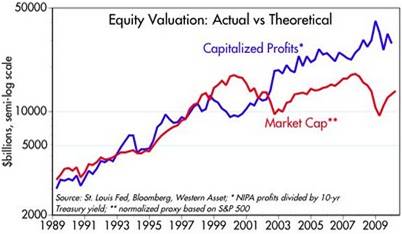
With so much uncertainty out in the marketplace, how do we know if the overall market is cheap or expensive? According to Scott Grannis, former Chief Economist at Western Asset Management and author of the Calafia Beach Pundit blog, the dipstick components necessary to measure the value of the market are corporate profits relative to the level of Gross Domestic Product (GDP) and the value (market cap) of the S&P 500 index. Grannis is a believer in the tenet that stock prices follow earnings, and as you can see from his charts below, earnings have grown much faster than stock prices over the last 10 years:
20 Year Chart
50 Year Chart
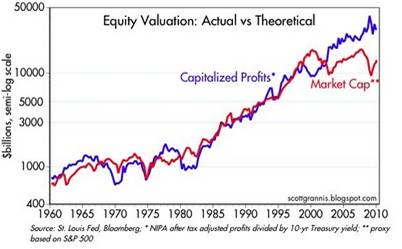
As you can see there is an extremely tight correlation on the 50-year chart until the last decade. What does the recent diverging trend mean? Here’s what Grannis has to say:
“Note that profits doubled from 1998 to 2009, yet the S&P 500 index today is still lower than it was at the end of 1998…equities continue to be extremely undervalued. Another way of looking at this is that the market is discounting current profits using an 8% 10-yr Treasury yield, or a 50% drop in corporate profits from here. Simply put, according to this model the market is priced to some very awful assumptions.”
How will this valuation gap be alleviated? Grannis correctly identifies two scenarios to achieve this end: 1) Rising treasury yields; and 2) Rising equity prices. His base case would be a move on the 10-year yield to 5.5%, and a move upwards in the S&P 500 index +50%.
Judging by Grannis’s dipstick measurement, there’s plenty of oil in the system to prevent the market engine from overheating just quite yet.
Read the Complete Scott Grannis Article
Wade W. Slome, CFA, CFP®
Plan. Invest. Prosper.
*DISCLOSURE: Sidoxia Capital Management (SCM) and some of its clients own certain exchange traded funds, but at the time of publishing SCM had no direct positions in GS, UBS, or any security referenced in this article. No information accessed through the Investing Caffeine (IC) website constitutes investment, financial, legal, tax or other advice nor is to be relied on in making an investment or other decision. Please read disclosure language on IC “Contact” page.
Mozilo and Healthcare Tan Tax to the Rescue?

Ideological trains came crashing together as the battle for comprehensive healthcare reform resulted in the whole enchilada approach of the Democrats winning over the baby-step approach advocated by the Republicans. Thank goodness there is a savior to remedy the hefty $940 billion costs of the national healthcare plan…Angelo Mozilo. Not only will this mortgage tycoon (former CEO of Countrywide – the largest U.S. mortgage lender at one time) have his fat-cat wallet to fund multiple new healthcare taxes on the wealthy, but the government will also be collecting a new 10% tanning tax on all Mr. Mozilo’s bronzing sessions. Perhaps the CBO (Congressional Budget Office) healthcare reform cost saving estimates ($138 billion in the first decade) may come in even better than anticipated?
20,000,000 Tanning Sessions to Health
The public shouldn’t shed a tear for the real estate pain Mr. Mozilo endured – he still managed to stash a nice pile of dough before the mortgage walls came tumbling down on him. Given Mr. Mozilo’s timely sale of about $300 million in Countrywide stock before the share price cratered, coupled with the $23.8 million retirement fund and roughly $21 million in deferred compensation (Minyanville.com), Mr. Mozilo should have enough money to cover about 20,000,000 tanning sessions by my calculation. That sounds like a rather large number, but I expect Mr. Mozilo will shrewdly negotiate a bulk discount for the sessions, even if the government disapproves of the asssociated lost tax revenues.
However, one major potential hurdle for Mozilo may be finding the adequate time for tanning. If the SEC (Securities and Exchange Commission) is successful in prosecuting him on the alleged securities fraud and insider trading charges, then he may need to petition for a tanning bed in the prison gym.
Unintended Beach-going Consequences
Although we all condemn the harmful side effects of skin cancer from sunbathing, let’s not completely dismiss some of the advantages, including the benefits of Vitamin D production. Other cited ailments benefitting from sunlight exposure include, eczema, arthritis, psoriasis, acne, season affective disorder, and depression. One of the worse afflictions suffered by beach-goers (male and female alike) is the tragic “pastiness” condition. One of the severe unintended consequences of President Obama’s tanning tax may indeed be the extreme ridicule unleashed on light skinned beach bums that are unable to afford the tanning tax (see photo below).

Toss the Drumstick
On a more serious note, I get the fact that the government wants to raise a substantial amount of money to cover an extensive healthcare bill like this one – either through taxes and/or cost cuts. However, I think there are other areas in the healthcare food chain that need to climb higher in the national debate. Although, I’m OK with the tanning tax, I strongly believe there is more fertile ground in attacking obesity (see article on the Economics and Consequences of Obesity) and other costlier areas of treatment. The amount of money spent on managing obesity, and associated ailments, trounces the expenditures directed towards cancer by more than $50 billion by some estimates. Dated data shows we are spending more than $100 billion dollars on obesity-related healthcare costs. One study estimates obesity costs in the United States will reach $344 billion by 2018.
Bolstering the severity of the condition, the CDC (Center of Disease Control) noted the following:
“More than one third of U.S. adults—more than 72 million people—and 16% of U.S. children are obese. Since 1980, obesity rates for adults have doubled and rates for children have tripled. Obesity rates among all groups in society—irrespective of age, sex, race, ethnicity, socioeconomic status, education level, or geographic region—have increased markedly.”
I realize the importance of a copper tone tan can have on the lives of millions of Americans, and I also recognize the tanning tax is just a small blip in the growing 2,200 healthcare bill signed into law. Nonetheless, the spotlight of the healthcare debate needs to focus on the highest cost silos (i.e., obesity). Otherwise, I’m not completely sure whether all of Angelo’s taxed tanning sessions will be enough to cover our country’s immense healthcare costs?
Related Article: Bill Maher Chearleads No Profit Healthcare
Wade W. Slome, CFA, CFP®
Plan. Invest. Prosper.
*DISCLOSURE: Sidoxia Capital Management (SCM) and some of its clients own certain exchange traded funds, but at the time of publishing had no direct positions in BAC or any security mentioned in this article. No information accessed through the Investing Caffeine (IC) website constitutes investment, financial, legal, tax or other advice nor is to be relied on in making an investment or other decision. Please read disclosure language on IC “Contact” page.
Jumping on the Globalization Train

What happens when you mix a group of Saudi Arabians, Germans, Chinese, French, and South Koreans with billions of dollars? This is not the lead-in question to a politically incorrect joke, but rather a teaser related to a multi-billion infrastructure project currently under a bidding process in Saudi Arabia.
The proposed $7 billion, 450 kilometer high speed Saudi Arabian railway connecting Islam’s two holiest cities (Mecca and Medina) is expected to ease congestion of the 2.5 million Muslims making the annual journey to Mecca as part of the Hajj pilgrimage.
Amidst the fallout from the recent global financial crisis, the benefits of capitalism, globalization, and free trade have come under attack. There obviously were some horrible decisions made and the collapse of financial institutions around the world underscored the necessity to shore up our regulatory system. Nonetheless, this microcosm of a project is proof positive that globalization is alive and well (see also Friedman Flat World article). How else can you explain China Railway Construction Corp./Beijing Railway Administration (China), Siemens (Germany), Hyundai/Samsung (South Korea), Alstom (France), and Saudi Binladin Group (Saudi Arabia) coming together on a multi-billion project bidding process?
Oil Rich Countries Think Strategically
Saudi Arabia is not the only oil-rich country that has used the dramatic increase in oil revenues to fund investments in the future. Beyond Saudi Arabia, other oil rich areas like Qatar, Russia, and the UAE (United Arab Emirates) federation are examples of regions wanting to join the 21st Century global party rather than sitting around idly. The billions of black gold being pumped from the oil reservoirs is getting poured into infrastructure, such as technology, roads, bridges, hospitals, and yes…railways. These countries realize the importance of diversifying their economies away from the dependence on any one sector. Leadership from these regions understand the damaging economic impact of boom-bust energy price cycles, therefore they are doing their best by diversifying into other economic areas – including infrastructure. How serious is Saudi Arabia when it comes to investments? Well, the United States stimulus program was a drop in the bucket (single digit percentage of GDP) relative to Saudi Arabia, which according to BusinessWeek had the largest stimulus package among the Group of 20 (69% of GDP).
The Case for Free Trade
As protectionists and trade union organizers scratch and scream in response to expansion of globalization, competing countries around the world have their economic foot on the pedal when it comes to extending trade borders.
Tariffs, quotas and various other taxes only serve to drag down the competitiveness of our country’s most treasured industries.
These economic trade concepts are not new. Adam Smith, considered by some as the “father of economics” wrote about the “invisible hand” in his famous book Wealth of Nations (1776) and economist David Ricardo explained “comparative advantage” in his book On the Principles of Political Economy and Taxation (1817). Without getting into the nitty-gritty, suffice it to say the advantages to free trade have been well documented over the centuries.
As the standards of living climbs for hundreds of millions of people in developing countries, these populations are becoming fertile ground for the sale of U.S. technology, pharmaceuticals, appliances, automobiles, and other goods and services.
Rather than pouring sand into the gears of innovation, incentives need to be established to motivate product excellence. Otherwise, capital and jobs will migrate to other countries. Intel CEO (INTC) Paul Otellini, who was recently quoted in a New York Times article, is urging Congress to improve business, tax, and education incentives. Thanks to China’s tax policy and availability of a skilled labor pool, Intel is able to save $1 billion on a $4.5 billion plant being constructed this year – not exactly chump change.
Certainly, rules need to be created that promote fairness and credible enforcement of penalties, otherwise the benefits of trade become diluted.
Overall, the recent financial crisis caused economists, politicians, and various pundits to question the validity and benefits of capitalism, globalization, and free trade. In the vast spanning web of global commerce, the recent high speed Saudi railway may only represent a very tiny thread in the whole world’s infrastructure spend. Nonetheless, this multi-billion project integrating international heavyweights from all over world proves that despite the shortcomings of globalization, capitalism, and free trade, the benefits remain substantial and there is still time to jump back on the train.
Read The Financial Times article on the Saudi Arabia railway project.
Wade W. Slome, CFA, CFP®
Plan. Invest. Prosper.
*DISCLOSURE: Sidoxia Capital Management (SCM) and some of its clients own certain exchange traded funds, but at the time of publishing had no direct positions in Intel (INTC), China Railway Construction Corp., Beijing Railway Administration, Siemens, Hyundai/Samsung, Alstom, and Saudi Binladin Group or any security mentioned in this article. No information accessed through the Investing Caffeine (IC) website constitutes investment, financial, legal, tax or other advice nor is to be relied on in making an investment or other decision. Please read disclosure language on IC “Contact” page.
Extrapolation: Dangers of Mixing Cyclical & Secular

One of the toughest jobs in making investment decisions is determining whether changes in profit growth rates are due to cyclical trends or secular trends. The growth of technology and the advent of the internet have not only accelerated the pace of information exchange, but these advancements have also led to the explosion of information (read more).
Drowning in too much information can make the most basic decisions confusing. One of the dreaded by-products of “information overload” is extrapolation. When faced with making a difficult or time consuming decision, many investors choose the path of least resistance, which is to fall back on our good friend…extrapolation.
Rather than taking the time of gathering the appropriate data, exploring both sides of an argument, and having objective information guide educated decisions, many investors open their drawers and grab their trusty ruler. The magic ruler is a wonderful straight-edged tool that can coherently connect any two data points. The beauty of the wooden instrument is the never-ending ability to bolt on a simple convenient story on why a short-term trend will persist forever (upwards or downwards).
We saw it firsthand as the world got sucked down the drain of the global financial crisis. Throughout 2008 bearish pundits like Nouriel Roubini, Peter Schiff, Meredith Whitney, and Jimmy Rogers came out of the woodwork (read more about Pessimism Porn) comparing the environment to the Great Depression and calling for economic collapse. Needless to say, equity markets rebounded significantly in 2009. The vicious rally was not strong enough, nor has the economic data turned adequately rosy for the bears to pack up their bags and hibernate. To be fair, the panicked moods have subsided for “Happy Abby” (Abby Joseph Cohen – Goldman Sachs strategist) to make a few short cameos on CNBC (read more), but we are far from the euphoric heights of the late ‘90s.
I think recent comments by John Authers, columnist at The Financial Times, captures the essence of the current sour mood despite the economic and equity market rebounds:
“Last year’s rebound was, most likely, a bear market bounce. The central hypothesis remains intact. On balance of probabilities, the rally since March has been a (very big) rally within a bear market, and the downward move is a (not so big) correction to that rally. There is no new reason to fear we will revisit the lows of 2009, but every reason to believe that stocks are still fundamentally mired in a bear market.”
Just as overly pessimistic bearishness can cloud judgment, so too can rose colored glasses. Chief economist at the National Association of Realtors, David Lereah, is an example of how biased bullishness can cloud reasoning too. Among the many comments that made Lereah a lightning rod, in July 2006 he noted the real estate “market is stabilizing” and followed up six months later by claiming, “It appears we have established a bottom.”
Extrapolation is a fun, easy tool, but at some point the simple laws of economics must kick into gear. Supply and demand generally do not rise and fall in a linear fashion in perpetuity. As the saying goes, “The herd is often led to the slaughterhouse.” Rather, I argue mean- reversion is a much more powerful tool than extrapolation for investors (read more).
The country faces many critical problems that cannot be ignored and politicians need to show leadership in addressing them. I encourage and remind people that we have survived through multiple wars, assassinations, currency crises, banking crises, SARS, mad cow, swine flu, widening deficits, recessions, and even political gridlock. So next time someone tells you the world is coming to the end, or a stock is going to the moon, do yourself a favor by putting away the ruler and aggregating the relevant data on both sides of an argument before jumping to hasty conclusions.
Wade W. Slome, CFA, CFP®
Plan. Invest. Prosper.
DISCLOSURE: Sidoxia Capital Management (SCM) and some of its clients own certain exchange traded funds, but at time of publishing had no direct positions in LM, or GS. No information accessed through the Investing Caffeine (IC) website constitutes investment, financial, legal, tax or other advice nor is to be relied on in making an investment or other decision. Please read disclosure language on IC “Contact” page.
Mauboussin Takes the Outside View

Michael Mauboussin, Legg Mason Chief Investment Strategist and author of Think Twice, is a behavioral finance guru and in his recent book he explores the importance of seriously considering the “outside view” when making important decisions.
What is Behavioral Finance?
Behavioral finance is a branch of economics that delves into the non-numeric forces impacting a diverse set of economic and investment decisions. Often these internal and external influences can lead to sub-optimal decision making. The study of this psychology-based discipline is designed to mitigate economic errors, and if possible, improve investment decision making.
Two instrumental contributors to the field of behavioral finance are economists Daniel Kahneman and Amos Tversky. In one area of their research they demonstrated how emotional fears of loss can have a crippling effect in the decision making process. In their studies, Kahneman and Tversky showed the pain of loss is more than twice as painful as the pleasure from gain. How did they illustrate this phenomenon? Through various hypothetical gambling scenarios, they highlighted how irrational decisions are made. For example, Kahneman and Tversky conducted an experiment in which participating individuals were given the choice of starting with an initial $600 nest egg that grows by $200, or beginning with $1,000 and losing $200. Both scenarios created the exact same end point ($800), but the participants overwhelmingly selected the first option (starting with lower $600 and achieving a gain) because starting with a higher value and subsequently losing money was not as comfortable.
The impression of behavioral finance is burned into our history in the form of cyclical boom, busts, and bubbles. Most individuals are aware of the technology bubble of the late 1990s, or the more recent real estate/credit craze, however investors tend to have short memories are unaware of previous behavioral bubbles. Take the 17th century tulip mania, which witnessed Dutch citizens selling land, homes, and other assets in order to procure tulip bulbs for more than $70,000 (on an inflation-adjusted basis), according to Stock-Market-Crash.net. We can attempt to delay bubbles, but they will forever be a part of our economic fabric.
The Outside View
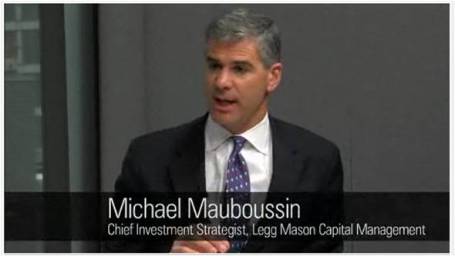 Click here for Michael Mauboussin interview with Morningstar
In his book Think Twice Mauboussin takes tenets from behavioral finance and applies it to individual’s decision making process. Specifically, he encourages people to consider the “outside view” when making important decisions.
Mauboussin makes the case that our decisions are unique, but share aspects of other problems. Often individuals get trapped in their heads and internalize their own problems as part of the decision making process. Since decisions are usually made from our personal research and experiences, Mauboussin argues the end judgment is usually biased too optimistically. Mauboussin encourages decision makers to access a larger outside reference class of diverse opinions and historical situations. Often, situations and problems encountered by an individual have happened many times before and there is a “database of humanity” that can be tapped for improved decision making purposes. By taking the “outside view,” he believes individual judgments will be tempered and a more realistic perspective can be achieved.
In his interview with Morningstar, Mauboussin provides a few historical examples in making his point. He uses a conversation with a Wall Street analyst regarding Amazon (AMZN) to illustrate. This particular analyst said he was forecasting Amazon’s revenue growth to average 25% annually for the next ten years. Mauboussin chose to penetrate the “database of humanity” and ask the analyst how many companies in history have been able to sustainably grow at these growth rates? The answer… zero or only one company in history has been able to achieve a level of growth for that long, meaning the analyst’s projection is likely too optimistic.
Mean reversion is another concept Mauboussin addresses in his book. I consider mean reversion to be one of the most powerful principles in finance. This is the idea that upward or downward moving trends tend to revert back to an average or normal level over time. In describing this occurrence he directs attention to the currently, overly pessimistic sentiment in the equity markets (see also Pessimism Porn article). At end of 1999 people were wildly optimistic about the previous decade due to the significantly above trend-line returns earned. Mean reversion kicked in and the subsequent ten years generated significantly below-average returns. Fast forward to today and now the pendulum has swung to the other end. Investors are presently overly pessimistic regarding equity market prospects after experiencing a decade of below trend-line returns (simply look at the massive divergence in flows into bonds over stocks). Mauboussin, and I concur, come to the conclusion that equity markets are likely positioned to perform much better over the next decade relative to the last, thanks in large part to mean reversion.
Behavioral finance acknowledges one sleek, unique formula cannot create a solution for every problem. Investing includes a range of social, cognitive and emotional factors that can contribute to suboptimal decisions. Taking an “outside view” and becoming more aware of these psychological pitfalls may mitigate errors and improve decisions.
Wade W. Slome, CFA, CFP®
Plan. Invest. Prosper.
DISCLOSURE: Sidoxia Capital Management (SCM) and some of its clients own certain exchange traded funds and AMZN, but at time of publishing had no direct positions in LM, or MORN. No information accessed through the Investing Caffeine (IC) website constitutes investment, financial, legal, tax or other advice nor is to be relied on in making an investment or other decision. Please read disclosure language on IC “Contact” page.
Google vs. China: Running Away from 660 Million Eyeballs?

Wait, let me get this straight. Google, the $185 billion behemoth that wants to take over the world is seriously considering turning its back on a rapidly growing cluster of 660 million eyeballs (330 million Chinese internet users according to BusinessWeek)? After hitting their head on an obscenely high market share in the U.S. (67% search share based on Nielsen data) and looking for new geographies to expand, I’m supposed to believe Google will walk away from the third largest economy on this planet (see China: Trade of the Century)? The explanation given for Google’s capitulation is discontent related to unknown hackers and censorship concerns. If that’s not enough, this alleged saint-like posturing comes after Google sold its censorship soul for years, before seeing the free speech light. Although the company’s mission is to “do no evil,” Google had no qualms aggressively poaching Microsoft (MSFT) miracle maker, Kai-Fu Lee, to kick-start their Chinese presence. If free speech is truly at the root of the Google’s unease, then why wait four whole years and a hack-attack before laying down an ultimatum on the Chinese government?
I Smell a Rat
In a blog post written by Google’s Chief Legal Officer, David Drummond, the company explains how their iron curtain digital defense was bent but not broken:
“We have evidence to suggest that a primary goal of the attackers was accessing the Gmail accounts of Chinese human rights activists. Based on our investigation to date we believe their attack did not achieve that objective. Only two Gmail accounts appear to have been accessed, and that activity was limited to account information (such as the date the account was created) and subject line, rather than the content of emails themselves.”
I’m no exterminator, but I smell a rat. All this feels a lot more like politics and business tactics then it does an altruistic display of free-speech martyrdom. The Chinese government and Google executives know what is at risk, as they both play a high stakes game of “chicken.”
Google goes onto say:
“As part of our investigation we have discovered that at least twenty other large companies from a wide range of businesses–including the Internet, finance, technology, media and chemical sectors–have been similarly targeted.”
I’m confused. These unknown hackers attacked 20 different companies and only unsuccessfully cracked two Gmail accounts. The evidence sounds pretty harmless on the surface, if this language is representative of reality. Maybe I’m wrong, and a foiled cyber-attack is reason enough to cease operations in a country inhabiting a potential 1.3 billion customers.
Sure China represents a relatively small portion of Google’s revenues (estimated at less than $1 billion and a single digit percentage of revenues), but Google would be insane to walk away from this massive long-term growth market, even if Baidu (BIDU) is currently eating their lunch. Although Google has a smaller #2 position in China, it still has a respectable 35.6% search market share (according to BusinessWeek).
Not Just About Search – Cell Phones Too
Even if they claimed they were throwing in the white towel on their Chinese search business, I don’t think they really want to flush their newly minted cell phone prospects down the toilet. Even if 275 million or so cell phone users in the U.S. is fertile ground for Google to target their new Android-based phones, I’m guessing they have penciled out the gigantic mobile potential of the rapidly expanding 700 million+ Chinese mobile phone user market.
While I can’t take the scenario of Google ceasing China operations off the table, I consider the chance of Google shutting its doors in China significantly less than 50%. While the bold Google statement of feasibility review regarding their Chinese business existence has gained a lot of attention, I think calmer heads will eventually prevail and Google will resume their targeting of 660 million Chinese eyeballs. Who knows, the high stake game of “chicken” may even benefit their bottom-line as they win the hearts and minds of more future free-speech users.
DISCLOSURE: Sidoxia Capital Management (SCM) and some of its clients own GOOG shares and China based exchange traded funds at the time of this article’s publishing, but did not have a direct position in MSFT and BIDU shares. No information accessed through the Investing Caffeine (IC) website constitutes investment, financial, legal, tax or other advice nor is to be relied on in making an investment or other decision. Please read disclosure language on IC “Contact” page.
Short-Termism and the Destruction of Wealth

Oscar Wilde, famous Irish playwright, is known for saying “People know the price of everything and the value of nothing.” In a new book titled the Value of Nothing, Raj Patel questions the efficacy of pure capitalism and builds on that idea that many of society’s major economic problems relate to the lack of focus on value. For example, the cost of a $2 greasy burger or $1 candy bar is actually much higher once you factor in the health costs associated with obesity and diabetes – not to mention indirect charges like trash management or environmental costs.
Patel focuses a decent amount on the social damage caused by the consumerism culture for cheap goods. I think this is certainly relevant when you consider our energy policies. Whether you are a “greenie” or not is almost irrelevant from a strategic or security standpoint. Since we import more than 2/3 of our oil from abroad – much of it from countries that wish to do us harm – it seems almost like a no-brainer to have government create incentives to wean us off our addiction to oil (see Thomas Friedman article). Since pure independence will take decades to achieve, I firmly believe we must simultaneously expand our pool of domestic available fossil fuel resources without getting into holy wars over the environment. If there is a shared focus for energy independence and lower-cost, long-term solutions, then surely there can be space for some common ground.
Short-Termism in the Investment World
In the world of investing, instant gratification, short-termism and the “Cramer-ization” of America have served as fuel behind the housing and credit induced binges that have dragged down our economy. I think Jack Gray of Grantham, Mayo, Van Otterloo nailed it when he said, “Excessive short-termism results in permanent destruction of wealth, or at least permanent transfer of wealth.” Decisions made based on the short-term concerns regarding today’s price may have longer lasting impacts, if the consequences of short-termism are not balanced with the probable outcomes discounted into future values. Short-termism merely creates useless churning and transaction costs that make Wall Street intermediaries a fortune, at the cost of investors.
Gray has a great chart from John Bogle data at Vanguard providing a historical perspective on portfolio turnover percentage basis (the inverse being the average investment holding period in years for fund managers):

As you can see from the data chart, the average holding period for equity mutual funds has gone from about 5 years (20% turnover) in the mid 1960s to significantly less than 1 year (> 100% turnover) in recent years. Advancements in technology have lowered the damaging costs of transacting, but the increased frequency, coupled with other costs (impact, spread, emotional, etc.), have been shown to be detrimental over time (Bogle).
Congress would do taxpayers a favor too if they focused on the long-term, rather than piling on debt and building deficits for future generations. If Raj Patel and Jack Gray can get our leaders and investors to strategically think about long-term value, then I know I can sleep more comfortably at night.
Listen to NPR Raj Patel Radio Interview
Wade W. Slome, CFA, CFP®
Plan. Invest. Prosper.
DISCLOSURE: Sidoxia Capital Management (SCM) and some of its clients own certain exchange traded funds (including Vanguard Funds), but at time of publishing had no direct position in any company mentioned in this article. No information accessed through the Investing Caffeine (IC) website constitutes investment, financial, legal, tax or other advice nor is to be relied on in making an investment or other decision. Please read disclosure language on IC “Contact” page.
Cash Pile Still Growing

Despite the sluggish economic reports, corporate cash piles have been expanding (see “Nest Egg” chart), thanks to aggressive cost-cutting, stabilization in GDP numbers, and meager capital programs. As part of stingy CFOs and executives controlling expenses, companies have been slow to hire despite an expected two quarters of economic growth. Job hiring is likely to remain scarce since capacity utilization and capital expenditures will probably remain priorities before job payrolls expand. It may be that jobs were the first area cut as the crisis unfolded and the last aspect to rebound in the economic expansion.
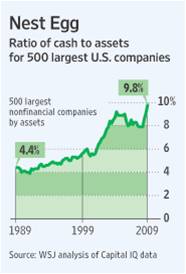
Source: The Wall Street Journal and Capital IQ
As the saying goes, “A bank only lends to those people whom do not need it.” Common knowledge has it that most jobs are created from small and medium sized businesses (SMBs). Unfortunately, the inaccessibility of loans for these SMBs has contributed to the lackluster job recovery. The hemorrhaging of jobs has slowed to a trickle, but sustainable recovery will eventually require new, substantive job creation. Rather than fund what appear to be risky loans to SMBs, banks are choosing to repair their weary balance sheets to reap the benefits of a very steep yield curve (borrowing at low short-term interest rates and lending at relatively high long-term interest rates). Bankers are not the only people stockpiling cash (see other article on cash). On the capital raise side, larger corporations have had more success in tapping the capital credit markets since bond issuance has been flowing nicely.

Source: Haver Analytics and Gluskin Sheff
As multi-national corporations continue to benefit from a relatively weak dollar and Wall Street persists to underestimate the trajectory of the U.S. corporate profit rebound, banks are hoarding more capital, which is leading to a larger cash pile. When will all this cash reflow back into the marketplace? The timing is unclear, but if the profitability and hoarding trends continue, the low-yielding cash piles spoiling on the balance sheets are likely to be released into the economy in the form of capital expenditures and rehiring. Job seekers will breathe a sigh of relief once these corporate wallets become too uncomfortably fat.
Wade W. Slome, CFA, CFP®
Plan. Invest. Prosper.
DISCLOSURE: Sidoxia Capital Management (SCM) and some of its clients own certain exchange traded funds (such as VFH), but at time of publishing had no direct position in any company mentioned in this article. No information accessed through the Investing Caffeine (IC) website constitutes investment, financial, legal, tax or other advice nor is to be relied on in making an investment or other decision. Please read disclosure language on IC “Contact” page.
Lessons Learned from Financial Crisis Management 101

For many investors the financial crisis over the last 24 months was an expensive education. Rather than have to enroll and take the courses all over again, I am hopeful we can put that past education to good use. Here are some valuable lessons I learned from my two year degree in Financial Crisis Management 101.
Investors Don’t Get Paid For Emotions: In investing, emotional decisions generally lead to suboptimal  decisions. Over the financial crisis, despite the market rebound last year, many investors fell prey to fear. This queasiness (see Queasy Investors article) resulted in money being stuffed under the mattress – earning subpar yields – and asset allocations dramatically shifting towards bonds. Not surprisingly, the Barclays Aggregate Bond Index fell -1% in 2009 as the herd piled in. On the flip side, those willing to brave the equity markets were rewarded with a +23% gain in the S&P500 index. Certainly this bond-equity picture looked different in 2008, but unfortunately many mainstream portfolios lacked adequate bond exposure then. As famed Fidelity Magellan fund manager Peter Lynch points out, fretting about your portfolio can work against you: “Your ultimate success or failure will depend on your ability to ignore the worries of the world long enough to allow your investments to succeed.”
Martin Luther King Jr. put anxious emotions into perspective by expressing, “Normal fear protects us; abnormal fear paralyses us.” Prudent conservatism makes sense, but panicked alarm can lead you astray. Behavioral economists Daniel Kahneman and Amos Tversky punctuated this idea by showing the impact that “loss” has on peoples’ psyches. Through their research, Kahneman and Tversky demonstrated the pain of loss is more than twice as painful as the pleasure from gain. Euphoria, whether for homes or for other forms of credit-induced spending, is not a desirable emotion when investing either – just ask any house-flipping Florida or California resident looking for work. The moral of the story: plan for a rainy day and don’t succumb to the elation of the herd. Create a disciplined systematic approach that relies less on your gut. Emotional decisions, as we’ve seen over the last few years, generally do not fare well.
Quality Doesn’t Die in a Crisis: Good companies with solid growth prospects don’t disappear in a bear market. On  the contrary, they typically are in much better position to invest, step on the throats of their competitors, and steal market share. Many of the quality companies left for dead last year have risen from the ashes. Leveraged financials and debt laden companies were hit the hardest, and bounced nicely last year, but the market leaders are the companies that endure through bull and bear markets.
Buy and Hold is Not Dead: Catching fish  can be difficult if one constantly dips their line in and out of the water. Academic research falls pretty bluntly on the shoulders of “day traders,” and I’m still searching for a Warren Buffett equivalent to show up on Oprah or Charlie Rose espousing the virtues of speculation – oh wait, maybe Jim Cramer qualifies?
Long-term investors are a rare but dying breed – just look at the average fund manager’s holding period, which has dropped from about five years in the 1960s to less than one year today. The 1980s and 1990s weren’t too bad for buy and holders (about a +1,400% increase), but the strategy has subsequently gone in hibernation for a decade. Warren Buffett may be pushing a bit too far when he says, “Our favorite holding period is forever,” but directionally this posture may actually work well over the next ten years. Patience can pay off – even if you arrive late to the game. For example, if you bought Wal-Mart shares (WMT) after it rose 10-fold during its first 10 years, you still could have achieved a 60x return over the next 30 years. I, myself, believe there is a happy medium between high frequency trading (see HFT article) and “forever” investing. Regardless of your time horizon, I agree with late Sir John Templeton who said, “The only way to avoid mistakes is not to invest – which is the biggest mistake of all.”
Cyclical is Not Secular: Party crashers may be optimistic about the prospects of a gathering, but if they arrive too  late to the event, there may be no more food or wine left. The same principle applies to investment themes, as well-known value manager Bill Miller states, “Latecomers are usually persuaded that the cyclical has become the secular.” Over the last few years, the secular arguments of “real estate prices will never go down nationally,” and the belief that emerging markets like China would “decouple” from the U.S. market in 2008, simple were proved wrong. Time will tell if the gold-bugs will be right regarding their call for continued secular increases, or if the spike is a crescendo on a return to more normalized levels. On the whole, I much rather prefer to arrive at a big party prematurely, rather than showing up late sifting through the crumbs and scraping the bottom of the punch bowl.
Turn Off the TV: Fanning the flames of our daily emotions are media outlets. Thanks to globalization, the internet,  and the 24/7 news cycle, we are bombarded with some type of daily fear factor to worry about. Typically, an eloquent strategist or economist pontificates on the direction of the market. In many instances these talking heads don’t even manage client money or are not held accountable for their predictions (see Peter Schiff article). I like Barron’s Michael Santoli’s description of these story-telling market mavens, “A strategist’s first job is to have a plausible, defensible case to shop around client conference rooms globally. Being right is gravy.” Although intellectually stimulating, I advise you to limit your consumption and delivery of strategist commentary to cocktail parties and don’t let their advice sway your portfolio decisions. You’ll be much better served by listening to veteran investors who have successfully navigated choppy market cycles. Famed growth investor William O’Neil shrewdly chimes in on the subject too, “Since the market tends to go in the opposite direction of what the majority of people think, I would say 95% of all these people you hear on TV shows are giving you their personal opinion. And personal opinions are almost always worthless … facts and markets are far more reliable.”
Bad Loans are Made in Good Times: Markus Brunnermeier, a Princeton economist known for studying financial bubbles, declared this observation regarding loans. Hindsight is 20-20, but it’s no wonder that boat loads of no-doc, no down-payment, teaser rate subprime loans and overleveraged risky private equity loans were being made when unemployment was at 5% — not today’s 10% rate. Now with the loan spigots shut, the tables have been turned. Relatively few loans are now being made, but with a massively steep yield curve, surviving financial institutions are in a golden age for bringing on new wildly lucrative assets onto their balance sheets. Sure, the industry is still saddled with toxic legacy assets, but the negative impact should begin fading in coming quarters if the economy can continue building a firmer foundation.
Diversification Matters: Contrary to current thinking, which believes diversification didn’t help investors through  the crisis, owning certain asset classes like treasuries, certain commodities, and cash did help in 2008. Certainly, the correlations between many asset classes converged in the heat of the panic, but I’m convinced the benefits of diversification provide beneficial shock absorbers for most investment portfolios. Princeton professor and economist Burton Gordon Malkiel sums it up succinctly, “Diversity reduces adversity.”
The Herd is Often Led to the Slaughterhouse: The technology and housing bubble implosions serve as gentle  reminders of the slaughterhouse fate for those who follow the herd. Avoiding consensus thinking is virtually a requirement of long-term outperformance. As Sir John Templeton stated, “It’s impossible to produce superior performance unless you do something different from the majority.” John Paulson can also attest to this fact. If aggressively shorting the housing market and loading up on CDS insurance was the consensus, his firm would not have made $20 billion over 2007 and 2008.
These are obviously not all the lessons to be learned from the financial crisis, and by following a philosophy of continual learning, future mistakes should provide additional insights to help guard against losses and capitalize on potential opportunities. Having freshly graduated from Financial Crisis Management 101, I hope to immediately implement this education to land on the financial market’s Dean’s List.
Wade W. Slome, CFA, CFP®
Plan. Invest. Prosper.
DISCLOSURE: Sidoxia Capital Management (SCM) and some of its clients own certain exchange traded funds (including fixed income ETFs and FXI). Also at time of publishing SCM and some of its clients had a direct long position in WMT, but no position in BEN or BRKA/B. No information accessed through the Investing Caffeine (IC) website constitutes investment, financial, legal, tax or other advice nor is to be relied on in making an investment or other decision. Please read disclosure language on IC “Contact” page.




 Investing Caffeine
