Posts filed under ‘Profiles’
Wealth Creation Using the Demi-Ashton Ratio

Ajay Kapur at Mirae Asset Securities is bullish on the global markets in the short-run (he sees the S&P 500 index reaching 1250 by March 2010), but even more optimistic in the long-run due to a demographic shift occurring in particular markets. According to this Chief Global Strategist, the more Demi Moores and less Ashton Kutchers we have populating the earth, the better our financial markets will perform.
Mr. Kapur’s Demi-Ashton argument is based on the belief that the higher the ratio of middle aged workers in their 40s (Demis) versus those in their 20s (Ashtons) will result in higher stock prices. Basically, those in their 40s generally have accumulated more wealth to invest and are very concerned about their impending retirement, while those in their 20s have little savings to invest and are more concerned about going to clubs and chasing the opposite sex. Seems to make logical sense.
Even though he is bullish in the domestic markets in the short-run, he sees the U.S., Canada, and Western Europe persisting through a secular bear market that began in 2000 and will last through 2015. Mr. Kapur is quick to point out these markets generally maxed-out when the Demi-Ashton ratios peaked in the 2000 timeframe. When these ratios were rising, for example as in Japan in the 1980s and the U.S. in the 1990s, the respective markets went on an upwards tear. Kapur sees emerging markets like Russia, Eastern Europe, and Latin America benefitting from the rising Demi-Ashton ratios in the coming years.
Whether his hypothesis proves correct or not, I admire the strategist’s bold call on the market direction. Typically economists and strategists herd together due to fear of being an outlier. As for Demi Moore and Ashton Kutcher, they should sleep fine with respect to their retirement plans, as long as they do not go on M.C. Hammer, Michael Jackson, or Mike Tyson spending binges.
Wade W. Slome, CFA, CFP®
Plan. Invest. Prosper.
Walking Down “Money Honey” Memory Lane

Don’t shoot the messenger, even if it means walking down “money-honey” memory lane. Maria Bartiromo has been a staple for business television viewers since she joined CNBC in 1993. The broad hair-styles of Maria Bartiromo, ranging from the “Tease” and “Business Mullet” to the “Classic” and the “Librarian,” have been more volatile than the CBOE Volatility Index (VIX). Word has it that the Chicago Mercantile Exchange (CME) is working on a hair futures contract, designed to hedge against potential price spikes in the hairspray market.
Click Here For Clusterstock’s Random Walk Through Bartiromo’s Hairstyles
To avoid any sexist comment critics, and if there are enough requests, I will submit a “dew dude” montage of Wade Slome’s past cranial mop designs. For those outraged by the hair-dew review, rest assured knowing Mrs. Bartiromo has been quoted as saying, “Frankly, I’m flattered” by the “money-honey” reference.
Like a day trader adapting to the changing markets, Mrs. Bartiromo has shown tremendous versatility in adjusting to the ever-changing business style demands. Some may debate whether her journalistic intensity has kept pace with the times. Change is a constant when considering financial markets and hairstyle trends – I’ll be watching Mrs. Bartiromo work her craft in both areas.
Wade W. Slome, CFA, CFP®
Plan. Invest. Prosper.
Buffett Sells Insurance: Weapons of ANTI-Destruction

Writing Options is the Opposite of Mass Destruction
Those same “Weapons of Mass Destruction” that Warren Buffett so ardently warned investors against are the same derivatives that catapulted Berkshire Hathaways (BRKA) Q2 earnings performance. Chris McKhann at OptionMonster summarized Buffet’s moves:
Buffett has sold a large number of puts on four major indexes starting in 2007: the S&P 500, the FTSE 100, the Euro Stoxx 50, and the Nikkei 225. He took in $4.9 billion, with a potential loss of more than $35 billion–but only if all four indexes were at zero come the expiration date (at which point we would be worrying about other things).
Derivatives are like a gun, if used responsibly for gaming or for self-defense, then they can be a useful tool. Unfortunately, like guns, these derivatives are used irresponsibly in many instances. This point is especially true in areas like Credit Default Swaps where there were inadequate regulations and capital requirements to prevent disastrous outcomes (e.g., AIG’s collapse). With proper transparency, capital requirements, and proper regulation, derivatives can be used to manage risk rather than create additional risk.
Although I wouldn’t categorize myself as a value investor like Warren, I would prefer to call myself a growth investor with a value conscience. With that said, if you incorporate valuation within your investment discipline, I believe writing (selling) options is a brilliant idea. I can make this assertion because I’ve used this strategy for myself and my hedge fund. Volatility has a direct impact on the amount of premiums collected; therefore the trading levels of the CBOE Volatility Index (VIX) will have a directly correlated impact on option writing profitability. For example, if I’m selling flood insurance, I’m going to collect much higher rates in the period right after Katrina occurred.
If you are willing to accept free money from speculators betting on short-term swings in prices (Warren sold long-term, multi-year options), while being forced to sell/buy stock at price levels you like, then why not?! However, buying and selling puts and calls is a different game in my book, and one I personally do NOT excel at. I’ll keep to utilizing “Weapons of Anti-Destruction” and collect premiums up-front, like Warren, from speculators and leave the rest of the options strategies to others.
Wade W. Slome, CFA, CFP®
Plan. Invest. Prosper.
DISCLOSURE: Sidoxia Capital Management and client accounts do not have direct positions in AIG or BRKA/B at the time the article was published. Sidoxia Capital Management and its clients do have long exposure to TIP shares. No information accessed through the Investing Caffeine (IC) website constitutes investment, financial, legal, tax or other advice nor is to be relied on in making an investment or other decision. Please read disclosure language on IC “Contact” page.
Bernanke Portfolio Takes Painful Hit

As a former tenured economics professor at Princeton University, I would believe Ben Bernanke would understand and appreciate the power of diversification, but apparently not. The bulk of his $1.2 million to $2.5 million (only a broad range was disclosed) was invested in a large-cap stock fund and a fixed-rate annuity from TIAA-CREF. Some would say his portfolio could use a higher dosage of small-cap, mid-cap, international and alternative asset classes, including real estate. With arguably the highest ranking finance job in the universe, wouldn’t you expect him to have a smoking hot portfolio? The data paints a different picture.
According to publicly disclosed data, Bernanke’s assets were down -29% (about -$600,000) in 2008, better than the S&P 500, but not comparable since his portfolio also included fixed income securities like Canadian treasury bonds and an annuity fund. For whatever reason, the global money czar couldn’t or wouldn’t use his knowledge to outmaneuver the markets. Why didn’t he use the Yen carry trade to buy crude oil up to $140 per barrel, then short emerging markets during 2008 before going long technology stocks beginning on March 9, 2009?
Certainly, Bernanke does not want to create a conflict of interest, whether real or implied. I’m sure Bernanke is not day trading options and shorting levered Exchange Traded Funds (ETFs) on E-Trade, because the headaches it would create for him would undoubtedly outweigh any short-term financial benefits earned from his investment ideas. Even if Bernanke felt he could exploit profit opportunities, the real bucks will come from speaking events and consulting prospects after he leaves his position of Federal Reserve Chairman. If Bernanke does a better job with his portfolio, perhaps he can retire at a younger age…
Read Article on Bernanke Portfolio
Wade W. Slome CFA, CFP®
Plan. Invest. Prosper.
Is Trump’s Business Better than His Hair?

Should Trump's Hair or Business Acumen be Fired?!
Fiery debate still swirls around the authenticity of Donald Trump’s hair (piece), but what about his business acumen? Just this year in February, Trump Entertainment filed for Chapter 11 bankruptcy. Maybe “The Donald” should be “fired?!”
If this was his only economic fatality in Trump’s career, one might cut him a little slack. I however am not enslaved into his glorified status in the media and press. My critical eye lacks the generosity necessary to honor him a free hall pass. When looking at Trump’s career, the tabloids must not forget that Trump’s Taj Mahal Casino was also run into bankruptcy purgatory in 1991. Number #11 must be Trump’s magic number because in less than a year, Trump filed for Chapter 11 on the Trump Plaza Hotel and Casino and Trump’s Castle (March 1992).
Like an infomercial, “But wait, there’s more!” In November 2004, Trump Hotels & Casino Resorts Inc. filed for Chapter 11 bankruptcy. This company reemerged out of bankruptcy as a new operating company, Trump Entertainment Resorts Inc., only to…you guessed it, file bankruptcy again. I think I see a pattern here.
With the vast bankruptcy experience Trump holds and with him and his daughter Ivanka Trump quitting from Trump Entertainment earlier this year, Donald is now trying to scoop up this company for a $100 million steal. The bankruptcy court and creditors will determine if it’s a fair deal. If not approved, rest assured, Donald will have an extra $100 million to spend wisely – possibly building another company into bankruptcy failure or perhaps…better hair care?
Wade W. Slome, CFA, CFP®
Plan. Invest. Prosper.
Ackman Builds Fortune Through Optimism and Confidence

Source: Portfolio.com
Bill Ackman, 43 year old famed hedge fund manager and activist, was profiled by Jesse Eisenger in a May 2009 Portfolio.com piece with a title that has special meaning to me…The Optimist. I would never be presumptuous enough to compare myself to Mr. Ackman, but my firm, Sidoxia Capital Management, shares something in common with him – the name of my firm is actually derived from the Greek word for optimism (aisiodoxia).
Some confuse his confidence with arrogance, but regardless of your opinion, he has a track record to back up his bold assertions. For example, his six year investment in MBIA Inc. (MBI) netted Ackman about $1.1 billion in profits. At the end of 2008, his firm (Pershing Square Capital Management) managed $4.4 billion. His brainpower has been sought after by the upper echelon of Washington finance – Ackman has rubbed elbows and provided his views to the likes of Lawrence Summers (director of President Barack Obama’s National Economic Council) and Timothy Geithner (Treasury Secretary). Those who have invested for long periods know there is a fine balance between confidence and hubris as Ackman recognizes:
“The investment business is about being confident enough to know that you’re right and everyone else is wrong. Yet you have to be humble enough that you recognize when you’ve made a mistake.”
Another common trait with all good investors is the ability and willingness to put yourself out on a limb. As legendary investor Benjamin Graham states, “You’re neither right nor wrong because others agree with you. You’re right because your facts and reasoning are right.” This is exactly the approach Ackman took when he researched MBIA. While the rest of the world was following the real estate herd as they were about to fall off a cliff, Ackman realized the calamitous situation brewing and warned others of the pending disaster. Being a contrarian is hard-work, and requires detailed analysis for the necessary conviction, a key ingredient for successful investments. Lots of blood, sweat, and tears were certainly used in Ackman’s long-lasting review and attack on MBIA Inc. that began in 2002, punctuated with a 66 page report entitled “Is MBIA Triple A?”

Click Here to Watch November 2008 Interview With Charlie Rose
There is another universal bond between all great investors – failure. Ackman is no exception and suffered his fair share of bumps along the road. Most notably, the forced closure of his hedge fund and investment firm Gotham Partners in 2003 was an unpleasant experience. His concentrated fund that held Target (TGT) investments was down -93% in early March 2009, according to Portfolio.com. Throughout all the trials and tribulations, Ackman remains as he likes to call it, “resilient.”
Life is never easy for the great investors, or as Don Hays says, “You are only right on your stock purchases (and sales) when you are sweating.” Ackman has had to sweat out a volatile ride ever since he first dove in to purchase Target Corp. shares. As the article in Portfolio.com points out, at one point Ackman had nearly lost $2 billion with his bet on Target and suffered a hard fought loss in a proxy battle with the Target board.
Investing bystanders should do themselves a favor and carefully track Ackman’s moves. The outcome of his Target investment is unknown; however I’m confident and optimistic that Bill Ackman will ultimately build on his long-term track record of success.
Wade W. Slome, CFA, CFP®
Plan. Invest. Prosper.
Wade W. Slome, CFA, CFP®
Plan. Invest. Prosper.
DISCLOSURE: Sidoxia Capital Management (SCM) and some of its clients own certain exchange traded funds and AAPL, but at the time of publishing SCM had no direct position in MBI, TGT, or any other security referenced in this article. No information accessed through the Investing Caffeine (IC) website constitutes investment, financial, legal, tax or other advice nor is to be relied on in making an investment or other decision. Please read disclosure language on IC “Contact” page.
Howard Right on the Mark(s)
Legendary investor Howard Marks opines on the financial markets in his recently quarterly client memo. One should pay attention to these battle-tested veterans with scars to prove their survival skills. Rather than neatly package a common theme from the long document I will highlight a few areas.

Marks is cautious but sees better buying opportunities ahead.
Recent Past vs. Long Past: For most of the 16 page memo Howard Marks reminisces on his 40+ years in the investment industry and contrasts the 2003-2007 period with the majority of his years. He states in the old days, “There were no swaps, index futures or listed options. Leverage wasn’t part of most institutional investors’ arsenal…or vocabulary. Private equity was unknown, and hedge funds were too few and outré to matter. Innovations like quantitative investing and structured products had yet to arrive, and few people had ever heard of ‘alpha.'”
Marks on Siegel: Marks targets Wharton Professor Jeremy Siegel as a contributor to the overly bullish mentality of 2003-2007, “Siegel’s research was encyclopedic and supported some dramatic conclusions, perhaps foremost among them his showing that there’s never been a 30-year period in which stocks didn’t outperform cash, bonds and inflation…but…30 years can be a long time to wait.”
Marks on Risk: “So yes, it’s true that investor’s can’t expect to make much money without taking risk. But that’s not the same as saying risk taking is sure to make you money…If risky investments always produced high returns, they wouldn’t be risky.” On the psychological impacts of risk, Marks goes on to say, “When investors are unworried and risk-tolerant, they buy stocks at high p/e ratios and private companies at high EBITDA multiples, and they pile into bonds despite narrow yield spreads and into real estate at minimal “cap rates.'”
On Quant Models and Business Schools: Marks quotes Warren Buffet regarding the complexity of quantitative models, “If you need a computer or a calculator to make a calculation, you shouldn’t buy it.” Charlie Munger adds his two cents on why quantitative models exist: “They teach that in business schools because, well, they’ve got to do something.”
Investing as a Mixture of Art & Science: In my book I describe investing as a combination of “Art” and “Science.” Marks addresses a s similar insight through an Albert Einstein quote:
“Not everything that can be counted counts, and not everything that counts can be counted.”
Views on the Credit Rating Agencies: To highlight the absurdity of the mortgage credit rating system, Marks compares the agencies’ ratings to hamburger: “If it’s possible to start with 100 pounds of hamburger and end up selling ten pounds of dog food, 40 pounds of sirloin and 50 pounds of filet mignon, the truth-in-labeling rules can’t be working.”
If you would like to access the remainder of memo, click here to read the rest. Overall, Mr. Marks gives a balanced view of the markets and economy, but feels “better buying opportunities lie ahead.” Thankfully, I’m finding some myself.
Wade W. Slome, CFA, CFP®
Plan. Invest. Prosper.
Calamos Still “Growing” Strong

Calamos Investments recently came out with their quarterly Market Review and Outlook. John P. Calamos, Sr., the Company founder, began investing his family’s money over 50 years ago and is well known for their successful “growth” style of investing. Calamos founded Calamos Asset Management in 1977, and won BusinessWeek’s best manager for 2003 and 2004. Over the years, the company diversified from its bread and butter convertibles into equity, enhanced fixed-income, global and international, core bond, cash management and alternative strategies. Overall, the newsletter offers a fairly sobering outlook (“Longterm Scared”); however there are some excellent investing nuggets, especially when it comes to the firm’s current positioning:
“Because we are not in a secular bull market, investing discipline is even more important. We believe these are the rules for today’s environment”:
1. Washington D.C. is the new growth city
2. Valuations will not get as stretched in the equity markets and growth expectations will be revised down considerably
3. Old-fashioned dividends mean something
4. G7 competitive devaluations and protectionist legislation will become the norm
5. To grow, emerging nations must become consumption driven and attempt to become independent of the developed nations
6. Knowledge is free, but capital may be much harder to get
7. Real returns after tax will take on new meaning
8. Baby boomers will reprioritize spending
9. The rules will change often!
Technology Exposure: For those that have followed my writings in the past, you are familiar with my positive bias towards technology. The technology sector is littered with land mines and risks. Nonetheless, through technology, our country has and will continue to innovate new products and services that will improve our standard of living. The “Technology Revolution” is not only benefiting our society, we are exporting the fruits of our discoveries to developing countries across the world. Take Intel Corporation (INTC) for example – it garnered about 85% of its revenues in 2008 from international markets.
Here is what Calamos has to say about their “Significant Overweight” exposure to the Technology sector:
“Productivity enhancement and cost controls should help technology spending.”
- We see consumers remaining willing to purchase certain “special” products such as iPhones, laptops and flat-screens.
- We have found software companies offering stable revenue streams, strong balance sheets with lots of cash, and products that offer solutions for cost reduction and productivity.
- The sector will also benefit from global infrastructure stimulus spending.
- Stock valuations are attractive and the risk/reward is compelling.
- The sector may be re-establishing its leadership position in the equity market for the first time since last decade’s collapse.”
Materials and Energy Exposure: Developing countries are joining the party too, albeit later than the rest of the partygoers. The price of admission to the party is access to valuable commodities. Calamos has other reasons to be overweight the Materials and Energy sectors:
- Muted recovery implied in stock valuations.
- Further U.S. dollar devaluation and global stimulus spending should help boost commodity prices.
- The small capitalization of this sector and volatility of commodity prices will again make it prone to large price swings.
- U.S. dollar devaluation should help support energy prices.
- Mid-East turmoil adds to the attractiveness of this sector as it can hedge unforeseen energy price spikes.
- Stock valuations appear reasonable but government intervention will make this a difficult sector to value.
Like all great managers, Calamos has taken his lumps, but through it all his firm is still “growing” strong.
Wade W. Slome, CFA, CFP®
Plan. Invest. Prosper.
Bill Miller: Revenge of the Dunce?

Bill Miller’s Legg Mason Value Trust Fund (LMVTX) was down more than -55% in 2008 and many people considered him the industry dunce – due in part to his heavily concentrated stock positions and stubborn belief of holding onto his sinking “Financial” picks. Unfortunately this stance cratered results to abysmal depths – earning his fund the infamous Morningstar 1-Star Rating. But let’s not forget Mr. Miller did not become stupid over night. From 1991 through 2005 he beat the S&P 500 every year before hitting a rough patch in 2006-2008. His previous 15 year streak was the equivalent of me hitting .400 off Randy Johnson – very few, if any, can replicate. So, is the dunce back? Thus far in 2009, his fund is up about 25% through July 26th, handily trouncing the S&P 500 by more than 14% (Morningstar). Miller remains bullish on his outlook for financial markets although he caveats his prediction with three endogenous risks:
“Rising interest rates, a sharp rise in commodity prices (especially oil), and policy errors.”
Miller also brings up a topic I have brought up on numerous occasions in my monthly newsletter, which is that investors are sitting on piles of low earning cash:
“Assets in money market funds recently exceeded those in general equity funds for the first time in over 15 years. In contrast, at the market peak in October 2007, assets in equity funds were more than 3x greater than the assets in money market funds. The return on this mountain of cash rounds to zero, which is good when stocks and bonds are falling, but far from optimal when they are rising. Although I expect credit spreads and risk aversion to remain well above the averages of the past decade, there is plenty of room for them to narrow and for equities to move higher as this cash gradually moves out the curve in search of better returns.”
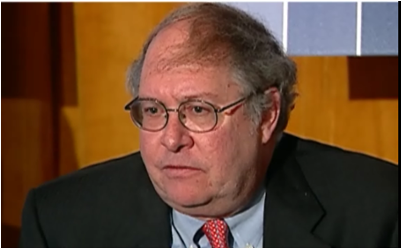
Smart guy, but could use a little help in the hair style department.
The average investor is late to both coming and going from the game. Don Hays, Strategist at Hays Advisory Services, notes, “We believe all good news at the top, and we doubt and disbelieve any good news at the bottom.” I think Bill concurs when he states the following:
“The psychological cycle goes something like this: first it is said the fiscal and monetary stimuli are not sufficient and won’t work. When the markets start up and the economic forecasts begin to be revised up — where we are now — the refrain is that it is only an inventory restocking and once it is over the economy will stall or we may even have a double dip. Once the economy begins to improve, the worry is that profits will not recover enough to justify stock prices. When profits recover, it is said that the recovery will be jobless; and when the jobs start being created, the fear is that this will not be sustained.”
Miller also makes some thoughtful points on the attractiveness of the financial sector, pointing to the disappearance of many competitors, appealing valuations, and rising pre-provision earnings. On the topic of inflation, Miller remains unworried about prices spiking up. He argues, logically, that rising unemployment and excess capacity will keep a lid on prices. True, however, with exploding debt levels and deficits, coupled with the insatiable appetites of emerging markets for commodities, not to mention spiraling healthcare prices, I believe inflation concerns may be here sooner than anticipated. Let’s not forget the stagflation experienced in the 1970s.
Read the Whole Bill Miller Newsletter Here
Bill Miller is still in a deep hole that he dug for himself, but I would not count this dunce out. Mean reversion is one of the most powerful principles of finance and if you ride Bill Miller’s coat-tails on any continued rebound, it could be a prosperous, memorable ride.
Wade W. Slome, CFA, CFP®
Plan. Invest. Prosper.
Ron Baron Swinging for Long Term Home Runs
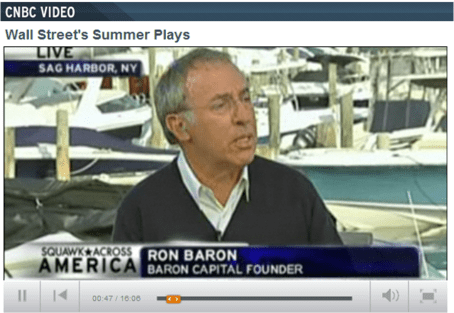
Growth Guru Ron Baron
Click Here to Watch Ron Baron CNBC Interview
The CNBC interview is a tad long with the first eight minutes better than the last eight. I can’t say I agree with a lot of his political rants, but his long-term success (BPTRX) is difficult to argue with despite his challenging track record over the last few years.
Ron Baron is considered one of the greatest growth investors of all-time, but unlike many of his modern growth peers he chooses not to play the quick trigger, momentum-based, “buy high, sell higher” strategy that merely purchases what’s working and sells what’s not. Rather he is investing in growth businesses that create long-term value, and focusing on those securitities trading at attractive prices. Seems like a very reasonable strategy to me, and an approach other historic investors like Peter Lynch followed. Like Lynch, Baron appreciates the impact of long-term home run stocks (Lynch called them “multi-baggers”). For example, in the interview Baron talks about the 30x return he earned on his Devry (DV) investment from the early 1990s; his 50x return on Charles Schwab (SCHW) from 1990; or Manor Care, up 100x from 1969 to its acquisition. Lynch enjoyed similar successes, but had an itchier trading trigger finger – his multi “bucket” strategy was quite unique (another day, another blog post).
When it comes to passive investing, Ron Baron like other active fund managers discredits the powers of index investing:
“With index funds, you are going to be investing in the most successful businesses at that point in time, and at the top of the market you will be massively over-weighted in those companies.”
Like the scarce number of .300 hitters in baseball, I believe there are a select few investment managers who can consistently outperform the market (a study in 2007 showed only 12 active career .300 hitters in Major League Baseball). I believe Baron is one of those .300 hitters in the investment world. The problems with analyzing manager performance are luck and “law of large numbers.” These phenomena wreak havoc on the examinations of short-run performance. The wheat ultimately gets separated from the chaff over the long-haul, but with the “Great Recession” of 2008-2009, many long-term investors are still hiding or shaking in their boots.
Ultimately, I believe the horse trading game of actively managed funds is a tough game to win. Most investors end up chasing performance and rotating in and out of positions at the wrong times. Nonetheless, Ron Baron has proved his ability to generate above average returns over the long haul. Taking a swing with Ron Baron might not be a bad idea.
Wade W. Slome, CFA, CFP
Plan. Invest. Prosper.




 Investing Caffeine
