Posts filed under ‘Politics’
Bin Laden Killing Overshadows Royal Rally

Excerpt from No-Cost May Sidoxia Monthly Newsletter (Subscribe on right-side of page)
Before the announcement of the killing of the most wanted terrorist in the world, Osama bin Laden, the royal wedding of Prince William Arthur Philip Louis and Catherine Middleton (Duke and Duchess of Cambridge) grabbed the hearts, headlines, and minds of people around the world. As we exited the month, a less conspicuous royal rally in the U.S. stock market has continued into May, with the S&P 500 index climbing +2.8% last month as the economic recovery gained firmer footing from the recession of 2008 and early 2009. As always, there is no shortage of issues to worry about as traders and speculators (investors not included) have an itchy sell-trigger finger, anxiously fretting over the possibility of losing gains accumulated over the last two years.
Here are some of the attention-grabbing issues that occurred last month:
 Powerful Profits: According to Thomson Reuters, first quarter profit growth as measured by S&P 500 companies is estimated at a very handsome +18% thus far. At this point, approximately 84% of companies are exceeding or meeting expectations by a margin of 7%, which is above the long-term average of a 2% surprise factor.
 Debt Anchor Front & Center: Budget battles remain over record deficits and debt levels anchoring our economy, but clashes over the extension of our debt ceiling will occur first in the coming weeks. Skepticism and concern were so high on this issue of our fiscal situation that the Standard & Poor’s rating agency reduced its outlook on the sovereign debt rating of U.S. Treasury securities to “negative,” meaning there is a one-in-three chance our country’s debt rating could be reduced in the next two years. Democrats and Republicans have put forth various plans on the negotiating table that would cut the national debt by $4 – $6 trillion over the next 10-12 years, but a chasm still remains between both sides with regard to how these cuts will be best achieved.
 Inflation Heating Up: The global economic recovery, fueled by loose global central bank monetary policies, has resulted in fanning of the inflation flames. Crude oil prices have jumped to $113 per barrel and gasoline has spiked to over $4 per gallon. Commodity prices have jumped up across the board, as measured by the CRB (Commodity Research Bureau) BLS Index, which measures the price movements of a basket of 22 different commodities. The CRB Index has risen over +28% from a year ago. Although the topic of inflation is dominating the airwaves, this problem is not only a domestic phenomenon. Inflation in emerging markets, like China and Brazil, has also expanded into a dangerous range of 6-7%, and many of these governments are doing their best to slow-down or reverse loose monetary policies from a few years ago.
 Expansion Continues but Slows: Economic expansion continued in the first quarter, but slowed to a snail’s pace. The initial GDP (Gross Domestic Product) reading for Q1 slowed down to +1.8% growth. Brakes on government stimulus and spending subtracted from growth, and high fuel costs are pinching consumer spending.
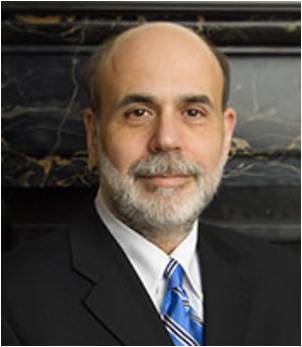 Ben Holds the Course: One person who is not overly eager to reverse loose monetary policies is Federal Reserve Chairman, Ben Bernanke. The Chairman vowed to keep interest rates low for an “extended period,” and he committed the Federal Reserve to complete his $600 billion QE2 (Quantitative Easing) bond buying program through the end of June. If that wasn’t enough news, Bernanke held a historic, first-ever news conference. He fielded a broad range of questions and felt the first quarter GDP slowdown and inflation uptick would be transitory.
Skyrocketing Silver Prices: Silver surged ahead +28% in April, the largest monthly gain since April 1987, and reached a 30-year high in price before closing at around $49 per ounce at the end of the month. Speculators and investors have been piling into silver as evidenced by activity in the SLV (iShares Silver Trust) exchange traded fund, which on occasion has seen its daily April volume exceed that of the SPY (iShares SPDR S&P 500) exchange traded fund.
 Obama-Trump Birth Certificate Faceoff: Real estate magnate and TV personality Donald Trump broached the birther issue again, questioning whether President Barack Obama was indeed born in the United States. President Obama produced his full Hawaiian birth certificate in hopes of putting the question behind him. If somehow Trump can be selected as the Republican presidential candidate for 2012, he will certainly try to get President Obama “fired!”
 Charlie Sheen…Losing! The Charlie Sheen soap opera continues. Ever since Sheen has gotten kicked off the show Two and a Half Men, speculation has percolated as to whether someone would replace Sheen to act next to co-star John Cryer. Names traveling through the gossip circles include everyone from Woody Harrelson to Jeremy Piven to Rob Lowe. Time will tell whether the audience will laugh or cry, but regardless, Sheen will be laughing to the bank if he wins his $100 million lawsuit against Warner Brothers (TWX).
Wade W. Slome, CFA, CFP®
Plan. Invest. Prosper.
DISCLOSURE: Sidoxia Capital Management (SCM) and some of its clients own certain commodity and S&P 500 exchange traded funds, but at the time of publishing SCM had no direct position in SLV, SPY, TWX, or any other security referenced in this article. No information accessed through the Investing Caffeine (IC) website constitutes investment, financial, legal, tax or other advice nor is to be relied on in making an investment or other decision. Please read disclosure language on IC “Contact” page.
Rebuilding after the Political & Economic Tsunami

Excerpt from Free April Sidoxia Monthly Newsletter (Subscribe on right-side of page)
The Start of the Arab Uprising
The Arab uprising grew its roots from an isolated and disgraced Tunisian fruit vendor (26- year-old Mohammed Bouazizi) who burned himself to death in protest of the persistent, deep-seeded corruption prevalent throughout the government (view excellent 60 Minutes story on Tunisia uprising). The horrific death ultimately led to the swift removal of Egypt’s 30-year President Hosni Mubarak, whose ejection was spurred by massive Facebook-organized protests. Technology has flattened the world and accelerated the sharing of powerful ideas, which has awoken Arab citizens to see the greener grass across other global democratic nations. Facebook, Twitter, and LinkedIn can be incredible black-holes of productivity destroyers (I know firsthand), but as recent events have proven, these social networking services, which handle about 1 billion users globally, can also serve valuable purposes.
As the flames of unrest have been fanned across the Middle East and Northern Africa, autocratic dictators haven’t had the luxury of idly sitting on their hands. Instead, these leaders have been pushed to relent to the citizens’ wishes by addressing previously taboo issues, such as human rights, corruption, and economic opportunity. These fresh events feel like new-found changes, but these major social tectonic shifts have been occurring throughout history, including our lifetimes (e.g., Tiananmen Square massacre and the fall of the Berlin Wall).
Good News or Bad News?

Recent headlines have created angst among the masses, and the uncertainty has investors asking a lot of questions. Besides radioactive concerns in both Japan and the Middle East (one actual, one figurative), the “worry list” of items continues to stack higher. Oil prices, inflation, the collapsing dollar, exploding deficits, a China bubble, foreclosures, unemployment, quantitative easing (QE2), mountainous debt, 2012 elections, and the end of the world among others, are worries crowding people’s brains. Incredibly, somehow the market still manages to grind higher. More specifically, the Dow Jones Industrial Average has climbed a very respectable +6.4% for 2011.
With the endless number of worries, how on earth could the major market indexes still advance, especially after a doubling in value from 24 months ago? For one, these political and economic shocks are nothing new. History has shown us that democratic, capitalistic markets ultimately move higher in the face of wars, assassinations, banking crises, currency crises, and various other stock market frauds and scandals. I’m willing to go out on a limb and say these worrisome events will continue this year, next year, and even over the next decade.
Most baby boomers living in the early 1980s remember when 30-year mortgage rates on homes reached 18.5%, inflation hit 14.8%, and the Federal Funds interest rate peaked near 20%. Boomers also survived Vietnam, Watergate, the Middle East oil embargo, Iranian hostage crisis, 1987 Black Monday, collapse of the S&L banks, the rise and fall of the Cold War, Gulf War I/II, yada, yada, yada. Despite all these cataclysmic events, from the last birth of the Baby Boomers (1964), the Dow Jones Industrial catapulted from about 890 to 12,320. This is no April Fool’s joke! The market has increased a whopping 14-fold (without dividends) in the face of all this gruesome news. You won’t find that story on the front-page of The Wall Street Journal.
Lost Decade Goes on Sale

The gains over the last four and half decades have been substantial, but much more is said about the recent “Lost Decade.” Although it has generally been a lousy decade for most investors in the stock market, eventually the stock market follows the direction of profits. What the popular press negates to mention is that S&P 500 operating earnings have more than doubled from about $47 in 1999 to an estimated $97 in 2011. Over the same period, the price of the market has been chopped by more than half (i.e., the Price – Earnings multiple has been cut from 29x to 13.5x). With stocks selling at greater than -50% off from 1999, no wonder smart investors like Warren Buffett are buying America – Buffett just spent $9 billion in cash on buying Lubrizol Corp (LZ). Retail investors absolutely loved stocks in 2000 at the peak, believing there was virtually no risk. Now the tables have been turned and while stock prices are trading at a -50% discount, retail investors are intensely skeptical and nervous about the prospects for stocks. Shoppers don’t usually wait for prices to go up 30% and then say, “Oh goody, prices are much higher now, so I think I will buy!” but that is what they are saying now.
I don’t want to oversell my enthusiasm, because the deals were dramatically better in March of 2009. Hindsight is 20-20, but at the nadir of the stock market, stock prices traded at bargain basement levels of 7x times 2011 earnings. We may not see opportunities like that again in our lifetime, so sitting in cash may not be the most advisable positioning.
Although I would argue every investor should have some exposure to equities, an investor’s time horizon, objectives, constraints and risk tolerance should be the key determinants of whether your investment portfolio should have 5% equity exposure or 95% exposure.
So while the economic and political dominoes may appear to be tumbling based on the news du jour, don’t let the headlines and the so-called media pundits scare you into paralysis. Bad news and tragedy will continue, but fortunately when it comes to prosperity, history is on our side. As you attempt to organize and pickup the financial pieces of the last few years, make sure you have a disciplined, long-term investment plan that adapts to changing market and personal conditions.
Wade W. Slome, CFA, CFP®
Plan. Invest. Prosper.
DISCLOSURE: Sidoxia Capital Management (SCM) and some of its clients own certain exchange traded funds, but at the time of publishing SCM had no direct position in LZ, Facebook, Twitter, LinkedIn, BRKA/B, or any other security referenced in this article. No information accessed through the Investing Caffeine (IC) website constitutes investment, financial, legal, tax or other advice nor is to be relied on in making an investment or other decision. Please read disclosure language on IC “Contact” page.
Nuclear Knee-Jerk Reaction

It’s amazing how quickly the long-term secular growth winds can reverse themselves. Just a week ago, nuclear energy was thought of as a safe, clean, green technology that would assist the gasoline pump pain in our wallets and purses. Now, given the events occurring in Japan, “nuclear” has become a dirty word equated to a life-threatening game of Russian roulette.
Despite the spotty information filtering in from the Dai-Ichi plant in Japan, we are already absorbing knee-jerk responses out of industrial heavyweight countries like Germany and China. Germany has temporarily closed seven nuclear power centers generating about a quarter of its nuclear capacity, and China has instituted a moratorium on all new facilities being built. How big a deal is this? Well, China is one country, and it alone currently accounts for 44% of the 62 global nuclear reactor projects presently under construction (see chart below).
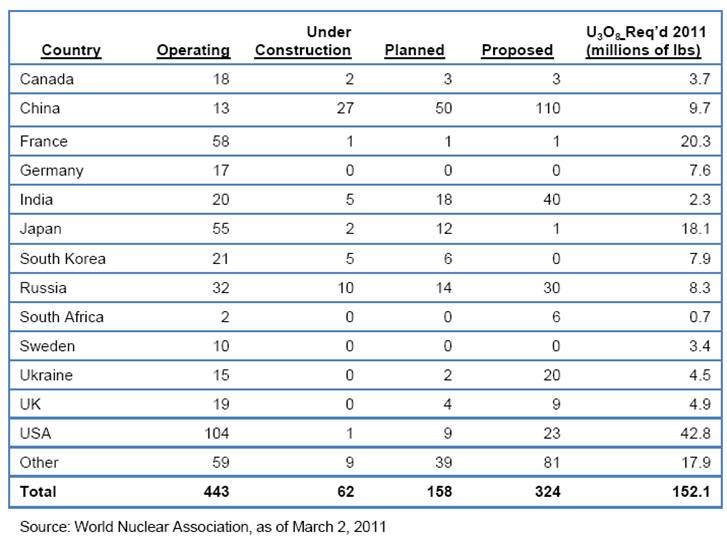
Source: World Nuclear Association (URRE Presentation)
As a result of the damaged Fukushima reactors, coupled with various governmental announcements around the globe, Uranium prices have dropped a whopping -30% within a month – plunging from about $70 per pound to around $50 per pound today.
Where does U.S. Nuclear Go from Here?
As you can see from the chart below, the U.S. is the largest producer of nuclear energy in the world, but since our small population is such power hogs, this relatively large nuclear capability only accounts for roughly 20% of our country’s total electricity needs. France, on the other hand, manages about half the reactors as we do, but the French derive a whopping 75% of their total electricity needs from nuclear power. According to the Nuclear Energy Institute, Japanese reliance on nuclear power falls somewhere in between – 29% of their electricity demand is filled by nuclear energy. Like Japan, the U.S. imports most of its energy needs, so if nuclear development slows, guess what, other resources will need to make up the difference. OPEC and various other oil-rich, dictators in the Middle East are licking their chops over the future prospects for oil prices, if a cost-effective alternative like nuclear ends up getting kicked to the curb.
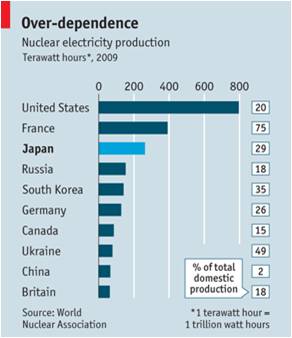
Source: The Economist
As I alluded to above, there is, however, a silver lining. As long as oil prices remain elevated, any void created by a knee-jerk nuclear backlash will only create heightened demand for alternative energy sources, including natural gas, solar, wind, biomass, clean coal, and other creative substitutes. While we Americans may be addicted to oil, we also are inventive, greedy capitalists that will continually look for more cost-efficient alternatives to solve our energy problems (see also Electrifying Profits). Unlike other countries around the world, it looks like the private sector will have to do the heavy lifting to solve these resources on their own dime. Limited subsidies have been introduced, but overall our government has lacked a cohesive energy plan to kick-start some of these innovative energy alternatives.
Déjà Vu All Over Again
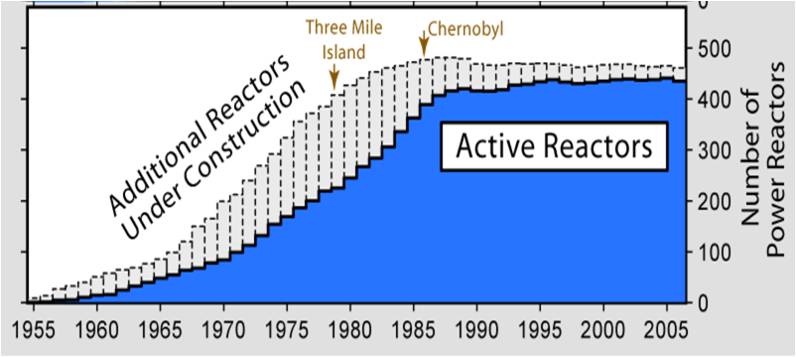
We saw what happened on our soil in March 1979 when the Three Mile Island nuclear accident in Pennsylvania consumed the hearts and minds of the country. Pure unadulterated panic set in and new nuclear production ground to a virtual halt. When the subsequent Chernobyl incident happened in April 1986 insult was added to injury. As you can see from the chart below, nuclear reactor capacity has plateaued for some twenty years now.
Source: Wikipedia
The driving force behind the plateauing nuclear facilities is the NIMBY (Not In My Back Yard) phenomenon. The Three Mile Island incident is still fresh in people’s minds, which explains why only one nuclear plant is currently under construction in our country, on top of a base of 104 U.S. reactors in 31 states. I point this out as an ambivalent NIMBY-er since I work 30 miles away from one of the riskiest, 30-year-old nuclear plants in the country (San Onofre).
Unintended Consequences
The Sendai disaster is home to the worst Japanese earthquake in 140 years, by some estimates, but history will prove once again what unintended consequences can occur when impulsive knee-jerk decisions are made. Just consider what has happened to oil prices since the moratorium on offshore drilling (post-BP disaster) was instituted. Sure we have witnessed a dictator or two topple in the Middle East, and there currently is adequate supply to meet demand, but I would make the case that we should be increasing domestic oil supplies (along with alternative energy sources), not decreasing supplies because it is politically safe.
Time will tell if the Japanese earthquake/tsunami-induced nuclear disaster will create additional unintended consequences, but I am hopeful the recent events will at a minimum create a serious dialogue about a comprehensive energy policy. If the comfortable, knee-jerk reaction of significantly diminishing nuclear production is broadly adopted around the world, then an urgent alternative supply response needs to occur. Otherwise, you may just need to enjoy that bike ride to work in the morning, along with that nice, romantic candle-lit dinner at night.
Wade W. Slome, CFA, CFP®
Plan. Invest. Prosper.
DISCLOSURE: Sidoxia Capital Management (SCM) and some of its clients own certain exchange traded funds and alternative energy securities, but at the time of publishing SCM had no direct position in BP, URRE, or any other security referenced in this article. No information accessed through the Investing Caffeine (IC) website constitutes investment, financial, legal, tax or other advice nor is to be relied on in making an investment or other decision. Please read disclosure language on IC “Contact” page.
Spreading the Seeds of Democracy

Excerpt from Free March Sidoxia Monthly Newsletter (Subscribe on right-side of page)
As we bathe ourselves in petroleum products, it is moments like these that highlight our deeply engrained addiction to oil. The flames of fundamental human rights, freedom, and democracy are spreading like wildfire throughout the Middle East and North Africa, and as a result, the cost of living and doing business has gone up. What started as a random plea by a Tunisian fruit merchant in response to insidious corruption (26 year old Mohammed Bouazizi burned himself to death in revolt to continuous crooked government bribes) has resulted in a broad wave of protesters removing two authoritarian, autocratic Arab leaders. Egyptian President Hosni Mubarak and Tunisian President Zine al-Abidine Ben Ali have been swiftly cast out by energized protesters, and other repressive leaders are likely bound to topple as well.
Who’s next and when? You’ll have to stay tuned, but Colonel Muammar Gaddafi, the Libyan leader, is on the short list. Leaders in Yemen, Bahrain, Jordan, and Algeria are among the other countries that are feeling the heat too. Even though Egypt, Libya, Tunisia, and other aforementioned countries remain relative oil lightweights, fear over a political contagion spreading to more substantive countries like Saudi Arabia has gotten speculators frothing at the mouth, which pushed oil prices above $100 per barrel and gasoline prices to an average of $3.37 per gallon (about $3.60 in California according to AAA motor club).

Source: FT.com - The U.S. population is a fraction of the size of China and India, but we continue guzzling dramatically more crude.
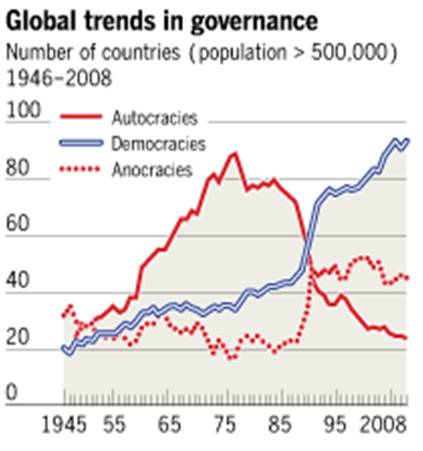
While the bloodshed on the streets has created fodder for great sensationalist headlines for the media outlets, the fact of the matter is that the spread of democracy is nothing new, and the innate desire for basic human rights has never died. Going back to 1900 the world housed about 10 practicing democracies, and today there are arguably more than 100 democratic (and quasi-democratic) countries (see blue line in chart below).
Source: The Financial Times.com
In the U.S., our standard of living has exploded for more than a generation. The internet – and applications like Facebook and Twitter – have flattened the planet and connected the rest of the world to the pleasures available to free, transparent, and open societies. As we have experienced firsthand in Iraq, however, regime changes and moves towards democracy can be messy and costly. Ultimately, the native populations must spearhead the drive toward democratic, political change. Regime change solely rammed through by the U.S. will only create temporary change, and with our fiscal wallets empty, we frankly cannot afford it (see Global Babysitter).
Embracing Alternatives
We didn’t run out of stones in the Stone Age, and we did not run out of steel in the Industrial Revolution. When it comes to oil, the same principle applies. As globalization accelerates the expansion of democratic, emerging middle classes around the world, other oil-rich countries, like Saudi Arabia, understand the havoc that $100-$125 dollar a barrel has on demand destruction. Just like a drug dealer does not want to scare its addicted users, so too oil producers do not want to price consumers out of the market with high prices. Oil may be the lubricant for global commerce, but unlike the empty promises offered by the Jimmy Carter era in the 1970s, technology advancements in the alternative energy industry have reached critical mass. If you don’t believe me, just take a gander at the $17 billion the Chinese are pouring into electric vehicle technology (see Electrifying Profits), or the 20% total energy mandate from renewable sources being instituted in Europe by 2020. Even if we choose to watch from the sidelines and pick our noses, our foreign competitors will wave with delight as they embrace alternative energy resources and race past us. Even if political turmoil temporarily worsens in the Middle East, any additional oil price increases will only make alternative energy resources more economical, and thereby accelerate adoption and make disciples of alternative energy less dependent on some of these oil-rich, corrupt regimes.
Wade W. Slome, CFA, CFP®
Plan. Invest. Prosper.
DISCLOSURE: Sidoxia Capital Management (SCM) and some of its clients own certain exchange traded funds, but at the time of publishing SCM had no direct position in any other security referenced in this article. No information accessed through the Investing Caffeine (IC) website constitutes investment, financial, legal, tax or other advice nor is to be relied on in making an investment or other decision. Please read disclosure language on IC “Contact” page.
The Impoverished Global Babysitter

I don’t mind being a babysitter for the world, as long as I get paid for it. Unfortunately, not only are we paying to be the nation’s global defense babysitter, but we are also paying for the protection responsibility with unsustainable borrowings.
I don’t want to be a cold-hearted neighbor to our friends and allies, but it is all a matter of degree. Collecting a vacationing neighbor’s newspaper and mail, and watching for any potential suspicious activity is all part of being a conscientious, dependable neighbor, but where do you draw the line? As a good neighbor, should I also be responsible for paying for and installing a security system on their premises? Or how about getting my 16 year old nephew to spend the night at my neighbor’s because of some scary noises heard during the previous night?
For politicians to say we need to cut spending but defense spending is off the table is hypocritical. Bruce Bartlett, columnist at The Fiscal Time, had this to say on the subject:
“No one is saying the defense budget is the sole source of the deficit, but the fact is that it has risen from 3 percent of the gross domestic product in fiscal year 2001 to 4.7 percent this year. That additional 1.7 percent of GDP amounts to $250 billion in spending — almost 20 percent of this year’s budget deficit. And according to a recent Congressional Research Service report, the cost of wars in Iraq and Afghanistan alone accounted for 23 percent of the combined budget deficits between fiscal years 2003 and 2010.”
Even the government should have learned one of the prime lessons from the 2008-2009 financial crisis: tough times require the necessity to do more with less. Whether you are talking about a large corporation like $173 billion valued General Electric (GE), a small mom-and-pop coffee shop, or a middle-class family of four, the moral of the story is bad things eventually happen to individuals, corporations, and governments that live beyond their means. The crisis was exacerbated by excessive borrowing to achieve the higher standard of living and operations.
New Heightened Sensibility?
The initial deficit reduction proposals crafted by the bipartisan commission headed by Erskine Bowles and Alan Simpson should be lauded, regardless of how much Congress decides to dilute the $4 trillion in budget cuts over the next 10 years. The plan may not garner votes for politicians, but these types of necessary cuts will place our country on firmer ground and provide a more sustainable path to prosperity. More specifically, the plan would bring the federal budget deficit down to 2.2% of GDP (Gross Domestic Product) by 2015 and reduce the country’s debt to 60% of GDP by 2024.
Building Flying Rolls Royces
Bowles and Simpson appear to get it, but our bloated government doesn’t seem to understand. If I were running an unprofitable company with a lot of debt, would it be a good idea to develop a new flying Rolls Royce car fleet (with questionable utility) for my employees? Common fiscal sense would dictate the answer to be “NO.”
Regrettably our government has answered “yes” by building a ridiculously costly flying Rolls Royce fleet of its own under the name of Joint Strike Fighter (the F-35 program from Lockheed Martin Corp. [LMT]). This absurdly priced program – the costliest in our country’s history – is projected to cost up to $382 billion for 2,443 aircraft over the next two decades (Reuters). This translates into a whopping $156 million per aircraft. Cost overruns have already come in 40-90% higher than expected over the last nine years, and the price tag continues to rise. The state of the art jet program is touted as a Swiss army knife (flexibility to be used by all three branches of the military), but may actually turn out to be a butter knife due to the program’s questioned utility (see great PBS video here).
So like any company, individual, or government, there is something called prioritization. By cutting fat in less critical areas, a portion of those savings can be redeployed to INCREASE spending in the areas that matter. I won’t wade into the relative merits (or lack thereof) related to Afghanistan and Iraq expenditures or appropriate troop levels, but suffice it to say, I’m certain spending can be cut in many areas to make room for our country’s primary defense priorities.
I’m no defense expert but when faced to deal with a murky, inconspicuous issue of terrorism (cave dwelling insurgents and bomb-making sleeper cells), intelligence collection and international coordination make more sense than building $150 million flying Rolls Royces, which are better suited for fighting an obsolete cold war than finding terrorist needles in a global haystack.
Crotch Costs
Layer on the new TSA passenger flight costs associated with crotch fondling pat downs and the costs related to buying miniaturized shampoo and gel containers, one wonders if tax-payer money can be more efficiently spent. For what it’s worth, the FDA has approved the latest body scanning machines with no health concerns, so if an airport worker gets his/her jollies by ogling an overweight out of shape passenger like me, then so be it. The fact of the matter is that estimates show 99% of passengers choose the innocuous body scan, which displays a white, ghost-like naked computer image to the agent. For those worried about self image issues or privacy concerns, perhaps the airports can set up a meet-and-greet room option for passengers to become better acquainted with the agent before passing through the scanner.
Freeloaders Cutting Spend
Source: The Financial Times
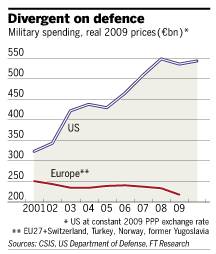
Domestic defense spending cuts become especially touchy when discussed in concert with European spending reductions. Take for example German plans to slash $10.7 billion in defense spending by 2014 and British spending cuts of 10% to 20% (around $6 – $12 billion). Europeans are labeled by Americans as socialists because of their lengthy paid vacations, maternity leaves, and generous healthcare benefits. More power to them and I desire all those things for myself and my family too, but I just don’t want my taxes to pay for others’ benefits when our country cannot afford those same wonderful benefits for ourselves.
While our Defense Secretary, Robert Gates, has been talking a good game with respect to a $100 billion in savings cuts, these cuts should be put in the context of a $567 billion budget for 2011 and a $700 billion estimated 2015 budget. As it turns out, these $100 billion in cuts are not cuts at all – Gates is also talking out of the other side of his mouth by saying he wants to continue increasing overall defense spending.
Is the size of spending appropriate? According to SIPRI, an independent international research institute, the U.S. defense budget accounts for 54% of the world’s total military spending, when our population only represents less than 5% of the world’s total. If that is not a disproportionate subsidy to the rest of the world, then I do not know what one is? The real longer term threat is not Iran or North Korea, but rather China. I’ll go out on a limb and say we can probably hold our own for a while, considering China is still only spending about 15% of what we spend on defense.
As I stated earlier, it is more important than ever to do more with less. Corporations are clearly doing that now by cutting spending, while still able to create record profits. The government has to get on board with trimming fat in all areas of our government…including defense. Coordinating intelligence and combining resources across the globe is crucial if we want to get more bang for our buck, while still devoting adequate resources to fend off the real and immediate evil threats of terrorism. Babysitting is an important duty and responsibility, but as impoverished Americans we are not capable of providing that service to the whole world free of charge.
Wade W. Slome, CFA, CFP®
Plan. Invest. Prosper.
DISCLOSURE: Sidoxia Capital Management (SCM) and some of its clients own certain exchange traded funds, but at the time of publishing SCM had no direct position in GE, LMT, Rolls Royce, or any other security referenced in this article. No information accessed through the Investing Caffeine (IC) website constitutes investment, financial, legal, tax or other advice nor is to be relied on in making an investment or other decision. Please read disclosure language on IC “Contact” page.
Will the Fiscal Donkey Fly?

Source: TopPayingIdeas.com/blog
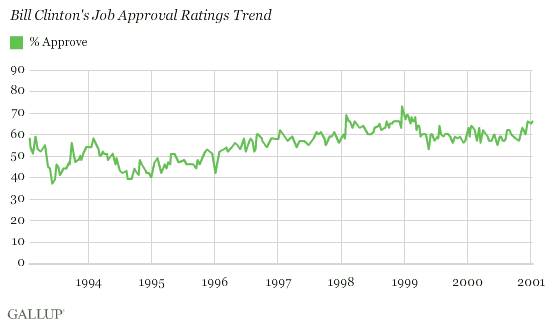
Will Barack Obama become a “one-termer” like somewhat recent Presidents, Democrat Jimmy Carter (1977-1981) and Republican George H.W. Bush #41 (1989-1993)? Or will Obama get the Democratic donkey off the ground like Bill Clinton managed to do after the 1994 mid-term election when Republican Newt Gingrich spearheaded the Contract with America, which led to a similar Republican majority in the House of Representatives. Clinton’s approval ratings were in the dumps at the time, comparable to voter’s current lackluster opinion of Obama and his spending spree (see also Profitless Healthcare).
Source: Gallup
Reagan Rebound
Similarly, Republican Ronald Reagan (1981-1989) was picking up the pieces with his lousy approval rating after the 1982 midterm election. Tax cuts, “trickle-down” supply side economics, and a tough stance on the Russian Cold War turned around the economy and his approval rating and catapulted him to reelection in a landslide victory. Reagan carried 49 states with the help of Reagan Democrats (one-quarter of registered Democrats voted for him).
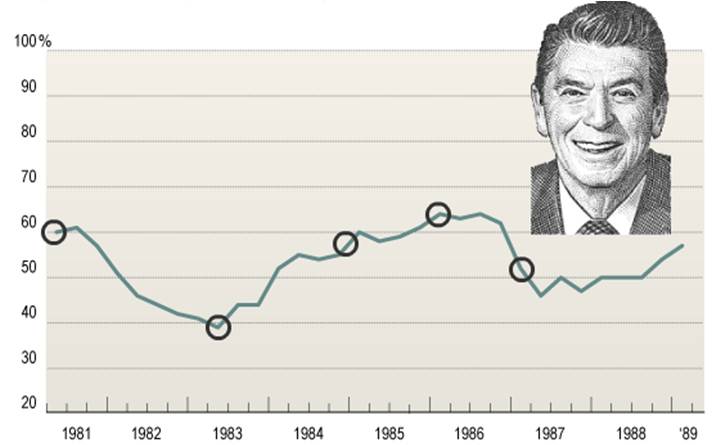
Source: The Wall Street Journal
One should be clear though, popularity is not the only factor that plays into reelection success. George H. W. Bush had the highest average approval rating in five decades (60.9% approval), only superseded by John F. Kennedy (70.1% approval). The economy, international politics, and other external factors also play a large role in the reelection process.
Flying Donkey Time?
If President Obama wants to get the Democratic donkey off the ground and raise his current approval rating of 47% and remedy his self-admitted “shellacking” by the Republicans, then he will need to shift his hard-left political agenda more towards the middle, like Clinton did in 1994. If he leads on ideology alone, then the next two years will likely be a long tough slog for him and his Democratic colleagues.
In order to shift toward the center and gain more Independent voters, Obama will need to find common ground with Republicans and Tea-Partiers. Obama has already conceded in principle to extend the Bush tax cuts, but if he wants to gain more political capital, he will have to gain some ground in the area of fiscal responsibility. With the help of a strong economy, Clinton managed to run surpluses, but front and center today is a $1.3 trillion deficit and over $13 trillion in debt. The first step in building any credibility on the issue will come on December 1st when the president’s bi-partisan commission for deficit reduction will release its report.
It will be interesting which party will show leadership in making unpopular spending cuts, just as the 2012 re-election cycle just begins. The elephants in the room are the entitlements (Medicare and Social Security), and although less talked about, efficient cuts to defense spending should be put on the table. Sure, pork barrel spending, inefficient subsidies, tax loopholes, are gaps that need to be filled, but they alone are rounding errors given our country’s unsustainable current circumstances. Whether or not politicians (red or blue) will point out the unpopular elephants in the room will be interesting to watch.
Financial irresponsibility at the consumer and corporate level were major drivers behind the 2008-2009 financial crisis, and both individuals and businesses are responsibly adjusting their expense structures and balance sheets. Our government has to wake up to reality and adjust its expense structure and balance sheet too. Although foreign countries have reacted (i.e., European austerity), egotistical American politicians on both sides of the aisle haven’t quite woken up and smelled the coffee yet. Thank goodness for the democracy that we live in because citizens are pointing to the elephants in the room and demanding reckless spending and debt levels to come under control. If President Barack Obama doesn’t want to become another one-termer, he’ll have to move more to the center and get the finances of our country under control. If the stubborn donkey refuses to deal with reality and remains flightless, hopefully an elephant or ship-full of tea partiers can get this grass roots call for fiscal sanity off the ground.
Wade W. Slome, CFA, CFP®
Plan. Invest. Prosper.
DISCLOSURE: Sidoxia Capital Management (SCM) and some of its clients own certain exchange traded funds, but at the time of publishing SCM had no direct position in any other security referenced in this article. No information accessed through the Investing Caffeine (IC) website constitutes investment, financial, legal, tax or other advice nor is to be relied on in making an investment or other decision. Please read disclosure language on IC “Contact” page.
Ration or Tax: Eating Cake Not an Option

We live in an instant gratification society that would like everything for free ( like my pal Bill Maher), which explains why we want to have our healthcare cake and eat it too. I think George Will said it best when discussing universal healthcare coverage, “If you think health care is expensive now, just wait until it is free.” Look, I love free stuff too, like the rest of us, whether it’s free sausage sample at Costco (COST) or a breath mint at the Olive Garden (DRI). But regrettably, exploding deficits come at a price.
With midterm elections coming up, the issue of healthcare is once again front and center. The majority party feels like a checkbook is a solution to healthcare prosperity. Can you really look me in the eyes and say covering additional 32 million uninsured Americans is going to save us money. The government hasn’t exactly built a ton of credibility with the disastrous train-wreck we call Medicare, which is already carrying 45 million covered passengers.
The minority party hasn’t done a lot better with the layering of the 2006 unsustainable Medicare Part D drug plan. Conservatives are campaigning on “repeal and replace” and that is great, but where are the cuts?
There are only two solutions to our current healthcare problem: ration or tax (read Plucking Feathers of Taxpaying Geese). Is healthcare a right or privilege? I don’t know, but if we want to cover current obligations, or add 32 – 50 million more uninsured, then we will be required to cut expenses (ration) to pay for increased benefits and/or increase taxes to cover additional benefits. I would love to cover all Americans, along with the starving children in Africa too, but unfortunately we are limited by our resources. Writing checks with borrowed money will only last for so long.
How severe are the exploding healthcare costs, which are covering the graying of the 76 million baby boomers? Here’s how Forbes describes the unsustainable Medicare obligations:
The Medicare Trustees tell us that Medicare’s expected future obligations exceeded premiums and dedicated taxes by $89 trillion (measured in current dollars). No, that’s not a misprint. To put that number in perspective, Medicare’s liability is about 5 1/2 times the size of Social Security’s ($18 trillion) and about six times the size of the entire U.S. economy.
Not a pretty picture. These estimates look pretty far in the future, but even more bare bone figures arrive at a still frightening $33 trillion. Take a look at healthcare spending forecasts as a percentage of GDP – even the lowest estimates are depressing:
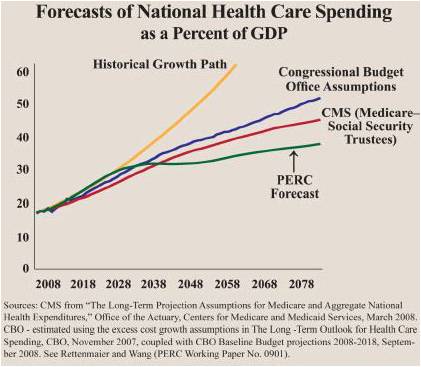
Source: National Center for Policy Analysis via Forbes
In our increasingly flat globalized world, competition between countries is becoming even more intense. We are in a marathon race for improved standards of living, and all these debts and deficits are dragging us down like an anchor tied to our legs. Even without considering other massive entitlements like Social Security, healthcare alone has the potential of grinding our economy to a halt. Politicians are great at promising more benefits and tax cuts in exchange for your votes, but true leadership requires delivering the sour medicine necessary for future prosperity. Before we eat the healthcare cake, let’s raise the money to buy the cake first.
Read more about the Medicare Explosion on Forbes
Wade W. Slome, CFA, CFP®
Plan. Invest. Prosper.
DISCLOSURE: Sidoxia Capital Management (SCM) and some of its clients own certain exchange traded funds, but at the time of publishing SCM had no direct position in COST, DRI, or any other security referenced in this article. No information accessed through the Investing Caffeine (IC) website constitutes investment, financial, legal, tax or other advice nor is to be relied on in making an investment or other decision. Please read disclosure language on IC “Contact” page.
California…This Bud’s for You

I guess it’s time for Californians to dust off their bongs and break out the rolling papers because Proposition 19, the proposal to legalize personal marijuana consumption for adults in the Golden State, is coming up for vote next month. Judging by recent polls, the proposition is gaining steam…or smoke.
Results show that 52% of voters are backing the proposition versus 41% opposed and 7% undecided. In fact, the data shows Californians are supporting ganja more than they are backing the state Senatorial and Gubernatorial candidates (Barbara Boxer, Dianne Feinstein, Carly Fiorina, Jerry Brown and Meg Whitman).
Proponents are fiercely battling the opposition in the remaining weeks before the big vote. Given all the controversy, I wouldn’t be surprised if pro-pot advocacy groups enlisted renowned rapper Snoop Dogg as a paid spokesman to support the cause. I can hear Snoop now, “Vote yes on ‘pot,’ but remember friends don’t let friends drive doped.” Alternatively, I’m sure Altria Group (MO), maker of the famous Marlboro branded cigarettes, wouldn’t mind getting into the profitable cannabis business. They could even hire ex-President Clinton, who could admit he “inhaled…and enjoyed it,” while consuming some cannabis legally in California.

Would Snoop and Bill Say Yes to Legalized Marijuana?
The Budding of Prop. 19
What was the genesis of Proposition 19? Well, this isn’t the first time the wacky weed debate has actually been put to a vote in California. Almost four decades ago a similarly titled Proposition 19 initiative showed up on the ballot. Was it a coincidence the same number was used…perhaps? On the bright side, more mature protesters will not have to break the piggybank to buy new Proposition 19 buttons and T-shirts. This type of recycling gives new meaning to the word being “green.”
From a broader political policy perspective, marijuana consumption is no small problem. An estimated $113 billion of pot is sold each year nationally, with more than 10% of that attributed to California weed smokers. A whopping 15 million Americans have admitted to using pot within the last month, according to one survey. Of all the marijuana smoked, around fifty percent of the illegal bud is said to originate from foreign sources, most notably Mexico, which is dealing with deadly drug cartels that are killing innocent civilians by the thousands and threatening our borders. Proposition 19 cheerleaders are quick to point out that the legalization of cannabis would remove valuable money from foreign criminals’ pockets.
Legalizing and taxing cannabis has the potential of raising billions for the state of California. We all know about the sad state of fiscal affairs for California ($19 billion budget deficit) along with the dismal financial shape of neighboring states – an estimated $137 billion in deficits over fiscal 2011 and 2012 (see The Next Looming Bailout). Contributing to the deficits is the overcrowding of our jails and prisons. Ever since the “Just Say No” to drugs campaign, which started in 1984, prison populations have quadrupled – many of the prisoners being non-violent pot smokers. So, why not collect some cash from the millions that are already smoking pot illegally and help reduce our damaging deficits and free up space for more violent criminals?
Calling All Sin-Consuming Hypocrites
I understand the opposition to cannabis legalization, primarily based on concerns relating to public safety, workplace productivity, and potential losses in federal funding, but if certain people are opposed to Proposition 19, I sure hope they are up in arms over the numerous other legal (but sinful) products and services that permeate our daily lives. If pot is deemed harmful and illegal by society, then where are all the picketers protesting this long list of other sinfully legal products and services?
- Casinos/Gambling
- Cigarettes
- Lotteries
- Alcohol
- Prostitution (Nevada)
- Guns/Hunting
- Ho Hos/Twinkies/Sodas (Fat Tax)
The potential safety issue surrounding an increase in stoned drivers is a real one. However, if we have managed to reduce drunk driving, with the help of severe penalties, over the last few decades, I’m fairly confident we can keep slothful, Domino’s pizza (DPZ) loving, pot-smokers under control.
There is no shortage of controversy surrounding this political hot-button issue, but drastic times call for drastic measures. You may be against the legalization of marijuana, but if Proposition 19 passes in California, you may want to go long Domino’s, and short Nike Inc. (NKE).
Wade W. Slome, CFA, CFP®
Plan. Invest. Prosper.
DISCLOSURE: Sidoxia Capital Management (SCM) and some of its clients own certain exchange traded funds, but at the time of publishing SCM had no direct position in MO, DPZ, NKE, or any other security referenced in this article. No information accessed through the Investing Caffeine (IC) website constitutes investment, financial, legal, tax or other advice nor is to be relied on in making an investment or other decision. Please read disclosure language on IC “Contact” page.
Sachs Prescribes Telescope Over Microscope

Jeffrey Sachs, Professor at Columbia University and one of Time magazine’s “100 most influential people” recommends that our country takes a longer-term view in handling our problems (read Sachs’s full bio). Instead of analyzing everything through a microscope, Sachs realizes that peering out over the horizon with a telescope may provide a clearer path to success versus getting sidetracked in the emotional daily battles of noise.
I do my fair share of media and politician bashing, but every once in a while it’s magnificent to discover and enjoy a breath of fresh common sense, like the advice coming from Sachs. Normally, I become suffocated with a wet blanket of incessant, hyper-sensitive blabbering that comes from Washington politicians and airwave commentators. With the advent of this thing we call the “internet,” the pace and volume of daily information (see TMI “Too Much Information” article) crossing our eyeballs has only snowballed faster. Rather than critically evaluate the fear-laced news, the average citizen reverts back to our Darwinian survival instincts, or to what Seth Godin calls the “Lizard Brain. ”
Sachs understands the lingering nature to our country’s problems, so in pulling out his long-term telescope, he created a broad roadmap to recovery – many of the points to which I agree. Here is an abbreviated list of his quotes:
On Short-Termism:
“Despite the evident need for a rise in national saving after 2008, President Barack Obama tried to prolong the consumption binge by aggressively promoting home and car sales to already exhausted consumers, and by cutting taxes despite an unsustainable budget deficit. The approach has been hyper short-term, driven by America’s two-year election cycle. It has stalled because US consumers are taking a longer-term view than the politicians.”
On Differences between China and the U.S.:
“China saves and invests; the US talks, consumes, borrows, and talks some more.”
On Why Tax Cuts and Stimulus Alone Won’t Work:
“Short-term tax cuts or transfers on top of America’s $1,500bn budget deficit are unlikely to do much to boost demand, while they would greatly increase anxieties over future fiscal retrenchment. Households are hunkering down, and many will regard an added transfer payment as a temporary windfall that is best used to pay down debt, not boost spending.”
On Malaise Hampering Businesses:
“Businesses, for their part, are distressed by the lack of direction….Uncertainty is a real killer.”

On 5-Point Plan to a U.S. Recovery:
1) Increased Clean Energy Investments: The recovery needs “a significant boost in investments in clean energy and an upgraded national power grid.”
2) Infrastructure Upgrade: “A decade-long program of infrastructure renovation, with projects such as high-speed inter-city rail, water and waste treatment facilities and highway upgrading, co-financed by the federal government, local governments and private capital.”
3) Further Education: “More education spending at secondary, vocation and bachelor-degree levels, to recognize the reality that tens of millions of American workers lack the advanced skills needed to achieve full employment at the salaries that the workers expect.”
4) Infrastructure Exports to the Poor: “Boost infrastructure exports to Africa and other low-income countries. China is running circles around the US and Europe in promoting such exports of infrastructure. The costs are modest – essentially just credit guarantees – but the benefits are huge, in increased exports, support for African development and a boost in geopolitical goodwill and stability.”
5) Deficit Reduction Plan: “A medium-term fiscal framework that will credibly reduce the federal budget deficit to sustainable levels within five years. This can be achieved partly by cutting defense spending by two percentage points of gross domestic product.”
Rather than succumb to the nanosecond, fear-induced headlines that rattle off like rapid fire bullets, Sachs supplies thoughtful long-term oriented solutions and ideas. The fact that Sachs mentions the word “decade” three times in his Op-ed highlights the lasting nature of these serious problems our country faces. To better see and deal with these challenges more clearly, I suggest you borrow Sachs’s telescope, and leave the microscope in the lab.
Read Full Financial Times Article by Jeffrey Sachs
Wade W. Slome, CFA, CFP®
Plan. Invest. Prosper.
*DISCLOSURE: Sidoxia Capital Management (SCM) and some of its clients own certain exchange traded funds, but at the time of publishing SCM had no direct position in any security referenced in this article. No information accessed through the Investing Caffeine (IC) website constitutes investment, financial, legal, tax or other advice nor is to be relied on in making an investment or other decision. Please read disclosure language on IC “Contact” page.
Blushing Pinocchio – The Half Trillion Lie

When in doubt, or when in debt by half a trillion dollars, why not just make some crazy stuff up? This is the exact strategy California pension administrators used when implementing +50% increases in union member benefits earlier this decade. The pension plans decided to take a break from reality and enter fantasyland when they projected the Dow Jones Industrial Average would hit 25,000 by the end of the decade and 28,000,000 by 2099, a forecast that would even make Pinocchio blush.
Dealing with the Problem
Governor Arnold Schwarzenegger and his economic advisors attempted to take on the unions. Unfortunately, not everyone got the message. On the day the Governor struck a deal with the unions, California Public Employees’ Retirement System (CalPERS) ordered a hike of $4 billion to the annual pension payments to its members.
The financial woes of California have been well documented as the state looks to lower its $19.1 billion deficit and an estimated one-half trillion dollars in unfunded pension liabilities – a level equal to about seven times the state’s total debt level. Even after multiple years of severe cuts, Schwarzenegger has had to resort to drastic measures, including his most recent desperate move to get some 200,000 state workers to accept slashes in pay to a $7.25/hour minimum wage.
Facing Reality
As I have discussed in the past, dealing with excessive debt requires a gut check. Cutting debt is similar to dieting – easy to understand, but difficult to execute (see my Debt Control article).
Whether Republican candidate Meg Whitman or Democratic candidate Jerry Brown wins the thankless position of California Governor, they will have to face the elephant in the room, but hopefully they will not resort to fuzzy accounting or predictions of Dow 28 million that would make even Pinocchio blush.
Read Full Related Article from Vincent Fernando at Business Insider
Wade W. Slome, CFA, CFP®
Plan. Invest. Prosper.
*DISCLOSURE: Sidoxia Capital Management (SCM) and some of its clients own certain exchange traded funds, but at the time of publishing SCM had no direct positions in any security referenced in this article. No information accessed through the Investing Caffeine (IC) website constitutes investment, financial, legal, tax or other advice nor is to be relied on in making an investment or other decision. Please read disclosure language on IC “Contact” page.




 Investing Caffeine

