Posts filed under ‘Fixed Income (Bonds)’
Treasury Bubble Hasn’t Burst….Yet

10-Year Treasury Chart (5-14-09)
Clusterstlock’s Joe Weisenthal’s takes a historical look on 10-year Treasury yields going back to 1962. As you can see, the yield is still below 1962 levels, despite the massive inflationary steps the Federal Reserve and Treasury have taken over the last 18 months (6-26-09 yield was 3.51%). These trends can also be put into perspective by reading Vincent Fernando’s post at http://www.researchreloaded.com. Take a peek.
Ways to take advantage of this trend include purchases of TBT (UltraShort 20+ Year Treasury ProShares) or short TLT (iShares Barclays 20+ Year Treasury Bond)*.

Reverse View of Historical 10-Year Treasury Yield
*Disclosure: Sidoxia Capital Management clients and/or Slome Sidoxia Fund may have a short position in TLT.
Debt: The New Four-Letter Word
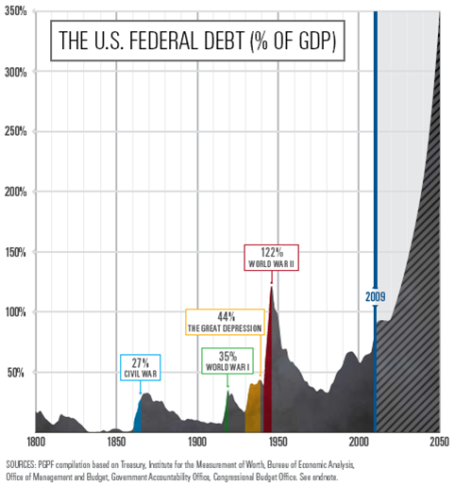
D-E-B-T, our country’s new four-letter word, used to be a fun toy the masses played and danced with to buy all kinds of goods and services. Debt was creatively utilized for all types of things, including, our super-sized McMansions purchased with Option ARM (Adjustable Rate Mortgage) Countrywide loans; our 0% financing car binges (thanks to now-bankrupt Chrysler and General Motors); and our no-payment-for-two-years, big screen plasma TVs (financed at now-bankrupt Circuit City). Eventually consumers, corporations, and governments realized excessive debt creates all kinds of lingering problems – especially in recessionary periods. We are by no means out of the woods yet, but consumers are now spending less than they are taking in, as evidenced by a positive and rising savings rate. This slowdown in spending is bad for short-term demand, but eventually these savings will be recycled into our economy leading to productive and innovative value creating jobs that will jumpstart the economy back on a path to sustainable growth.
Click Here For Excellent Article from the Peterson Foundation
In our hot-cold society, where the pendulum of greed and fear swing dramatically from one side to the next, we are also observing an unhealthy level of risk aversion by financial institutions. This excessive caution is unfortunately choking off the health of legitimate businesses that need capital/debt in order to survive. As we continue to see a pickup in the leading indicators for an economic recovery, banks should loosen up the credit purse strings to provide capital for profitable, growing businesses – even if there are hiccups along the way.
National Debt “Blob” Must Be Slowed

In the famous 1958 sci-fi horror film, “The Blob”, a gelatinous, ever-growing creature from outer space threatens to take over the town of Downingtown, Pennsylvania by methodically engulfing everything in its path. Steve McQueen eventually learns that freezing the Blob will halt its progression. In our country, entitlements, in the form of Medicare and Social Security, serve as our 21st century Blob. As the chart above shows, entitlements have expanded dramatically over the last 40 years and stand to expand faster, as the 76 million Baby Boomers reach retirement and demand more Social Security and Medicare benefits. Clearly the current path we are travelling on is not sustainable, and beyond breakthroughs in technology, the only way we can suitably address this problem is by cutting benefits or raising taxes. We only dug ourselves in a deeper financial hole with the enactment of Medicare Part D (prescription drug benefits for Medicare participants). I must admit I have great difficulty in understanding how we are going to expand health care coverage for the vast majority of Americans in the face of exploding deficits and debt burdens. I eagerly await specifics.
With an enlarging national debt burden and widening deficits, the U.S. is only becoming more reliant on foreign investors to finance our shortcomings. This trend too cannot last forever (see chart below). At some point, foreigners will either balk by not providing us the financing, or demanding prohibitively high interest rates on any funding we request – thereby negatively escalating our already high interest payment streams to bondholders.
 Regardless of your political view, the problem pretty simply boils down to elementary school math. The government either needs to cut expenses or raise revenue (taxes or growth initiatives). Politically, the stimulative spending path is easier to rationalize, but as we see in California, eventually the game ends and tough cuts are forced to be made.
Let’s hope the painful lessons learned from this financial crisis will steer us back on path to more responsible borrowing – a point where D-E-B-T is no longer considered a dirty four-letter word.
“Bill, Say It Ain’t So…”
Bond guru and Newport Beach neighbor, Bill Gross, is out with his entertaining monthly PIMCO piece (Click Here). Try to keep a box of tissues close by in case you cry during the read. His views support my stance on short duration bonds and TIPs (Treasury Inflation Protected Securities), but big Bill would NEVER stand to root for equities – especially after his call for Dow 5000 a while back.
In this CNBC piece, he points out the obvious troubles we face from all the debt we’re choking on. As a country, we need the “Heimlich Maneuver!”

"Save to Your Grave"
Building Your Financial Future – Mistakes Made in Investment Planning

Building Your Dream Future Requires a Plan
Building your retirement and financial future can be likened with the challenge of designing and building your dream home. The tools and strategies selected will determine the ultimate cost and outcome of the project.
I constantly get asked by investors, “Wade, is this the bottom – is now the right time to get in the markets?” First of all, if I precisely knew the answer, I would buy my own island and drink coconut-umbrella drinks all day. And secondarily, despite the desire for a simple, get-rich quick answer, the true solution often is more complex (surprise!). If building your financial future is like designing your dream home, then serious questions need to be explored before your wealth building journey begins:
1) Do I have enough money, and if not, how much money do I need to develop my financial future?
2) Can I build it myself, or do I need the help of professionals?
3) Do I have contingency plans in place, should my circumstances change?
4) What tools and supplies do I need to effectively bring my plans to life?
Most investors I run into have no investment plan in place, do not know the costs (fees) of the tools and strategies they are using, and if they are using an advisor (broker) they typically are in the dark with respect to the strategy implemented.
For the “Do-It-Yourselfers”, the largest problem I am witnessing right now is excessive conservatism. Certainly, for those who have already built their financial future, it does not make sense to take on unnecessary risk. However, for most, this is a losing strategy in a world laden with inflation and ever-growing entitlements like Medicare and Social Security. There’s clearly a difference between stuffing money under the mattress (short-term Treasuries, CDs, Money Market, etc.) and prudent conservatism. This is a credo I preach to my clients.
In many cases this conservative stance merely compounds a previous misstep. Many investors undertook excessive risk prior to the current financial crisis – for example piling 100% of investment portfolios into five emerging market commodity stocks.
What these examples prove is that the average investor is too emotional (buys too much near peaks, and capitulates near bottoms), while paying too much in fees. If you don’t believe me, then my conclusions are perfectly encapsulated in John Bogle’s (Vanguard) 1984-2002 study. The analysis shows the average investor dramatically underperforming both the professionally managed mutual fund (approximately by 7% annually) and the passive (“Do Nothing”) strategy by a whopping 10% per year.
Building your financial future, like building your dream home, requires objective and intensive planning. With the proper tools, strategies and advice, you can succeed in building your dream future, which may even include a coconut-umbrella drink.
Steepening Yield Curve – Disaster or Recovery?

Various Treasury Maturities in 2006 Highlighting Inversion
Wait a second, aren’t we suffering from the worst financial crisis in some seven decades; our GDP (Gross Domestic Product) is imploding; real estate prices are cratering; and we are hemorrhaging jobs faster than we can say “bail-out”? We hear it every day – our economy is going to hell in a hand basket.
If Armageddon is indeed upon us, then why in the heck is the yield-curve steepening more than a Jonny Moseley downhill ski run? Bears typically point to one or all of the following reasons for the rise in long-term rates:
- Printing Press: The ever-busy, government “Printing Press” is working overtime and jacking up inflation expectations.
- Debt Glut: Our exploding debt burden and widening budget and trade deficits are rendering our dollar worthless.
- Foreign “Nervous Nellies”: Foreign Treasury debt buyers (the funders of our excessive spending) are now demanding higher yields for their lending services, particularly the Chinese.
- Yada, Yada, Yada: Other frantic explanations coming from nervous critics hiding in their bunkers.
All these explanations certainly hold water; however, weren’t these reasons still in place 3, 6, or even 9 months ago? If so, perhaps there are some other causes explaining steepening yield curve.
One plausible explanation for expanding long-term rates stems from the idea that the bond market actually does integrate future expectations and is anticipating a recovery. Let us not forget the “inverted yield curve” we experienced in 2006 (see Chart ABOVE) that accurately predicted the looming recession in late 2007. Historically, when short-term rates have exceeded long-term rates, this dynamic has been a useful tool for determining the future direction of the economy. Now we are arguably observing the reverse take place – the foundations for recovery are forming.

Treasury Yield Curve (June 2009)
Alternatively, perhaps the trend we are currently examining is merely a reversal of the panic rotation out of equities last fall. If Japanese style deflation is less of a concern, it makes sense that we would see a rebound in rates. The appetite for risk was non-existent last year, and now there have been some rays of sunlight that have glimmered through the dark economic clouds. Therefore, the selling of government guaranteed securities, which pushed prices down and yields upward, is a logical development. This trend doesn’t mean the equity markets are off to the races, but merely reflects investors’ willingness to rotate a toe (or two) back into stocks.
Navigating the Fixed Income Waters

Fixed Income Rapids Can Be Treacherous
Given the downward plunge in equity markets that started at the beginning of 2008, investors have flocked to fixed income options in droves. But buyers should beware. Swimming in the fixed income markets is not like frolicking around in the kiddy pool, but rather more like swimming in treacherous, crocodile-infested waters. Not all bonds are created equally, so arming yourself with knowledge regarding bond investing risks can save lots of money (and limbs).
Bond prices move in the inverse direction of interest rates – so now that interest rates have fallen to five-decade lows, is now the best time to buy bonds? Certainly there are segments of the bond market that offer tremendous value, but when the Federal Funds Rate (the key benchmark inter-bank lending rate that the Federal Reserve sets) stands at effectively 0%, that means there is only one regrettable direction for rates to go.
Before diving head first into the bond market, investors should educate themselves about the following risks:
Interest Rate Risk: With record low interest rates, coupled with massive amounts of government stimulus injected both here and abroad, the risk of rising interest rates is becoming a larger reality. Large government deficits and expanding government debt issuance can lead to inflation pressures that are correlated to upward movements in interest rates.
Default Risk: Bonds typically pay bondholders interest payments (coupons) until maturity (expiration), however in challenging financial times, various issuing entities may be incapable of paying its investors, and therefore may default. As the recession matures, more and more companies are defaulting on their debt obligations.
Reinvestment Risk: Owning healthy yielding bonds in a declining interest rate environment is the equivalent of sailing with a tailwind – however all good things must eventually come to an end. At maturity, investors must also face the risk of potentially reallocating proceeds into lower yielding (lower coupon) alternatives. For those investors relying on higher fixed income payments to cover living expenses, reinvestment risk can pose a real threat to their financial future.
Callable Risk: Just like ice cream comes in different flavors, so do bonds. Certain bonds come equipped with an add-on “callable” feature that allows the issuer to retake possession of the bond for a predetermined price. In periods of declining interest rates, as we have experienced since the early 1980s, this advantageous option has been included repeatedly by many bond issuing entities. Prepayment risk for mortgage securities can also lead to suboptimal investment returns.
Liquidity Risks: This whole banking crisis that our global financial system is currently digesting has highlighted the importance of liquidity, and the painful clogging effects of illiquid fixed income securities. Forced sales of illiquid securities (due to lack of buyers) can lead to unanticipated and drastically low proceeds for sellers.
Overall, bonds offer tremendous diversification benefits to an investment portfolio and with the exploding baby boom generation entering retirement these fixed income vehicles are attractive. Just remember, before you dip that toe into the bond market waters, beware of the lurking risks hiding below the surface.