Posts filed under ‘Education’
The Yuppie Bounce & the Lemming Leap
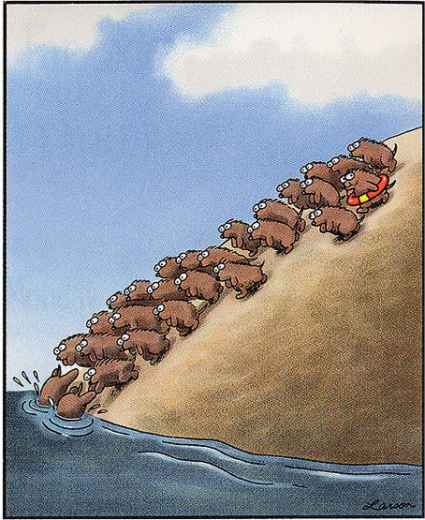
Source: Gary Larson – Where’s Your Preserver?
Making money in the stock market is a tough game, and most people don’t beat the market because like lemmings the average investor follows the herd mentality to underperformance. So, should Wall Street analysts and the media be crucified for their analysis? The short answer is yes. Certainly there are some exceptional analysts and journalists, however most of them merely report what is happening or are looking in the rear-view mirror. Beyond that, the vast majority of commentators prey on emotions of the public and masses by pushing them into knee-jerk selling panics at the bottom and also getting them frothing at the mouth to buy at market peaks. Can I understand why they offer such bad advice? Yes. Quite simply, the incentive structures are wrong.
If you are an analyst or journalist, the number one priority (incentive) is not to be wrong, because if they are mistaken, then job loss becomes a bona fide risk. However, if they throw in some fancy language and mix it in with a lot of caveats, there virtually is no risk of being wrong. If factors happen to change, no worries, their opinions can change too. Therefore, most analysts huddle together in tight packs reporting the same news du jour as everyone else, while mixing in a fair dosage of fear and greed to drum up more interest. These incentives align well for the journalists/analysts but unfortunately not for the average investor.
Joshua Brown over at the Reformed Broker recently wrote an excellent piece highlighting his so-called “Yuppie Bounce” example. Last winter, as all the discretionary consumer stocks (Joshua Brown calls them “waster stocks”) were getting pasted, the pundits were advising investors to pile into defensive stocks. Lo and behold, this was the absolute worst time to follow that advice. Mr. Brown gives a superb Starbucks (SBUX) versus Wal-Mart (WMT) example showing how SBUX has effectively doubled over the last nine months just as WMT flat-lined.

Source: The Reformed Broker (Joshua M. Brown)
Investing is like a game of chess, so although a current move may sound logical, it’s more important to think about decisions multiple steps into the future. Most successful long-term investors don’t follow the conventional lines of thinking, and they are generally swimming against the tide. Therefore, if you are going to jump in with the other lemmings, make sure you have your life preserver with you.
DISCLOSURE: Some Sidoxia Capital Management and client accounts HAVE direct positions in WMT at the time the article was published. No information accessed through the Investing Caffeine (IC) website constitutes investment, financial, legal, tax or other advice nor is to be relied on in making an investment or other decision. Please read disclosure language on IC “Contact” page.
Stock Market Nirvana: Butter in Bangladesh

Hallelulah to Jason Zweig at The Wall Street Journal for tackling the subject of data mining through his interview with David Leinweber, author of Nerds on Wall Street. All this talk about Goldman Sachs, High Frequency Trading (HFT) and quantitative models is making my head spin and distorting the true value of data modeling. Quantitative modeling should serve as a handy device in your tool-box, not a robotic “black box” solely relied on for buy and sell recommendations. As the article points out, all types of sites and trading platforms are hawking their proprietary tools and models du jour.
The problem with many of these models, even for the ones that work, is that financial market behavior and factors are constantly changing. Therefore any strategy exploiting outsized profits will eventually be discovered by other financial vultures and exploited away. As Mr. Leinweber points out, these models become meaningless if the data is sliced and diced to form manipulated relationships and predictive advice that make no sense.
Butter in Bangladesh: To drive home the shortcomings of data mining, Leinweber uses a powerful example in his book, Nerds on Wall Street, of butter production in Bangladesh. In searching for the most absurd data possible to explain the returns of the S&P 500 index, Leinweiber discovered that butter production in Bangladesh was an excellent predictor of stock market returns, explaining 75% of the variation of historical returns. The Wall Street Journal goes onto add:
By tossing in U.S. cheese production and the total population of sheep in both Bangladesh and the U.S., Mr. Leinweber was able to “predict” past U.S. stock returns with 99% accuracy.
For some money managers, the satirical stab Leinweber was making with the ridiculous analysis was lost in translation – after the results were introduced Leinweber had multiple people request his dairy-sheep model. “A distressing number of people don’t get that it was a joke,” Leinweber sighed.
Super Bowl Crystal Ball: Leinweber is not the first person to discover the illogical use of meaningless factors in quantitative models. Industry observers have noticed stocks tend to perform well in years the old National Football league team wins the Super Bowl. Unfortunately, this year we had two “old” NFL teams play each other (Pittsburgh Steelers and Arizona Cardinals). Oops, I guess we need to readjust those models again.
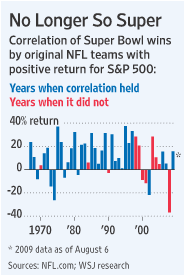
Other bizarre studies have been done linking stock market performance to the number of nine-year-olds living in the U.S. and another linking positive stock market returns to smog reduction.
Data Mining Avoidance Rules:
1) Sniff Test: The data results have to make sense. Correlation between variables does not necessarily equate to causation.
2) Cut Data into Slices: By dividing the data into pieces, you can see how robust the relationships are across the whole data set.
3) Account for Costs: The results may look wonderful, but the model creator must verify the inclusion of all trading costs, fees, and taxes to increase confidence results will work in the real world.
4) Let Data Brew: What looks good on paper might not work in real life. “If a strategy’s worthwhile,” Mr. Leinweber says, “then it’ll still be worthwhile in six months or a year.”
Not everyone has a PhD in statistics, however you don’t need one to skeptically ask tough questions. Doing so will help avoid the buried land mines in many quantitative models. Happy butter churning…
Wade W. Slome, CFA, CFP®
Plan. Invest. Prosper.
Jack Welch University: Diploma or Black Belt?
You too can get your name plastered across a university (or online) for a measly $2 million. That’s what Jack Welch did when he purchased a 12% stake in the primarily online Masters of Business Administration Program (MBA) of Chancellor University. The name of the school according to The Wall Street Journal will be the Jack Welch Institute (JWI).
According to the WSJ:
Boston research firm EduVentures Inc. estimates that 11% of the roughly 18.5 million U.S. college students took most of their classes online in the fall of 2008, up from 1% a decade ago.Online higher education will generate revenue of $11.5 billion this year, EduVentures says. But “there is a concern about quality,” says EduVentures Chief Executive Tom Dretler, because there’s “much, much less selectivity” of students in the admissions process.
So what does a Jack Welch student receive upon graduation – a diploma or a General Electric (GE) Six Sigma Black Belt? And what about Jack’s hard-nosed, no-nonsense business approach? Will all students learn how to negotiate like Jack, especially when it comes to retirement perks? The $21,000 tuition bill sounds steep on the surface, but well worth it if graduates can finagle exit package perks like Welch’s $86,000 a year consultant fee, use of an $80,000 per month Manhattan apartment, court-side seats to the New York Knicks and U.S. Open, seating at Wimbledon, box seats at Red Sox and Yankees baseball games, country club fees, security services and restaurant bills (The New York Times), not to mention a limousine, a cook, free flowers, country-club memberships and a charge account at Jean Georges restaurant.
Now that’s an MBA degree that may attract interest.
Wade W. Slome, CFA, CFP® www.Sidoxia.com
Religious Pursuit of Stock Knowledge (Top 5 Books)

Feed Your Brain
In this stress-filled society dominated with endless amounts of information, and where the masses chase instant gratification, it is difficult to find the time, energy, and focus to curl up to a good book. But in life, knowledge acquisition requires more than a quick keyboard dance on Google.com, or a fleeting skim of a Wikipedia passage. Mastering a subject requires in-depth, nuanced analysis, and books are ideal vehicles used to achieve this aim.
When it comes to the topic of equity investing, it feels as though there are an infinite number of books scattered on the investment menu. Investing in many ways is like religion – there are so many different styles to choose from, even if many of them strive for the same or similar goals. Therefore, I believe if investors are fine-tuning or shopping for an investment philosophy, it makes sense to explore a cross-section of investment styles/religions.
In my view, successful equity investing integrates a balanced mix of “art” and “science.” Too much emphasis on either aspect can be detrimental to investors’ financial health. Although understanding the science takes time, training and patience, generally a committed student can learn the nuts and bolts of investing by mastering the key financial equations, ratios, and concepts. However, becoming a fluent investment artist requires the adept understanding and prediction of human behavior – no easy task.
Having logged thousands of hours and decades of years, my blood shot eyes and finance-soaked brain came up with a balanced mix of “art” and “science” in what I call my, “Top 5 Stock Book Starter Kit”:
A Random Walk Down Wall Street by Burton Malkiel
A great foundational investment book that tackles the major internal and external factors impacting our complex financial markets.
Beating the Street by Peter Lynch
A “Hall-of-Famer” growth investor, Lynch successfully managed the Fidelity Magellan Fund from 1977 to 1990 and averaged a +29% annual return. This book provides countless pearls of wisdom for both the seasoned pro and the bushy-tailed novice.
The Intelligent Investor by Benjamin Graham
When Warren Buffet pronounces this, “By far the best book on investing ever written,” people should pay attention. Graham is considered by many to be the father of “value” investing.
Reminiscences of a Stock Operator by Edwin Lefevre
This book profiles the life and times of early 20th century trader Jesse Livermore, commonly believed to be the greatest trader of all-time. Livermore provides a view into the “fast money” approach that contrasts the traditional “growth” and “value” investment styles.
Common Stocks and Uncommon Profits by Phil Fisher
A Wall Street legend that explains the key factors of superior stock returns.
There you go…upon completion, you will have officially become a stock guru!