Posts filed under ‘Education’
Sukuk: Islamic Loophole for Dubai Debt Debacle

Islamic followers can be capitalists too. Although oil prices (currently around $77 per barrel) have fallen from the peak near $150 per barrel in 2008, oil rich nations have gotten creative in how they raise debt-like financing. Critical to fueling the speculative expansion in some oil rich areas has been the growth in sukuk bonds, which have been created as a function of an exploited loophole embedded in Islamic finance principles.
U.S. Does Not Have Monopoly on Debt Driven Greed
The pricked debt bubble that spanned a range of entities, from Icelandic banks to Donald Trump’s empire (read more), has now spread to Dubai commercial real estate. At the center of the storm is Dubai World, a quasi-government owned conglomerate of Dubai, which is in the process of negotiating a $26 billion debt restructuring with the government and sukuk bondholders. The overleveraged Dubai market ($80 billion in total debt) is home to the tallest building in the world, largest man-made islands, and a ski-resort based in the desert – all projects built with the help of debt in the face of collapsing real estate prices. Critical to Dubai World’s debt restructuring is a $3.5 billion sukuk bond issued by its commercial real estate subsidiary Nakheel Development (“Nakheel”). So what exactly is a sukuk (plural of sakk)?
Investopedia lists the following definition for sukuk:
“An Islamic financial certificate, similar to a bond in Western finance, that complies with Sharia, Islamic religious law. Because the traditional Western interest paying bond structure is not permissible, the issuer of a sukuk sells an investor group the certificate, who then rents it back to the issuer for a predetermined rental fee. The issuer also makes a contractual promise to buy back the bonds at a future date at par value.”
Sukuk “No-No”s
The generation of money on top of money – interest payments or what’s called “Riba” – is strictly forbidden by Shari’ah law. As a result, issuers must issue and repurchase sukuk at par (original value), not at a discount or a premium. Shari’ah law encompasses more than Islamic law, it also covers the amorphous spiritual and moral obligations demanded from the religious practitioners. In order to ensure compliance with Islamic principles, many financial institutions and funds typically have a Shari’ah Board monitoring the details of the sukuk. Shari’ah law is very consistent with the teachings in the Quran (the Western version of the Bible). Mixing finance and religion may seem strange on the surface, but I guess if we use world history as a proxy, we shouldn’t be surprised that money and Muhammad somehow find a way to coexist.

Click Here to View CNBC Interview on Sukuk Bonds
Sukuk Structure & Market
The core Islamic finance principles underpinning the sukuk market have been around for more than 1,500 years, but the actual sukuk market was actually introduced in Malaysia around 1990. Since then, the market has been on a continual uptrend. What makes this $1 trillion Islamic debt market (HSBC estimate) even fuzzier is the scores of sukuk structures (See Ijara Sukuk chart below – very similar to a sale-leaseback arrangement), and the diverse geographic issuer/investor base. For example, greater than 60% of Nakheel’s investors are based outside the Middle East (a large portion in Malaysia). Making matters as clear as mud, each geographic region and structure has its own interpretation of legal rights and Shari’ah law. Layer on issues such as derivatives, bankruptcy rights, and penalty fees and you end up with only more complexity. What’s more, many of these sukuk bonds involve Special Purpose Vehicles (SPVs) – made famous by the off-balance sheet variety used by Enron Corp. – in order to get around the Islamic issuance loopholes.
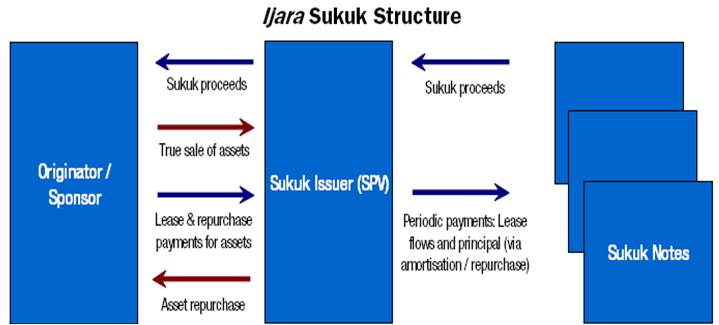
Source: Moody's Investor Service
Sukuk Liquidity
The illiquidity of sukuk market hasn’t made resolving the Dubai debt restructuring any easier. The sukuk market doesn’t come close to matching the liquidity of traditional corporate and sovereign debt markets. Little trading is done in secondary markets because most investors in sukuk bonds follow a buy and hold strategy. The lion’s share of trading in this immature market gets completed through inter-institution, over-the-counter transactions. A recent $500 million sukuk deal issued by General Electric (GE) last month has only raised awareness for the financing structure (pre-Nakheel restructuring). As oil rich states strive to diversify their economic bases, I would expect more deals to get done, in spite of the recent Dubai mess. How severe the recent Dubai sukuk black eye will be depends on how Nakheel, the United Arab Emirates (UAE), Abu Dhabi, bondholders, and other constituents restructure the pending sukuk obligations by the December 14th deadline.
The recent debt restructuring talks in Dubai highlight the complexity of this relatively new Islamic financing structure. With very few sukuk bankruptcy cases in existence, the structures remain largely untested and uncertain. How the Dubai debt debacle ultimately gets resolved will have a significant impact on this nascent, but rapidly growing market. Until the sukuk restructuring is settled, Dubai may just need to put the construction of that next man-made island on hold.
Wade W. Slome, CFA, CFP®
Plan. Invest. Prosper.
DISCLOSURE: Information and data from Moody’s Investor Service (Shari’ah and Sukuk: A Moody’s Primer 5/31/2006), CNBC interview 12/2/09, Financial Times 12/1/09, and other articles. Sidoxia Capital Management (SCM) and some of its clients own certain exchange traded funds, but at time of publishing had no direct positions in GE. No information accessed through the Investing Caffeine (IC) website constitutes investment, financial, legal, tax or other advice nor is to be relied on in making an investment or other decision. Please read disclosure language on IC “Contact” page.
More Eggs in Basket May Crack Portfolio

NOT putting all your eggs in one basket makes intuitive sense to many investors. Burton Malkiel, Princeton Professor, economist, and author, summed it up succinctly, “Diversity reduces adversity.” Diversification acts like shock absorbers on a car – it smoothens out the ride on a bumpy financial road (read more on diversification). Jason Zweig, Wall Street Journal writer, acknowledges the academic findings that underpin these diversification benefits by stating the following:
“As many studies have shown, at least 40% of the variability in returns can be reduced by moving from a single company to 20. Once a portfolio contains 20 or 30 stocks, adding more does little to damp the fluctuations in wealth over time.”
Despite the evidence, Jason Zweig explores the conventional views on diversification more closely.
Turning the Diversification Concept on its Head
Zweig, not satisfied with the standard thinking on the topic, decided to explore the work of Don Chance, a finance professor at the Louisiana State University business school. Professor Chance asked more than 200 students to consecutively select stocks until they each held a portfolio of 30 positions. Here are two of the main findings:
1) Averages Hold Firm: On average, for the group of students, diversifying from a single stock to 20 reduced portfolio risk by roughly 40% – just as would be expected from the academic research.
2) Individual Portfolios Riskier: After the first few initial stock picks, for each individual portfolio, were made from a list of large cap household names (e.g., XOM, SBUX, NKE), Professor Chance found in many instances students dramatically increased portfolio risk. These students juiced up the octane in their portfolios by venturing into much smaller, more volatile stock selections.
Deceiving Diversification
Gur Huberman, a Columbia Finance Professor also points out a tendency for investors to clump stock selections together in groups with similar risk profiles, thereby reducing diversification benefits. Diversifying from one banking stock to 20 banking stocks may actually do more damage. Statistically, Zweig points out, “Thirteen percent of the time, a 20-stock portfolio generated by computer will be riskier than a one-stock portfolio.”
Professor Chance found similar results according to Zweig:
“One in nine times, they [students] ended up with 30-stock portfolios that were riskier than the single company they had started with. For 23%, the final 30-stock basket fluctuated more than it had with only five stocks.”
Diversified Views on Diversification
Chance and Huberman are not the only professionals to question the benefits of diversification:
Warren Buffett: A diversification skeptic declares, “Put all your eggs in one basket and then watch that basket very carefully.” Alternatively, Buffett says, “Diversification is protection against ignorance.”
Peter Lynch: He referred to diversification as “deworsification,” especially when it came to companies diversifying into non-core businesses.
Charlie Munger: “Wide diversification, which necessarily includes investment in mediocre businesses, only guarantees ordinary results.”
Zweig’s Solution:
“If you want to pick stocks directly, put 90% to 95% of your money in a total stock-market index fund. Put the rest in three to five stocks, at most, that you can follow closely and hold patiently. Beyond a handful, more companies may well leave you less diversified.”
Portfolio diversification and concentration have been issues studied for decades. As you can see, there are different viewpoints regarding the benefits. As Zweig establishes, through the research of Don Chance, putting more eggs in your basket may actually crack your portfolio, not protect it.
Read Complete WSJ Jason Zweig Article
Wade W. Slome, CFA, CFP®
Plan. Invest. Prosper.
DISCLOSURE: Sidoxia Capital Management (SCM) and some of its clients own certain exchange traded funds, but at time of publishing had no direct positions in XOM, SBUX, BRKA/B or NKE. No information accessed through the Investing Caffeine (IC) website constitutes investment, financial, legal, tax or other advice nor is to be relied on in making an investment or other decision. Please read disclosure language on IC “Contact” page.
Secure Your GPS (Global Portfolio Specialist)

We’ve all been there, our head in our hands, lost in the middle of nowhere. One reason for blame can be overconfidence in the directions provided or our map reading abilities. Now we have GPS (Global Positioning System) devices – a tool I now could never live without. In the investment world, with the damage that has been done, intelligent advice is needed more than ever. Unfortunately, there is no GPS device to guide our investments, but many individuals would do their self a favor by finding the right experienced professional advisor to act as your GPS device (Global Portfolio Specialist).
Getting from point A to point B in the real world can be quite simple. In the investment world, the roadways are constantly shifting. Changes in interest rates, tax policies, unemployment, fiscal initiatives can represent obstacles, the equivalent of road construction barriers, potholes, erosion, mudslides, and earthquakes in our quest for financial freedom. Navigating these winding paths can require a GPS advice. Asking for help or directions can be embarrassing and castigating for some, especially for some proud males. Stubbornly appearing to have the answer can be more important for some, and can cloud the decision making process – even if assistance can lead to the most efficient path to prosperity.
Having a guide at your fingertips as you meet unknown forks in the road is a nice asset to have. Unfortunately finding the right guide is much easier said than done, many guides can have ulterior motives and hidden agendas that conflict with yours. So although, having a guide may be ideal, finding the right guide requires a lot of research (read how to find an advisor). The scope of qualifications between the capabilities of one advisor compared to another can be like comparing a plastic butter knife with a stainless steel swiss-army knife. The cheap butter knife may handle a few simple needs, but most investors would be better served by someone with a breadth of tools that can assist you with a diverse set of circumstances.

The old cliché states men hate to get directions while women seek a security blanket (a plan). GPS is not full proof, as occasionally the software is not updated or gets confused. But tech geeks like me have grown to love the assistance and benefit from the heightened efficiency and safety it provides. Not only am I more confident, but it also gets me to where I want to go in less time.
Having your guide is important when it comes to investments, but having someone with expertise in tax planning (should I consider Roth conversion in 2010?); estate planning (what impact will the expected changes in the estate tax rate have on my future?); and insurance planning (do I have adequate life, health, and business insurance?) can be critical. All these areas can have a profound impact on whether you achieve your personal and financial goals.
Along the road of life, there can be many bumps, twists and turns. If you would like the assistance of a professional advisor, consider doing your homework and finding the appropriate GPS. Here is a checklist:
1) Where are You Now? This means taking inventory of your assets and liabilities, getting a handle on your income and expenses, and having a firm understanding of your tax and family planning issues (will, trust, powers of attorneys, etc.)
2) Where are You Going? Next you need to know where you want to go? You may have a rough idea, but in order to create a coherent plan, goals need to be defined.
3) Create a Plan. Everyone’s map or blueprint will look different. Some will need highly detailed directions, while others due to different circumstances may have less complex needs or shorter distances to travel. Some may need guidance and directions to reach an adjacent state, while others may have more ambitious goals or planning needed to reach the peak of Mount Everest. Different destinations and circumstances will require different planning.
4) Monitor and Adjust Plan as Necessary. Road conditions, weather, breakdowns, flight cancellations, among many other unforeseen circumstances can change the path to your goal. That’s why it’s so important to review, not only the changes in external circumstances, such as the financial markets, but also any individual changes whether it’s health, family, personal, or goal related.
Some people prefer to do things the old-fashion way or are happy with subpar technology (i.e., compass). However, if you do not want to get lost, or want a clearer defined map, then it’s time to shop for that new Global Portfolio Specialist who can help guide you to your destination.
Wade W. Slome, CFA, CFP®
Plan. Invest. Prosper.
DISCLOSURE: Sidoxia Capital Management (SCM) or its clients owns certain exchange traded funds, but currently has no direct position in GRMN. No information accessed through the Investing Caffeine (IC) website constitutes investment, financial, legal, tax or other advice nor is to be relied on in making an investment or other decision. Please read disclosure language on IC “Contact” page.
Back to the Future: Mag Covers (Part III)

Congratulations to those who have graduated through my first two articles (Part I and Part II) regarding the use of media magazine covers as contrarian investment indicator tools. We’ve reviewed magazine’s horrendous ability of predicting market shifts during the 1970s and Tech Bubble of 2000, and now we will take a peek at the “Great Recession” of 2008 and 2009. If you have the stamina to complete this final article, your diploma and selfless glory will be waiting for you at the end.
This magazine cover series was not designed to be utilized as an exploitable investment strategy, but rather to increase awareness and raise skepticism surrounding investment content. Just because something is written or said by journalist or blogger does not mean it is a fact (although I fancy facts). In the field of investing, along with other behavioral disciplines, there are significant gray areas left open to interpretation. A more educated, critical eye exercised by the general public will perhaps release us from the repetitive boom-bust cycles we’ve become accustomed to. Perhaps my goal is naïve and idealistic, nonetheless I dare to dream.
The wounds from a year ago are still fresh, and we have not fully escaped from the problems that originally got us into this mess, but it is amazing what a 60%+ market move since March can do to the number of “Great Depression” references. Let’s walk down calamity memory lane over the last year:
Great Depression Redux?

Months ago we were in the midst of a severe recession, and the media was not shy about jumping on the “pessimism porn” bandwagon for the sake of ratings. Like a Friday the 13th sequel (nice tie in!), CNBC just weeks ago was plugging the crisis anniversary of the Lehman Brothers failure. Time magazine’s portrayal of the financial crisis as the next Great Depression, including the soup kitchen lines, mass unemployment, and collapse of thousands of banks, was used like chum to feed the frenzy of shocked investing onlookers. Unemployment rates are still creeping up, albeit at a slower rate, but we are nowhere near the 25% levels seen in the Great Depression.
American Disintegration
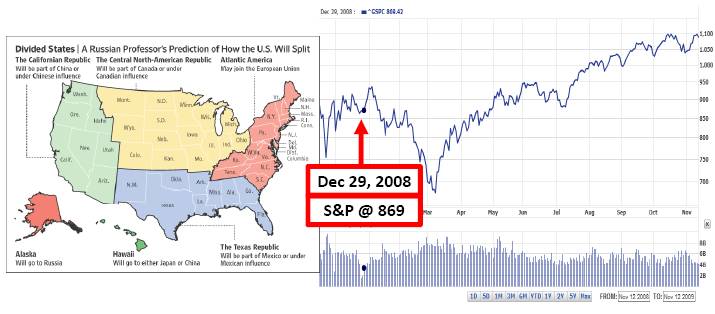
One of my favorite articles (read here) of the global crisis was written by The Wall Street Journal late last year about a Russian Professor, Igor Panarin (also a former KGB analyst). I find it absurdly amusing that the WSJ would even give credence to this story, but perhaps now I can look forward to an Op-Ed in their newspaper from Iranian President Mahmoud Ahmadinejad or North Korean Leader Kim Jong Ill. Not only did Professor Panarin pronounce the complete evaporation of the United States, but he also provided a specific timeframe. In late June or early July 2010, he expects the U.S. to fall into civil war and subsequently get carved up into six pieces by particular foreign regions, including China, Mexico, E.U., Japan, Canada, and Russia (which will control Alaska of course). I guess Sarah Palin will not be a happy camper?
Other Crisis Souvenirs

Hey Georgy, let me know when you turn bullish…so I can sell!
Market Mayhem
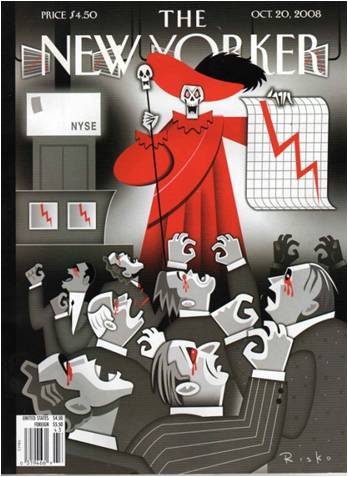
- Who’s that on the cover? Nancy Pelosi?!
Lessons Learned
Contrarianism for the sake of contrarianism is not necessarily a good thing. Trend can be your friend too. Bubbles take much longer to inflate than they burst, so it may be in your best interest to ride the wave of ecstasy for longer than the early alarm ringers. Take for example Alan Greenspan’s infamous irrational exuberance speech in 1996, when the NASDAQ index was trading around 1300. As we all know, the NASDAQ went on to pierce the 5000 mark, four years later. Sorry Al…right idea, but a tad early. Although he may have been correct directionally, his timing and degree were way off. Pundits like Nouriel Roubini and Peter Schiff are other examples of prognosticators who identified the financial crisis many years before the catastrophe actually hit. As I noted previously, trading based on magazine covers was not conceived as a legitimate investable strategy, but as I’ve shown they can be indicators of sentiment. And these sentiment indicators can be used as a valuable apparatus in your toolbox to prevent harmful decisions at the worst possible times.
Thanks for coming Back to the Future on this historical tour of cover stories. Now that you have graduated with honors, next time you are in line at the grocery store, feel free to flash your diploma to receive a discount on a magazine purchase.
Class dismissed.
Wade W. Slome, CFA, CFP®
Plan. Invest. Prosper.
DISCLOSURE: No information accessed through the Investing Caffeine (IC) website constitutes investment, financial, legal, tax or other advice nor is to be relied on in making an investment or other decision. Please read disclosure language on IC “Contact” page.
Back to the Future: Mag Covers (Part II)
In my most recent article, I went Back to the Future to examine the role magazine covers play as a contrarian indicator in fear-driven markets like we experienced in the 1970s (see previous story). Investing is both an art and science. While measuring the scientific aspects of the market can be more straight-forward, the behavioral and emotional sides to investing are more subjective. Magazines act as sentiment sensors to gauge the fear and froth pulses of the general investing public. Since last time we explored fear, let’s check out some froth from the 1990s technology boom.
How to Invest in the Hottest Market Ever
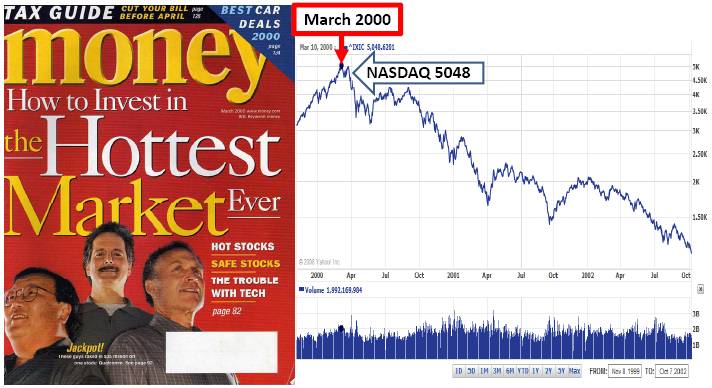
Seeing the forest from the trees can be difficult when you’re trapped in the thick of it, but the March 2000 issue of Money magazine’s “How to Invest in the Hottest Market Ever” is a classic example of the mentality that reigned supreme in the late 1990s technology bubble. Objective, fact-filled articles that challenge the status quo are not necessary to generate sales, but articles and magazine covers that pander to the raw emotions of fear and greed keep the cash register ringing. If you don’t believe me, just read the sensational headlines at your local grocery store explaining how swine flu will kill us all and how there are millions to be made in melting gold coins and jewelry (read gold article).
I love some of the quotes from the article, especially from Pam, the 51 year old divorced New York City art museum volunteer who bought AOL, Microsoft, and Qualcomm (which rose +2,621% in 1999) who dismisses diversification: “I feel pretty safe now. I think we are in a new paradigm now.” Yeah, a “new economy” that catapulted Yahoo to a Price/Earnings ratio of 400x’s earnings; Cisco 109x’s earnings; and Sun Microsystems practically a bargain basement steal at 88x’s earnings. For reference purposes, the S&P 500 index currently trades for about 14.6x’s estimated 2010 earnings and 19.5x on 2009 estimates.
GetRich.com
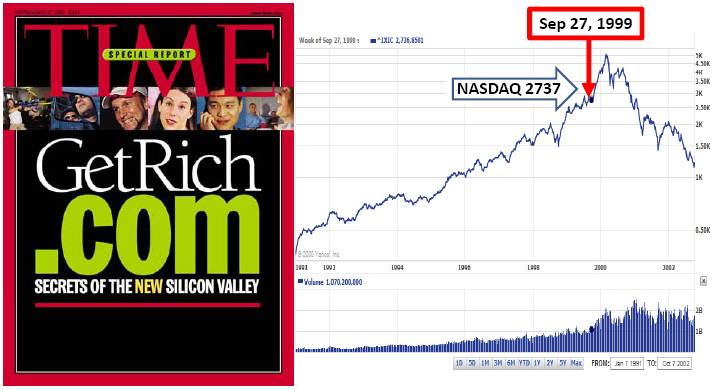
Another landmark masterpiece I love is the September 1999 Time cover, “GetRich.com.” Never mind the unabated technology boom (excluding a brief hiccup in 1998) that inflated the bubble for a decade – Time still managed to unearth the “Secrets of the New Silicon Valley.” The article goes onto to express the get-rich formula:
“Can’t program a computer? Not a techno savvy? Not a problem. If you’ve got a hot Internet business idea, Silicon Valley’s astonishing start-up machine will do the rest.”
Like a drug dealer pushing heroin on an addict, the article goes on to entice its readers to question “Why have a boss when you and three buddies can build your own publicly traded company in two years? Windows this big don’t open very often.”
A Few More Favorites
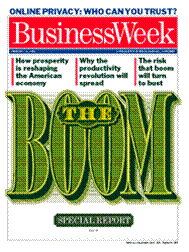
Great timing on this February 2000 cover…a month before the crash!

This July 1999 cover captures envy. Everyone's getting rich!
As we saw during the technology boom, media outlets have no shame in shoveling greed inducing slop to the hungry general public. Like all historical events that end tragically, valuable lessons can be learned from our mistakes. Developing a discerning palette for the news we digest is a critical quality to generating an informed investment decision process. With the 1970s and 1990s behind us, as the last of my three part series, we’ll use time travel to another period to see if modern magazine editors fare any better in market timing as compared to their predecessors. Please excuse me while I jump in my time machine.
Wade W. Slome, CFA, CFP®
Plan. Invest. Prosper.
DISCLOSURE: Sidoxia Capital Management (SCM) or its clients has a long position in CSCO and QCOM at the time this article was originally posted. SCM owns certain exchange traded funds, but currently has no direct position in YHOO, MSFT, or JAVA. No information accessed through the Investing Caffeine (IC) website constitutes investment, financial, legal, tax or other advice nor is to be relied on in making an investment or other decision. Please read disclosure language on IC “Contact” page.
Back to the Future: Mag Covers (Part I)
Magazine Covers Part II – – – Magazine Covers Part III
I’m not referring to the movie, Back to the Future, about a plutonium-powered DeLorean time machine that finds Marty McFly (played by Michael J. Fox) traveling back in time. Rather, I am shining the light on the uncanny ability of media outlets (specifically magazines) to mark key turning points in financial markets – both market bottoms and market tops. This will be the first in a three part series, providing a few examples of how magazines have captured critical periods of maximum fear (buying opportunities) and greed (selling signals).
People tend to have short memories, especially when it comes to the emotional rollercoaster ride we call the stock market. Thanks to globalization, the internet, and the 24/7 news cycle, we are bombarded with some fear factor to worry about every day. Although I might forget what I had for breakfast, I have been a student of financial market history and have experienced enough cycles to realize as Mark Twain famously stated, “History never repeats itself, but it often rhymes” (read previous market history article). In that vein, let us take a look at a few covers from the 1970s:
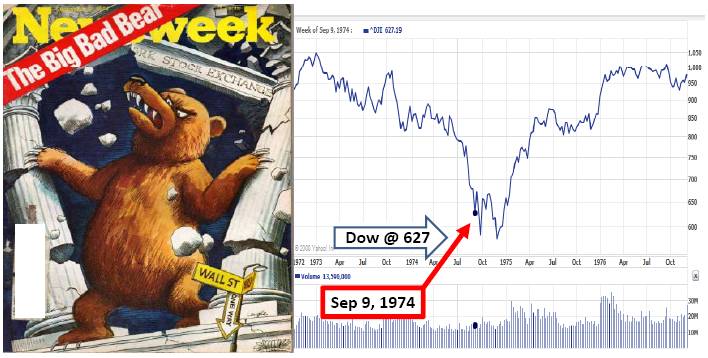
Newsweek’s “The Big Bad Bear” issue came out on September 9, 1974 when the collapse of the so-called “Nifty Fifty” (the concentrated set of glamour stocks or “Blue Chips”) was in full swing. This group of stocks, like Avon, McDonalds, Polaroid, Xerox, IBM and Disney, were considered “one-decision” stocks investors could buy and hold forever. Unfortunately, numerous of these hefty priced stocks (many above a 50 P/E) came crashing down about 90% during the1973-74 period.
Why the glum sentiment? Here are a few reasons:
- Exiting Vietnam War
- Undergoing a Recession
- 9% Unemployment
- Arab Oil Embargo
- Watergate: Presidential Resignation
- Franklin National Failure
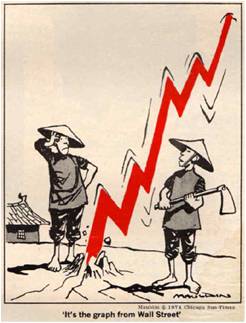
A cartoon from the same bearish 1974 cover article.
Not a rosy backdrop, but was this scary and horrific phase the ideal time to sell, as the magazine cover may imply? No, actually this was a shockingly excellent time to purchase equities. The Dow Jones Industrial Average, priced at 627 when the magazine was released, is now trading around 10,247…not too shabby a return considering the situation looked pretty darn bleak at the time.
Reports of the Market’s Death Greatly Exaggerated
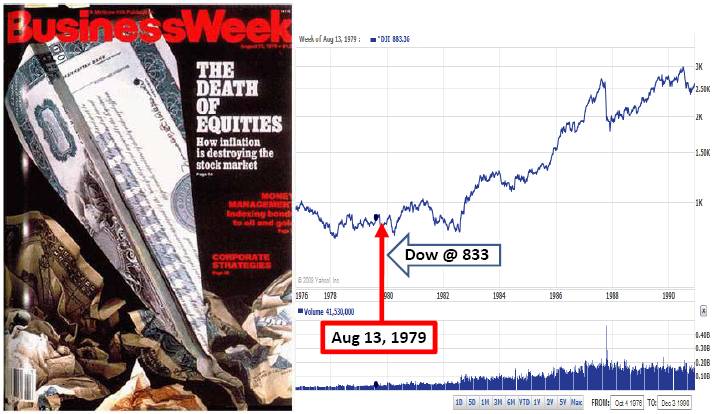
Sticking with the Mark Twain theme, the reports of the market’s demise was greatly exaggerated too – much the same way we experienced the overstated reaction to the financial crisis early in 2009. BusinessWeek’s August 13, 1979 magazine captured the essence of the bearish mood in the article titled, “The Death of Equities.” This article came out, of course, about 18 months before a multi-decade upward explosion in prices that ended in the “Dot-com” crash of 2000. In the late 1970s, inflation reached double digit levels; gold and oil had more than doubled in price; Paul Volcker became the Federal Reserve Chairman and put on the economic brakes via a tough, anti-inflationary interest rate program; and President Jimmy Carter was dealing with an Iranian Revolution that led to the capture of 63 U.S. hostages. Like other bear market crashes in our history, this period also served as a tremendous time to buy stocks. As you can see from the chart above, the Dow was at 833 at the time of the magazine printing – in the year 2000, the Dow peaked at over 14,000.
The walk down memory lane is not over yet. Conveniently, the Back to the Future story was designed as a trilogy (just like my three-part magazine review), so stay tuned for “Part II” – coming soon to your future.
Wade W. Slome, CFA, CFP®
Plan. Invest. Prosper.
DISCLOSURE: Sidoxia Capital Management (SCM) has a short position in MCD at the time this article was originally posted. SCM owns certain exchange traded funds, but currently has no direct position in Avon (AVP), Polaroid, Xerox (XRX), IBM or Disney (DIS). No information accessed through the Investing Caffeine (IC) website constitutes investment, financial, legal, tax or other advice nor is to be relied on in making an investment or other decision. Please read disclosure language on IC “Contact” page.
One Size Does Not Fit All

When you go shopping for a pair of shoes or clothing what is the first thing you do? Do you put on a blindfold and feel for the right size? Probably not. Most people either get measured for their personal size or try on several different outfits or shoes. When it comes to investments, the average investor makes uninformed decisions and in many instances relies more on what other advisors recommend. Sometimes this advice is not in the best interest of the client. For example, some broker recommendations are designed to line their personal pockets with fees and/or commissions. In some cases the broker may try to unload unpopular product inventory that does not match the objectives and constraints of the client. Because of the structure of the industry, there can be some inherent conflicts of interest. As the famous adage goes, “You don’t ask a barber if you need a haircut.”
Tabulate Inventory
A more appropriate way of managing your investment portfolio is to first create a balance sheet (itemizing all your major assets and liabilities) individually or with the assistance of an advisor (see “What to Do” article) – I recommend a fee-only Registered Investment Advisor (RIA)* who has a fiduciary duty towards the client (i.e., legally obligated to work for the best interest of the client). Some of the other major factors to consider are your short-term and long-term income needs (liquidity important as well) and your risk tolerance.
Risk Appetites
The risk issue is especially thorny because the average investor appetite for risk changes over time. Typically there is also a significant difference between perceived risk and actual risk.
For many investors in the late 1990s, technology stocks seemed like a low risk investment and everyone from cab drivers to retired teachers wanted into the game at the exact worst (riskiest) time. Now, as we have just suffered through the so-called Great Recession, the risk pendulum has swung back in the opposite direction and many investors have piled into what historically has been perceived as low-risk investments (e.g., Treasuries, corporate bonds, CDs, and money market accounts). The problem with these apparently safe bets is that some of these securities have higher duration characteristics (higher price volatility due to interest rate changes) and other fixed income assets have higher long-term inflation risk.
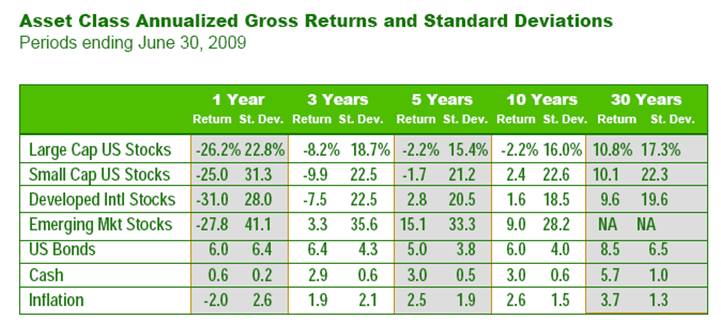
Source (6/30/09): Morningstar Encorr Analyzer (Ibbotson Associates) via State Street SPDR Presentation
A more objective way of looking at risk is by looking at the historical risk as measured by the standard deviation (volatility) of different asset classes over several time periods. Many investors forget risk measurements like standard deviation, duration, and beta are not static metrics and actually change over time.
Diversification Across Asset Classes Key
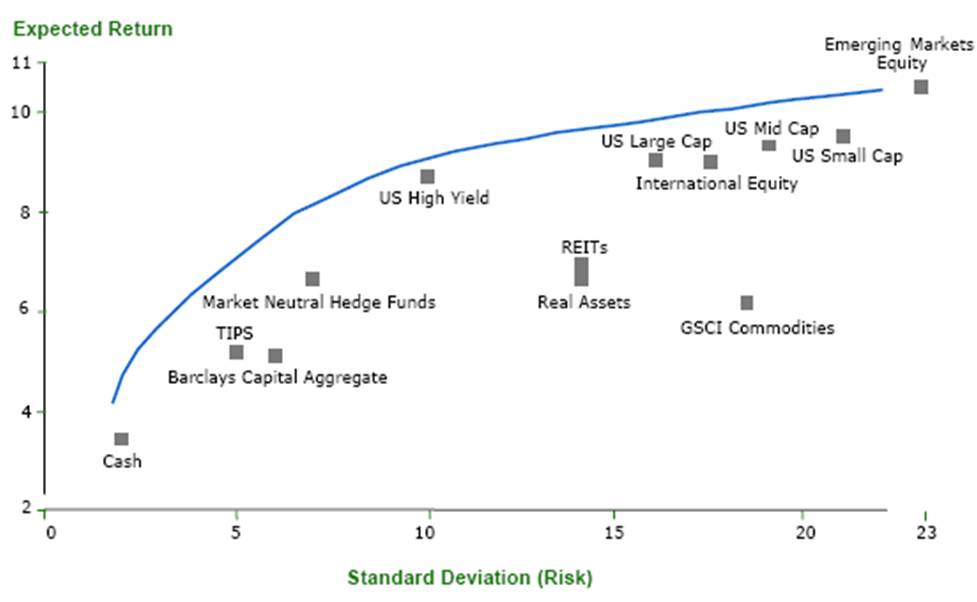
Source: State Street Global Advisors (June 30, 2009)
Correlation, which measures the price relationship between different asset classes, increased dramatically across asset classes in 2008, as the global recession intensified. However, over longer periods of time important diversification benefits can be achieved with a proper mixture of risky and risk-free assets, as measured by the Efficient Frontier (above). Conceptually, an investor’s main goal should be to find an optimal portfolio on the edge of the frontier that coincides with their risk tolerance.
Tailor Portfolio to Changing Circumstances
 In my practice, I continually run across clients or prospects that initially find themselves at the extreme ends of the risk spectrum. For example, I was confronted by an 80 year old retiree needing adequate income for living expenses, but improperly forced by their broker into 100% equities. On the flip side, I ran into a 40 year old who decided to allocate 100% of their retirement assets to fixed income securities because they are unsure of stocks. Both examples are inefficient in achieving their different investment objectives, yet there are even larger masses of the population suffering from similar issues.
Financial markets and client circumstances are constantly changing, so the objectives of the portfolio should be periodically revisited. One size does not fit all, so it’s important to construct the most efficient customized portfolio of assets that meets the objectives and constraints of the investor. Take it from me, I’m constantly re-tailoring my wardrobe (like my investments) to meet the needs of my ever-changing waistline.
Wade W. Slome, CFA, CFP®
Plan. Invest. Prosper.
*DISCLOSURE: For disclosure purposes, Sidoxia Capital Management, LLC is a Registered Investment Advisor (RIA) certified in the State of California. No information accessed through the Investing Caffeine (IC) website constitutes investment, financial, legal, tax or other advice nor is to be relied on in making an investment or other decision. Please read disclosure language on IC “Contact” page.
Compounding: A Penny Saved is Billions Earned
What is “compounding” and why is it so great? It sounds like such a fancy financial term. One can think of compounding as a snowball rolling down a hill – the longer the snowball rolls (or the higher up the mountain you begin), the more compounding will expand the size of your snowball. Expanding your investment portfolio through compounding should be your major goal.
Albert Einstein, arguably one of the most intelligent people to walk this planet, was asked to describe mankind’s greatest discovery. His answer: “compound interest.” He went so far as to call it one of the “Eight Wonders of the World.” The benefits of compounding can be demonstrated via famous explorer, Christopher Columbus.
We all know the story, “In 1492, Christopher Columbus sailed the ocean blue.” To emphasize the benefits of compounding, let us suppose that Christopher Columbus made an investment in the historic year of 1492. If Chris had placed a single penny in a 6% interest-bearing account and instructed someone to remove the interest every year and put it in a piggybank, the total value collected in that piggybank would eventually accumulate to more than 30 cents. A pretty nice multiplier-effect on one penny, but not too much absolute cold hard cash to write home about…agreed?

"It's magic, I can turn pennies into billions."
However, if the young explorer had placed the same paltry investment of one cent into the same interest-bearing account, but LEFT the remaining earned interest to compound (thereby earning interest upon the previously earned interest) the results would be drastically different.
What would you guess the compounded account would be worth in 2009?
$10,000? $100,000? $1 million? $10 million? $100 million?
“NO” is the correct answer to all these guesses.
The correct answer: $121,096,709,346.21! Your eyes do not deceive you. That one penny invested in 1492 would have grown to $121 billion dollars today. If you don’t believe me, pull out your calculator and multiply $.01 * 1.06%, and repeat 517 times. Surely, we will not live 517 years to collect on an investment of such long duration. However, with proper planning everyone has the ability to invest quite a bit more than one cent to significantly build future wealth.
As an advisor, the problems related to compounding I see investors commit most are two-fold:
1) Investors are constantly shifting money in and out of their accounts (usually at suboptimal points) due to apprehension and greed, thereby nullifying the benefits of compounding.
2) Because of overpowering fear relating to current economic conditions, investors are parking their money in low yielding CDs (Certificates of Deposit), savings accounts, checking accounts, money market accounts, or other low returning investment vehicles. This strategy is equivalent to pushing the aforementioned snowball over the sidewalk, rather than down a long, steep hill.
In order to reap the rewards of compounding and dramatically expand your investment portfolio, a systematic, disciplined approach to investing needs to be followed. A system that more likely than not has a 20 year horizon rather than 20 days. Now go start saving those pennies!
EPS House of Cards: Tricks of the Trade

As we enter the quarterly ritual of the tsunami of earnings reports, investors will be combing through the financial reports. Due to the flood of information, and increasingly shorter and shorter investment time horizons, much of investors’ focus will center on a few quarterly report metrics – primarily earnings per share (EPS), revenues, and forecasts/guidance (if provided).
Many lessons have been learned from the financial crisis over the last few years, and one of the major ones is to do your homework thoroughly. Relying on a AAA ratings from Moody’s (MCO) and S&P (when ratings should have been more appropriately graded D or F) or blindly following a “Buy” rating from a conflicted investment banking firm just does not make sense.
FINANCIAL SECTOR COLLAPSE
Given the severity of the losses, investors need to be more demanding and comprehensive in their earnings analysis. In many instances the reported earnings numbers resemble a deceptive house of cards on a weak foundation, merely overlooked by distracted investors. Case in point is the Financial sector, which before the financial collapse saw distorted multi-year growth, propelled by phantom earnings due to artificial asset inflation and excessive leverage. One need look no further than the weighting of Financial stocks, which ballooned from 5% of the total S&P 500 Index market capitalization in 1980 to a peak of 23% in 2007. Once the credit and real estate bubble burst, the sector subsequently imploded to around 9% of the index value around the March 2009 lows. Let’s be honest, and ask ourselves how much faith can we put in the Financial sector earnings figures that moved from +$22.79 in 2007 to a loss of -$21.24 in 2008? Current forecasts for the sector are looking for a rebound back up to +$11.91 in 2010. Luckily, the opacity and black box nature of many of these Financials largely kept me out of the 2009 sector implosion.
WHAT TO WATCH FOR
But the Financial sector is not the only fuzzy areas of accounting manipulation. Thanks to our friends at the FASB (Financial Accounting Standards Board), company management teams have discretion in how they apply different GAAP (Generally Accepted Accounting Principles) rules. Saj Karsan, a contributing writer at Morningstar.com, also writes about the “Fallacy of Earnings Per Share.”
“EPS can fluctuate wildly from year to year. Writedowns, abnormal business conditions, asset sale gains/losses and other unusual factors find their way into EPS quite often. Investors are urged to average EPS over a business cycle, as stressed in Security Analysis Chapter 37, in order to get a true picture of a company’s earnings power.”
These gray areas of interpretation can lead to a range of distorted EPS outcomes. Here are a few ways companies can manipulate their EPS:
Distorted Expenses: If a $10 million manufacturing plant is expected to last 10 years, then the depreciation expense should be $1 million per year. If for some reason the Chief Financial Officer (CFO) suddenly decided the building would last 40 years rather than 10 years, then the expense would only be $250,000 per year. Voila, an instant $750,000 annual gain was created out of thin air due to management’s change in estimates.
Magical Revenues: Some companies have been known to do what’s called “stuffing the channel.” Or in other words, companies sometimes will ship product to a distributor or customer even if there is no immediate demand for that product. This practice can potentially increase the revenue of the reporting company, while providing the customer with more inventory on-hand. The major problem with the strategy is cash collection, which can be pushed way off in the future or become uncollectible.
Accounting Shifts: Under certain circumstances, specific expenses can be converted to an asset on the balance sheet, leading to inflated EPS numbers. A common example of this phenomenon occurs in the software industry, where software engineering expenses on the income statement get converted to capitalized software assets on the balance sheet. Again, like other schemes, this practice delays the negative expense effects on reported earnings.
Artificial Income: Not only did many of the trouble banks make imprudent loans to borrowers that were unlikely to repay, but the loans were made based on assumptions that asset prices would go up indefinitely and credit costs would remain freakishly low. Based on the overly optimistic repayment and loss assumptions, banks recognized massive amounts of gains which propelled even more imprudent loans. Needless to say, investors are now more tightly questioning these assumptions. That said, recent relaxation of mark-to-market accounting makes it even more difficult to estimate the true values of assets on the bank’s balance sheets.
Like dieting, there are no easy solutions. Tearing through the financial statements is tough work and requires a lot of diligence. My process of identifying winning stocks is heavily cash flow based (see my article on cash flow investing) analysis, which although lumpier and more volatile than basic EPS analysis, provides a deeper understanding of a company’s value-creating capabilities and true cash generation powers.
As earnings season kicks into full gear, do yourself a favor and not only take a more critical” eye towards company earnings, but follow the cash to a firmer conviction in your stock picks. Otherwise, those shaky EPS numbers may lead to a tumbling house of cards.
Read Saj Karsan’s Full Article
Wade W. Slome, CFA, CFP®
Plan. Invest. Prosper.
DISCLOSURE: Sidoxia Capital Management has no direct position in MCO or MHP at the time this article was originally posted. No information accessed through the Investing Caffeine (IC) website constitutes investment, financial, legal, tax or other advice nor is to be relied on in making an investment or other decision. Please read disclosure language on IC “Contact” page.
Super Sizing May Be Hazardous to Your Portfolio’s Health

You may be familiar with the 2004 Academy Award nominated documentary titled Super Size Me, in which the creator Morgan Spurlock decides to film his 30 day journey of eating McDonalds (MCD) for breakfast, lunch, and dinner, making sure he samples every item on the menu. In addition, any time a McDonald’s employee asked Mr. Spurlock whether he wanted to “Super Size” his beverage or French fry order, he complied by ordering the larger size. What was the result from this gluttonous, month-long, fast food binge?
Mr. Spurlock ended up gaining about 25 pounds in weight, his cholesterol sky-rocketed, his liver function deteriorated dramatically, he experienced heart palpitations, and became depressed, among other symptoms. At one point a doctor told him if he continued overindulging at the same pace, he could die.
Well, over the years, investors, governments, and corporations have been doing their own form of “Super-Sizing,” but not by eating Big Macs, Apple Turnovers, and Fish Fillets, but rather consuming too much debt, real estate, and other risky assets, like stocks and hedge funds. Now, like Morgan Spurlock, investors are “de-toxing” by saving more and creating a better balanced portfolio diet. Investors have learned their lessons from our “Great Recession” and are dieting on lower risk assets and consuming a broader set of asset classes. An investor’s diet should cover a broad spectrum of options, including diversified choices across asset class, size, style, and geography. Alternative asset classes, like real estate, commodities, and loans should be evaluated as well.
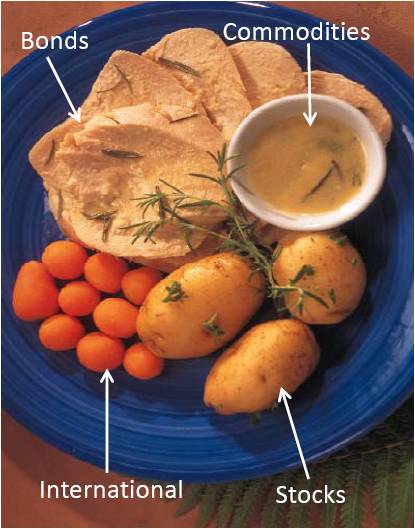
After the massive crash post-Lehman Brothers, many investors and academics have cast doubts about the relative benefits of diversification, arguing there was no investment class or segment to hide – everything fell equally. There is some truth to the argument, with some exceptions like treasuries, cash, and certain commodities. Globalization and the tighter inter-connectedness between countries can shoulder part of the blame of the synchronized freefall in late 2008 and early 2009. Nonetheless, unless you were short the market, even if you were relatively diversified, pain was spread out generously across many investors.
What countless investors fail to recognize is the constant variability in historical relationship data (e.g., correlations, standard deviation, and covariance) – all the better reason to be broadly diversified. Nobel Prize winners Robert Merton and Myron Scholes know first-hand what can happen when you rely too heavily on historical correlations. Their over-reliance on their quantitative models led to the economic collapse of Long Term Capital Management, which nearly brought the entire economic globe to its knees. Importantly, the magnitude of diversification benefit varies throughout an economic cycle. Since the market rebound in March of this year, we have clearly seen the advantages of diversification.
From a geographical perspective, emerging markets like Russia, which is up over +117% (excluding dividends), are trouncing the domestic averages. Diversification benefits across particular industries and sectors are also evident in areas like technology. For example, the NASDAQ and IIX (Internet Index) are up about +34% and +52% in 2009, respectively. In relation to style characteristics, “Growth” is trouncing “Value” as measured by the Russell 1000 Growth and Value benchmarks. “Growth” is up +25% this year, more than double the appropriate Russell “Value” benchmark. It comes as no surprise that the conservative investments that outperformed in the market collapse, like fixed income and utilities, have generally lagged the other segments.
Like Morgan Spurlock, investors need to resist the “Super Size” temptations in their concentrated portfolios and learn from the binging mistakes experienced by others. A more balanced investment diet across asset class, size, style, and geography will lead to a healthier portfolio and steadier return profile. Now if you will excuse me, I would like to get a bite to eat – perhaps a wholesome McGarden Burger.
Wade W. Slome, CFA, CFP®
Plan. Invest. Prosper.
DISCLOSURE: Sidoxia Capital Management has a short position in MCD at the time this article was originally posted. No information accessed through the Investing Caffeine (IC) website constitutes investment, financial, legal, tax or other advice nor is to be relied on in making an investment or other decision. Please read disclosure language on IC “Contact” page.




 Investing Caffeine
