Posts filed under ‘Education’
Investor Wake-Up Call

Source: Photobucket
The Pre Wake-Up Conversation

“Hey Milfred, did you see our brokerage statement? There must be a misprint. It says our portfolio of bonds is down.”

“Buford, how can that be, when our bond portfolio has been up for 30 consecutive years? I hear Jim Bernanke is trying to artificially inflate the economy by printing money and using it to buy bonds.”
“Sweetheart, you got it wrong…it’s Ben Jernanke.”
“Ohhh, yeah honey, you’re right. I never expected prices to go down after government bond yields were up almost 50% in a few months.”
“Sweetie, maybe we should give our broker a call?”
“Oh you mean Skip? I think he wants us to call him a financial consultant or financial advisor now…not a broker.”
“Well anyway, I just read the largest fund manager in the world, Bill Gross, is trying to convert his bond fund into a stock fund (read article). I can’t imagine why Mr. Gross would want to do that (see PIMCO article), but maybe Skip knows? You know, after Skip sold us that high commission annuity and Class-A mutual fund with that 6.25% load, he decided to take his wife, kids, parents, and in-laws to Tahiti for the holidays.”
“Oh I know, Skip is such a nice young man, and so thoughtful.”
“You’re right Pumpkin, I just wish we could hear from him more than once every two years.”
“That’s right Snookum, but at least we get to talk to him when he drops off the paperwork, and his secretary is sure nice.”
“What I really like about Skip is that he always makes so much common sense – he always tells us to buy investments that have already done really well like bonds and gold.”
“Exactly Buford. I just wonder how much longer it will take for stocks to become popular again, given the stock market is already up about 100% from the beginning of 2009? Perhaps with another +30% or so, maybe Skip will switch all our money out of bonds back into stocks?”
“What I love even more about Skip is that not only does he have us buy the popular investments, but he really protects us from buying the low-priced investments that are selling at bargain prices.”
“I hear you Muffin – come to think of it, maybe I should return that sweater I recently purchased at Marshall’s for 50% off – there may be an awful reason I do not know about.”
“Good idea Sweet Pea. The other thing I love about Skip is that he is so knowledgeable…he says the exact same thing I hear from those smart news people on TV. Good thing we have a reliable professional to protect our entire life savings.”
“You’re right as usual dear. He may only have a high school GED, but we’re lucky he has these fancy letters behind his name that I never heard of like PFS, AFC, and RFC… those must be some important credentials.”
“I feel better after our conversation. Maybe we’ll hear from Skip, and if not, I’m sure he’ll drop-off some paperwork for a new investment, if our portfolio goes down by another 10%.”
The Wake-Up Reality
I make some of these comments with tongue firmly in cheek, but the fact remains we live in a financial world with a structurally flawed system of loosely regulated, banks, brokerage firms, insurance companies, ratings agencies, hedge funds, mutual funds, and other financial institutions that continue to repeatedly place their interests ahead of clients. If the 2008-2009 financial crisis hasn’t taught you anything, then you should realize it behooves you to take control of your financial situation. At least ask tough questions that result in answers you can understand – not a lot of technical mumbo-jumbo that makes an advisor sound smart. Make life easier on yourself and have a blunt wake-up call conversation, otherwise grab a pen and get ready for Skip’s call – he’s about to come over with some more paperwork.
Related articles:
Beating off the Financial Sharks
Fees, Exploitation and Confusion Hammer Investors
Investment Credentials: The Letter Shell Game
Wade W. Slome, CFA, CFP®
Plan. Invest. Prosper.
DISCLOSURE: Sidoxia Capital Management (SCM) and some of its clients own certain exchange traded funds, but at the time of publishing SCM had no direct position in TJX, or any security referenced in this article. No information accessed through the Investing Caffeine (IC) website constitutes investment, financial, legal, tax or other advice nor is to be relied on in making an investment or other decision. Please read disclosure language on IC “Contact” page.
Invisible Costs of Trading

Source: Photobucket
You can feel them, but you can’t see them. I’m talking about invisible trading costs. Although some single transaction trading costs can run as high as hundreds of dollars at the large brokerage firms, investors are generally aware of the bottom-basement commissions paid on trades executed at discount brokerage firms like Scottrade, TD Ameritrade (AMTD), E-Trade (ETFC), and Charles Schwab (SCHW) – generally less than $10 per trade. Unfortunately, these commissions are estimated to only account for 20% of total trading costs1. What most investors are unaware of are the host of invisible trading costs and expenses associated with active trading.
Here are some of the invisible costs:
Bid-Ask Spread: Besides the explicit commissions charged, traders must incur the implicit costs of the bid-ask spread. Let’s suppose you have a stock trading at $12.50 per share (ask price) and $12.25 per share (bid price). If you were to immediately buy one share for $12.50 (ask) and sell immediately for $12.25 (ask), then you would be -2% in the hole instantly – more than double the $7.95 commission paid on a $1,000 investment. Effectively, the investor would already be down about -3% the instant the small investment was made.
Impact Costs: The issue of impact costs is a bigger problem for larger institutional investors, although thinly traded stocks (those securities with relatively small trading volume) can even become expensive for retail investors. Suppose the same stock mentioned previously initially traded at $12.50 per share before you transacted, but reached $13.00 per share upon completion (with an average $12.75 price paid). The $.25 cent increase (average price minus initial price) translates into another -2% increase in the costs.
Taxes: It’s not what you make that matters, but rather what you keep that makes the difference. If you make a decent amount of money actively trading, but end up giving Uncle Sam more than potentially 40% of the gains, then your bank account may grow less than expected.
While my examples may shed some light on the costs of trading, an in-depth study using data from Morningstar and NYSE was conducted by three astute professors (Roger Edelen [University of California, Davis], Richard Evans [University of Virginia], and Gregory Kadlec [Virginia Polytechnic Institute]) showing that an average fund’s annual trading costs were estimated to be 1.44%, higher than an average fund’s overall expense ratio of 1.21%.
Unfortunately from an investor’s standpoint, as much as 30% of all trading costs can be attributed to money naturally pouring in and out of funds, due to fund share purchases and redemptions. Therefore, wildly popular or out-of-favor funds will have a detrimental impact on performance. I know firsthand the costs of managing a large fund, much like captaining a supertanker – you create a lot of waves and it can take a while to change directions. Smaller funds, however, can navigate trades more nimbly, much like a speedboat leaving behind smaller cost waves in its wake.
Style can also have an impact on trading costs. Value-based funds that sell into strength or buy into weakness can be considered liquidity providers, and therefore will experience lower trading costs. On the flip side, momentum strategies effectively pour gasoline on hot stocks purchases and pile on damaging sales to cratering losers.
Emotional Costs of Trading
More impactful, but more difficult to quantify, are the emotional trading costs of greed and fear (i.e., chasing extended winners out of greed and panicking out of losing positions due to fear). Constantly hounding winners and capitulating your losers may work in a few instances, but can lead to disastrous results in the long-run. Even if an investor is correct on the sale of a security, the investor must also be right on the subsequent buy transaction (no easy feat).
With that said, there are no hard and fast rules when buying/selling stocks. Buying a stock that has doubled or tripled in and of itself is not necessarily a bad idea, as long as you have credible assumptions and data to support adequate earnings/cash flow growth and/or multiple expansion. Consistent with that thought process, a plummeting stock is not reason enough to buy, and does not automatically mean the price will subsequently rebound. Reversion to the mean can be a powerful force in security selection, but you need a disciplined process to underpin those investment decisions.
Spiritual Savings
As I have stated in the past, investing is like a religion (read more Investing Religion). Most investors stubbornly believe their financial religion is the right way to make money. I personally believe there is more than one way to make money, just as I believe different religions can coexist to achieve their spiritual goals. Through academic research, and a lot of practical experience, my religion believes in the implementation of low-cost, tax efficient products and strategies used over longer-term time horizons. I use a blend of active and passive management that leverages my professional experience (see Sidoxia’s Fusion product), but I would fault nobody for pursuing a purely passive investment strategy. As John Bogle shows, and has proven with the financial success of his company Vanguard, passive investing by and large materially outperforms professional mutual fund managers (see Hammered Investors article).
Investing can be thrilling and exciting, but like a leaky faucet, the relatively small and apparently harmless list of trading costs have a way of collecting over the long-run before sinking long-term performance returns. Sure, there are some high-frequency traders that make a living by amassing a large sums of rebates for providing short-term liquidity, but for most investors, excessive exposure to invisible trading costs will lead to visible underperformance.
Read more about trading cost study here1
Wade W. Slome, CFA, CFP®
Plan. Invest. Prosper.
DISCLOSURE: Sidoxia Capital Management (SCM) and some of its clients own certain exchange traded funds (including Vanguard funds), but at the time of publishing SCM had no direct position in AMTD, ETFC, SCHW, Scottrade, MORN, or any other security referenced in this article. No information accessed through the Investing Caffeine (IC) website constitutes investment, financial, legal, tax or other advice nor is to be relied on in making an investment or other decision. Please read disclosure language on IC “Contact” page.
Eggs or Oatmeal: Binging on Over-Analysis
I about chuckled my way out of my chair when ESPN reminded me of the absurd over-analysis that takes place in the sports world (I can’t wait for the 8 hour pre-game show before the upcoming Super Bowl) through a 30-second, football commercial. Typically when sports analysts get together, the most irrelevant issues are scrutinized under a microscope. After endless wasted amounts of time, the viewer is generally left with lots of worthless information about an immaterial topic. In this particular video, San Diego NFL quarterback Phillip Rivers innocently asks Sunday Countdown football analysts Chris Berman, Mike Ditka, Keyshawn Johnson, Tom Jackson, and Cris Carter whether they would like some eggs or oatmeal for breakfast?
Mayhem ensues while the analysts breakdown everything from the pros of frittatas and brats to the cons of cholesterol and sauerkraut. After listening to all the jaw flapping, Phillip Rivers is left dejected, banging his head against the kitchen refrigerator. It is funny, I feel much the same way as Phillip Rivers does when I’m presented with same overkill analysis found plastered over the financial media and blogosphere.
Analysis of Over-Analysis
Just as I mock the excess analysis occurring in the financial world, I will move ahead and assess this same over-thinking (that’s what we bloggers do). If this much analysis takes place when examining simple options such as eggs vs. oatmeal, or AFC vs. NFC, just imagine the endless debate that arises when discussing the merits of investing in a simple, diversified domestic equity mutual fund. Sounds simple on paper, but if I want to be intellectually honest, I first need to compare this one fund versus the thousands of other equity fund offerings, not to mention the thousands of other ETFs (Exchange Traded Funds), bond funds, lifecycle funds, annuities, index funds, private equity funds, hedge funds, and other basket-related investment vehicles.
Mutual funds are only part of the investment game. We haven’t even scratched the surface of individual securities, futures, options, currencies, CDs, real estate, mortgage backed securities, or other derivatives.
The investment menu is virtually endless (see TMI – Too Much Information), and new options are created every day – many of which are indecipherable to large swaths of investors (including professionals).
Sidoxia’s Questions of Engagement
Not all analysis is psychobabble, but separating the wheat from the manure can be difficult. Before engaging in the never-ending over-analysis taking place in the financial world, answer these three questions:
1.) “Do I Care?” If the latest advance-decline statistics on the NYSE don’t tickle your fancy, or the latest “breaking news” headline on monthly pending home sales doesn’t float your boat, then maybe it’s time to do something more important like…absolutely anything else.
2.) “Do I Understand?” If conversation drifts towards complex currency swaptions comparing the Thai Baht against the Brazilian Real, then perhaps it’s time to leave the room.
3.) “Is This New News?” Not sure if you heard, but there’s this new shiny metal called gold, and it’s the cure-all for inflation, deflation, and any-flation (hyperbole for those not able to translate my written word sarcasm). The point being, ask yourself if the information you receive is valuable and actionable. Typically the best investment ideas are not discussed 24/7 over every media venue, but rather in the boring footnotes of an unread annual report.
Investing in the Stock Market
For individual securities it’s best to stick to your circle of competence with companies and industries you understand – masters like Peter Lynch and Warren Buffett appreciate this philosophy. Once you find an investment opportunity you understand, you need a way of appraising the value and gauging a company’s growth trajectory. As Charlie Munger and Warren Buffett have described, “value and growth are two sides of the same coin.” Cigar-butt investing solely using value-based metrics is not enough. Even value jock Warren Buffet appreciates the merit of a good business with sustainable expansion prospects. As a matter of fact, some of Buffett’s best performing stocks are considered the greatest growth stocks of all-time. If you cannot assign a price (or range), then you are merely playing the speculation game. Speculation often comes in the form of stock tips (i.e.,stock broker or Jim Cramer) and day trading (see Momentum Investing and Technical Analysis).
We live in a world of endless information, and the analysis can often become overkill. So when overwhelmed with data, do yourself a favor by asking yourself the three questions of engagement – that way you will not miss the forest for the trees. As for stocks, stick with industries and companies you understand and develop a disciplined investment process by appraising both the growth and valuation components of the investment. If making these decisions are too difficult, perhaps you should stay in the kitchen and have Phillip Rivers whip you up some scrambled eggs or serve you a bowl of oatmeal.
Wade W. Slome, CFA, CFP®
Plan. Invest. Prosper.
DISCLOSURE: Sidoxia Capital Management (SCM) and some of its clients own certain exchange traded funds, but at the time of publishing SCM had no direct position in DIS, BRKA/B, or any other security referenced in this article. No information accessed through the Investing Caffeine (IC) website constitutes investment, financial, legal, tax or other advice nor is to be relied on in making an investment or other decision. Please read disclosure language on IC “Contact” page.
Sentiment Cycle of Fear and Greed
Investing can be like a cross-country emotional roller-coaster ride to retirement. There are plenty of ups and downs, and plenty of unexpected twist and turns, but as long as investors stay the course, they will eventually reach their retirement objective. If not properly kept in check, however, emotions have the potential of sabotaging and/or delaying retirement objectives.
Barry Ritholtz at The Big Picture revisited the topic of sentiment cycles to hammer home the counterintuitive nature of successful investing (see also Doing the Opposite). As Ritholtz correctly points out in his chart, “euphoria” is actually the emotional “point of maximum financial risk,” and “despondency” is the “point of maximum financial opportunity.”
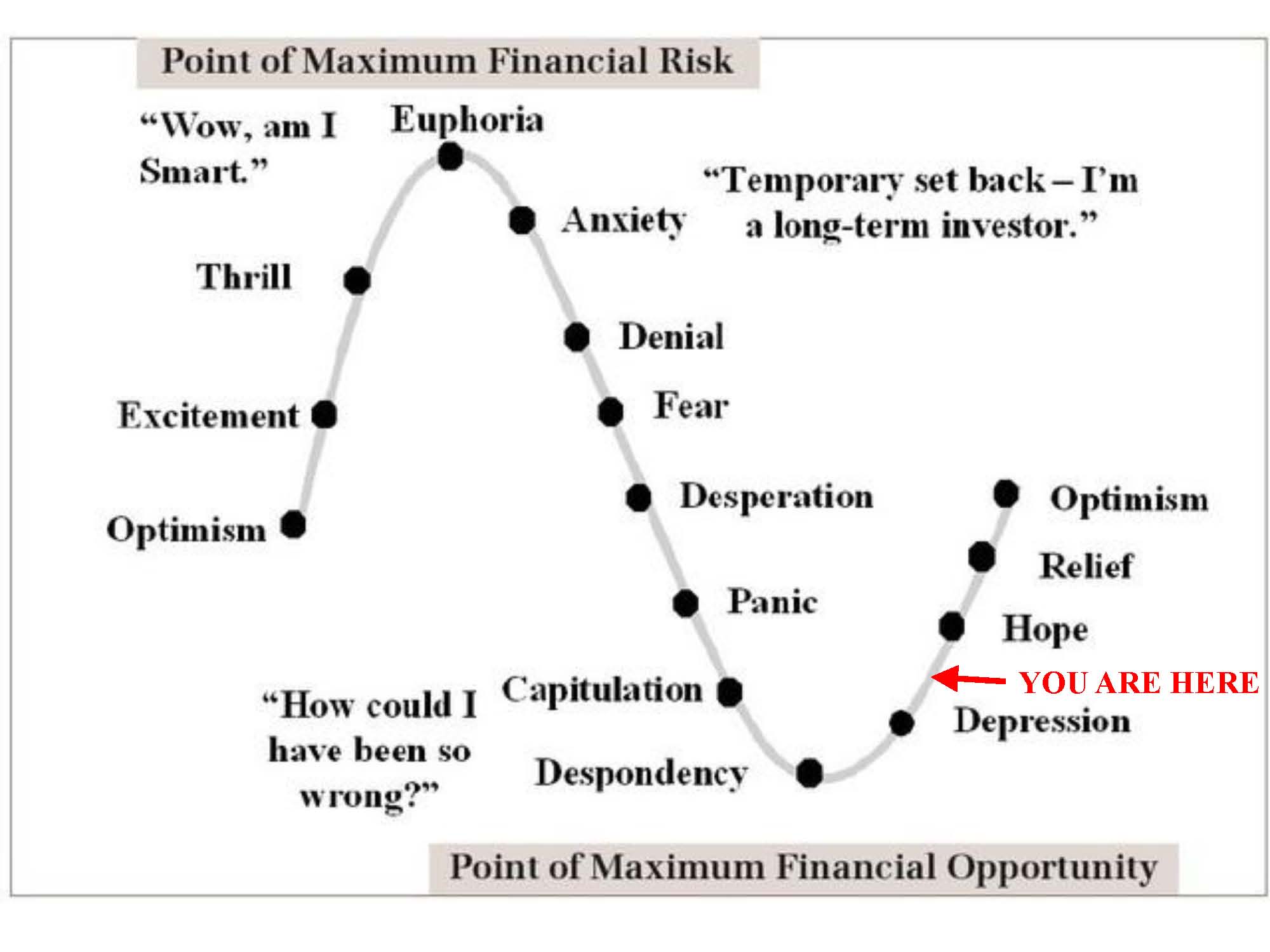
Source: The Big Picture with RED Sidoxia comments
In other words when the housing market was “euphoric” with demand in 2006, the financial risk was the highest, as millions of leveraged borrowers and homeowners painfully realized. Average investors suffered the reverse problem in early 2009 when “despondency” ruled the day and equity markets have marched upwards approximately +80% to +100%. Millions of investors bought real estate near the peak of the market and sold equities near the bottom of the market. Buying high and selling low is not a recipe for a retirement investment plan.
A more comedic representation of the sentiment cycle is provided below (CLICK TO ENLARGE). Laughable but spot on.

If investing was so simple, Jim Cramer would be among Forbes wealthiest top 10 and Lenny Dyskstra would have his private jet back (see story).
Where we are exactly on the sentiment cycle curve is debatable (my opinion is in RED on top chart), but if investors want to accelerate their path to financial success, they need to play the equity markets a lot more like a game of chess – anticipating future events not reacting to current ones. Too often, what appears as the obvious investment choice generates the worst long-term results. While on the investment rollercoaster, the choices that create the sweatiest palms are usually the best long-term decisions.
Read more about “Sentiment Cycles” from The Big Picture
Wade W. Slome, CFA, CFP®
Plan. Invest. Prosper.
DISCLOSURE: Sidoxia Capital Management (SCM) and some of its clients own certain exchange traded funds, but at the time of publishing SCM had no direct position in any other security referenced in this article. No information accessed through the Investing Caffeine (IC) website constitutes investment, financial, legal, tax or other advice nor is to be relied on in making an investment or other decision. Please read disclosure language on IC “Contact” page.
P/E Binoculars, Not Foggy Rearview Mirror

Robert Shiller is best known for his correctly bearish forecasts on the housing market, which we are continually reminded of through the ubiquitous Case-Shiller housing index, and his aptly timed 2000 book entitled Irrational Exuberance. Shiller is also well known for his cyclically adjusted 10-year price-earnings tool, also known as P/E-10. This tool chooses to take a rearview mirror look at the 10-year rolling average of the S&P composite stock index to determine whether the equity market is currently a good or bad buy. Below average multiples are considered to be predictive of higher future returns, and higher than average multiples are considered to produce lower future returns (see scatterplot chart).
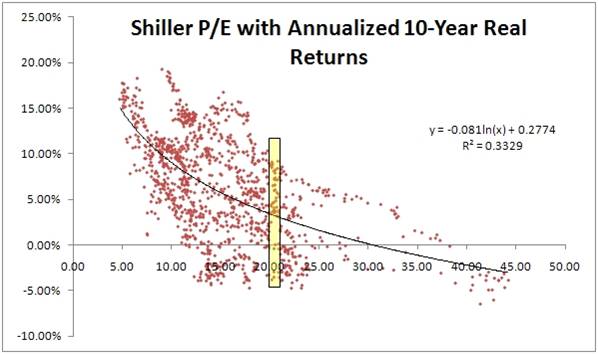
Source: http://www.mebanefaber.com (June 2010)
Foggy Mirror
If you were purchasing a home, would the price 10 years ago be a major factor in your purchase decision? Probably not. Call me crazy, but I would be more interested in today’s price and even more interested in the price of the home 10 years into the future. The financial markets factor in forward looking data (not backward looking data). Conventional valuation techniques applied to various assets, take for example a bond, involve the discounting of future cash flow values back to the present – in order to determine the relative attractiveness of today’s asset price. The previous 10-years of data are irrelevant in this calculation.
Although I believe current and future expectations are much more important than stale historical data, I can appreciate the insights that can be drawn by comparing current information with historical averages. In other words, if I was purchasing a house, I would be interested in comparing today’s price to the historical 10-year average price. Currently, the P/E-10 ratio stands at a level around 22x – 38% more expensive than the 16x average value for the previous decade. That same 22x current P/E-10 ratio compares to a current forward P/E ratio of 13x. A big problem is the 22x P/E-10 is not adequately taking into account the dramatic growth in earnings that is taking place (estimated 2010 operating earnings are expected to register in at a whopping +45% growth).
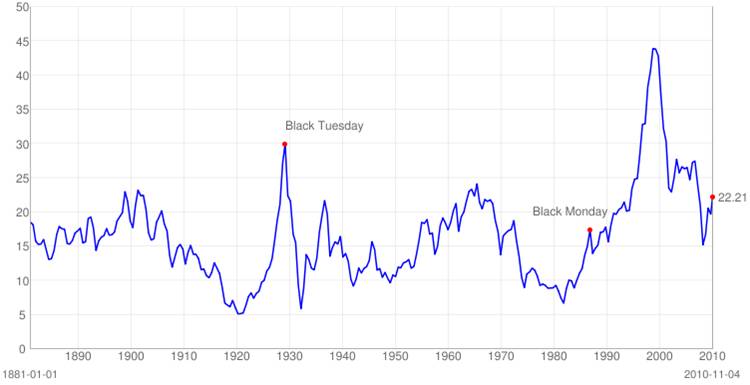
Mean P/E 10 Value is 16.4x Source: http://www.multpl.com
Additional problems with P/E-10:
1) The future 10 years might not be representative of the extreme technology and credit bubble we experienced over the last 10 years. Perhaps excluding the outlier years of 2000 and 2009 would make the ratio more relevant.
2) The current P/E-10 ratio is being anchored down by extreme prices from a narrow sector of technology a decade ago. Value stocks significantly outperformed technology over the last 10 years, much like small cap stocks outperformed in the 1970s when the Nifty Fifty stocks dominated the index and then unraveled.
3) Earnings are rising faster than prices are increasing, so investors waiting for the P/E-10 to come down could be missing out on the opportunity cost of price appreciation. The distorted P/E ratios earlier in the decade virtually guarantee the P/E-10 to drop, absent a current market melt-up, because P/E ratios were so high back then.
4) The tool has been a horrible predictor over very long periods of time. For example, had you followed the tool, the red light would have caused you to miss the massive appreciation in the 1990s, and the green light in the early 1970s would have led to little to no appreciation for close to 10 years.
Shiller himself understands the shortcomings of P/E-10:
“It is also dangerous to assume that historical relations are necessarily applicable to the future. There could be fundamental structural changes occurring now that mean that the past of the stock market is no longer a guide to the future.”
How good an indicator was P/E-10 for the proponent himself at the bottom of the market in February 2009? Shiller said he would get back in the market after another 30% drop in the ratio (click here for video). As we know, shortly thereafter, the market went on a near +70% upwards rampage. I guess Shiller just needs another -55% drop in the ratio from here to invest in the market?
Incidentally, Shiller did not invent the cyclically adjusted P/E tool, as famed value investor Benjamin Graham also used a similar tool. The average investor loves simplicity, but what P/E-10 offers with ease-of-use, it lacks in usefulness. I agree with the P/E-10 intent of smoothing out volatile cycle data (artificially inflated in booms and falsely depressed in recessions), but I recommend investors pull out a pair of binoculars (current and forward P/Es) rather than rely on a foggy rearview mirror.
Wade W. Slome, CFA, CFP®
Plan. Invest. Prosper.
DISCLOSURE: Sidoxia Capital Management (SCM) and some of its clients own certain exchange traded funds, but at the time of publishing SCM had no direct position in any other security referenced in this article. No information accessed through the Investing Caffeine (IC) website constitutes investment, financial, legal, tax or other advice nor is to be relied on in making an investment or other decision. Please read disclosure language on IC “Contact” page.
Sentiment Indicators: Reading the Tea Leaves

Market commentators and TV pundits are constantly debating whether the market is overbought or oversold. Quantitative measures, often based on valuation measures, are used to support either case. But the debate doesn’t stop there. As a backup, reading the emotional tea leaves of investor attitudes is relied upon as a fortune telling stock market ritual (see alsoTechnical Analysis article). Generally these tools are used on a contrarian basis when deciding about purchase or sale timing. The train of thought follows excessive optimism is tied to being fully invested, therefore the belief is only one future direction left…down. The thought process is also believed to work in reverse.
Actions Louder Than Words
When it comes to investing, I believe actions speak louder than words. For example, words answered in a subjective survey mean much less to me in gauging optimism or pessimism than what investors are really doing with their cool, hard cash. Asset flow data indicates where money is in fact going. Currently the vast majority of money is going into bonds, meaning the public hates stocks. That’s fine, because without pessimism, there would be fewer opportunities.
Most sentiment indicators are an unscientific cobbling of mood surveys designed to check the pulse of investors. How is the data used? As mentioned above, the sentiment indicators are commonly used as a contrarian tool…meaning: sell the market when the mood is hot and buy the market when it is cold.
Here are some of the more popular sentiment indicators:
1) Sentiment Surveys (AAII/NAAIM/Advisors): Each measures different bullish/bearish opinions regarding the stock market.
2) CBOE Volatility Index (VIX): The “fear gauge” developed using implied option volatility (read also VIX article).
3) Breadth Indicators (including Advanced-Decline and High-Low Ratios): Measures the number of up stocks vs. down stocks. Used as measurement device to identify extreme points in a market cycle.
4) NYSE Bullish Percentage: Calculates the percentage of bullish stock price patterns and used as a contrarian indicator.
5) NYSE 50-Day and 200-Day Moving Average: Another technical price indicator that is used to determine overbought and oversold price conditions.
6) Put/Call Ratio: The number of puts purchased relative to calls is used by some to measure the relative optimism/pessimism of investors.
7) Volume Spikes: Optimistic or pessimistic traders will transact more shares, therefore sentiment can be gauged by tracking volume metrics versus historical averages.
Sentiment Shortcomings
From a ten thousand foot level, the contrarian premise of sentiment indicators makes sense, if you believe as Warren Buffett does that it is beneficial to buy fear and sell greed. However, many of these indicators are more akin to reading tea leaves, than utilizing a scientific tool. Investors enjoy black and white simplicity, but regrettably the world and the stock market come in many shades of gray. Even if you believe mood can be accurately measured, that doesn’t account for the ever-changing state of human temperament. For instance, in a restaurant setting, my wife will change her menu choice four times before the waiter/waitress takes her order. Investor sentiment can be just as fickle depending on the Dubai, Greece, Swine Flu, or foreclosure headline du jour.
Other major problems with these indicators are time horizon and degree of imbalance. Yeah, an index or stock may be oversold, but by how much and over what timeframe? Perhaps a security is oversold on an intraday chart, but dramatically overbought on a monthly basis? Then what?
The sentiment indicators can also become distorted by a changing survey population. Average investors have fled the equity markets and have followed the pied piper Bill Gross to fixed income nirvana. What we have left are a lot of unstable high frequency traders who often change opinions in a matter of seconds. These loose hands are likely to warp the sentiment indicator results.
Strange Breed
Investors are strange and unique animals that continually react to economic noise and emotional headlines in the financial markets. Despite the infinitely complex world we live in, people and investors use everything available at their disposal in an attempt to make sense of our endlessly random financial markets. One day interest rate declines are said to be the cause of market declines because of interest rate concerns. The next day, interest rate declines due to “quantitative easing” comments by Federal Reserve Chairman Ben Bernanke are attributed to the rise in stock prices. So, which one is it? Are rate declines positive or negative for the market?
On a daily basis, the media outlets are arrogant enough to act like they have all the answers to any price movement, rather than chalking up the true reason to random market volatility, sensationalistic noise, or simply more sellers than buyers. Virtually any news event will be handicapped for its market impact. If Ben Bernanke farts, people want to know what he ate and what impact it will have on Fed policy.
Sentiment indicators are some of the many tools used by professionals and non-professionals alike. While these indicators pose some usefulness, overreliance on reading these sentiment tea leaves could prove hazardous to your fortune telling future.
Wade W. Slome, CFA, CFP®
Plan. Invest. Prosper.
DISCLOSURE: Sidoxia Capital Management (SCM) and some of its clients own certain exchange traded funds, but at the time of publishing SCM had no direct position in any other security referenced in this article. No information accessed through the Investing Caffeine (IC) website constitutes investment, financial, legal, tax or other advice nor is to be relied on in making an investment or other decision. Please read disclosure language on IC “Contact” page.
Why it’s NOT Different This Time

“Those who don’t know history are destined to repeat it.”
– Edmund Burke – British Statesman and Philosopher (1729-1797)
I wasn’t a history major in college, but I’ve learned two things by studying history books: 1) The unchanging psyche of human nature leads history consistently to repeats itself; and 2) There is never a shortage of goofballs willing to make zany predictions.
Robert Zuccaro is no exception to lesson number two, as evidenced by his 2001 book, Why it’s Different this Time…Dow 30,000 by 2008! Sticking one’s neck out is never too difficult when you have a multi-decade trend behind your back – I guess Dow “14,000” just didn’t sound sexy enough back then. Unfortunately the herd reacting to these bold, extreme predictions eventually realize (usually post-mortem) that they are quickly approaching a tail-end of a cycle. The cab driver, hair dresser, and mechanic realized the dangers of following the “New Economy” cheerleaders in 1999 when everyone was piling into dot-com stocks (see Bubblicious technology table ).
Dow 1,000 Here We Come!

- Source: Yahoo! Finance

Today, the Zuccaros of the world have been washed to the curb, and new “Armageddon” extremists have sprouted up to the surface, like perma-bear Peter Schiff and his call for Dow 2,000 or his $5,000 per ounce gold estimate. More recently, Robert Prechter has one-upped Schiff by forecasting Dow 1,000 with the assistance of the not-so ironclad Elliott Wave Theory philosophy (see Technical Analysis: Astrology or Lob Wedge). If you’re in the Prechter camp, either crawl back into your bunker or start digging that dream cave you always wanted.

Source: Elliott Wave International
“Hey, Look Here at My Crazy Forecast!”
Publicity doesn’t necessarily rain praise on those parroting the consensus view (although the warmth of job security is appreciated), but rather the extreme outliers love to bask in the glow of media attention. The extremists consistently repeat “why it’s different this time.” What is different is the set of circumstances, but what history shows us over and over again is the emotions of fear and greed feeding the bubbles of excess are exactly the same. Whether you’re talking about the Tulip-Mania of the 1630s, the Nifty Fifty stocks of 1973-1974, the technology Four Horsemen of the mid-1990s, or the Icelandic Banks of 2008, what we learn from the lessons of history is that human nature will never change and fear and greed will continue creating and bursting future bubbles.
People playing the game long enough understand, “It’s NOT different this time.” Not only have we endured repeated wars, recessions, banking crises, currency crises, but we have also survived every exotic animal disease known to man, including Mad Cow, Swine Flu, Bird Flu, West Nile, etc.
Robert Zuccaro and Robert Prechter may get an “A” for their attention grabbing forecasts, but thus far the grade earned on accuracy is closer to an “F.” More specifically, Zuccaro’s prediction never came close to 30,000 by the end of 2008 (only off by about 21,000 points), and guess what, Bob Prechter has a long way to go before reaching his Dow 1,000 target. So here is my proposition: Why don’t we just split the difference between Zuccaro’s 2008 and Prechter’s 2016 forecasts and take the average? If it turns out they are equally bad forecasters, then Dow 15,500 by 2012 should be no problem ([30,000 + 1,000] ÷ 2)!
Regardless of the ultimate outcome of this market (double-dip or sustained recovery), what I do know is there will continue to be wacky outlandish forecasters rationalizing why a trend will go on for infinity and why “this time is different.” In reality these attention mongers will always be around ensuring this time (or next time) will never be different…just the same fear and greed as always.
Wade W. Slome, CFA, CFP®
Plan. Invest. Prosper.
DISCLOSURE: Sidoxia Capital Management (SCM) and some of its clients own certain exchange traded funds, but at the time of publishing SCM had no direct position in any other security referenced in this article. No information accessed through the Investing Caffeine (IC) website constitutes investment, financial, legal, tax or other advice nor is to be relied on in making an investment or other decision. Please read disclosure language on IC “Contact” page.
Skiing Portfolios Down Bunny Slopes

Oh Nelly, take it easy…don’t get too crazy on that bunny slope. With fall officially kicking off and the crisp smell of leaves in the air, the new season also marks the beginning of the ski season. In many respects, investing is a lot like skiing. Unfortunately, many investors are financially skiing their investment portfolios down a bunny slope by stuffing their money in low yielding CDs, money market accounts, and Treasury securities. The bunny slope certainly feels safe and secure, but many investors are actually doing more long-term harm than good and could be potentially jeopardizing their retirements.
Let’s take a gander at the cautious returns offered up from the financial bunny slope products:
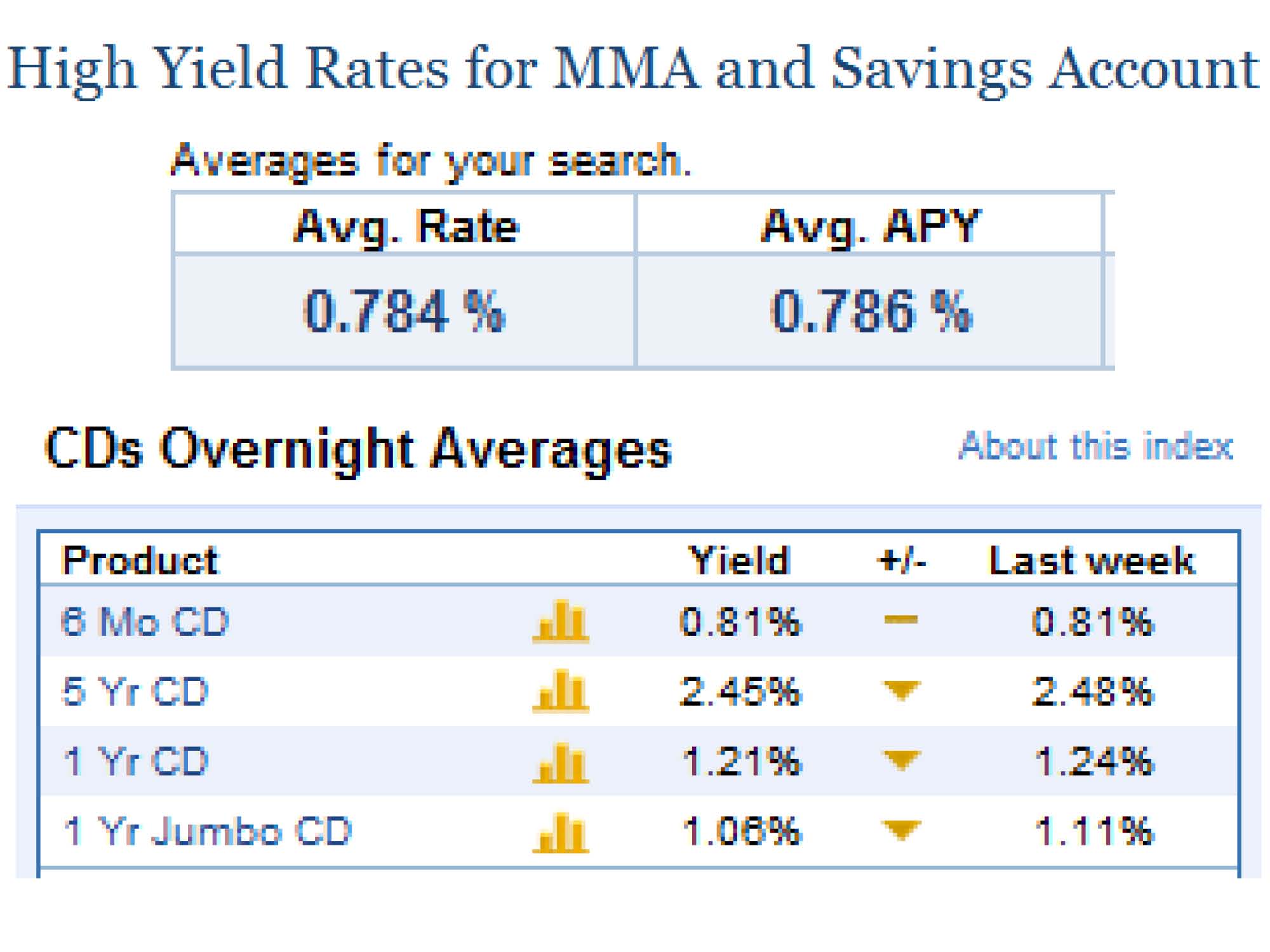
Source: Bankrate.com
That CD earning 1.21% should cover a fraction of your medical insurance premium hike, or if you accumulate the interest from your money market account for a few years, perhaps it will cover the family seeing a new 3-D movie. If you also extend the maturity on that CD a little, maybe it can cover an order of chicken fingers at Applebees (APPB)?!
We all know, for much of the non-retiree population, the probability that entitlement programs like Social Security and Medicare will be wiped out or severely cut is very high. Not to mention, life expectancies for non-retirees are increasing dramatically – some life insurance actuarial tables are registering well above 100 years old. These trends indicate the criticalness of investing efficiently for a large swath of the population, especially non-retirees.
Let’s Face It, One Size Does Not Fit All

Bodie Miller & Grandpa
As I have pointed out in the past, when it comes to investing (or skiing), one size does not fit all (see article). Just as it does not make sense to have Bode Miller (32 year old Olympic gold medalist) ski down a beginner’s bunny slope, it also does not make sense to take a 75-year old grandpa helicopter skiing off a cornice. The same principles apply to investment portfolios. The risk one takes should be commensurate with an individual’s age, objectives, and constraints.
Often the average investor is unaware of the risks they are taking because of the counterintuitive nature of the financial market dangers. In the late 1990s, technology stocks felt safe (risk was high). In the mid-2000s, real estate felt like a sure bet (risk was high), and in 2010, Treasury bonds and gold are currently being touted as sure bets and safe havens (read Bubblicious Bonds and Shiny Metal Shopping). You guess how the next story ends?
Unquestionably, coasting down the bunny slopes with CDs, money market accounts, and Treasuries is prudent strategy if you are a retiree holding a massive nest egg able to meet all your expenses. However, if you are younger non-retiree and do not want to retire on mac & cheese or work at Wal-Mart as a greeter into your 80s, then I suggest you venture away from the bunny slope and select a more suitable intermediate path to financial success.
Wade W. Slome, CFA, CFP®
Plan. Invest. Prosper.
DISCLOSURE: Sidoxia Capital Management (SCM) and some of its clients own certain exchange traded funds, and WMT, but at the time of publishing SCM had no direct position in APPB, or any other security referenced in this article. No information accessed through the Investing Caffeine (IC) website constitutes investment, financial, legal, tax or other advice nor is to be relied on in making an investment or other decision. Please read disclosure language on IC “Contact” page.
Crisis Delivers Black-Eye to Classic Economists

Markets are efficient. Individuals behave rationally. All information is reflected in prices. Huh…are you kidding me? These are the beliefs held by traditional free market economists (“rationalists”) like Eugene Fama (Economist at the University of Chicago and a.k.a. the “Father of the Efficient Market Hypothesis”). Striking blows to the rationalists are being thrown by “behavioralists” like Richard Thaler (Professor of Behavioral Science and Economics at the University of Chicago), who believes emotions often lead to suboptimal decisions and also thinks efficient market economics is a bunch of hogwash.
Individual investors, pensions, endowments, institutional investors, governments, are still sifting through the rubble in the aftermath of the 2008-2009 financial crisis. Experts and non-experts are still attempting to figure out how this mass destruction occurred and how it can be prevented in the future. Economists, as always, are happy to throw in their two cents. Right now traditional free market economists like Fama have received a black eye and are on the defensive – forced to explain to the behavioral finance economists (Thaler et. al.) how efficient markets could lead to such a disastrous outcome.
Religion and Economics
Like religious debates, economic rhetoric can get heated too. Religion can be divided up in into various categories (e.g., Christianity, Islam, Judaism, Hinduism, Buddhism, and other), or more simply religion can be divided into those who believe in a god (theism) and those who do not (atheism). There are multiple economic categorizations or schools as well (e.g., Keynsians, monetarism, libertarian, behavioral finance, etc.). Debates and disagreements across the rainbow of religions and economic schools have been going on for centuries, and the completion of the 2008-09 financial crisis has further ignited the battle between the “behavioralists” (behavioral finance economists) and the “rationalists” (traditional free market economists).
Behavioral Finance on the Offensive
In the efficient market world of the “rationalists,” market prices reflect all available information and cannot be wrong at any moment in time. Effectively, individuals are considered human calculators that optimize everything from interest rates and costs to benefits and inflation expectations in every decision. What classic economics does not include is emotions or behavioral flaws.
Purporting that financial market decisions are not impacted by emotions becomes more difficult to defend if you consider the countless irrational anomalies considered throughout history. Consider the following:
- Tulip Mania: Bubbles are nothing new – they have persisted for hundreds of years. Let’s reflect on the tulip bulb mania of the 1600s. For starters, I’m not sure how classic economists can explain the irrational exchanging of homes or a thousand pounds of cheese for a tulip bulb? Or how peak prices of $60,000+ in inflation-adjusted dollars were paid for a bulb at the time (C-Cynical)? These are tough questions to answer for the rationalists.
- Flash Crash: Seeing multiple stocks (i.e., ACN and EXC) and Exchange Traded Funds (ETFs) temporarily trade down -99% in minutes is not exactly efficient. Stalwarts like Procter & Gamble also collapsed -37%, only to rebound minutes later near pre-collapse levels. All this volatility doesn’t exactly ooze with efficiency (see Making Millions in Minutes).
- Negative T-Bill Rates: For certain periods of 2008 and 2009, investors earned negative yields on Treasury Bills. In essence, investors were paying the government to hold their money. Hmmm?
- Technology and Real Estate Bubbles: Both of these asset classes were considered “can’t lose” investments in the late 1990s and mid-2000s, respectively. Many tech stocks were trading at unfathomable values (more than 100 x’s annual profits) and homebuyers were inflating real estate prices because little to no money was required for the purchases.
- ’87 Crash: October 19, 1987 became infamously known as “Black Monday” since the Dow Jones Industrial Average plunged over -22% in one day (-508 points), the largest one-day percentage decline ever.
The list has the potential of going on forever, and the recent 2008-09 financial crisis only makes rationalists’ jobs tougher in refuting all this irrational behavior. Maybe the rationalists can use the same efficient market framework to help explain to my wife why I ate a whole box of Twinkies in one sitting?
Rationalist Rebuttal
The rationalists may have gotten a black eye, but they are not going down without a fight. Here are some quotes from Fama and fellow Chicago rationalist pals:
On the Crash-Related Attacks from Behavioralists: Behavioralists say traditional economics has failed in explaining the irrational decisions and actions leading up to the 2008-09 crash. Fama states, “I don’t see this as a failure of economics, but we need a whipping boy, and economists have always, kind of, been whipping boys, so they’re used to it. It’s fine.”
Rationalist Explanation of Behavioral Finance: Fama doesn’t deny the existence of irrational behavior, but rather believes rational and irrational behaviors can coexist. “Efficient markets can exist side by side with irrational behavior, as long as you have enough rational people to keep prices in line,” notes Fama. John Cochrane treats behavioral finance as a pseudo-science by replying, “The observation that people feel emotions means nothing. And if you’re going to just say markets went up because there was a wave of emotion, you’ve got nothing. That doesn’t tell us what circumstances are likely to make markets go up or down. That would not be a scientific theory.”
Description of Panics: “Panic” is not a term included in the dictionary of traditional economists. Fama retorts, “You can give it the charged word ‘panic,’ if you’d like, but in my view it’s just a change in tastes.” Calling these anomalous historic collapses a “change in tastes” is like calling Simon Cowell, formerly a judge on American Idol, “diplomatic.” More likely what’s really happening is these severe panics are driving investors’ changes in preferences.
Throwing in White Towel Regarding Crash: Not all classic economists are completely digging in their heels like Fama and Cochrane. Gary Becker, a rationalist disciple, acknowledges “Economists as a whole didn’t see it coming. So that’s a black mark on economics, and it’s not a very good mark for markets.”
Settling Dispute with Lab Rats
The boxing match continues, and the way the behavioralists would like to settle the score is through laboratory tests. In the documentary Mind Over Money, numerous laboratory experiments are run using human subjects to tease out emotional behaviors. Here are a few examples used by behavioralists to bolster their arguments:
- The $20 Bill Auction: Zach Burns, a professor at the University of Chicago, conducted an auction among his students for a $20 bill. Under the rules of the game, as expected, the highest bidder wins the $20 bill, but as an added wrinkle, Burns added the stipulation that the second highest bidder receives nothing but must still pay the amount of the losing bid. Traditional economists would conclude nobody would bid higher than $20. See the not-so rational auction results here at minute 1:45.
- $100 Today or $102 Tomorrow? This was the question posed to a group of shoppers in Chicago, but under two different scenarios. Under the first scenario, the individuals were asked whether they would prefer receiving $100 in a year from now (day 366) or $102 in a year and one additional day (day 367)? Under the second scenario, the individuals were asked whether they would prefer receiving $100 today or $102 tomorrow? The rational response to both scenarios would be to select $102 under both scenarios. See how the participants responded to the questions here at minute 4:30.
Rationalist John Cochrane is not fully convinced. “These experiments are very interesting, and I find them interesting, too. The next question is, to what extent does what we find in the lab translate into how people…understanding how people behave in the real world…and then make that transition to, ‘Does this explain market-wide phenomenon?,’” he asks.
As alluded to earlier, religion, politics, and economics will never fall under one universal consensus view. The classic rationalist economists, like Eugene Fama, have in aggregate been on the defensive and taken a left-hook in the eye for failing to predict and cohesively explain the financial crash of 2008-09. On the other hand, Richard Thaler and his behavioral finance buds will continue on the offensive, consistently swinging at the classic economists over this key economic mind versus money dispute.
See Complete Mind Over Money Program
Wade W. Slome, CFA, CFP®
Plan. Invest. Prosper.
DISCLOSURE: Sidoxia Capital Management (SCM) and some of its clients own certain exchange traded funds, but at the time of publishing SCM had no direct position in ACN, EXC, or any other security referenced in this article. No information accessed through the Investing Caffeine (IC) website constitutes investment, financial, legal, tax or other advice nor is to be relied on in making an investment or other decision. Please read disclosure language on IC “Contact” page.
ETF Slam Dunk: Mixing Jordan & Rodman

Players in the same game may use different strategies in the hunt for success. Take five-time NBA champ Dennis “The Worm” Rodman vs. Hall of Famer and fourteen-time All-Star Michael Jordan. Rodman’s bad-boy antics, tattoos, and loud hair colors more closely resemble the characteristics of a brash trader or quick-trigger hedge fund manager, which explains why Rodman played for five different NBA teams. Jordan on the other-hand was less impulsive, and like a long-term investor, held a longer term horizon with respect to team loyalty – he spent 13 seasons with one team (Chicago Bulls), excluding a brief, half-hearted return to the Washington Wizards. Despite their differences, they shared one common goal…the ambition to win.
In the investment world, traders and long-term investors in many cases could be even more different than Rodman and Jordan…just think Jim Cramer and Warren Buffett. But when it comes to the exploding trend of Exchange Traded Funds (ETFs) expansion, traders and investors of all types share the common appreciation for lower costs (management fees and trading commissions). Beyond the lower costs, ETFs also offer a wide and growing range of liquid exposures, regardless of whether a trader wants to hold the ETF for five hours or an investor wants to own it for five years. The benefits of low cost and liquidity, relative to traditional actively managed mutual funds, are two key reasons why this market has blossomed to $822 billion in size and is still strengthening at a healthy clip.

Source: SPDR
The flight to bonds and out of equities has been well documented (see chart below), but underneath the surface is a migrating investor trend out of active managers, and into lower cost vehicles for equity exposure (ETFs and Index Funds). The poster child beneficiary of this movement is the Vanguard Group (based in Valley Forge, Pennsylvania), which manages $1.4 trillion in fund assets, including $112 billion in ETFs (Bloomberg). Equity heavy fund management companies like Janus Capital Group Inc. (JNS) and T. Rowe Price Group Inc. (TROW) have felt the brunt of the pain from the disinterested investing public.

Source: Iacono Research
The migration away from expensive actively managed funds has created a cut-throat dog-fight for ETF market share. Competition has gotten so bad that discount brokerage firms like Fidelity Investments ($1.25 trillion in mutual fund assets) and Charles Schwab Corp. (SCHW) have begun offering free ETF trading. Just two days ago Schwab also purchased Windward Investment Management, Inc. (~$3.9 billion in assets under management), for $150 million in stock and cash.
At the end of the day, money goes where it is treated best. Irrespective of differences between long-term investors and short-term traders, the lower costs and improved liquidity associated with ETFs have shifted money away from more costly, actively traded mutual funds. At my firm, Sidoxia Capital Management, I choose to use a diversified hybrid approach via my Fusion investment products (Conservative, Moderate, and Aggressive). Fusion integrates low-cost, tax-efficient investment vehicles and strategies, including fixed income securities (including funds & ETFs), individual stocks, and equity ETFs. Regardless of the differing preferences of hair colors and tattoos, my bet is that Dennis Rodman and Michael Jordan could agree on the importance of two things…winning games and using ETFs.
Wade W. Slome, CFA, CFP®
Plan. Invest. Prosper.
*DISCLOSURE: Sidoxia Capital Management (SCM) and some of its clients own certain exchange traded funds, but at the time of publishing SCM had no direct position in JNS, TROW, SCHW or any other security referenced in this article. No information accessed through the Investing Caffeine (IC) website constitutes investment, financial, legal, tax or other advice nor is to be relied on in making an investment or other decision. Please read disclosure language on IC “Contact” page.




 Investing Caffeine
