Posts filed under ‘economy’
Plumbers & Cops: Can the Debt Ceiling be Fixed?

The ceiling is leaking, but it’s unclear whether it will be repaired? Rather than fix the seeping fiscal problem, Democrats and Republicans have stared at the leaky ceiling and periodically applied debt ceiling patches every year or two by raising the limit. Nanosecond debt ceiling coverage has reached a nauseating level, but this issue has been escalating for many months. Last fall, politicians feared their long-term disregard of fiscally responsible policies could lead to a massive collapse in the financial ceiling protecting us, so the President called in the bipartisan plumbers of Alan Simpson & Erskine Bowles to fix the leak. The commission swiftly identified the problems and came up with a deep, thoughtful plan of action. Unfortunately, their recommendations were abruptly dismissed and Washington fell back into neglect mode, choosing instead to bicker like immature teenagers. The result: poisonous name calling and finger pointing that has placed Washington politicians one notch above Cuba’s Fidel Castro, Venezuela’s Hugo Chavez, and Iran’s Mahmoud Ahmadinejad on the list of the world’s most hated leaders. Strategist Ed Yardeni captured the disappointment of American voters when he mockingly states, “The clowns in Washington are making people cry rather than laugh.”
Although despair is in the air and the outlook is dour, our government can redeem itself with the simple passage of a debt ceiling increase, coupled with credible spending reduction legislation (and possibly “revenue enhancers” – you gotta love the tax euphimism).
The Elephant in the Room
Our country’s spending problems is nothing new, but the 2008-2009 financial crisis merely amplified and highlighted the severity of the problem. The evidence is indisputable – we are spending beyond our means:

Source: scottgrannis.blogspot.com
If the federal spending to GDP chart is not convincing enough, then review the following graph:
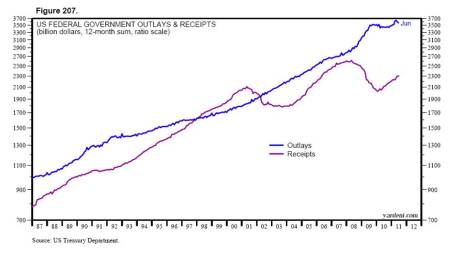
- Source: blog.yardeni.com – A graph a first grader could understand.

You don’t need to be a brain surgeon or rocket scientist to realize government expenditures are massively outpacing revenues (tax receipts). Expenditures need to be dramatically reduced, revenues increased, and/or a combination thereof. Applying for a new credit card with a limit to spend more isn’t going to work anymore – the lenders reviewing those upcoming credit applications will straightforwardly deny the applications or laugh at us as they gouge us with prohibitively high borrowing costs. The end result will be the evaporation of entitlement programs as we know them today (including Medicare and Social Security). For reference of exploding borrowing costs, please see Greek interest rate chart below. The mathematical equation for the Greek financial crisis (and potentially the U.S.) is amazingly straightforward…Loony Spending + Looney Politicians = Loony Interest Rates.

Source: Bloomberg.com via Wikipedia.com
To illustrate my point further, imagine the government owning a home with a mortgage payment tied to a 2.5% interest rate (a tremendously low, average borrowing cost for the U.S. today). Now visualize the U.S. going bankrupt, which would then force foreign and domestic lenders to double or triple the rates charged on the mortgage payment (in order to compensate the lenders for heightened U.S. default risk). Global investors, including the Chinese, are pointing a gun at our head, and if a political blind eye on spending continues, our foreign brethren who have provided us with extremely generous low priced loans will not be bashful about pulling the high borrowing cost trigger. The ballooning mortgage payments resulting from a default would then break an already unsustainably crippling budget, and the government would therefore be placed in a position of painfully slashing spending. Too extreme a shift towards austerity could spin a presently wobbling economy into chaos. That’s precisely the situation we face under a no-action Congressional default (i.e., no fix by August 2nd or shortly thereafter). To date, the Chinese have collected their payments from us with a nervous smile, but if the U.S. can’t make some fiscally responsible choices, our Asian Pacific pals will be back soon with a baseball bat to collect.
The Cops to the Rescue
Any parent knows disciplining teenagers doesn’t always work out as planned. With fiscally irresponsible spending habits and debt load piling up to the ceiling, politicians are stealing the prospects of a brighter future from upcoming generations. The good news is that if the politicians do not listen to the parental voter cries for fiscal sanity, the capital market cops will enforce justice for the criminal negligence and financial thievery going on in Washington. Ed Yardeni calls these capital market enforcers the “bond vigilantes.” If you want proof of lackadaisical and stubborn politicians responding expeditiously to capital market cops, please hearken back to September 2008 when Congress caved into the $700 billion TARP legislation, right after the Dow Jones Industrial average plummeted 777 points in a single day.
Who exactly are these cops? These cops come in the shape of hedge funds, sovereign wealth funds, pension funds, endowments, mutual funds, and other institutional investors that shift their dollars to the geographies where their money is treated best. If there is a perceived, heightened risk of the United States defaulting on promised debt payments, then global investors will simply take their dollar-denominated investments, sell them, and then convert them into currencies/investments of more conscientious countries like Australia or Switzerland.
Assisting the capital market cops in disciplining the unruly teenagers are the credit rating agencies. S&P (Standard and Poor’s) and Moody’s (MCO) have been watching the slow-motion train wreck develop and they are threatening to downgrade the U.S.’ AAA credit rating. Republicans and Democrats may not speak the same language, but the common word in both of their vocabularies is “reelection,” which at some point will effect a reaction due to voter and investor anxiety.
Nobody wants to see our nation’s pipes burst from excessive debt and spending, and if the political plumbers can repair the very obvious and fixable fiscal problems, we can move on to more important challenges. It’s best we fix our problems by ourselves…before the cops arrive and arrest the culprits for gross negligence.

Wade W. Slome, CFA, CFP®
Plan. Invest. Prosper.
DISCLOSURE: Performance data from Morningstar.com. Sidoxia Capital Management (SCM) and some of its clients own certain exchange traded funds, but at the time of publishing SCM had no direct position in MCO, or any other security referenced in this article. No information accessed through the Investing Caffeine (IC) website constitutes investment, financial, legal, tax or other advice nor is to be relied on in making an investment or other decision. Please read disclosure language on IC “Contact” page.
Stretching Rubber Band Creating More Value

Concerns over debt ceiling negotiations, European financial challenges, and overall economic malaise has reached a feverish pitch in the U.S., yet in the background, a valuation rubber band has quietly been stretching to ever more attractive levels. Regardless of whether seniors might not receive Social Security checks, troops not obtain ammunition, and investors not collect credit rating agency love, corporations keep churning profits out like they are going out of style (17%+ growth in 2011 estimated earnings). We have barely scratched the surface on earnings season, and I’m sure better than expected earnings from the likes of Google Inc. (GOOG), JPMorgan Chase & Co. (JPM), FedEx Corp. (FDX), Nike Inc. (NKE), and Bed Bath & Beyond Inc. (BBBY) will not sway the bears, but in the meantime profits keep chugging along. Although profits have more than doubled in the last 12 years, not to mention a halving in interest rates (10-year Treasury yield cut from 6% to about 3%), yet the S&P 500 is still down approximately -4% (June 1999 – June 2011).
What Gives?
Could the valuation stretching continue as earnings continue to grind higher? Absolutely. Just because prices have been chopped in half, doesn’t mean they can’t go lower. From 1966 – 1982 the Dow Jones Industrial index traded at around 800 and P/E multiples contracted to single digits. That rubber band eventually snapped and the index catapulted 17-fold from 800 to almost 14,000 in 25 years. Even though equities have struggled in the 21st century, a few things have changed from the low-point reached about 30 years ago. For starters, we have not hit an inflation rate of 15% or a Federal Funds rate of 20% (4% and 0% today, respectively), so we have a tad bit more headroom before the single digit P/E apocalypse descends upon us. If you listen to Peter Lynch, investor extraordinaire, his “Rule of 20” states a market equilibrium P/E ratio should equal 20 minus the inflation rate. This rule would imply an equilibrium P/E ratio of 16-17 when the current 2011 P/E multiple implies a value slightly above 13 times earnings. The bears may claim victory if the earnings denominator collapses, but if earnings, on the contrary, continue coming in better than expected, then the sun might break through the clouds in the form of significant price appreciation.
Another change that has occurred since the days of Cabbage Patch dolls has been the opening floodgates of globalization. The technology revolution has accelerated the flattening of the globe, which has created numerous new opportunities and threats. Creating a company like Facebook with about 750 million users and an estimated value of $80 billion to $100 billion couldn’t happen 30 years ago, but on the flip side, our country is also competing with billions of motivated brains lurking in the far reaches of the world with a singular focus of sucking away our jobs, resources, and dollars. Winners recognize this threat and are currently adapting. Losers blind to this trend remain busy digging their own graves.
Future is Uncertain
As famous Jedi Master Yoda aptly identified, “Always in motion is the future.” The future is always uncertain, and if it wasn’t, I would be on my private island drinking umbrella drinks all day. With undecided debt ceiling negotiations occurring over the next few weeks, political rhetoric will be blaring and traders will be hyperventilating with defibrillator paddles close at hand. If history is a guide, stupid decisions may be made, but the almighty financial markets (and maybe a few Molotov cocktails at a local protest rally) will eventually slap politicians in the face to wake up to reality. Perhaps you recall the attention the markets earned from legislators when the Dow fell 777 points in a single September 2008 trading session. Blood on the streets forced Congress to approve the Troubled Asset Relief Program hot potato four days after the initial vote failed. And if that wasn’t a gentle enough reminder for Democrats and Republicans, then a few lessons can be learned from the interest rate sledgehammer that capital markets vigilantes have slammed on the Greeks (10-year Greek yields are hovering above 17%+).
Down but Not Out
The stories of debt collapse, hyperinflation, double-dip recessions, plunging dollar, secular bear markets, and government shutdowns are all plausible but remote scenarios. As Winston Churchill so eloquently stated, “You can always count on Americans to do the right thing – after they’ve tried everything else.” Voter moods are so venomous that if fiscal irresponsibility is not changed, politicians will be voted straight out of office – even hardcore, extremist elected officials understand this self-serving point.
Suffice it to say, as the political noise reaches a deafening pitch in the coming weeks and months, a quiet rubber band in the background keeps stretching. When the political noise dies down, you may just hear a noise snapping stock prices higher.
Wade W. Slome, CFA, CFP®
Plan. Invest. Prosper.
DISCLOSURE: Performance data from Morningstar.com. Sidoxia Capital Management (SCM) and some of its clients own certain exchange traded funds, GOOG, and FDX, but at the time of publishing SCM had no direct position in JPM, NKE, BBBY, Facebook, or any other security referenced in this article. No information accessed through the Investing Caffeine (IC) website constitutes investment, financial, legal, tax or other advice nor is to be relied on in making an investment or other decision. Please read disclosure language on IC “Contact” page.
Job Losses = Job Creation

Apple Inc. (AAPL) is considered the quintessential innovation company. After all, if you flip over an iPad or an iPhone it will clearly state, “Designed by Apple in California. Assembled in China.” Apple is just too busy innovating to worry about dirtying their hands by assembling products – they can simply outsource that work. Many people have a problem with the millions of manufacturing jobs moving offshore, but if I am the self anointed “Innovation Czar” for the United States, I definitely favor keeping the $120,000 Apple engineering jobs over the low-cost $2 per hour jobs being lost to China (or cheaper developing country). Oh sure, I would prefer keeping both workers, but if push comes to shove, I much rather keep the six-figure job. The bad news is the displaced American iPhone/iPad assembler must find an alternative lower-skilled employment opportunity. The good news is there are plenty of service-based jobs that will NOT get outsourced to the Chinese. If displaced workers are unhappy serving lattes at Starbucks or changing bedpans at the local hospital (or other unglamorous service-based job), then they can choose to retool their skills through education, in order to land higher-paying jobs not getting outsourced.

Bass Ackwards Job Assessment
While I may agree with many points made by Time Magazine’s Fareed Zakaria in his article, The Future of Innovation: Can America Keep Pace?, I think Zakaria is looking at the job trade-off a little backwards. Here is what says about Apple-created job losses in a CNN blog post:
“Apple has about $70 billion in revenues. The company that makes Apple’s products called Foxconn is in China. They have about the same revenue – $70 billion dollars. Apple employees 50,000 people. Foxconn employs 1,000,000 people. So you can have all the innovation you want and tens of thousands of engineers in California benefit, but hundreds of thousands of people benefit in China because the manufacturing has gone there. What does that mean? America needs to innovate even more to keep pace.”
Wow, that’s very altruistic of Apple to create thousands of jobs for Foxconn in Asia, but that $70 billion in Apple revenues likely generates close to 10 times the profits that Foxconn creates (Apple had 24% net profit margins last quarter versus probably a few percent at Foxconn). As Innovation Czar, I’ll gladly take the $20 billion in Apple profits added to the U.S. economy over the last 12 months versus the $2-3 billion profits at Foxconn (my estimate). Let’s be clear, profitable companies add jobs (Apple added over 12,000 employees in fiscal 2010, up +35%) – not weak or uncompetitive companies losing money.
Although the U.S. is losing low-skilled jobs to the likes of Foxconn, guess what those $120k engineering jobs at Apple are creating? Those positions are also generating lots of $12/hour service jobs. When you are paying your workers billions of dollars, like Apple, a lot of those dollars have a way of recirculating through our economy. For instance, if I am a six-figure employee at Apple, I am likely funding leisure jobs in Tahoe for family vacations; supporting jobs at Cheesecake Factory (CAKE) and Chipotle Mexican Grill (CMG) because my demanding schedule at Apple means more take-out meals; and creating jobs for auto workers at Ford (F) thanks to my new SUV purchase.
Margin Surplus Redux
The same arguments I make in the Apple vs. Foxconn comparison are very similar to the case I wrote about in Margin Surplus Retake, which compares the profit and trade deficit dynamics occurring in a $1,000 Toshiba laptop sale. Although Toshiba and its foreign component counterparts may recognize twice the revenues in a common laptop sale as American suppliers (contributing to our country’s massive trade deficit), Intel Corp. (INTC) and Microsoft Corp. (MSFT) generate six times the profits as Toshiba and company. The end result is a massive profit or margin surplus for the Americans – a better barometer to financial reality than stale government trade deficit statistics.
There are obviously no silver bullets or easy answers to resolve these ever-growing economic issues, but as political gridlock grinds innovation to a halt, globalization is accelerating. The rest of the world is racing to narrow the gap of our innovative supremacy, but our sense of entitlement will get us nowhere. Zakaria points out that by 2013, China is expected to overtake the U.S. as the leading scientific research publisher and after we held a three-fold increase in advanced engineering and technology masters degrees in 1995, China surpassed us in 2005 (63,514 in China vs. 53,349 in the U.S.). China may not be home to Facebook or Google Inc. (GOOG), but Baidu Inc. (BIDU) is headquartered in China with a market capitalization of $43 billion and Tencent Holdings is valued at more than $50 billion (not to mention Tencent has roughly the same number of users as Facebook – more than 600 million).
The jobless recovery has been painful for the 14 million unemployed, but there is hope for all, if innovation and education (see Keys to Success) can create more six-figure Apple jobs to offset less valuable jobs lost to outsourcing. In order to narrow the chasm between rich and poor in our country, Americans need to climb the labor ladder of innovation. Contrary to Fareed Zakaria’s assertion, swapping quality job gains with crappy job losses, is an economic trade I would make every day and twice on Sunday. If the country wants to return to the path of economic greatness and sustainable job creation, the country needs to embrace this idea of outsourced creative destruction.
Wade W. Slome, CFA, CFP®
Plan. Invest. Prosper.
DISCLOSURE: Performance data from Morningstar.com. Sidoxia Capital Management (SCM) and some of its clients own certain exchange traded funds, AAPL, and GOOG, but at the time of publishing SCM had no direct position in Foxconn, Facebook, MSFT, INTC, CAKE, CMG, F, BIDU, Tencent, Toshiba, or any other security referenced in this article. No information accessed through the Investing Caffeine (IC) website constitutes investment, financial, legal, tax or other advice nor is to be relied on in making an investment or other decision. Please read disclosure language on IC “Contact” page.
Curing Our Ills with Innovation

Fareed Zakaria thoughts have blanketed both traditional and internet media outlets, spanning everything from Newsweek to Time, and the New York Times to CNN. With an undergraduate diploma from Yale and his PhD from Harvard, Dr. Zakaria has built up quite a following, especially when it comes to foreign affairs.
In his latest Time magazine article, Can America Keep Pace?, Zakaria addresses the role of innovation in the U.S., “Innovation is as American as apple pie.” The innovation lead the U.S. maintains over the rest of the world will not evaporate over night because this cultural instinct is bred into our DNA – innovation is not something you one can learn directly from a textbook, Wikipedia, or Google (GOOG). With that said, the innovation gap is narrowing between developed and developing countries. New York Times columnist Tom Friedman captured this sentiment when he stated the following:
“French voters are trying to preserve a 35-hour work week in a world where Indian engineers are ready to work a 35-hour day.”
The fungibility of labor has pressured industries by transferring jobs abroad to much lower-cost regions like China and India, and that trend is only expanding further into countries with even lower labor cost advantages. Zakaria agrees:
“America’s future growth will have to come from new industries that create new products and processes. Older industries are under tremendous pressure.”
The good news is the United States maintains a significant lead in certain industries. For instance, we Yankees have a tremendous lead in fields such as biotechnology, entertainment, internet technologies, and consumer electronics.
The poster child for innovation is Apple Inc. (AAPL), which arose from the ashes of death ten years ago with its then ground-breaking new product, the iPod. Since then, Apple has introduced many innovative products and upgrades as a result of its research and development efforts, including the recently launched iPad.
The Education Engine
Where we are falling short is in education, which is the foundation to innovation. In a country with a high school system that Microsoft Corp.’s (MSFT) founder Bill Gates calls “obsolete,” society is left with one-third of the students not graduating and nearly half of the remaining graduates unprepared for college. In this instant gratification society we live in, the long-term critical education issue has been pushed to the backburner. Other emerging countries like China and India are churning out more college graduates by the millions, and also dominating us in the key strategic count of engineering degrees.
Government’s Role
With the massive debt and deficits our country currently faces, an ongoing debate about the size and role of government persists. Zakaria makes the case that government must place a significant role when it comes to innovation. Unfortunately, the U.S. wastes billions on pork-barrel projects and suboptimal subsidies while dilly-dallying in political gridlock over critical investments in education, infrastructure spending, basic research, and energy policies. In the meantime, our fellow competing countries are catching up to us, and in certain cases passing us (e.g., alternative energy investments – see Electric Profits).
Zakaria makes this point on the subject:
“The fastest-growing economies are all busy using government policy to establish commanding leads in one industry after another. Google’s Eric Schmidt points out that ‘the fact of the matter is, other countries are putting a lot more money into nurturing new industries than we are, and we are not going to win unless we do something like what they’re doing.’”
As a matter of fact, an ITIF (Information Technology & Innovation Foundation) study measuring innovation improvement from 1999 to 2009, as it related to government funding for basic research, education and corporate-tax policies, ranked the U.S. dead last out of 40 countries.
Not All is Lost – Pie Slice Maintained
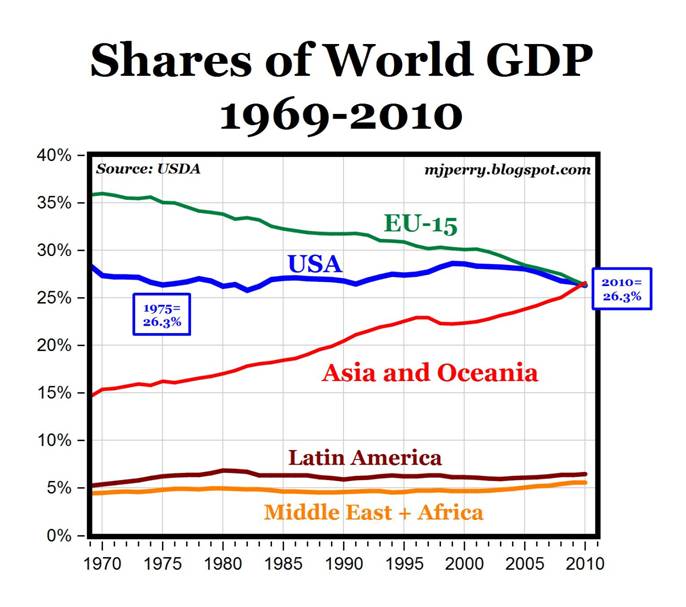
Source: Carpe Diem
Although the outlook may sounds bleak, not all is lost. In a recent Wall Street Journal interview with Bob Doll Chief Equity Strategist at the world’s largest money management company (BlackRock has $3.6 trillion in assets under management), he makes the case that the U.S. remains the leading source of technological innovation and home to the greatest universities and the most creative businesses in the world. He sees this trend persisting in part because of our country’s relative demographic advantages:
“Over the next 20 years, the U.S. work force is going to grow by 11%, Europe’s going to fall by five, and Japan’s going to fall by 17. This alone tells me the U.S. has a huge advantage over Europe and a bigger one over Japan for growth.”
So while emerging markets, like those in Asia, continue to gain a larger slice of the global GDP pie, Mark Perry at Carpe Diem shows how the U.S has maintained its proportional slice of a growing global economic pie, over the last four decades.
Growth is driven by innovation, and innovation is driven by education. If America wants to maintain its greatness, the focus needs to be placed on innovation-led growth. The world is moving at warp speed, and our neighbors are moving swiftly, whether we come along for the ride or not. The current, sour conversations regarding deficits, debt ceilings, entitlements, wars, and unemployment are all essential discussions, but more importantly, if these debates can be refocused on accelerating innovation, the country will be well on its way to curing its ills.
See also Our Nation’s Keys to Success
Wade W. Slome, CFA, CFP®
Plan. Invest. Prosper.
DISCLOSURE: Sidoxia Capital Management (SCM) and some of its clients own certain exchange traded funds, GOOG, and AAPL, but at the time of publishing SCM had no direct position in MSFT, or any other security referenced in this article. No information accessed through the Investing Caffeine (IC) website constitutes investment, financial, legal, tax or other advice nor is to be relied on in making an investment or other decision. Please read disclosure language on IC “Contact” page.
Economic Tug-of-War as Recovery Matures

Excerpt from No-Cost June 2011 Sidoxia Monthly Newsletter (Subscribe on right-side of page)
With the Rapture behind us, we can now focus less on the end of the world and more on the economic tug of war. As we approach the midpoint of 2011, equity markets were down -1.4% last month (S&P 500 index) and are virtually flat since February – trading within a narrow band of approximately +/- 5% over that period. Investors are filtering through data as we speak, reconciling record corporate profits and margins with decelerating economic and employment trends.
Here are some of the issues investors are digesting:
 Profits Continue Chugging Along: There are many crosscurrents swirling around the economy, but corporations are sitting on fat profits and growing cash piles owing success to several factors:
- International Expansion: A weaker dollar has made domestic goods and services more affordable to foreigners, resulting in stronger sales abroad. The expansion of middle classes in developing countries is leading to the broader purchasing power necessary to drive increasing American exports.
- Rising Productivity: Cheap labor, new equipment, and expanded technology adoption have resulted in annualized productivity increases of +2.9% and +1.6% in the 4th quarter and 1st quarter, respectively. Eventually, corporations will be forced to hire full-time employees in bulk, as bursting temporary worker staffs and stretched employee bases will hit output limitations.
- Deleveraging Helps Spending: As we enter the third year of the economic recovery, consumers, corporations, and financial institutions have become more responsible in curtailing their debt loads, which has led to more sustainable, albeit more moderate, spending levels. For instance, ever since mid-2008, when recessionary fundamentals worsened, consumer debt in the U.S. has fallen by more than $1 trillion.
 Fed Running on Empty: The QE2 (Quantitative Easing Part II) government security purchase program, designed to stimulate the economy by driving interest rates lower, is concluding at the end of this month. If the economy continues to stagnate, there’s a possibility that the tank may need to be re-filled with some QE3? Maintaining the 30-year fixed rate mortgage currently around 4.25%, and the 10-year Treasury note yielding around 3.05% will be a challenge after the program expires. Time will tell…
 Slogging Through Mud: Although corporate profits are expanding smartly, economic momentum, as measured by real Gross Domestic Product (GDP) growth, is struggling like a vehicle spinning its wheels in mud. Annualized first quarter GDP growth registered in at a meager +1.8% as the economy weans itself off of fiscal stimulus and adjusts to more normalized spending levels. An elevated 9% unemployment rate and continued weak housing market is also putting a lid on consumer spending. Offsetting the negative impacts of the stimulative spending declines have been the increasing tax receipts achieved as a consequence of seven consecutive quarters of GDP growth.
 Mixed Bag – Euro Confusion: Germany reported eye-popping first quarter GDP growth of +5.2%, the steepest year-over-year rise since reunification in 1990, yet lingering fiscal concerns surrounding the likes of Greece, Portugal, and Italy have intensified. Fitch, for example, recently cut its rating on Greece’s long-term sovereign debt three notches, from BB+ to B+ plus, and placed the country on “rating watch negative” status. These fears have pushed up two-year Greek bond yields to over 26%. Regarding the other countries mentioned, Standard & Poor’s, another credit rating agency, cut Italy’s A+ rating, while the European Union and International Monetary Fund agreed on a $116 billion bailout program for Portugal.
Wade W. Slome, CFA, CFP®
Plan. Invest. Prosper.
DISCLOSURE: Sidoxia Capital Management (SCM) and some of its clients own certain exchange traded funds, but at the time of publishing SCM had no direct position in any security referenced in this article. No information accessed through the Investing Caffeine (IC) website constitutes investment, financial, legal, tax or other advice nor is to be relied on in making an investment or other decision. Please read disclosure language on IC “Contact” page.
It’s the Earnings, Stupid

Source: MaxMillionaire.WordPress.com
Political strategist James Carville famously stated, “It’s the economy stupid,” during the 1992 presidential campaign. Despite a historic record approval rating of 90 by President George H.W. Bush after the 1991 Gulf War victory, Bush Sr. still managed to lose the election to President Bill Clinton because of a weak economy. President Barack Obama would serve himself well to pay attention to history if he wants to enter the “two-termer” club. Pundits are placing their bets on Obama due to his large campaign war chest, a post-Osama bin Laden extinguishment approval bump, and a cloudy Republican candidate weather forecast. If however, the unemployment rate remains elevated and the current administration ignores the spending/debt crisis, then the President’s re-election hopes may just come crashing down.
Price Follows Earnings
The similarly vital relationship between the economy and politics applies to the relationship of earnings and the equity markets too. Instead of the key phrase, “It’s the economy stupid,” in the stock market, “It’s all about the earnings stupid” is the crucial guideline. The balance sheet may play a role as well, but at the end of the day, the longer-term trend in stock prices eventually follows earnings and cash flows (i.e., investors will pay a higher price for a growing stream of earnings and a lower price for a declining or stagnant stream of earnings). Ultimately, even value investors pay more attention to earnings in the cases where losses are deteriorating or hemorrhaging (e.g. a Blockbuster or Enron). Another main factor in stock price valuations is interest rates. Investors will pay more for a given stream of earnings in a low interest rate environment relative to a high interest rate environment. Investors lived through this in the early 1980s when stocks traded at puny 7-8x P/E ratios due to double-digit inflation and a Federal Funds rate that peaked near 20%.

Source: HaysAdvisory.com – S&P 500 earnings growth keeps chugging along despite worries.
Bears Come Out of Hibernation
Today, earnings portray a different picture relative to the early eighties. Not only are S&P 500 operating earnings growing at a healthy estimated rate of +17% in 2011, but the 10-year Treasury note is also trading at a near-record low yield of 3.06%. In spite of these massively positive earnings and cash flow dynamics occurring over the last few years, the recent -3% pullback in the S&P 500 index from a month ago has awoken some hibernating bears from their caves. Certainly a slowing or pause in the overall economic indicators has something to do with the newfound somber mood (i.e., meager Q1 real GDP growth of +1.8% and rising unemployment claims). Contributing to the bears’ grumpy moods is the economic debt hangover we are recovering from. However, a large portion of the fundamental economic expansion experienced by corporate America has not been fueled by the overwhelming debt still being burned off throughout the financial sector and eventually our federal and state governments. Companies have become leaner and meaner – not only paying down debt, but also increasing dividends, buying back stock, and doing more acquisitions. The corporate debt-free muscle is further evidenced by the $100 billion in cash held by the likes of IBM, Microsoft Corp. (MSFT), and Google Inc. (GOOG) – and still growing.
At a 13.5x P/E multiple of 2011 earnings, perhaps the stock market is pricing in an earnings slowdown? But as of last week, about 70% of the S&P 500 companies reporting Q1 earnings have exceeded expectations. If this trend continues, perhaps we will see James Carville on CNBC rightfully shouting the maxim, “It’s the earnings, stupid!”
Wade W. Slome, CFA, CFP®
Plan. Invest. Prosper.
DISCLOSURE: Sidoxia Capital Management (SCM) and some of its clients own certain exchange traded funds and GOOG, but at the time of publishing SCM had no direct position in IBM, MSFT, Blockbuster, Enron, or any other security referenced in this article. No information accessed through the Investing Caffeine (IC) website constitutes investment, financial, legal, tax or other advice nor is to be relied on in making an investment or other decision. Please read disclosure language on IC “Contact” page.
Bin Laden Killing Overshadows Royal Rally

Excerpt from No-Cost May Sidoxia Monthly Newsletter (Subscribe on right-side of page)
Before the announcement of the killing of the most wanted terrorist in the world, Osama bin Laden, the royal wedding of Prince William Arthur Philip Louis and Catherine Middleton (Duke and Duchess of Cambridge) grabbed the hearts, headlines, and minds of people around the world. As we exited the month, a less conspicuous royal rally in the U.S. stock market has continued into May, with the S&P 500 index climbing +2.8% last month as the economic recovery gained firmer footing from the recession of 2008 and early 2009. As always, there is no shortage of issues to worry about as traders and speculators (investors not included) have an itchy sell-trigger finger, anxiously fretting over the possibility of losing gains accumulated over the last two years.
Here are some of the attention-grabbing issues that occurred last month:
 Powerful Profits: According to Thomson Reuters, first quarter profit growth as measured by S&P 500 companies is estimated at a very handsome +18% thus far. At this point, approximately 84% of companies are exceeding or meeting expectations by a margin of 7%, which is above the long-term average of a 2% surprise factor.
 Debt Anchor Front & Center: Budget battles remain over record deficits and debt levels anchoring our economy, but clashes over the extension of our debt ceiling will occur first in the coming weeks. Skepticism and concern were so high on this issue of our fiscal situation that the Standard & Poor’s rating agency reduced its outlook on the sovereign debt rating of U.S. Treasury securities to “negative,” meaning there is a one-in-three chance our country’s debt rating could be reduced in the next two years. Democrats and Republicans have put forth various plans on the negotiating table that would cut the national debt by $4 – $6 trillion over the next 10-12 years, but a chasm still remains between both sides with regard to how these cuts will be best achieved.
 Inflation Heating Up: The global economic recovery, fueled by loose global central bank monetary policies, has resulted in fanning of the inflation flames. Crude oil prices have jumped to $113 per barrel and gasoline has spiked to over $4 per gallon. Commodity prices have jumped up across the board, as measured by the CRB (Commodity Research Bureau) BLS Index, which measures the price movements of a basket of 22 different commodities. The CRB Index has risen over +28% from a year ago. Although the topic of inflation is dominating the airwaves, this problem is not only a domestic phenomenon. Inflation in emerging markets, like China and Brazil, has also expanded into a dangerous range of 6-7%, and many of these governments are doing their best to slow-down or reverse loose monetary policies from a few years ago.
 Expansion Continues but Slows: Economic expansion continued in the first quarter, but slowed to a snail’s pace. The initial GDP (Gross Domestic Product) reading for Q1 slowed down to +1.8% growth. Brakes on government stimulus and spending subtracted from growth, and high fuel costs are pinching consumer spending.
 Ben Holds the Course: One person who is not overly eager to reverse loose monetary policies is Federal Reserve Chairman, Ben Bernanke. The Chairman vowed to keep interest rates low for an “extended period,” and he committed the Federal Reserve to complete his $600 billion QE2 (Quantitative Easing) bond buying program through the end of June. If that wasn’t enough news, Bernanke held a historic, first-ever news conference. He fielded a broad range of questions and felt the first quarter GDP slowdown and inflation uptick would be transitory.

Skyrocketing Silver Prices: Silver surged ahead +28% in April, the largest monthly gain since April 1987, and reached a 30-year high in price before closing at around $49 per ounce at the end of the month. Speculators and investors have been piling into silver as evidenced by activity in the SLV (iShares Silver Trust) exchange traded fund, which on occasion has seen its daily April volume exceed that of the SPY (iShares SPDR S&P 500) exchange traded fund.
 Obama-Trump Birth Certificate Faceoff: Real estate magnate and TV personality Donald Trump broached the birther issue again, questioning whether President Barack Obama was indeed born in the United States. President Obama produced his full Hawaiian birth certificate in hopes of putting the question behind him. If somehow Trump can be selected as the Republican presidential candidate for 2012, he will certainly try to get President Obama “fired!”
 Charlie Sheen…Losing! The Charlie Sheen soap opera continues. Ever since Sheen has gotten kicked off the show Two and a Half Men, speculation has percolated as to whether someone would replace Sheen to act next to co-star John Cryer. Names traveling through the gossip circles include everyone from Woody Harrelson to Jeremy Piven to Rob Lowe. Time will tell whether the audience will laugh or cry, but regardless, Sheen will be laughing to the bank if he wins his $100 million lawsuit against Warner Brothers (TWX).
Wade W. Slome, CFA, CFP®
Plan. Invest. Prosper.
DISCLOSURE: Sidoxia Capital Management (SCM) and some of its clients own certain commodity and S&P 500 exchange traded funds, but at the time of publishing SCM had no direct position in SLV, SPY, TWX, or any other security referenced in this article. No information accessed through the Investing Caffeine (IC) website constitutes investment, financial, legal, tax or other advice nor is to be relied on in making an investment or other decision. Please read disclosure language on IC “Contact” page.
Inflation and the Debt Default Paradox

With the federal government anchored down with over $14 trillion in debt and trillion dollar deficits as far as the eye can see, somehow people are shocked that Standard & Poor’s downgraded its outlook on U.S. government debt to “Negative” from “Stable.” This is about as surprising as learning that Fat Albert is overweight or that Charlie Sheen has a substance abuse problem.
Let’s use an example. Suppose I received a pay demotion and then I went on an irresponsible around-the-world spending rampage while racking up over $1,000,000.00 in credit card debt. Should I be surprised if my 850 FICO score would be reviewed for a possible downgrade, or if credit card lenders became slightly concerned about the possibility of collecting my debt? I guess I wouldn’t be flabbergasted by their anxiety.
Debt Default Paradox?
With the recent S&P rating adjustment, pundits over the airwaves (see CNBC video) make the case that the U.S. cannot default on its debt, because the U.S. is a sovereign nation that can indefinitely issue bonds in its own currency (i.e., print money likes it’s going out of style). There is some basis to this argument if you consider the last major developed country to default was the U.S. government in 1933 when it went off the gold standard.
On the other hand, non-sovereign nations issuing foreign currencies do not have the luxury of whipping out the printing presses to save the day. The Latin America debt defaults in the 1980s and Asian Financial crisis in the late 1990s are examples of foreign countries over-extending themselves with U.S. dollar-denominated debt, which subsequently led to collapsing currencies. The irresponsible fiscal policies eventually destroyed the debtors’ ability to issue bonds and ultimately repay their obligations (i.e., default).
Regardless of a country’s strength of currency or central bank, if reckless fiscal policies are instituted, governments will eventually be left to pick their own poison…default or hyperinflation. One can think of these options as a favorite dental procedure – a root canal or wisdom teeth pulled. Whether debtors get paid 50 cents on the dollar in the event of a default, or debtors receive 100 cents in hyper-inflated dollars (worth 50% less), the resulting pain feels the same – purchasing power has been dramatically reduced in either case (default or hyperinflation).
Of course, Ben Bernanke and the Federal Reserve Bank would like investors to believe a Goldilocks scenario is possible, which is the creation of enough liquidity to stimulate the economy while maintaining low interest rates and low inflation. At the end of the day, the inflation picture boils down to simple supply and demand for money. Fervent critics of the Fed and Bernanke would have you believe the money supply is exploding, and hyperinflation is just around the corner. It’s difficult to quarrel with the printing press arguments, given the size and scale of QE1 & QE2 (Quantitative Easing), but the fact of the matter is that money supply growth has not exploded because all the liquidity created and supplied into the banking system has been sitting idle in bank vaults – financial institutions simply are not lending. Eventually this phenomenon will change as the economy continues to recover; banks adequately build their capital ratios; the housing market sustainably recovers; and confidence regarding borrower creditworthiness improves.
Scott Grannis at the California Beach Pundit makes the point that money supply as measured by M2 has shown a steady 6% increase since 1995, with no serious side-effects from QE1/QE2 yet:
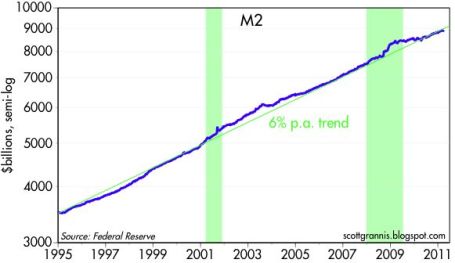
- Source: Calafia Beach Pundit

In fact, Grannis states that money supply growth (+6%) has actually grown less than nominal GDP over the period (+6.7%). Money supply growth relative to GDP growth (money demand) in the end is what really matters. Take for instance an economy producing 10 widgets for $10 dollars, would have a CPI (Consumer Price Index) of $1 per widget and a money supply of $10. If the widget GDP increased by 10% to 11 widgets (10 widgets X 1.1) and the Federal Reserve increased money supply by 10% to $11, then the CPI index would remain constant at $1 per widget ($11/11 widgets). This is obviously grossly oversimplified, but it makes my point.
Gold Bugs Banking on Inflation or Collapse
Gold prices have been on a tear over the last 10 years and current fiscal and monetary policies have “gold bugs” frothing at the mouth. These irresponsible policies will no doubt have an impact on gold demand and gold prices, but many gold investors fail to acknowledge a gold supply response. Take for example Freeport-McMoRan Copper & Gold Inc. (FCX), which just reported stellar quarterly sales and earnings growth today (up 31% and 57%, respectively). FCX more than doubled their capital expenditures to more than $500 million in the quarter, and they are planning to double their exploration spending in fiscal 2011. Is Freeport alone in their supply expansion plans? No, and like any commodity with exploding prices, eventually higher prices get greedy capitalists to create enough supply to put a lid on price appreciation. For prior bubbles you can reference the recent housing collapse or older burstings such as the Tulip Mania of the 1600s. One of the richest billionaires on the planet, Warren Buffett, also has a few thoughts on the prospects of gold.
The recent Standard & Poor’s outlook downgrade on U.S. government debt has caught a lot of press headlines. Fears about a technical default may be overblown, but if fiscal constraint cannot be agreed upon in Congress, the alternative path to hyperinflation will feel just as painful.
Wade W. Slome, CFA, CFP®
Plan. Invest. Prosper.
DISCLOSURE: Sidoxia Capital Management (SCM) and some of its clients own certain exchange traded funds, but at the time of publishing SCM had no direct position in FCX, or any other security referenced in this article. No information accessed through the Investing Caffeine (IC) website constitutes investment, financial, legal, tax or other advice nor is to be relied on in making an investment or other decision. Please read disclosure language on IC “Contact” page.
Nuclear Knee-Jerk Reaction

It’s amazing how quickly the long-term secular growth winds can reverse themselves. Just a week ago, nuclear energy was thought of as a safe, clean, green technology that would assist the gasoline pump pain in our wallets and purses. Now, given the events occurring in Japan, “nuclear” has become a dirty word equated to a life-threatening game of Russian roulette.
Despite the spotty information filtering in from the Dai-Ichi plant in Japan, we are already absorbing knee-jerk responses out of industrial heavyweight countries like Germany and China. Germany has temporarily closed seven nuclear power centers generating about a quarter of its nuclear capacity, and China has instituted a moratorium on all new facilities being built. How big a deal is this? Well, China is one country, and it alone currently accounts for 44% of the 62 global nuclear reactor projects presently under construction (see chart below).
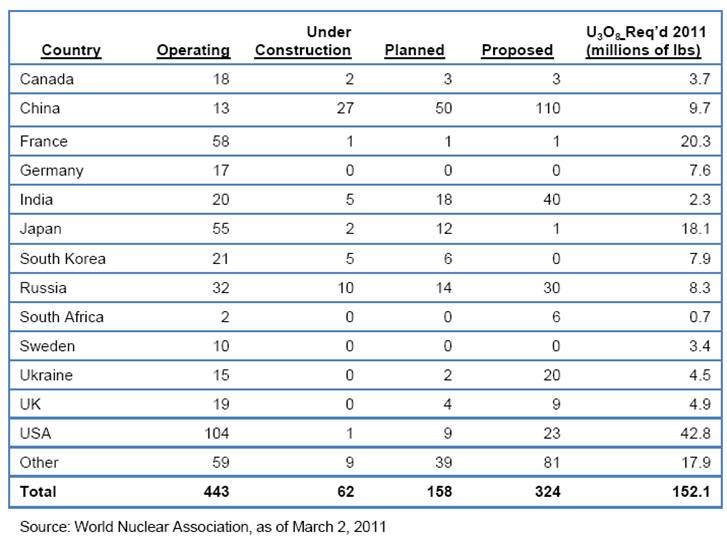
Source: World Nuclear Association (URRE Presentation)
As a result of the damaged Fukushima reactors, coupled with various governmental announcements around the globe, Uranium prices have dropped a whopping -30% within a month – plunging from about $70 per pound to around $50 per pound today.
Where does U.S. Nuclear Go from Here?
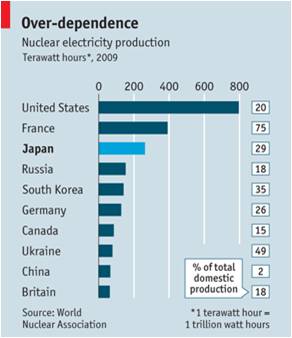
As you can see from the chart below, the U.S. is the largest producer of nuclear energy in the world, but since our small population is such power hogs, this relatively large nuclear capability only accounts for roughly 20% of our country’s total electricity needs. France, on the other hand, manages about half the reactors as we do, but the French derive a whopping 75% of their total electricity needs from nuclear power. According to the Nuclear Energy Institute, Japanese reliance on nuclear power falls somewhere in between – 29% of their electricity demand is filled by nuclear energy. Like Japan, the U.S. imports most of its energy needs, so if nuclear development slows, guess what, other resources will need to make up the difference. OPEC and various other oil-rich, dictators in the Middle East are licking their chops over the future prospects for oil prices, if a cost-effective alternative like nuclear ends up getting kicked to the curb.
Source: The Economist
As I alluded to above, there is, however, a silver lining. As long as oil prices remain elevated, any void created by a knee-jerk nuclear backlash will only create heightened demand for alternative energy sources, including natural gas, solar, wind, biomass, clean coal, and other creative substitutes. While we Americans may be addicted to oil, we also are inventive, greedy capitalists that will continually look for more cost-efficient alternatives to solve our energy problems (see also Electrifying Profits). Unlike other countries around the world, it looks like the private sector will have to do the heavy lifting to solve these resources on their own dime. Limited subsidies have been introduced, but overall our government has lacked a cohesive energy plan to kick-start some of these innovative energy alternatives.
Déjà Vu All Over Again
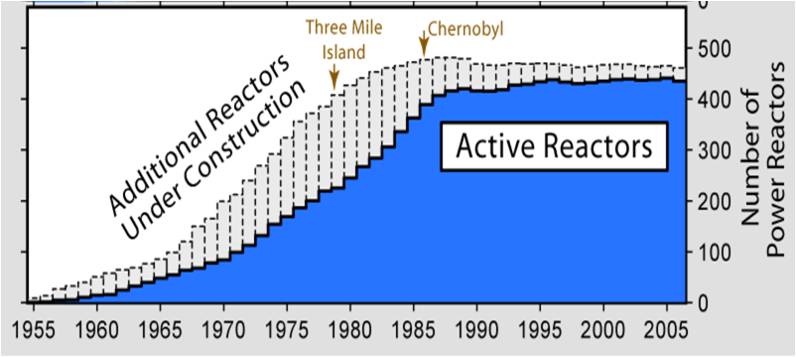
We saw what happened on our soil in March 1979 when the Three Mile Island nuclear accident in Pennsylvania consumed the hearts and minds of the country. Pure unadulterated panic set in and new nuclear production ground to a virtual halt. When the subsequent Chernobyl incident happened in April 1986 insult was added to injury. As you can see from the chart below, nuclear reactor capacity has plateaued for some twenty years now.
Source: Wikipedia
The driving force behind the plateauing nuclear facilities is the NIMBY (Not In My Back Yard) phenomenon. The Three Mile Island incident is still fresh in people’s minds, which explains why only one nuclear plant is currently under construction in our country, on top of a base of 104 U.S. reactors in 31 states. I point this out as an ambivalent NIMBY-er since I work 30 miles away from one of the riskiest, 30-year-old nuclear plants in the country (San Onofre).
Unintended Consequences
The Sendai disaster is home to the worst Japanese earthquake in 140 years, by some estimates, but history will prove once again what unintended consequences can occur when impulsive knee-jerk decisions are made. Just consider what has happened to oil prices since the moratorium on offshore drilling (post-BP disaster) was instituted. Sure we have witnessed a dictator or two topple in the Middle East, and there currently is adequate supply to meet demand, but I would make the case that we should be increasing domestic oil supplies (along with alternative energy sources), not decreasing supplies because it is politically safe.
Time will tell if the Japanese earthquake/tsunami-induced nuclear disaster will create additional unintended consequences, but I am hopeful the recent events will at a minimum create a serious dialogue about a comprehensive energy policy. If the comfortable, knee-jerk reaction of significantly diminishing nuclear production is broadly adopted around the world, then an urgent alternative supply response needs to occur. Otherwise, you may just need to enjoy that bike ride to work in the morning, along with that nice, romantic candle-lit dinner at night.
Wade W. Slome, CFA, CFP®
Plan. Invest. Prosper.
DISCLOSURE: Sidoxia Capital Management (SCM) and some of its clients own certain exchange traded funds and alternative energy securities, but at the time of publishing SCM had no direct position in BP, URRE, or any other security referenced in this article. No information accessed through the Investing Caffeine (IC) website constitutes investment, financial, legal, tax or other advice nor is to be relied on in making an investment or other decision. Please read disclosure language on IC “Contact” page.
Flying to the Moon via Hyperinflation

With Ben Bernanke and his fellow Fed friends about to crank up the printing presses to overdrive, QE2 (quantitative easing part II) is top of mind among investors. QE2 talks of purchasing Treasuries and mortgage backed securities to pump more dollars into the financial system has been cited by many observers as a key factor in the upward progression in the equity markets over the last couple months. But is too much of a good thing in the short-run, detrimental in the long run due to inflationary pressures?
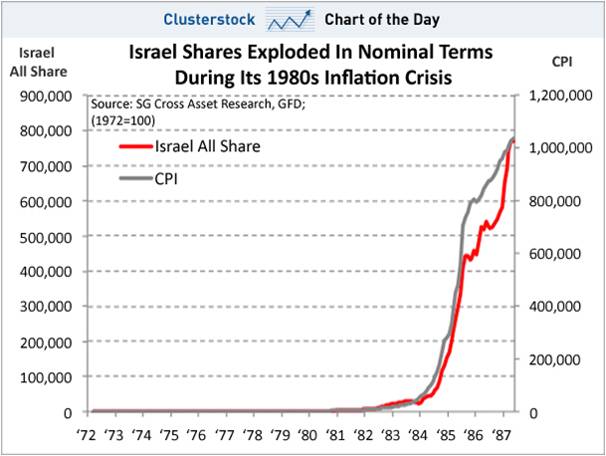
Not necessarily, if you consider the path of stocks in the hyperinflationary Israeli market of the 1970s and 1980s. Dylan Grice from Societe Generale notes that Israeli inflation averaged 84% from 1972 – 1987. During that period, Israeli equity markets managed to increase by a factor of 6,500 times according to Grice. So while inflation skyrocketed to the moon, so did stock prices. Will QE2 ignite dormant core inflation, which is hovering around 1%? If a declining U.S. dollar and rising commodity prices are the canary in the coalmine, then maybe piling into bonds like the majority of Americans is not the best idea?
Source: Business Insider - Clusterstock
Grice may be worried about inflation in the U.S., but Japan is at the forefront on his radar. Supporting that view, he has a modest 63,00,000.00 target on the Nikkei index by 2025 (the index sits at 9,160 today). That’s right…63 million. A near 7,000-fold increase may sound insane, but with exploding debt levels and deficits, coupled with declining demographics from an aging population, perhaps hyperinflation is not out of the question?
If push comes to shove, the Japanese government may print enough money to monetize debt the marketplace cannot absorb. Crazier things have happened in world history – during 1923 in the Weimar Republic of Germany hyperinflation led to a 4,200,000,000,000 German Mark to $1 U.S. dollar exchange rate. More recently we experienced a 79,600,000,000% inflation rate in Zimbabwe and the government actually issued a $100 trillion note. These astronomical inflation rates make our domestic inflationary worries seem like kids-play, but eventually the simple laws of economics will take over, if we do not get our fiscal house in order.
Double digit inflation in the U.S. during the stagflation era of the 1970s crimped Price-Earnings (P/E) ratios to single-digit levels, but this is not surprising with a Federal Funds rate that hit 20% in 1980 – 1981. Today the Fed Funds rate is at 0%, so I don’t think single-digit P/Es will be upon us anytime soon.
The great thing about money is it goes where it is treated best over the long run. In the short-run, money will slosh around and chase performance based on speculative animal spirits, but over time what Adam Smith called the “invisible hand” directs capital to appropriate investments. It was just a few months ago that pundits were talking about double-dip and deflation scenarios (see Double-Dip Guesses), and now on the brink of QE2, the pendulum has swung back to inflation fears. Printing excess amounts of money may provide temporarily fuel to help lift the economy off the ground, but if irresponsible fiscal decisions continue, then the economic rocket scheduled for the moon may come crashing back down with the economy. Do yourself a favor and pack a parachute filled with an adequate amount of equities – they will help protect you if your bond portfolio comes crashing down on higher rates and inflation.
Wade W. Slome, CFA, CFP®
Plan. Invest. Prosper.
DISCLOSURE: Sidoxia Capital Management (SCM) and some of its clients own certain exchange traded funds, but at the time of publishing SCM had no direct position in any other security referenced in this article. No information accessed through the Investing Caffeine (IC) website constitutes investment, financial, legal, tax or other advice nor is to be relied on in making an investment or other decision. Please read disclosure language on IC “Contact” page.




