Posts filed under ‘Banking’
Getting Debt Binge Under Control

Given the endless daily reminders about our federal government’s insatiable appetite for debt, the inevitable collapse of the dollar, and the potential for civil unrest, the average citizen might be surprised to find out the overall debt situation has actually improved. While our federal debt has been exploding (see also Investing Caffeine D-E-B-T article), households and businesses have been tightening their belts and cutting down on the debt binge of recent years. In fact, the overall debt for the U.S. grew at the slowest rate in a decade according to The Business Insider.
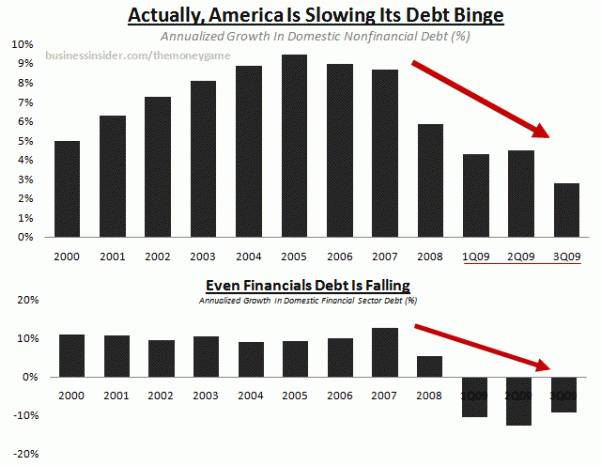
Source: The Business Insider. Steady debt growth decline.
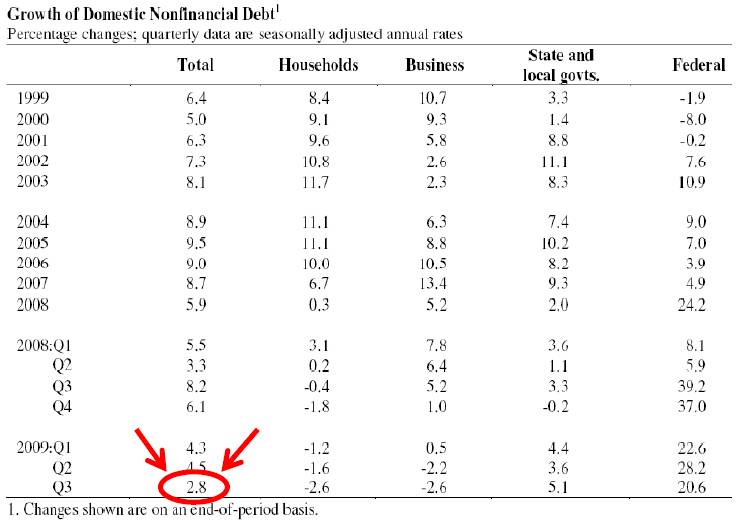
As you can see from the nitty-gritty in the Federal Reserve chart below, total Nonfinancial Debt grew at +2.8% in the 3rd quarter of 2009 (comprised of -2.6% Household Debt; -2.6% Business Debt; +5.1% State & Local Government Debt; and +20.6% Federal Debt).
What does this all mean? Not surprisingly, we are seeing the same trends in the debt figures that we are seeing in the components of our GDP (Gross Domestic Product). We learned from our Economics 101 class that the equation for GDP = C + I + G + (NX), which explains the components of economic growth.
- C = Consumer spending (or private consumption)
- I = Investment (or business spending)
- G = Government spending
- NX = Net exports (or exports – imports)
Consumer spending has been the biggest driver of growth before the financial crisis (fueled in part by the contribution of debt growth), accounting for more than 2/3 of our GDP. Now, with the consumer retrenching dramatically – spending less and saving more – we are seeing government spending (i.e., stimulus) pick up the slack.
These same dynamics are playing out in the total debt figures. Since the consumer is retrenching, they are saving more and paying down debt. Business owner debt has been chopped too, either by choice or because the banks simply are not lending. Here again, the government is picking up the slack by ramping up the debt growth.
Encouragingly, all is not lost. Economic principles, like the laws of physics, eventually take hold. Fortunately consumers and businesses have gone on a crash diet from debt – and the banks haven’t accommodated the pleading cash-starved either. Now legislators in our nation’s capital must do their part in dealing with the weighty spending. The overall debt progress is heartening, but Uncle Sam still needs to get off the Ho-Hos and Twinkies and start shedding some of that binge-related debt.
Read Full Business Insider Article
Wade W. Slome, CFA, CFP®
Plan. Invest. Prosper.
DISCLOSURE: Sidoxia Capital Management (SCM) and some of its clients own certain exchange traded funds and equity securities in client and personal portfolios at the time of publishing. No information accessed through the Investing Caffeine (IC) website constitutes investment, financial, legal, tax or other advice nor is to be relied on in making an investment or other decision. Please read disclosure language on IC “Contact” page.
China Executes Wall Street Solution

China is taking an innovative approach to white collar crime…execution. Yang Yanming, a rogue securities trader, completed his death sentence this week for embezzling $9.52 million (a daily rounding error for Goldman Sachs, I might add). Not exactly a cheery topic for the holiday season, but nonetheless, apparently an effective technique for cracking down on illegal behavior. Last I heard, there has been no mention of a $65 billion Chinese version of the Madoff Ponzi scheme? I wonder what kind of risks the financial division of AIG would have undertaken, if involuntary death sentences were considered as viable options in the back of their minds? China in fact carries out more annual executions (via lethal injection and gun) than any other country in the world.
Part of the recent financial crisis can be attributed to the culture of Wall Street and the investment industry, which centers on exploiting “OPM,” an acronym I use to describe “other people’s money.” Often, industry professionals (I use the term loosely) assume undue amounts of risk in hopes of securing additional income, no matter the potential impact on the client. The thought process generally follows: “Why should I risk my own capital to make a mega-bonus, when I can swing for the fences using someone else’s?” And if OPM cannot be secured from individuals, perhaps the capital can be borrowed from the banks – at least before the bailouts occurred.
OPM does come with some caveats, however. Say for example the OPM comes from the government. When TARP (Troubled Asset Relief Program) funds got crammed down the throats of the banking industry, the auspice of reduced bonuses didn’t sit very well with many of the fat-cat Wall Street executives. Financial institutions prefer their OPM with few strings and little to no accountability. Goldman Sachs (GS), JP Morgan (JPM), and Morgan Stanley (MS) weren’t big fans of the government’s pay scale, so these banks paid back the TARP funds at mid-year. Citigroup (C) is still negotiating with the U.S. Treasury and regulators to remove the scarlet phrase of “exceptional assistance” from their chests.
This subject of accountability brings up additional doses of blame to distribute. Not only are the gun-slinging bankers and advisers the ones to blame, but in many cases the clients themselves shoulder some of the responsibility. Either the clients’ start drinking the speculative “Kool-Aid” of their advisor or they neglect to ask a few basic questions for accountability. Just as Ronald Reagan stressed in his conversations with the Soviets, it is also imperative for clients to “trust but verify” the relationship with their advisor (read how to get your financial house in order).
One thing we learned from the crisis of 2008-2009 is that trust is a scarce resource. Investors can “luck” into a trustworthy relationship, but more often than not, just like anything else, it takes time and effort to build a worthy partnership.
The suppliers of OPM have gotten smarter and more skeptical after the crisis, however the managers of OPM haven’t discarded risk from their toolboxes. In addition to the general rebound in domestic equities, we have seen emerging markets, commodities, high-yield bonds, and foreign currencies (to name a few areas), also vault higher.
Regulatory reform for the financial industry is a hot topic for discussion, although virtually nothing substantive has been implemented yet. Incentives, accountability, and adequate capital requirements need to be put in place, so excessive risk-taking (like we saw at the AIG division handling Credit Default Swaps) doesn’t compromise the safety of our financial system. Also, traders need to be incentivized for making responsible decisions and punished adequately for participating in illegal activities. I know the President has a lot on his plate right now, but perhaps the Obama administration could set up a brief meeting with the capital punishment committee in Beijing. I’m confident the Chinese could assist us in “executing” a financial regulatory system solution.
Read Full Reuters Article on Rogue Chinese Trader
Wade W. Slome, CFA, CFP®
Plan. Invest. Prosper.
DISCLOSURE: Sidoxia Capital Management (SCM) and some of its clients own certain exchange traded funds (VFH) and BAC, but at time of publishing had no direct positions in GS, AIG, JPM, MS and C. No information accessed through the Investing Caffeine (IC) website constitutes investment, financial, legal, tax or other advice nor is to be relied on in making an investment or other decision. Please read disclosure language on IC “Contact” page.
FDIC: Busted Piggy Bank

Just as Bank of America (BAC) has decided to pay back $45 billion in TARP (Troubled Asset Relief Program) money, and the employment picture brightened with the recent improvement in the unemployment rate, our banking piggy bank, FDIC (Federal Deposit Insurance Corporation), has been busted. Recovering macroeconomic indicators haven’t allowed our banking system to get out of the woods quite yet. This struggling FDIC news comes even before the inexorable collapse expected in commercial real estate (see Wilbur Ross’ comments on the subject).
Sheila Bair, the Chairwoman of the FDIC, indicated with her sobering remarks that these trends will not disappear overnight:
“For now the credit adversity we have been discussing for some time remains with us, and we have been discussing for some time remains with us, and we expect that it will be at least a couple of more quarters before we see a meaningful improvement in that trend.”
With the FDIC adding 136 banks to its “problem list” in the third quarter (bringing the total to 552), the regulator was forced to pull out $38.9 billion from the piggy bank, officially draining the rainy day fund into the red.
Fixing the Problem
How will the FDIC replenish its hollow piggy bank? Ms. Bair has recently endorsed a letter sent to House Financial Services Committee Chairman (Barney Frank) that would force secured creditors (mainly banks) to create a slush fund for potential large bank failures that pose a threat to the system. Ms. Bair designed the program this way because all banks – big or small – would be forced to “evaluate the solvency of our largest financial firms.”
Due to the continuation of bank failures and loan loss deterioration, the FDIC fund balance slipped to a negative -$8.2 billion (the first time since dealing with the failing thrifts in 1992) for the September period. Therefore, Ms. Bair put forth an emergency measure that requires insured banks to prepay three years of insurance premiums by the end of 2009. This action is expected to raise approximately $45 billion in funds. Although the reserve piggy bank had an upside down balance, the FDIC can still keep the lights on and cover employee payroll because the regulatory entity still has $23.3 billion in cash and marketable securities on its balance sheet.
With the taxpayers flipping the bill for bailouts galore over the last two years, and Goldman Sachs (GS) wheelbarrowing out bonuses to their employees, Ms. Bair and politicians are looking to the industry to now shoulder more of the bank failure burden. Let’s hope the piggybank can be replenished so taxpayers don’t have to go scraping through their wallets again.
Wade W. Slome, CFA, CFP®
Plan. Invest. Prosper.
DISCLOSURE: Sidoxia Capital Management (SCM) and some of its clients own certain exchange traded funds (VFH) and BAC, but at time of publishing had no direct positions in GS. No information accessed through the Investing Caffeine (IC) website constitutes investment, financial, legal, tax or other advice nor is to be relied on in making an investment or other decision. Please read disclosure language on IC “Contact” page.
Turkey Stuffing, Wall Street Style

There will be no shortage of turkey stuffing this year, thanks to a story from Joshua Brown’s The Reformed Broker site (Wall Street Turkeys…Full of Stuffing).
In the spirit of Thanksgiving, which turkeys did journalist Terry Keenan roast?
Timothy Geithner: A fledgling economy and aggressive fiscal measures have painted a big target on Geithner’s back. I don’t fall into the “let’s lynch Geithner” camp, but Keenan feels “It’s a fair bet President Obama’s least-popular appointed official won’t be around to roast next Thanksgiving. “
John Thain: The former Merrill Lynch CEO and Bank of America executive who spent $1.2 million redecorating his Manhattan office made the list too. The man referred to as “I-Robot” may be difficult to cook, but regardless the article claims he is seeking to find employment running a different public company in the mean time.
Larry Summers: As the Director of President Obama’s National Economic Council, Mr. Summers has done a respectable job of flying below the radar, but not low enough to escape his past as Harvard University’s President (and the associate poor performing endowment).
Jeffrey Immelt: GE is no weakling, weighing in around $170 billion in market cap, but Keenan highlights the fledgling performance of NBC over the last two decades as reason to stuff this turkey.
Vikrim Pandit: The CEO of Citigroup survived a tumultuous period in 2009. Keenan however underscores how:
“His image suffered a big blow at the hands of Andrew Ross Sorkin, who paints an unflattering portrait of Pandit in his best-selling book, Too Big to Fail. If Pandit can’t play the “source game” to his advantage, it’s hard to see how he’s up to the much tougher task of reviving Citi’s fortunes.”
Now that we’re done with the turkey, could you please pass the stuffing.
Wade W. Slome, CFA, CFP®
Plan. Invest. Prosper.
DISCLOSURE: Sidoxia Capital Management (SCM) and its clients own certain exchange traded funds (including VFH), but currently have no direct positions in BAC, GE, or C. No information accessed through the Investing Caffeine (IC) website constitutes investment, financial, legal, tax or other advice nor is to be relied on in making an investment or other decision. Please read disclosure language on IC “Contact” page.
Meredith Whitney’s Cloudy Crystal Ball

Meredith Whitney, prominent banking analyst at her self-named advisory group, should have worn a bib to protect her from the adoring drool supplied by Maria Bartiromo in a recent CNBC interview. Ms. Whitney has quickly become a banking rock star during this “Great Recession” period. She was right at a critical juncture, and as a result she was thrust into the limelight. Much like Abby Joseph Cohen, the perma-bull Goldman Sachs strategist who gained notoriety in the late 1990s, Whitney (the perma-banking bear) will continue having difficulty living up to the lofty expectations demanded of her.
Despite the accolades, Whitney’s crystal ball has gotten cloudy in 2009. I suppose accuracy is not very important, judging by her bottom-half 2007 ranking (year of her major Citigroup call) in recommendation performance and 48%-ile ranking in the first half of 2008. Analysts, much like reporters, can avoid looking dumb by reporting the news du jour and by following the herd. Whitney has followed this formula with her continuous bearishness on the financial sector, excluding a brief but late upgrade of Goldman Sachs in July. Not only was her analysis tardy (Goldman’s stock tripled from the 2009 bottom), but her call has also underperformed the S&P 500 index since the upgrade.
Incoherent Inconsistencies
Like a bobbing and weaving wrestler (her husband John Layfield is a retired staged professional wrestler from the WWE), Whitney tries to concoct a completely mind-boggling narrative to explain her forecasts this year in the CNBC interview with Maria Bartiromo:
11/18/09 (XLF Price $14.60): “For the year, I have been at least ‘cover your shorts, go long.’ I haven’t been this bearish in a year.” (See Maria Bartiromo Interview)
Hmm, really? Are you kidding me? Wait a second…is this the same “go long” Meredith Whitney that expressed the following?
3/17/09: (XLF: 8.55 then, 14.60 now +71% ex-dividends): “These big banks are sitting on loans that were underwritten with bad math, and the stocks are going to go down…these stocks are uninvestable.”
(Fast forward to minute 8:20 for quote above)
2/4/09 (XLF: 8.97 then, 14.60 now +63% ex-dividends): “Investors should not even consider owning banks on an equity basis” (Click here and fast forward to minute 8:10 for quote).
The schizophrenic accounting of her postures are all the more confusing given her stance that the sector was “fairly valued” in October, according to the CNBC Bartiromo interview.
Don’t get me wrong, she made an incredible bearish call on Citigroup in the fall of 2007 and was expecting blood in the streets until a massive rebound in 2009 surprised her. Investors need to be wary of prognosticators that get thrust into the limelight (see Peter Schiff article) for a single prediction. The law of large numbers virtually guarantees a new breed of extreme forecasters will be rotated into the spotlight any time there is a major shift in the market direction. I choose to follow the footsteps of Warren Buffett and stay away from the game of market timing and market forecasts. I believe James Grant from the Interest Rate Observer states it best:
“The very best investors don’t even try to forecast the future. Rather, they seize such opportunities as the present affords them.”
Meredith Whitney may be a bright banking analyst and perhaps she’ll ultimately be proven right regarding the downward banking stock price trajectories, but like all bold forecasters she must live by the crystal ball, and die by the crystal ball.
Wade W. Slome, CFA, CFP®
Plan. Invest. Prosper.
DISCLOSURE: Sidoxia Capital Management (SCM) and its clients own certain exchange traded funds (including VFH), but currently have no direct positions in C, GS, or XLF. No information accessed through the Investing Caffeine (IC) website constitutes investment, financial, legal, tax or other advice nor is to be relied on in making an investment or other decision. Please read disclosure language on IC “Contact” page.
Too Big to Sink

If I got paid a nickel for every time I heard the phrase “too big to fail” to describe the state of affairs of our major financial institutions, I’d be retired on my private island by now. Jeremy Grantham, famed value investor and Chairman of Grantham Mayo Van Otterloo, recently compared the redesigning of our financial system to the Titanic and aptly described the hubris surrounding the ship’s voyage as “too big to sink!”
Mr. Grantham argues that many of the financial institution reform proposals have an irrelevant, misguided focus on improving the safety of the Titanic’s lifeboats rather than the structural design or competence of the captain. Maybe it’s better to plan for disaster prevention rather than disaster preparation? Grantham adds:
“By working to mitigate the pain of the next catastrophe, we allow ourselves to downplay the real causes of the disaster and thereby invite another one.”
When analyzing system failures, incentives are important to understand too. For example, the ship was “under-designed” and the captain had an ill-advised reward baked into a compensation bonus, if he beat the speed record (see article on compensation).
The Solution
Rather than protecting the bankers’ interests, Grantham contends we need “smaller, simpler banks that are not too big to fail.” At the heart of these massive financial conglomerates, pruning is necessary to separate the risky, proprietary trading departments, thereby ridding an “egregious conflict of interest with their clients.” As a former fund manager for a $20 billion fund, I was acutely aware of how my fund trading information and my conversations were being tracked by investment bankers and traders for themselves and their clients’ benefit. When the banks are managing your money alongside their own money, greed has a way of creeping in.
Beyond the prop trading desk legislation, Grantham believes those financial institutions “too big to fail” should be cut down into smaller pieces that can actually fail. Many of these entities are already what I like to call, “too complex to succeed,” evidenced by the stupefied responses provided by Congressmen and the CEOs of the banking institutions during the aftermath of the crisis. Reintroduction of some form of Glass-Steagall legislation (separation of investment banks from commercial banks) is another recommendation made by Grantham.
These suggestions sound pretty reasonable to me, but the bankers scream “If we become smaller and simpler and more regulated, the world will end and all serious banking will go to London, Switzerland, Bali Hai, or wherever,” Grantham adds in a mocking voice. If the foreigners want to operate irresponsibly, then Grantham says let them suffer the negative consequences every 15 years, or so.
The political will of legislators will be tested if substantive financial reforms actually come to pass. Jeremy Grantham understands the extreme importance of reform as explained concisely here, “A simpler, more manageable financial system is much more than a luxury. Without it we shall surely fail again.” Fail that is…like a sinking Titanic.
Read Jeremy Grantham’s Full Quarterly Newsletter
Wade W. Slome, CFA, CFP®
Plan. Invest. Prosper.
DISCLOSURE: No information accessed through the Investing Caffeine (IC) website constitutes investment, financial, legal, tax or other advice nor is to be relied on in making an investment or other decision. Please read disclosure language on IC “Contact” page.
Drought in Higher Rates May Be Over

The drought in higher interest rates may be nearing an end? Ever since the global financial crisis accelerated into full force in the fall of 2008, there were a constant flow of coordinated interest rate cuts triggered around the world with the aim of stimulating global GDP (Gross Domestic Product) and improving credit flow through the clogged financial pipes. Central banks across the world cut key benchmark interest rate levels and the impact of these reductions has a direct influence on what consumers pay for their financial products and services. More recently, we have begun to see the reversal of previous cuts with rate hikes witnessed in several international markets. Last week we saw Norway become the first western European country to raise rates, following an earlier October rate lift by Australia and another by Israel in August. For some countries, the sentiment has switched from global collapse fears to a stabilization posture coupled with future inflation concerns. In the U.S., the data has been more mixed (read article here) and the Federal Reserve has been clear on its intention to keep short-term rates at abnormally low levels for an extended period of time. That stance would likely change with evidence of inflationary pressures or improved job market conditions.
What Does This Mean for Consumers?
Prior to the financial crisis, credit availability flourished at affordably low rates. Now, with signs of a potential global recovery matched with regulatory overhauls, consumers may be impacted in several financial areas:
1) Credit Card Rates: Beyond regulatory changes in Washington (read more), the interest rate charged on unpaid credit card balances may be on the rise. When the Federal Reserve inevitably raises the targeted Federal Funds Rate (the interest rate for loans made between banks) from the current target rate range of 0.00% and 0.25%, this action will likely have direct upward pressure on consumer credit card rates. The associated increase in key benchmark rates such as the Prime Rate (the rate charged to a bank’s most creditworthy customers) and LIBOR (London Interbank Offer Rate) would result in higher monthly interest payments for consumers.
2) Other Consumer Loans: Many of the same forces impacting credit card rates will also impact other consumer loans, like home mortgages and auto loans. Pull out your loan documents – if you have floating or variable rate loans then you may be exposed to future hikes in interest rates.
3) Business Loans / Lines of Credit: Business owners -not just consumers – can also be impacted by rising rates. When the cost of funding goes up (.i.e., interest rates), the banks look to pass on those higher costs to the customer so the account profitability can be maintained.
4) Dollar & Import Prices: To the extent subsequent United States rate hikes lag other countries around the world, our dollar runs the risk of depreciating more in value (currency investors, all else equal, prefer currencies earning higher interest rates). A weaker dollar translates into foreign goods and services costing more. If international central banks continue to raise rates faster than the U.S., then imported good inflation could become a larger reality.
5) Hit to Bond Prices: Higher interest rates can also result in a negative hit to your bond portfolio. Higher duration bonds, those typically with longer maturities and lower relative coupon payments, are the most vulnerable to a rise in interest rates. Consider shortening the duration of your portfolio and even contemplate floating rate bonds.
Interest rates are the cost for borrowed money and even with the recent increase in consumers’ savings rate, consumers generally are still saddled with a lot of debt. Do yourself a favor and review any of your credit card agreements, loan documents, and bond portfolio so you will be prepared for any future interest rate increases. Shopping around for better rates and/or consolidating high interest rate debt into cheaper alternatives are good strategies as we face the inevitable end in the drought of higher global interest rates.
Wade W. Slome, CFA, CFP®
Plan. Invest. Prosper.
DISCLOSURE: No information accessed through the Investing Caffeine (IC) website constitutes investment, financial, legal, tax or other advice nor is to be relied on in making an investment or other decision. Please read disclosure language on IC “Contact” page.
Compensation: Pitchforks or Penalties

Currently there is witch hunt under way to get rid of excessive compensation levels, especially in the financial and banking industries. Members of Congress and their constituents are looking to reign in the exorbitant paychecks distributed to the fat-cat executives at the likes of Goldman Sachs, Bank of America and the rest of the banking field. According to The Financial Times, Goldman has set aside $16.7 billion so far this year for compensation and benefits and pay is on track to meet or exceed the $661,000 employee average in 2007. The public is effectively calling these executive bankers “cheaters” because they are receiving benefits they don’t deserve. The backlash resembles the finger-pointing we see directed at the wealthy steroid abusers in football or cork-bat swingers in baseball. Americans seem OK with big payouts as long as they are achieved in a fair manner. No one quibbles with the billions made by Bill Gates or Warren Buffett, but when you speak of other wealth cheaters like Jeff Skilling (Enron), Bernie Ebbers (WorldCom), or Dennis Kozlowski (Tyco), then the public cringes. The reaction to corporate crooks is similar to the response provoked by steroid use allegations tied to Major League Baseball players (i.e., Barry Bonds and Roger Clemens).
Less clear are the cases in which cheaters take advantage of a system run by regulators (referees) who are looking the other way or have inadequate rules/procedures in place to monitor the players. Take for example the outrage over $165 million in bonuses paid to the controversial AIG employees of the Financial Products division. Should AIG employees suffer due to lax rules and oversight by regulators? There has been no implication of illegal behavior conducted by AIG, so why should employees be punished via bonus recaptures? The rules in place allowed AIG to issue these lucrative Credit Default Swap (CDS) products (read more about CDS) with inadequate capital requirements and controls, so AIG was not shy in exploiting this lack of oversight. Rule stretchers and breakers are found in all professions. For example, Lester Hayes, famed All-Pro cornerback from the Oakland Raiders, used excessive “Stickum” (hand glue) to give himself an advantage in covering his opponents. If professionals legally operate within the rules provided, then punishments and witch hunts should be ceased.
Regulators, or league officials in sports, need to establish rules and police the players. Retroactively changing the rules after the game is over is not the proper thing to do. What the industry referees need is not pitchforks, but rather some yellow flags and a pair of clear glasses to oversee fair play.
Cash Givers Should Make the Rules
What should regulators and the government do when it comes to compensation? Simply let the “cash givers” make the rules. In the case of companies trading in the global financial markets, the shareholders should drive the rules and regulations of compensation. “Say on pay” seems reasonable to me and has already gained more traction in the U.K. On the other hand, if shareholders don’t want to vote on pay and feel more comfortable in voting for independent board members on a compensation committee, then that’s fine by me as well. If worse comes to worse, shareholders can always sell shares in those companies that they feel institute excessive compensation plans. At the end of the day, investors are primarily looking for companies whose goal it is to maximize earnings and cash flows – if compensation plans in place operate against this goal, then shareholders should have a say.
When it comes to government controlled entities like AIG or Citigroup, the cash givers (i.e., the government) should claim their pound of flesh. For instance, Kenneth Feinberg, the Treasury official in charge of setting compensation at bailed-out companies, decided to cut compensation across the board at American International Group, Citigroup, Bank of America, General Motors, GMAC , Chrysler, and Chrysler Financial for top executives by more than 90% and overall pay by approximately 50%.
Put Away the Pitch Forks
In my view, too much emphasis is being put on executive pay. Capital eventually migrates to the areas where it is treated best, so for companies that are taking on excessive risk and using excessive compensation will find it difficult to raise capital and grow profits, thereby leading to lower share prices – all else equal. Government’s job is to partner with private regulators to foster an environment of transparency and adequate risk controls, so investors and shareholders can allocate their capital to the true innovators and high-profit potential companies. Too big to fail companies, like AIG with hundreds of subsidiaries operating in over 100 countries, should not be able to hide under the veil of complexity. Even in hairy, convoluted multi-nationals like AIG, half a trillion CDS exposure risks need to be adequately monitored and disclosed for investors. That why regulators need to take a page from other perfectly functioning derivatives markets like options and futures and get adequate capital requirements and transparency instituted on exchanges. I’m confident that market officials will penalize the wrongdoers so we can safely put away the pitch forks and pull out more transparent glasses to oversee the industry with.
Wade W. Slome, CFA, CFP®
Plan. Invest. Prosper.
DISCLOSURE: Sidoxia Capital Management and its clients do not have a direct position in Goldman Sachs (GS), AIG, Berkshire Hathaway, BRKA/B, Citigroup (C), Enron, General Motors, GMAC , Chrysler, WorldCom, or Tyco International (TYC) shares at the time this article was originally posted. Sidoxia Capital Management and its clients do have a direct position in Bank of America (BAC). No information accessed through the Investing Caffeine (IC) website constitutes investment, financial, legal, tax or other advice nor is to be relied on in making an investment or other decision. Please read disclosure language on IC “Contact” page.
Surviving in a Post-Merger Financial World

The financial institution dominoes have fallen.
Over the last two years we have experienced the worst financial crisis since the Great Depression. As a result, financial institutions have come under assault from all angles, including its customers, suppliers, and regulators. And as we have watched the walls cave in on the banking and brokerage industries, we have seen a tremendous amount of consolidation. Like it or not, we need to adapt to the new environment.
The accelerated change began in early 2008 with the collapse of Bear Stearns and negotiated merger with JP Morgan Chase. Since then we saw the largest investment banking failure (Lehman Brothers), and the largest banking failure in history (Washington Mutual). Other mergers included the marriage of Merrill Lynch and Bank of America, the combination of Wachovia into Wells Fargo, and most recently the blending of Smith Barney into Morgan Stanley. These changes don’t even take into account the disruption caused by the government control of Fannie Mae, Freddie Mac, and AIG.
So what does all this change mean for consumers and investors?
1) Rise in Customer Complaints: Change is not always a good thing. Customer complaints rose 54% in 2008, and climbed 86% in the first three months of 2009 according to FINRA (Financial Industry Regulatory Authority), a nongovernmental regulator of securities companies. The main complaint is “breach of fiduciary duty,” which requires the advisor to act in the best interest of the client. Making the complaint stick can be difficult if the broker only must fulfill a “suitability” standard. To combat the suitability limitation, investors would be well served by investigating an independent Registered Investment Adviser (RIA) who has a fiduciary duty towards clients.
2) Less Competition = Higher Prices: The surviving financial institutions are now in a stronger position with the power to raise prices. Pricing can surface in various forms, including higher brokerage commissions, administrative fees, management fees, ATM fees, late fees, 12b-1 fees and more.
3) Customer Service Weakens: The profit pool has shrunk as lending has slowed and the real estate gravy train has come to a screeching halt. By cutting expenses in non-revenue generating areas, such as customer service, the financial institutions are having a difficult time servicing all their client questions and concerns. There is still fierce competition for lucrative accounts, but if you are lower on the totem pole, don’t expect extravagant service.
4) Increased Regulation: Consumer pain experienced in the financial crisis will likely lead to heightened regulation. For example, the Obama administration is proposing a consumer protection agency, but it may be years before tangible benefits will be felt by consumers. Financial institutions are doing their best to remove themselves from direct oversight by paying back government loans. In the area of financial planning, proposals have been brought to Congress to raise standards and requirements, given the limited licensing requirements. Time will tell, but changes are coming.
Investing in a Post-Merger Financial World: Take control of your financial future by getting answers from your advisor and financial institution. Get a complete list of fees. Find out if they are an independent RIA with a “fiduciary duty” to act in the client’s best interest. Research the background of the advisor through FINRA’s BrokerCheck site (www.finra.org) and the SEC’s Investment Adviser Public Disclosure Web site (www.sec.gov). Get referrals and shop around for the service you deserve. Survival in a post-merger world is difficult, but with the right plan you can be successful.
For disclosure purposes, Sidoxia Capital Management, LLC is an independent Registered Investment Advisor in California.
Wade W. Slome, CFA, CFP®
Plan. Invest. Prosper.
PPIP Becomes Miniaturized “Mini Me”

Mini-Me and Dr. Evil from famed Austin Powers movies
In two of Mike Myer’s Austin Powers movies, Verne Troyer plays Dr. Evil’s miniature clone, Mini-Me. At a “breathtaking” one-eighth the size of the fully-sized villain, Mini-Me didn’t quite pack the same evil punch as his surrogate daddy, Dr. Evil. The same can be said of the government’s PPIP (Public Private Investment Program), which was originally designed to unclog the financial system by removing toxic and illiquid investments from owners desiring liquidity.
Unfortunately, the PPIP size has been reduced to ppip dimensions. The Fundamental Analyst (FA) blogger (www.fundamentalanalyst.com) points out that the program’s scope has likely shrunk to $100 billion from the original goal of $1 trilllion – a proportion even smaller than Mini-Me’s relative size to Dr. Evil. Treasury Secretary Timothy Geithner’s explanation for the decline in program size is due to the improving financial market conditions and the capital raising activities of the banks. Perhaps partially true, but “not so fast” says FA – he blames the suspension of mark-to-market accounting as the driver for positive overstated banking earnings, which allowed the banks to hoodwink investors and raise capital under false pretenses.
Read the Fundamental Analyst’s Article on PPIP Here
FA goes onto highlight what little skin the participants (including, AllianceBernstein, BlackRock, Invesco, Oaktree Capital Management, TCW Group, and Wellington Management) have in the game relative to the other 93% of capital fronted by the taxpayers. I agree – the surplus taxpayer exposure is evil. Time will tell how effective the Mini-Me ppip program will be…

Original PPIP plan drawn up by the Financial Times




 Investing Caffeine
