Archive for August, 2010
Securing Your Bacon and Oreo Future

Stuffing money under the mattress earning next to nothing (e.g., 1.3% on a on a 1-year CD or a whopping 1.59% on a 5-year Treasury Note) may feel secure and safe, but how protected is that mattress money, when you consider the inflation eating away at its purchasing power?
We’ve all been confronted by older friends and family members proudly claiming, “When I was your age, (“fill in XYZ product here”) cost me a nickel and today it costs $5,000!” Well guess what…you’re going to become that same curmudgeon, except 20 or 30 years from now, you’re going to replace the product that cost a “nickel” with a “$15 3-D movie,” “$200 pair of jeans” and “$15,000 family health plan.” Chances are these seemingly lofty priced products and services will look like screaming bargains in the years to come.
The inflation boogeyman has been relatively tame over the last three decades. Kudos goes to former Federal Reserve Chairman Paul Volcker, who tamed out-of-control double-digit inflation by increasing short-term interest rates to 20% and choking off the money supply. Despite, the Bernanke printing presses smoking from excess activity, money has been clogged up on the banks’ balance sheets. This phenomenon, coupled with the debt-induced excess capacity of our economy, has led to core inflation lingering around the low single-digit range. Some even believe we will follow in the foot-steps of Japanese deflation (see why we will not follow Japan’s Lost Decades).
The Essentials: Oreos and Bacon
Even if you believe movie, jeans, and healthcare won’t continue inflating at a rapid clip, I’m even more concerned about the critical essentials – for example, indispensable items like Oreos and bacon. Little did you probably know, but according to ProQuest’s Historic newspaper database, a package of Oreos has more than quadrupled in price over the last 30 years to over $4.00 per package – let’s just say I’m not looking forward to spending $16.00 a pop for these heavenly, synthetic, hockey-puck-like, creamy delights.
Beyond Oreos, another essential staple of my diet came under intense scrutiny during my analysis. I’ve perused many an uninspiring chart in my day, but I must admit I experienced a rush of adrenaline when I stumbled across a chart highlighting my favorite pork product. Unfortunately the chart delivered a disheartening message. For my fellow pork lovers, I was saddened to learn those greasy, charred slices of salty protein paradise (a.k.a. bacon strips), have about tripled in price over a similar timeframe as the Oreos. Let us pray we will not suffer the same outcome again.
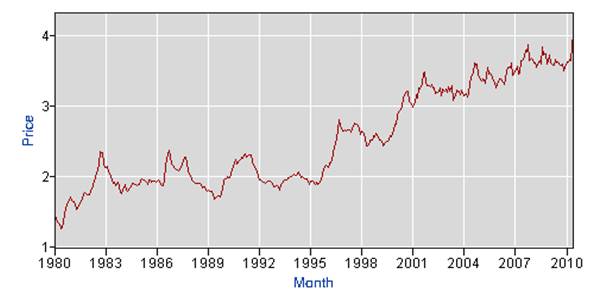
Sliced Bacon Prices (per lb.) – Source (Bureau of Labor Statistics)
It’s Not Getting Any Easier
Volatility aside, investing has become more challenging than ever. However, efficiently investing your nest egg has never been more critical. Why has efficiently managing your investments become so vital? First off, let’s take a look at the entitlement picture. Not so rosy. I suppose there are some retirees that will skate by enjoying their fully allocated Social Security check and Medicare services, but for the rest of us chumps, those luxurious future entitlements are quickly turning to a mirage.
What the financial crisis, rating agency conflicts, Madoff scandal, Lehman Brothers bankruptcy, AIG collapse, Goldman Sachs hearings, FinReg legislation, etc. taught us is the structural financial system is flawed. The system favors institutions and penalizes the investor with fees, commissions, transactions costs, fine print, and layers of conflicts of interests. All is not lost however. For most investors, the money stuffed under the mattress earning nothing needs to be resourcefully put to work at higher returns in order to offset rising prices. Putting together a diversified, low-cost, tax-efficient portfolio with an investment management firm that invests on a fee-only basis (thereby limiting conflicts) will put you on a path of financial success to cover the imperative but escalating living expenses, including of course, Oreos and bacon.
Wade W. Slome, CFA, CFP®
Plan. Invest. Prosper.
*DISCLOSURE: Sidoxia Capital Management (SCM) and some of its clients own certain exchange traded funds, but at the time of publishing SCM had no direct position in KFT, GS, Lehman Brothers, AIG (however own derivative tied to insurance subsidary), or any security referenced in this article. No information accessed through the Investing Caffeine (IC) website constitutes investment, financial, legal, tax or other advice nor is to be relied on in making an investment or other decision. Please read disclosure language on IC “Contact” page.
The New Abnormal – Now and Then

Mohamed El-Erian, bond manager and CEO of PIMCO (Pacific Investment Management Company, LLC) is known for patenting the terms “New Normal,” a period of slower growth, and subdued stock and bond market returns. Devin Leonard, a reporter from BusinessWeek, is probably closer to the truth when he describes our current financial situation as the “New Abnormal.” Accepting El-Erian description is tougher for me to accept than Leonard’s. Calling this economic environment the New Normal is like calling Fat Albert, “fat.” When roughly 15 million people are out of work, not receiving a steady paycheck, am I suppose to be surprised that consumer spending and confidence is sluggish?
Rather than a New Normal, I believe we are in the midst of an “Old Normal.” Unemployment reached 10.8% in 1982, and we recovered quite nicely, thank you, (the Dow Jones Industrial has climbed from a level about 800 in early 1982 to over 11,000 earlier in 2010). Sure, our economy carries its own distinct problems, but so did the economy of the early 1980s. For example:
- Inflation in the U.S. reached 14% in 1982 (core inflation today is < 1%) ;
- The Prime Rate exceeded 20%;
- Mexico experienced a major debt default;
- Wars broke out between the U.K./Falklands & Iran/Iraq;
- Chrysler got bailed out;
- Egyptian President Anwar Sadat was assassinated;
- Hyperinflation spread throughout South America (e.g., Bolivia, Argentina, Brazil)
As I’ve mentioned before, in recent decades we’ve survived wars, assassinations, currency crises, banking crises, Mad Cow disease, SARS, Bird Flu, and yes, even recessions – about two every decade on average. “We’ve had 11 recessions since World War II and we’ve had a perfect score — 11 recoveries,” famed investor Peter Lynch highlighted last year. Media squawkers and industry pundits constantly want you to believe “this time is different.” Economic cycles have an odd way of recurring, or as Mark Twain astutely noted, “History never repeats itself, but it often rhymes.” I agree.
Certainly, each recession and bear market is going to have its own unique contributing factors, and right now we’re saddled with excessive debt (government and consumers), real estate is still in a lot of pain, and unemployment remains stubbornly high (9.5% in June). Offsetting these challenges is a global economy powered by 6 billion hungry consumers with an appetite of achieving a standard of living rivaling ours. Underpinning the surge in developing market growth is the expansion of democratic rule and an ever-sprawling extension of the technology revolution. In 1900, there were about 10 countries practicing democracy versus about 120 today. These political advancements, coupled with the internet, are flattening the world in a way that is creating both new competition and opportunities. The rising tide of emerging market demand for our leading edge technologies not only has the potential of elevating foreigners’ standard of living, but pushing our living standards higher as well.
With the United States economy representing roughly 25% of the globe’s total Gross Domestic Product (~5% of the global population), simple mathematics virtually assures emerging markets will continue to eat more of the global economic pie. In fact, many economists believe China will pass the U.S. over the next 15 years. As long as the pie grows, and the absolute size (not percentage) of our economy grows, we should be happy as a clam as our developing country brethren soak up more of our value-added goods and services.
On a shorter term basis, Leonard profiles several abnormal characteristics practiced by consumers. Here’s what he has to say about the “New Abnormal”:
“The new abnormal has given rise to a nation of schizophrenic consumers. They splurge on high-end discretionary items and cut back on brand-name toothpaste and shampoo. Companies like Apple, whose net income jumped 94 percent in its last quarter, and Starbucks, which is enjoying a 61 percent increase in operating income over the same time frame, are thriving. Mercedes-Benz is having a record sales year; deliveries of new vehicles in the U.S. rose 25 percent in the first six months of 2010. Lexus and BMW were also up. Though luxury-goods manufacturers like Hermýs [sic] and Burberry are looking primarily to Asia for growth, their recent earnings reports suggest stabilization and even modest improvement in the U.S.”
Beyond the fray of high-end products, the masses have found reasons to also splurge at the nation’s largest mall (The Mall of America), home to a massive amusement park and a 1.2 million gallon aquarium. So far this year, the mall has experienced a +9% increase in sales.
So while El-Erian calls for a “New Normal” to continue in the years to come, what might actually be happening is a return to an “Old Normal” with ordinary cyclical peaks and valleys. If this isn’t true, perhaps we will all revert to a “New Abnormal” mindset described by Devin Leonard. If so, I will see you at the Mercedes dealership in my Burberry suit, with $3 latte in hand.
Read Devin Leonard’s Complete New Abnormal Article
Wade W. Slome, CFA, CFP®
Plan. Invest. Prosper.
*DISCLOSURE: Sidoxia Capital Management (SCM) and some of its clients own certain exchange traded funds and AAPL, but at the time of publishing SCM had no direct position in Mercedes, BMW, Burberry, Hermy’s, SBUX, or any security referenced in this article. No information accessed through the Investing Caffeine (IC) website constitutes investment, financial, legal, tax or other advice nor is to be relied on in making an investment or other decision. Please read disclosure language on IC “Contact” page.
Buy-Out Firms Shooting Blanks

Photo source: Photobucket
During the golden age of the mega-buyouts in the mid-2000s, when banks were lending like drunken sailors, and private equity firms were taking the practically free funding to shoot at almost every company in sight, it’s no wonder managers of these funds were “high-fiving” each other. Unfortunately for the participants, the music ended in 2007, and the heavy debt-loaded guns that previously were killing large elephant deals got replaced with harmless toy guns shooting blanks at phantom transactions.
Peter Morris, a former Morgan Stanley (MS) banker and author of the scornful report, “Private Equity, Public Loss,” took a critical eye at the industry pointing to the reasons these high risk-taking private equity firms are underperforming the S&P 500 significantly. Bolstering his underperformance assertions, Morris points to 542 deals in the Yale endowment that underperformed by -40% once fees were subtracted. The Center for the Study of Financial Innovation, which is affiliated with Morris, cites a 2005 paper by Steven Kaplan (University of Chicago), and Antoinette Schoar (Massachusetts Institute of Technology). The paper shows the average buy-out fund underperformed the S&P 500 index from 1980 – 2001.
Another factor that Morris feels should not be ignored relates to risk. Morris feels the excessive risk profiles associated with these private equity funds have not been adequately considered by many unknowing investors and public taxpayers. Pensioners are vulnerable to these underperforming, risk-adjusted returns, while unassuming taxpayers could also be on the hook if risky private equity bets go bad. Under certain scenarios these potentially rocky private equity investments could bring a financial institution to its knees and force governments to use taxpayer bailout money. The Financial Times features a $6.5 billion investment made by Terra Firma, which was subsequently written down to zero, to make its point about the inherent risk private equity plays in the overall financial system.
Heads We Win, Tails You Lose
What makes the purported underperformance more scathing is the fact that these funds should bear higher returns to compensate investors for the additional liquidity risk and leverage that is undertaken. Like hedge funds, most private equity funds charge a 2% management fee, and a 20% performance fee for results achieved above a certain hurdle rate. The problem, that many outside observers highlight, is that the private equity firms have very little skin in the game, for example as little as 2%. With not a lot of their own dough in the game, the fund managers have a built in incentive to swing for the fences, because a profit windfall will filter to them should they hit it big. Morris characterizes this conflict of interest as “heads we win, tails you lose.” Another knock against investors revolves around return calculations. The opacity surrounding returns makes private equity less attractive, since valuations are only truly accurately reflected upon sale, which often takes many years.
Have all these shortcomings scared off investors? Apparently not. Just recently Blackstone Group (BX) raised a new $13.5 billion fund, the firm’s 6th fund, fresh off of its 5th fund that raised a total of $20 billion. The focus of the new fund will be on Asia and North America. In the short-run, Europe will occupy less of the fund’s attention until the region’s economy recovers.
To the extent more of these studies garner traction, I’m sure the private equity industry will react with a forceful response, especially with billions in potential fees at stake. One thing is for sure, investors have become more demanding and shrewd post the financial crisis, so if private equity managers want to earn the rich fees of yesteryear, they will need to do better than shoot blanks.
Read The Financial Times Buy-Out Study Article
Wade W. Slome, CFA, CFP®
Plan. Invest. Prosper.
*DISCLOSURE: Sidoxia Capital Management (SCM) and some of its clients own certain exchange traded funds, but at the time of publishing SCM had no direct position in MS, BX, Terra Firma or any security referenced in this article. No information accessed through the Investing Caffeine (IC) website constitutes investment, financial, legal, tax or other advice nor is to be relied on in making an investment or other decision. Please read disclosure language on IC “Contact” page.




 Investing Caffeine
