Archive for December, 2009
More Eggs in Basket May Crack Portfolio

NOT putting all your eggs in one basket makes intuitive sense to many investors. Burton Malkiel, Princeton Professor, economist, and author, summed it up succinctly, “Diversity reduces adversity.” Diversification acts like shock absorbers on a car – it smoothens out the ride on a bumpy financial road (read more on diversification). Jason Zweig, Wall Street Journal writer, acknowledges the academic findings that underpin these diversification benefits by stating the following:
“As many studies have shown, at least 40% of the variability in returns can be reduced by moving from a single company to 20. Once a portfolio contains 20 or 30 stocks, adding more does little to damp the fluctuations in wealth over time.”
Despite the evidence, Jason Zweig explores the conventional views on diversification more closely.
Turning the Diversification Concept on its Head
Zweig, not satisfied with the standard thinking on the topic, decided to explore the work of Don Chance, a finance professor at the Louisiana State University business school. Professor Chance asked more than 200 students to consecutively select stocks until they each held a portfolio of 30 positions. Here are two of the main findings:
1) Averages Hold Firm: On average, for the group of students, diversifying from a single stock to 20 reduced portfolio risk by roughly 40% – just as would be expected from the academic research.
2) Individual Portfolios Riskier: After the first few initial stock picks, for each individual portfolio, were made from a list of large cap household names (e.g., XOM, SBUX, NKE), Professor Chance found in many instances students dramatically increased portfolio risk. These students juiced up the octane in their portfolios by venturing into much smaller, more volatile stock selections.
Deceiving Diversification
Gur Huberman, a Columbia Finance Professor also points out a tendency for investors to clump stock selections together in groups with similar risk profiles, thereby reducing diversification benefits. Diversifying from one banking stock to 20 banking stocks may actually do more damage. Statistically, Zweig points out, “Thirteen percent of the time, a 20-stock portfolio generated by computer will be riskier than a one-stock portfolio.”
Professor Chance found similar results according to Zweig:
“One in nine times, they [students] ended up with 30-stock portfolios that were riskier than the single company they had started with. For 23%, the final 30-stock basket fluctuated more than it had with only five stocks.”
Diversified Views on Diversification
Chance and Huberman are not the only professionals to question the benefits of diversification:
Warren Buffett: A diversification skeptic declares, “Put all your eggs in one basket and then watch that basket very carefully.” Alternatively, Buffett says, “Diversification is protection against ignorance.”
Peter Lynch: He referred to diversification as “deworsification,” especially when it came to companies diversifying into non-core businesses.
Charlie Munger: “Wide diversification, which necessarily includes investment in mediocre businesses, only guarantees ordinary results.”
Zweig’s Solution:
“If you want to pick stocks directly, put 90% to 95% of your money in a total stock-market index fund. Put the rest in three to five stocks, at most, that you can follow closely and hold patiently. Beyond a handful, more companies may well leave you less diversified.”
Portfolio diversification and concentration have been issues studied for decades. As you can see, there are different viewpoints regarding the benefits. As Zweig establishes, through the research of Don Chance, putting more eggs in your basket may actually crack your portfolio, not protect it.
Read Complete WSJ Jason Zweig Article
Wade W. Slome, CFA, CFP®
Plan. Invest. Prosper.
DISCLOSURE: Sidoxia Capital Management (SCM) and some of its clients own certain exchange traded funds, but at time of publishing had no direct positions in XOM, SBUX, BRKA/B or NKE. No information accessed through the Investing Caffeine (IC) website constitutes investment, financial, legal, tax or other advice nor is to be relied on in making an investment or other decision. Please read disclosure language on IC “Contact” page.
The Economics and Consequences of Obesity

‘Tis the season to consume a lot of calories, and my tighter fitting, post turkey-day trousers can attest to that fact. Healthcare reform is front and center in the national debate, as well, and the rising epidemic of obesity should play a significant role in the discussion. Why is this issue so important? According to female financial guru, Suze Orman, we are already spending $57 billion more on obesity than cancer. Obesity-related health care costs totaled about $117 billion in 2000, according to the CDC (Center of Disease Control). One study on obesity estimates the problem will cost the United States $344 billion in health costs by 2018.
Although it may be an uncomfortable issue to talk about, this matter has had a direct personal impact on my family, making the problem all the more tangible to me. Regardless of the function of genetics or what lifestyle choices are made, the negative consequences are indisputable.
Take a look at the table of negative outcomes provided by the CDC:
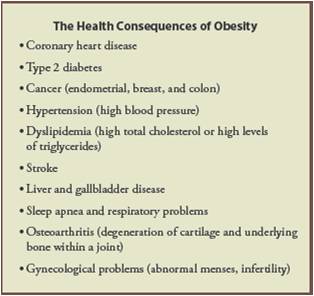
These consequences obviously take a large toll on the individuals, but they also have a massive impact on our healthcare system. And the CDC has the data to backup the severity of this intensifying problem:
“More than one third of U.S. adults—more than 72 million people—and 16% of U.S. children are obese. Since 1980, obesity rates for adults have doubled and rates for children have tripled. Obesity rates among all groups in society—irrespective of age, sex, race, ethnicity, socioeconomic status, education level, or geographic region—have increased markedly.”
Before solutions can be created, the root problems need to be addressed. One of the factors contributing to increased incidence of obesity is our unhealthy dietary habits (myself included). A chart from the New York Times highlights the economic impact of our food choices has been impacted by inflation trends. Over the last 30 years, unhealthy foods (beer, butter, and soda) have become much cheaper than healthy foods (fresh fruits and vegetables), on a relative basis (see chart below). Making a trip to fast food chains has not only become more convenient, but the practice has also become more affordable.

Source: Bureau of Labor Statistics (NY Times)
With our work lives stretched even further and stress levels rising, the picture below highlights the relationship between obesity (as measured by the Body Mass Index) and minutes spent per day eating. Our unhealthy, indoor, sedentary lifestyles take away from our healthy eating habits as well. The U.S. is the country with the highest percentage of individuals who are obese and the country that spends the third fewest minutes per day eating (eating more fast food). Seems like a fairly tight correlation.
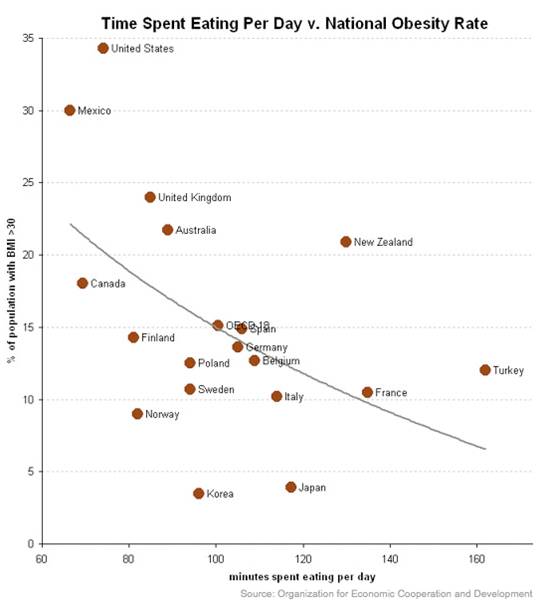
Data Source: OECD (Organization for Economic Cooperation and Development)
Solutions?
Education / Government: Educational support through cooperation with the government is necessary to spread the word regarding the consequences of obesity. Incentives also need to be integrated into our healthcare system so individuals can responsibly attack obesity head-on.
Behavioral Modification: Healthier diet and exercise lifestyles need to be evangelized. Implementation of economic incentives can possibly improve behavior by lowering insurance premiums in exchange for better health compliance.
Medications: Research needs to continue so innovative medications can help prevent and control obesity. Arena Pharmaceuticals (ARNA), VIVUS (VVUS), and Orexigen Therapeutics (OREX) are in the late stages in an attempt of getting their obesity drugs approved by the FDA. There is tremendous profit potential if the proper mix of efficacy and safety can be proven, however the detection of side-effects can potentially derail adoption and approval.
Surgery: Advancements have been introduced through medical technologies as well. Allergan’s (AGN) Lap-Band device is an example of an FDA approved device that effectively wraps around the stomach like a rubber-band to control excessive eating urges.
Obviously this is not an easy problem to deal with, as evidenced by the skyrocketing numbers. Many face inherent genetic hurdles in conquering diabetes, while others may have other health issues that contribute to overweight problems.
With the holidays upon us, I still plan on responsibly splurging on occasion, but I’m praying I will have the discipline to mix in some veggies and a run around the block with my eggnog and turkey leg. In the meantime, perhaps I’ll help support the economy by running to the mall and burning some holiday calories by doing some shopping!
Wade W. Slome, CFA, CFP®
Plan. Invest. Prosper.
DISCLOSURE: Sidoxia Capital Management (SCM) and some of its clients own certain exchange traded funds and AGN, but at time of publishing had no direct positions in ARNA, VVUS, or OREX. No information accessed through the Investing Caffeine (IC) website constitutes investment, financial, legal, tax or other advice nor is to be relied on in making an investment or other decision. Please read disclosure language on IC “Contact” page.




 Investing Caffeine
